February 13, 2026
Is 2026 the Best Time for First-Time Buyers to Enter Toronto’s Housing Market?
Share this article:



Manzeel is an award-winning Mortgage Broker and the Owner of the Toronto-based mortgage, Everything Mortgages.
With 16 years of experience in the Canadian mortgage industry and a formal background in mortgage underwriting, Manzeel’s lending expertise gives him unique insight into whether a deal is feasible which empowers his clients to make more informed lending decisions faster.
He has been recognized as one of Canada’s Top 10 Mortgage Brokers by the national Canadian Mortgage Professionals (CMP) Association. Him and his team of 18 mortgage agents are proud to offer a mortgage experience that's built on honesty, trust, and integrity. He prides himself on the brokerage’s dedication to deliver an excellent client experience throughout the entire home loan process from pre-approval to post-funding.
Since moving to Toronto in 1998, Manzeel has successfully launched and scaled several businesses from the ground up, ranging from a mortgage brokerage and a vast real estate investment portfolio to a private financing eCommerce platform. He continues to be a leader in the real estate industry as he uses his analytical expertise to seek new real estate investment opportunities.
As a tech junkie and avid sports enthusiast, when Manzeel’s not working with clients, you can find him reading technology blogs, playing squash or watching tennis with his two boys.
The Toronto housing market has transformed dramatically over the past year, creating what many experts are calling a rare window of opportunity for first-time buyers. For the first time since early 2021, average home prices have dipped below the $1 million mark, while inventory levels have climbed into buyer’s market territory. This shift raises a critical question: Is 2026 the best time for first-time buyers to enter Toronto’s housing market?
With benchmark prices down 8% year-over-year, homes selling below asking price, and motivated sellers across multiple property types, the conditions have never been more favorable for entry-level buyers in recent memory. However, affordability challenges persist despite these improvements, making it essential to understand both the opportunities and constraints that define this unique market moment.
Key Takeaways
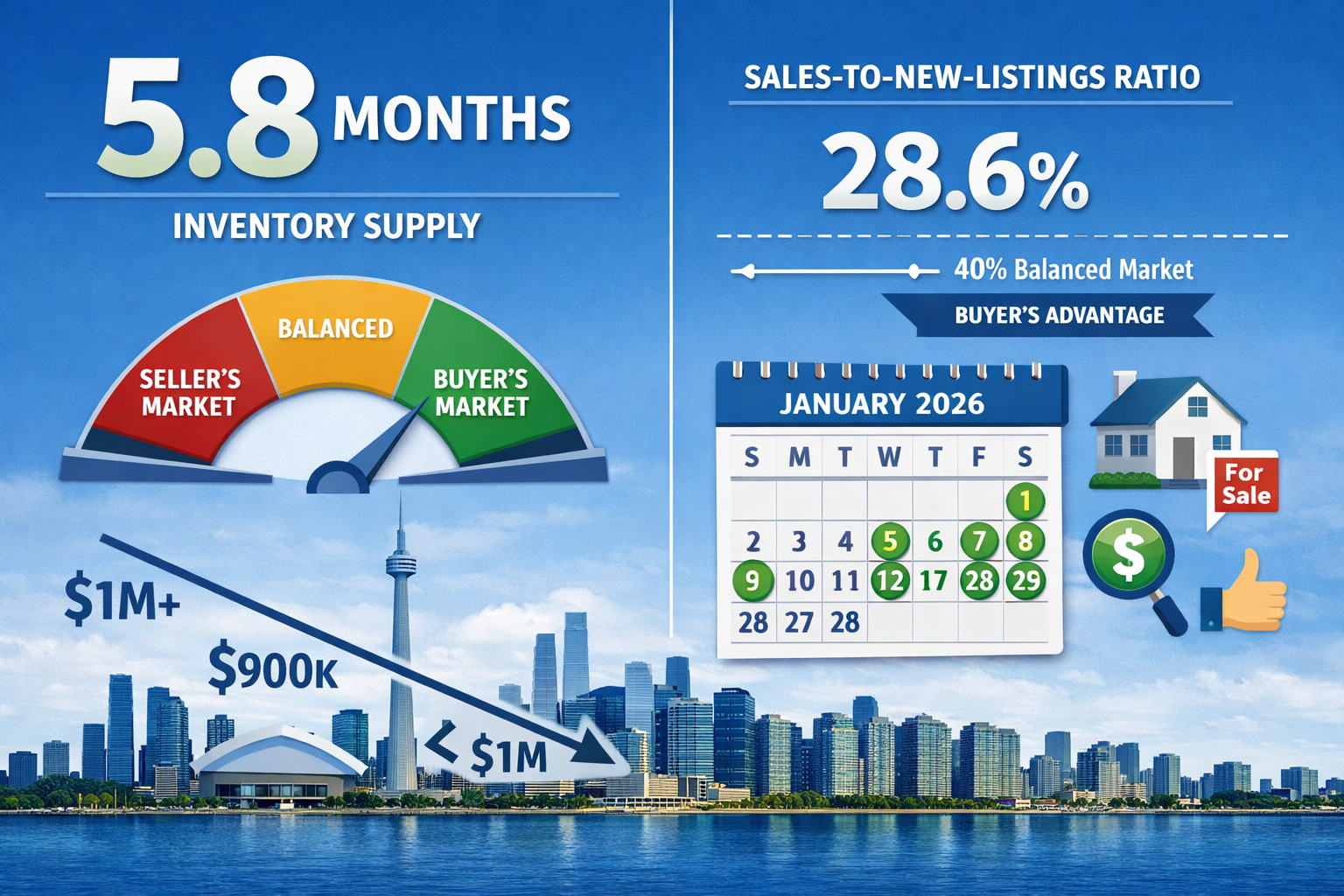
✅ Buyer’s market conditions confirmed: Toronto recorded 5.8 months of inventory supply in January 2026, with a sales-to-new-listings ratio of just 28.6%—well below the 40% threshold that defines balanced market conditions[3].
✅ Historic price correction: The average home price fell below $1 million for the first time in five years, while benchmark prices dropped 8% year-over-year to $936,100[3].
✅ Enhanced negotiating power: Homes are selling at 97% of asking price on average (down from 99%), and properties are staying on the market 67 days instead of 55 days, giving buyers more time and leverage[3].
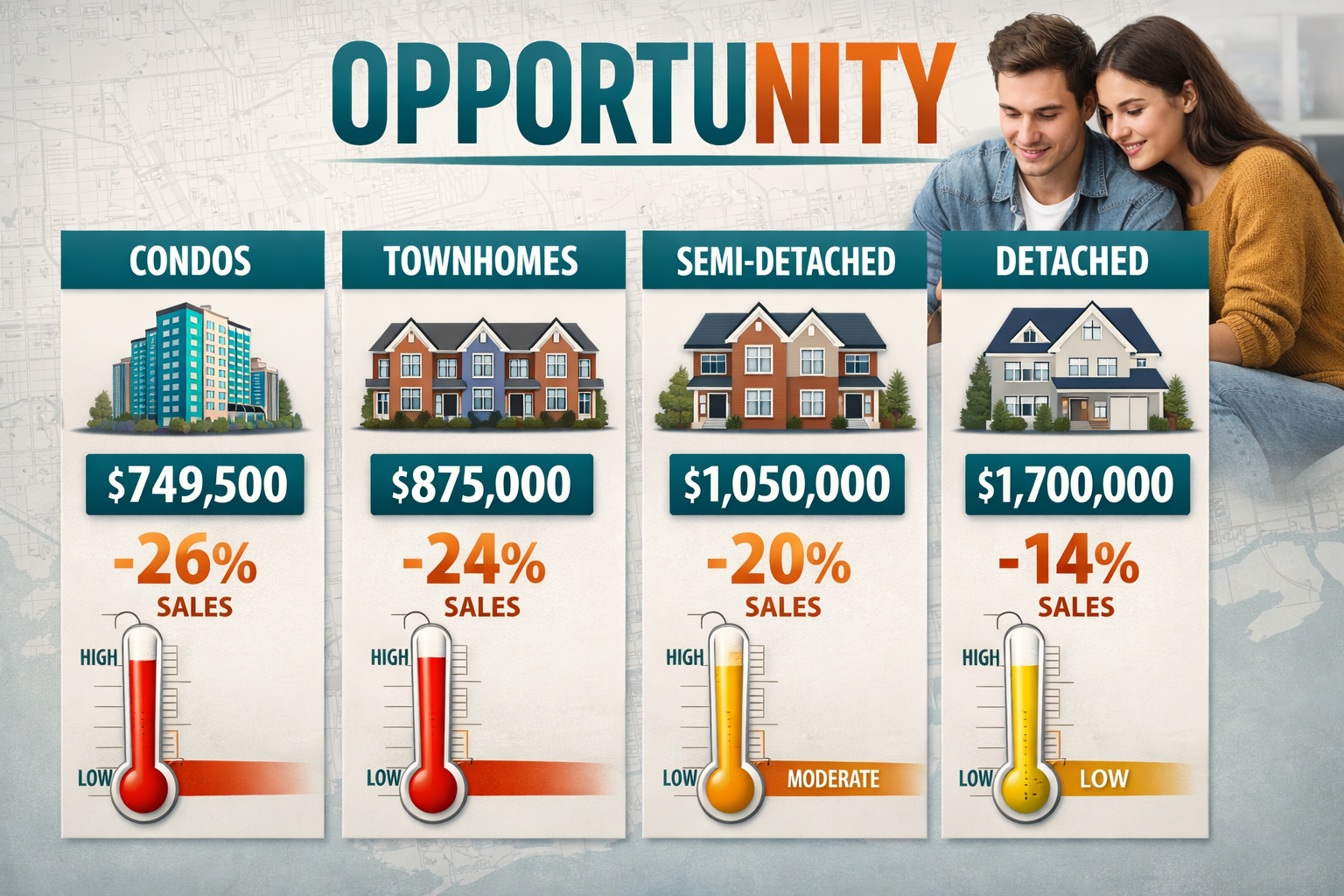
✅ Condos offer the lowest entry point: With a median price of $749,500 and sales down 26% year-over-year, condominiums present the most accessible option for first-time buyers facing motivated sellers[3].
✅ Stable outlook through 2026: Analysts and the Toronto Real Estate Board forecast relatively stable prices throughout the year, reducing the fear of buying before further significant declines[1][5].
Understanding Toronto’s Current Housing Market Dynamics in 2026
The Shift to Buyer’s Market Territory
January 2026 marked a significant milestone for Toronto’s real estate landscape. The Greater Toronto Area (GTA) recorded 5.8 months of inventory supply, a clear indicator that the market has shifted decisively in favor of buyers[3]. This metric measures how long it would take to sell all available homes at the current sales pace, and anything above 4-6 months typically signals a buyer’s market.
Equally telling is the sales-to-new-listings ratio of 28.6%, which sits far below the 40% threshold that defines balanced market conditions[3]. This means that for every 100 new homes listed, fewer than 29 are selling—creating substantial competition among sellers rather than buyers.
For first-time buyers who spent years watching bidding wars and properties selling within days, this represents a fundamental power shift. The days of unconditional offers and waived inspections have largely disappeared, replaced by a market where buyers can take their time, conduct thorough due diligence, and negotiate from a position of strength.
Price Corrections Creating Entry Points
Perhaps the most significant development for aspiring homeowners is the price correction that has brought average home prices below $1 million for the first time since early 2021[3]. The average selling price in January 2026 stood at $973,289, representing a 6.5% decline from the previous year[3].
More importantly, the benchmark home price (which provides a more accurate measure by tracking the same property types over time) fell to $936,100—an 8% year-over-year decrease[3]. This benchmark methodology eliminates distortions caused by changes in the mix of properties sold, giving a clearer picture of actual price movements.
Within the City of Toronto specifically, the median price dropped to $749,500, down 6.3% from January 2025[3]. This figure is particularly relevant for first-time buyers, as the median represents the middle point where half of all homes sold for less and half sold for more.
These price adjustments, while modest compared to some international markets, represent a meaningful improvement in accessibility for buyers who have been saving diligently but watching prices climb faster than their down payment funds.
Extended Marketing Periods and Negotiating Leverage
The average days on market increased to 67 days in January 2026, up from 55 days the previous year[3]. This extended marketing period provides several advantages for first-time buyers:
🏠 More time for research: Buyers can thoroughly investigate neighborhoods, compare properties, and avoid rushed decisions driven by fear of missing out.
🏠 Opportunity for multiple viewings: Rather than making offers after a single showing, buyers can revisit properties and bring family members or professionals for second opinions.
🏠 Stronger negotiating position: Properties that linger on the market signal seller motivation, creating opportunities to negotiate on price, closing dates, or included items.
The shift in negotiating power is further evidenced by the average sales-to-listing price ratio of 97% in January 2026, compared to 99% the previous year[3]. This means homes are selling at 3% below asking price on average—a stark contrast to the pandemic-era market where properties routinely sold for 10-20% above asking.
Property Type Opportunities: Where First-Time Buyers Find the Best Value
Condominiums: The Most Accessible Entry Point
For first-time buyers asking is 2026 the best time for first-time buyers to enter Toronto’s housing market, condominiums present the most compelling answer. With a median price of $749,500 and sales down 26% year-over-year[3], the condo segment shows the most significant buyer advantage.
This dramatic sales decline reflects the evaporation of investor demand that fueled the pandemic-era condo boom. Investors who purchased with expectations of continued appreciation and strong rental yields are now facing a different reality:
📉 Rising interest rates have made carrying costs more expensive
📉 Rental market saturation has reduced rental income potential
📉 Capital appreciation has stalled or reversed
📉 New construction completions have increased supply
For owner-occupiers, these investor challenges translate into motivated sellers willing to negotiate. Many condo sellers are now competing not just with other resale units but also with new construction developments offering incentives and modern amenities.
First-time buyers should focus on well-maintained buildings in established neighborhoods with strong transit access. Avoid buildings with high maintenance fees or special assessments, and always review the reserve fund study to ensure the building is financially healthy. Understanding common first-time home-buyer mistakes can help you avoid costly errors during the condo purchase process.
Townhomes and Semi-Detached Properties: Alternative Options with Seller Pressure
Freehold townhome sales fell 24% year-over-year, while semi-detached home sales dropped 20%[3]. These declines, while not as dramatic as the condo market, still indicate significant seller pressure and opportunity for buyers seeking more space than a condominium offers.
Townhomes provide an attractive middle ground for first-time buyers:
✔️ More living space than condos at a lower price than detached homes
✔️ Potential for yard space and multiple floors
✔️ Lower maintenance fees compared to condos
✔️ Opportunity to build equity in freehold property
Semi-detached homes offer similar advantages with even more space and privacy, though at a higher price point. The 20% sales decline suggests that sellers in this segment are facing motivated buyers who can negotiate effectively.
Both property types have seen less speculative investment than condos, meaning sellers are more likely to be families upgrading or downsizing rather than investors—potentially creating more reasonable negotiating dynamics.
Detached Homes: Still Challenging but Showing Cracks
While detached home sales declined only 14% year-over-year[3]—the smallest drop among property types—this segment remains the most challenging for first-time buyers due to price levels. However, even this traditionally resilient category is showing signs of seller pressure.
The smaller sales decline doesn’t necessarily mean detached homes are a poor choice for first-time buyers; rather, it reflects that this segment attracts more move-up buyers with substantial equity from previous home sales. For first-time buyers with higher incomes or significant down payments, the current market still offers better negotiating conditions than in recent years.
Financial Considerations: Is 2026 the Best Time for First-Time Buyers to Enter Toronto’s Housing Market?
Mortgage Rate Environment and Affordability
While prices have declined, the mortgage rate environment remains a critical factor in determining true affordability. Even with price corrections, monthly carrying costs depend heavily on the interest rate secured.
First-time buyers in 2026 should carefully consider their rate options. Those planning to purchase should explore resources on how 2026 mortgage renewals impact first-time home buyers to understand the broader rate environment.
The decision between fixed and variable rates has become increasingly complex. Buyers should review guidance on fixed vs. variable rates for Toronto first-time buyers in 2026 to determine which option aligns with their risk tolerance and financial situation.
Down Payment Strategies and Savings Tools
Building a sufficient down payment remains the primary barrier for most first-time buyers. However, several programs and strategies can accelerate this process:
Tax-Free First Home Savings Account (FHSA): This powerful tool allows first-time buyers to contribute up to $8,000 annually (lifetime maximum of $40,000) with tax-deductible contributions and tax-free withdrawals for home purchases. Learn more about how the Tax-Free First Home Savings Account can help you buy a house.
First-Time Home Buyer Incentive: While this program has limitations, it can reduce monthly carrying costs by providing shared equity financing.
Home Buyers’ Plan (HBP): Allows withdrawal of up to $35,000 per person from RRSPs for a down payment, with repayment spread over 15 years.
Gifted Down Payments: Many lenders accept gifted funds from immediate family members, though documentation requirements apply.
The key is to start saving aggressively while market conditions remain favorable. With analysts forecasting stable prices through 2026[1][5], buyers have time to build their down payment without fear of being priced out by rapid appreciation.
Income Requirements and Qualification
The stress test remains a significant hurdle for first-time buyers. Borrowers must qualify at either the contract rate plus 2% or 5.25%, whichever is higher. This means that even with lower prices, income requirements remain substantial.
For a $750,000 condo with a 10% down payment ($75,000), the mortgage amount would be $675,000. At a contract rate of 4.5%, buyers must qualify at 6.5% (4.5% + 2%), resulting in monthly payments of approximately $4,270 for qualification purposes. This typically requires a household income of at least $120,000 to meet debt service ratio requirements.
First-time buyers should focus on improving their credit scores before applying for mortgages. Review these 5 tips to rapidly improve your credit score to strengthen your application.
Self-employed buyers face additional documentation challenges but still have options. Those with non-traditional income should explore resources on getting a mortgage in Canada with a new job or alternative qualification methods.
Market Outlook: What Experts Predict for Toronto Real Estate in 2026
Stable Price Forecasts Through Year-End
Both the Toronto Real Estate Board (TRREB) and independent analysts forecast that home prices will remain relatively stable throughout 2026, rather than experiencing sharp declines or increases[1][5]. This stability prediction is based on several factors:
🔹 Interest rate stabilization: With the Bank of Canada’s rate cycle reaching a more neutral position, mortgage rates are expected to remain relatively steady.
🔹 Supply-demand equilibrium: While inventory has increased, it hasn’t reached levels that would trigger dramatic price collapses.
🔹 Economic fundamentals: Toronto’s diverse economy and continued immigration support underlying housing demand.
🔹 Construction constraints: Limited new supply entering the market prevents oversupply conditions.
For first-time buyers, this stability forecast is actually positive news. It suggests that those who purchase in early-to-mid 2026 are unlikely to experience immediate depreciation, while also indicating that waiting for significantly lower prices may not be rewarded.
Buyer Demographics and Market Participation
Ipsos polling reveals that 45% of intending homebuyers are first-time purchasers[5], highlighting that nearly half of all buyers planning to enter the market in 2026 are in the same position. This demographic dominance means that:
✅ Market conditions are particularly relevant to first-time buyer needs
✅ Entry-level properties will see sustained demand
✅ Builders and sellers are increasingly focused on this buyer segment
✅ Government policies may continue targeting first-time buyer support
However, overall homebuying intentions declined 5 percentage points to 22% for 2026 from 27% in 2025[7]. This suggests caution among potential buyers, possibly due to broader economic uncertainty, employment concerns, or lingering affordability challenges despite improved pricing.
This hesitation among other buyers actually creates opportunity for those who are financially prepared and committed to homeownership. Less competition means better negotiating conditions and more inventory to choose from.
Regional Variations Within the GTA
While Toronto proper shows a median price of $749,500[3], significant variations exist across the GTA:
905 Region: Suburban areas typically offer more space at lower price points but require consideration of commuting costs and lifestyle preferences.
Downtown Core: Premium pricing persists for properties near employment centers and transit, but these locations offer lifestyle benefits and potential for stronger long-term appreciation.
Emerging Neighborhoods: Areas undergoing revitalization or new transit development may offer value appreciation potential alongside current affordability.
First-time buyers should expand their geographic search beyond their ideal neighborhood to identify areas offering the best combination of affordability, lifestyle fit, and appreciation potential.
Strategic Considerations: Making the Right Decision for Your Situation
Assessing Your Personal Readiness
Determining is 2026 the best time for first-time buyers to enter Toronto’s housing market requires honest assessment of personal circumstances beyond market conditions:
Financial Stability: Do you have secure employment with stable income? Have you built an emergency fund covering 3-6 months of expenses beyond your down payment?
Long-Term Commitment: Are you planning to stay in the Toronto area for at least 5 years? Shorter timelines increase the risk of being forced to sell during unfavorable market conditions.
Lifestyle Readiness: Are you prepared for homeownership responsibilities including maintenance, property taxes, and insurance costs?
Relationship Stability: If purchasing with a partner, have you discussed long-term plans and financial responsibilities clearly?
Market timing matters, but personal readiness matters more. Buying during favorable market conditions while personally unprepared leads to stress and potential financial difficulties.
Calculating True Affordability
Many first-time buyers focus exclusively on whether they can qualify for a mortgage, but true affordability requires considering total carrying costs:
Monthly Expenses Include:
- Mortgage principal and interest
- Property taxes (typically 0.75-1% of property value annually in Toronto)
- Condo fees (for condominiums, often $400-700+ monthly)
- Home insurance ($100-200+ monthly)
- Utilities ($150-300+ monthly)
- Maintenance reserve (1% of property value annually for freehold properties)
A $750,000 condo with 10% down might have monthly costs of:
- Mortgage (4.5%, 25-year amortization): $3,750
- Property taxes: $470
- Condo fees: $550
- Insurance: $150
- Utilities: $200
- Total: $5,120/month
Compare this to your current rent plus the amount you’re saving monthly. If the difference is manageable and you’re prepared for occasional special assessments or repairs, homeownership may be financially viable.
The Cost of Waiting vs. Buying Now
First-time buyers often struggle with the decision to buy now or wait for potentially lower prices. Consider these factors:
Costs of Waiting:
- Continued rent payments building no equity
- Potential for prices to stabilize or increase
- Risk of rising interest rates increasing carrying costs
- Opportunity cost of not building equity and benefiting from potential appreciation
- Psychological cost of continued uncertainty
Benefits of Waiting:
- Additional time to save a larger down payment
- Potential for further price declines (though not forecasted)
- More time to improve credit scores or income
- Opportunity to observe market trends
For buyers who are financially ready and committed to Toronto long-term, the current market conditions of lower prices, reduced competition, and enhanced negotiating power may not be replicated soon. Analysts’ forecasts of stability suggest that waiting may not yield significantly better conditions[1][5].
Practical Steps for First-Time Buyers in 2026
Getting Mortgage Pre-Approval
Before beginning your property search, secure mortgage pre-approval to understand your budget and demonstrate seriousness to sellers. Pre-approval involves:
- Gathering documentation: Recent pay stubs, tax returns, employment letters, and bank statements
- Credit check: Lenders will review your credit history and score
- Debt service ratio calculation: Lenders determine how much you can borrow based on income and debts
- Rate hold: Most pre-approvals include a rate guarantee for 90-120 days
Working with a mortgage broker rather than going directly to a single bank often yields better rates and terms. Brokers have access to multiple lenders and can match your specific situation with the most appropriate product.
Understanding how to choose the right mortgage lender is crucial for securing favorable terms and avoiding costly mistakes.
Assembling Your Professional Team
Successful home purchases require collaboration with qualified professionals:
Mortgage Broker: Provides access to multiple lenders and helps navigate complex qualification requirements. This is especially important for those with unique situations like self-employment or recent job changes.
Real Estate Agent: Ideally someone specializing in first-time buyers who understands entry-level properties and can identify value opportunities. Look for agents with strong negotiating skills in buyer’s markets.
Real Estate Lawyer: Handles title searches, contract review, and closing procedures. Don’t wait until after your offer is accepted to find a lawyer.
Home Inspector: Conducts thorough property inspections to identify potential issues before finalizing purchases. This is especially important in older buildings or freehold properties.
Insurance Broker: Helps secure appropriate home insurance at competitive rates, which is required before closing.
Neighborhood Research and Property Selection
Toronto’s diverse neighborhoods offer vastly different lifestyles, amenities, and value propositions. First-time buyers should:
🔍 Research transit access: Proximity to TTC subway lines or GO stations significantly impacts daily convenience and resale value.
🔍 Evaluate amenities: Consider proximity to grocery stores, healthcare, parks, and entertainment options that match your lifestyle.
🔍 Assess school quality: Even without children, strong schools enhance property values and neighborhood stability.
🔍 Review development plans: Upcoming transit expansion or neighborhood revitalization can indicate appreciation potential.
🔍 Visit at different times: Experience neighborhoods during weekday mornings, evenings, and weekends to understand noise levels and activity patterns.
🔍 Talk to residents: Current residents provide insights into community dynamics, building management, and neighborhood changes.
For condominiums specifically, review the status certificate carefully, examining:
- Reserve fund adequacy for future major repairs
- Pending or recent special assessments
- Building rules and restrictions
- Rental restrictions if you might need flexibility
- Insurance coverage and claims history
Making Competitive Offers in a Buyer’s Market
While the market favors buyers, competitive offers still require strategy:
Include appropriate conditions: In a buyer’s market, conditional offers (on financing, inspection, status certificate review) are standard and expected. Don’t waive conditions to appear more competitive unless absolutely necessary.
Research comparable sales: Your agent should provide recent sales data for similar properties to justify your offer price.
Start below asking: With homes selling at 97% of asking on average[3], initial offers below asking price are reasonable. Your agent can advise on appropriate starting points based on property condition, days on market, and seller motivation.
Negotiate beyond price: Consider requesting included appliances, earlier possession dates, or seller-paid closing costs as part of negotiations.
Be prepared to walk away: In a buyer’s market, other opportunities exist. Don’t let emotional attachment lead to overpaying or accepting unfavorable terms.
Potential Challenges and Risk Factors
Affordability Constraints Despite Price Declines
While prices have declined 6-8% year-over-year[3], it’s crucial to recognize that affordability remains the core constraint for many first-time buyers. Incomes have not kept pace with historical home price growth, meaning that even with recent corrections, purchasing power remains limited for many households.
The fundamental challenge is that Toronto home prices, even at current levels, require substantial household incomes that many young professionals and families don’t yet earn. A $750,000 condo still requires approximately $120,000 in household income to qualify under stress test rules—well above median household incomes for younger demographics.
This means that while 2026 offers better conditions than recent years, it’s not universally accessible. First-time buyers must be realistic about whether their financial situation supports homeownership, even in improved market conditions.
Economic Uncertainty and Employment Stability
The broader economic environment in 2026 includes several uncertainties:
⚠️ Global economic volatility: International trade tensions, geopolitical conflicts, and economic slowdowns in major economies could impact Canadian employment and economic growth.
⚠️ Technology sector adjustments: Toronto’s significant tech employment base has experienced layoffs and restructuring, potentially affecting buyer confidence and qualification.
⚠️ Interest rate path: While rates have stabilized, unexpected inflation or economic shocks could force rate increases that impact affordability.
⚠️ Government policy changes: Housing policies, mortgage regulations, and tax rules can change, affecting market dynamics.
First-time buyers should ensure they have stable employment and emergency reserves before committing to homeownership during uncertain economic periods.
Condo-Specific Risks
While condominiums offer the most accessible entry point, they carry specific risks:
Maintenance fee increases: Aging buildings often face rising maintenance costs, special assessments for major repairs, or inadequate reserve funds.
Rental restrictions: Some buildings limit or prohibit rentals, reducing flexibility if you need to relocate.
Oversupply risk: Continued new construction could create supply pressure that limits appreciation potential.
Lifestyle restrictions: Condo living involves shared spaces, noise considerations, and building rules that don’t suit everyone.
Thorough due diligence on building financials, management quality, and physical condition is essential before purchasing any condominium.
Conclusion: Is 2026 the Best Time for First-Time Buyers to Enter Toronto’s Housing Market?
After examining market data, expert forecasts, and financial considerations, the answer to is 2026 the best time for first-time buyers to enter Toronto’s housing market is: it depends on your personal circumstances, but conditions are more favorable than they’ve been in years.
The evidence is compelling:
✅ Confirmed buyer’s market conditions with 5.8 months of inventory supply[3]
✅ Historic price correction bringing average prices below $1 million for the first time since 2021[3]
✅ Enhanced negotiating power with homes selling at 97% of asking and staying on market longer[3]
✅ Accessible entry points especially in the condo market at $749,500 median price[3]
✅ Stable outlook forecasted by experts, reducing risk of immediate post-purchase depreciation[1][5]
For first-time buyers who are financially prepared, have stable employment, are committed to Toronto long-term, and have completed thorough research, 2026 presents a window of opportunity that may not persist as market conditions normalize.
However, this opportunity is not universal. Those without sufficient down payments, stable incomes, or long-term commitment should continue building financial stability rather than rushing to buy simply because market conditions have improved.
Actionable Next Steps
If you’re considering entering the Toronto housing market as a first-time buyer in 2026:
1. Assess Your Financial Readiness
- Calculate your true affordability including all carrying costs
- Review your credit score and address any issues
- Build your down payment using FHSA and other savings tools
- Establish emergency reserves beyond your down payment
2. Get Professional Guidance
- Secure mortgage pre-approval to understand your budget
- Connect with a real estate agent specializing in first-time buyers
- Consult with a mortgage broker to explore all financing options
- Engage a real estate lawyer early in the process
3. Research Thoroughly
- Explore multiple neighborhoods matching your lifestyle and budget
- Attend open houses to understand property values and conditions
- Review market data and recent sales in target areas
- Consider different property types based on your needs and budget
4. Act Strategically
- Make informed offers based on comparable sales data
- Include appropriate conditions to protect your interests
- Negotiate beyond price to maximize value
- Be prepared to walk away if properties don’t meet your criteria
5. Plan for Long-Term Success
- Choose properties with strong fundamentals for appreciation potential
- Budget conservatively to handle unexpected expenses
- Consider future needs when selecting property size and location
- Build equity through accelerated payments when possible
The Toronto housing market in 2026 offers first-time buyers the best combination of lower prices, reduced competition, and enhanced negotiating power seen in recent years. For those who are ready, this represents a genuine opportunity to achieve homeownership in one of Canada’s most dynamic cities.
However, homeownership is a long-term commitment that extends far beyond market timing. The best time to buy is when your personal circumstances align with favorable market conditions—and for many first-time buyers, 2026 may be exactly that moment.
Take the time to prepare thoroughly, seek professional guidance, and make informed decisions based on your unique situation. The current market conditions create opportunity, but success requires combining that opportunity with careful planning and realistic expectations.
For additional guidance on navigating the Toronto real estate market as a first-time buyer, explore resources on surviving the 2026 mortgage renewal shock through refinancing and understanding your financing options.
References
[1] Gta Analysts Forecast Stable Homes Prices In 2026 – https://www.reminetwork.com/articles/gta-analysts-forecast-stable-homes-prices-in-2026/
[2] Buying Your First Home In Torontos 2026 Buyers Market A Step By Step Guide – https://everythingmortgages.ca/blog/buying-your-first-home-in-torontos-2026-buyers-market-a-step-by-step-guide/
[3] Toronto Housing Market – https://wowa.ca/toronto-housing-market
[4] Watch – https://www.youtube.com/watch?v=CwtgWW_ClYM
[5] Gta Home Sales And Prices Expected To Remain Stable In 2026 Amid Ongoing Affordability Pressures – https://trreb.ca/gta-home-sales-and-prices-expected-to-remain-stable-in-2026-amid-ongoing-affordability-pressures/
[6] Housing Market Outlook 2026 – https://globalnews.ca/news/11661284/housing-market-outlook-2026/
[7] Gta Sales Prices Trreb 2026 – https://storeys.com/gta-sales-prices-trreb-2026/
[8] Real Estate Forecast For The Next 5 Years In Ontario 2026 2030 – https://www.noradarealestate.com/blog/real-estate-forecast-for-the-next-5-years-in-ontario-2026-2030/
 Previous Page