February 17, 2026
First-Time Buyer Psychology: Why 5% Fewer GTA Residents Are Buying in 2026 Despite Perfect Market Conditions
Share this article:



Manzeel is an award-winning Mortgage Broker and the Owner of the Toronto-based mortgage, Everything Mortgages.
With 16 years of experience in the Canadian mortgage industry and a formal background in mortgage underwriting, Manzeel’s lending expertise gives him unique insight into whether a deal is feasible which empowers his clients to make more informed lending decisions faster.
He has been recognized as one of Canada’s Top 10 Mortgage Brokers by the national Canadian Mortgage Professionals (CMP) Association. Him and his team of 18 mortgage agents are proud to offer a mortgage experience that's built on honesty, trust, and integrity. He prides himself on the brokerage’s dedication to deliver an excellent client experience throughout the entire home loan process from pre-approval to post-funding.
Since moving to Toronto in 1998, Manzeel has successfully launched and scaled several businesses from the ground up, ranging from a mortgage brokerage and a vast real estate investment portfolio to a private financing eCommerce platform. He continues to be a leader in the real estate industry as he uses his analytical expertise to seek new real estate investment opportunities.
As a tech junkie and avid sports enthusiast, when Manzeel’s not working with clients, you can find him reading technology blogs, playing squash or watching tennis with his two boys.
}

The Greater Toronto Area real estate market presents a puzzling paradox in 2026. Despite the most favorable buyer conditions in years—falling prices, abundant inventory, and historically accessible mortgage rates—only 22% of GTA residents intend to purchase a home this year, down from 27% in 2025. This represents a significant 5 percentage point decline in buying intentions, occurring precisely when market fundamentals suggest opportunity[5].
For prospective homeowners, particularly first-time buyers who comprise 45% of intended purchasers, the disconnect between objective market conditions and subjective decision-making reveals a deeper psychological barrier at play[5]. Understanding First-Time Buyer Psychology: Why 5% Fewer GTA Residents Are Buying in 2026 Despite Perfect Market Conditions requires looking beyond traditional affordability metrics to examine the emotional and cognitive factors shaping homeownership decisions.
Key Takeaways
✅ Market conditions favor buyers: With 5.8 months of inventory supply, 8% benchmark price declines, and improved mortgage accessibility, 2026 offers unprecedented buyer advantages[2][4]
✅ Economic uncertainty trumps affordability: Despite better market access, consumer confidence concerns related to economic instability are the primary barrier preventing purchases[5]
✅ Psychological barriers outweigh financial opportunity: First-time buyers are experiencing decision paralysis, even as average selling prices fall below $1 million for the first time in five years[2][5]
✅ Strategic timing matters: Understanding the psychology behind hesitation can help qualified buyers capitalize on current conditions before market sentiment shifts[3]
✅ Professional guidance reduces anxiety: Working with experienced mortgage professionals can address confidence gaps and transform uncertainty into actionable homeownership plans
The Perfect Storm of Buyer-Friendly Market Conditions in 2026
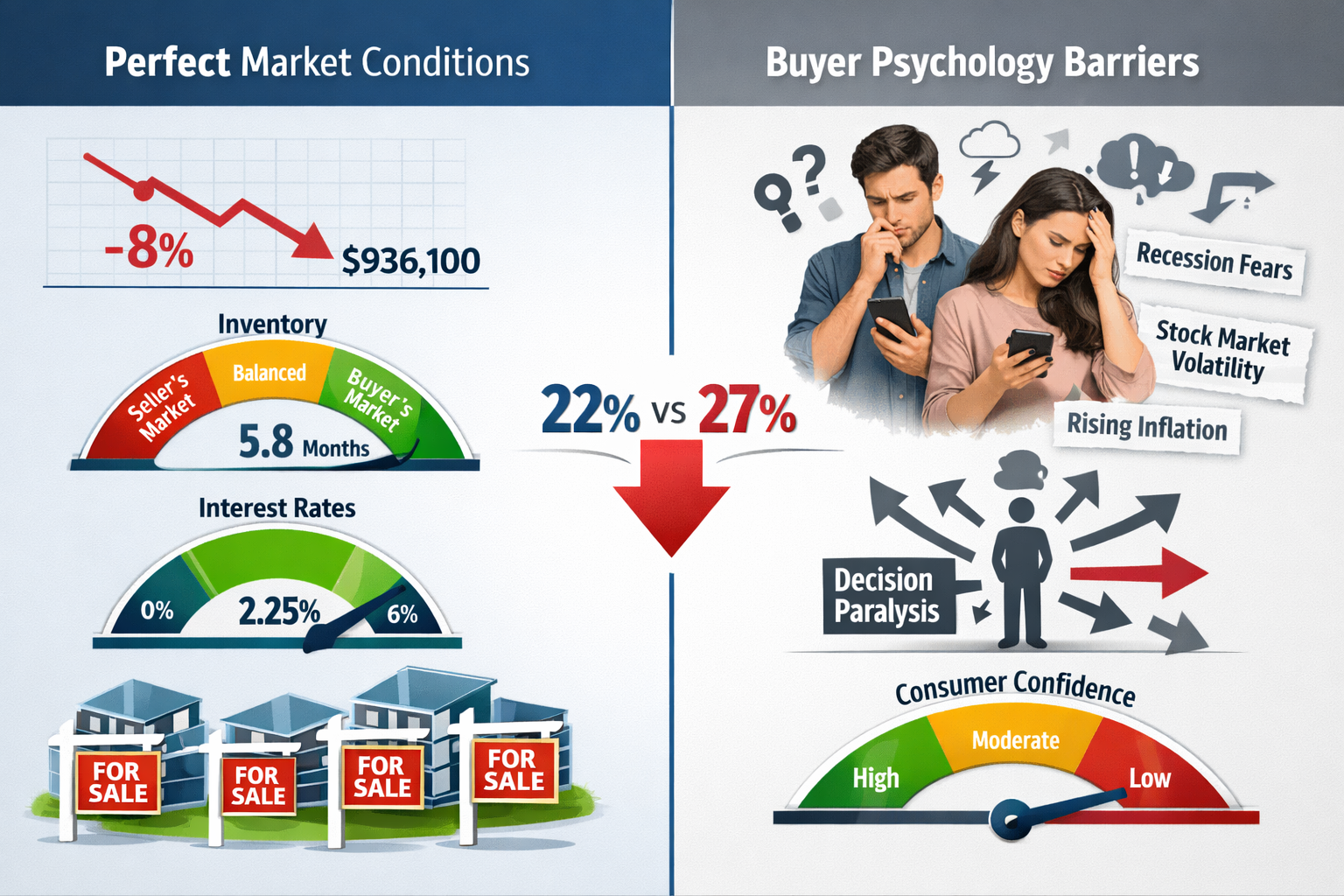
The GTA housing market has undergone a dramatic transformation that objectively favors purchasers. Average selling prices have fallen 6.5% year-over-year to $973,289 in January 2026, marking the first time in five years that average prices have dropped below the psychologically significant $1 million threshold[2][5]. Even more notably, benchmark prices specifically declined 8% to $936,100, representing substantial savings compared to the market peak[2].
Inventory Abundance Creates Negotiating Power
First-time homebuyers now hold unprecedented negotiating power with a 5.8-month supply of inventory—well into buyer’s market territory—compared to the competitive bidding wars that characterized previous years[2][4]. This inventory level provides breathing room for careful decision-making, property comparisons, and favorable negotiation outcomes.
The sales-to-new-listings ratio (SNLR) fell to just 28.6% in January 2026, down from 31.0% in January 2025, indicating a pronounced shift toward buyer advantage[2][4]. When this ratio falls below 40%, market dynamics typically favor purchasers with reduced competition and increased seller flexibility.
| Market Indicator | January 2026 | January 2025 | Change |
|---|---|---|---|
| Average Selling Price | $973,289 | $1,040,000+ | -6.5% ⬇️ |
| Benchmark Price | $936,100 | $1,017,500+ | -8.0% ⬇️ |
| Inventory Supply | 5.8 months | 4.2 months | +38% ⬆️ |
| Sales-to-New-Listings | 28.6% | 31.0% | -2.4% ⬇️ |
| Total Home Sales | 3,082 | 3,819 | -19.3% ⬇️ |
Differentiated Price Pressure Across Property Segments
Property segments have experienced differentiated price pressure, creating varied entry points for first-time buyers with different budget constraints[2]. Condos declined 26% in sales with median prices at $749,500 (down 6.3% year-over-year in the City of Toronto), freehold townhomes fell 24%, semi-detached homes dropped 20%, and detached homes decreased 14%[2].
This segmentation offers strategic opportunities for buyers willing to consider different property types based on their lifestyle needs and financial capacity. For many first-time purchasers, condos and townhomes represent accessible entry points into homeownership, particularly with current pricing adjustments.
Understanding qualifying for a mortgage before buying property becomes essential in this environment, as pre-approval provides the confidence to act decisively when opportunities arise.
Mortgage Accessibility Improvements
The Bank of Canada’s policy rate sitting at 2.25% has created improved mortgage accessibility compared to the restrictive conditions of 2023-2024[1]. While mortgage stress testing requirements remain in place, the lower base rates translate to more manageable qualifying thresholds for first-time buyers.
Additionally, programs like the First Home Savings Account (FHSA) provide tax-advantaged savings vehicles that enhance down payment capacity, while various federal initiatives continue supporting first-time purchaser accessibility[3].
Understanding First-Time Buyer Psychology: Why 5% Fewer GTA Residents Are Buying Despite Opportunity
The statistical decline from 27% to 22% in homebuying intentions represents approximately 18.5% fewer prospective purchasers entering the market despite objectively improved conditions[5]. This counterintuitive behavior reveals the powerful role of psychology in real estate decision-making.
Economic Uncertainty as the Primary Psychological Barrier
According to Ipsos survey data, “challenges with consumer confidence vis-à-vis current economic uncertainty” are explicitly cited as the core constraint, not affordability or market access[5]. This distinction is critical—the barrier isn’t whether buyers can purchase, but whether they feel confident doing so.
Several economic factors contribute to this uncertainty mindset:
🔴 Job Security Concerns: Despite relatively stable employment rates, fears about potential economic downturns create hesitation about long-term financial commitments
🔴 Inflation Anxiety: Although inflation has moderated from peak levels, psychological scarring from 2022-2023 price increases persists in consumer consciousness
🔴 Global Economic Volatility: International trade tensions, geopolitical instability, and uncertain economic forecasts create a generalized sense of caution
🔴 Future Rate Uncertainty: While current rates are favorable, concerns about potential future increases create decision paralysis
“The GTA’s affordability situation has actually improved with the Bank of Canada rate at 2.25%, yet homebuying intentions declined anyway. This demonstrates that psychological factors, not just financial metrics, drive purchasing decisions.”
The Paradox of Choice and Decision Paralysis
Behavioral economics research demonstrates that increased options can lead to decision paralysis rather than empowerment. With 17,975 active listings in January 2026 (up 4.8% year-over-year), first-time buyers face an abundance of choices that can paradoxically create anxiety rather than confidence[5].
This phenomenon manifests in several ways:
- Analysis Paralysis: Constantly comparing properties and waiting for “the perfect deal” prevents action
- Fear of Missing Out (FOMO) in Reverse: Concern that prices might fall further creates perpetual waiting
- Regret Aversion: Fear of making the “wrong” decision in uncertain times outweighs potential benefits
- Information Overload: Constant market updates and conflicting expert opinions create confusion
Many prospective buyers fall into the trap of common first-time home buyer mistakes, including waiting indefinitely for “perfect” conditions that may never materialize.
Lifestyle Flexibility Preferences Post-Pandemic
The psychological shift toward valuing flexibility over commitment has intensified since the pandemic. Many potential first-time buyers, particularly millennials and Gen Z purchasers, prioritize:
- Geographic mobility for career opportunities
- Lower maintenance responsibilities compared to homeownership
- Reduced financial obligation in uncertain economic times
- Lifestyle experimentation before settling into long-term commitments
This represents a fundamental shift in how younger generations view homeownership—less as an inevitable life milestone and more as one option among many for housing and wealth building.
Social Proof and Peer Influence
When only 22% of GTA residents intend to purchase, the lack of social proof reinforces hesitation[5]. Human psychology relies heavily on observing others’ behavior to validate decisions. When peers are also waiting, it creates a self-reinforcing cycle of inaction.
This social dynamic is particularly powerful among first-time buyers who lack personal experience with real estate transactions and rely on friends, family, and colleagues for validation of their decisions.
The Hidden Costs of Waiting: What Hesitant First-Time Buyers Risk Missing
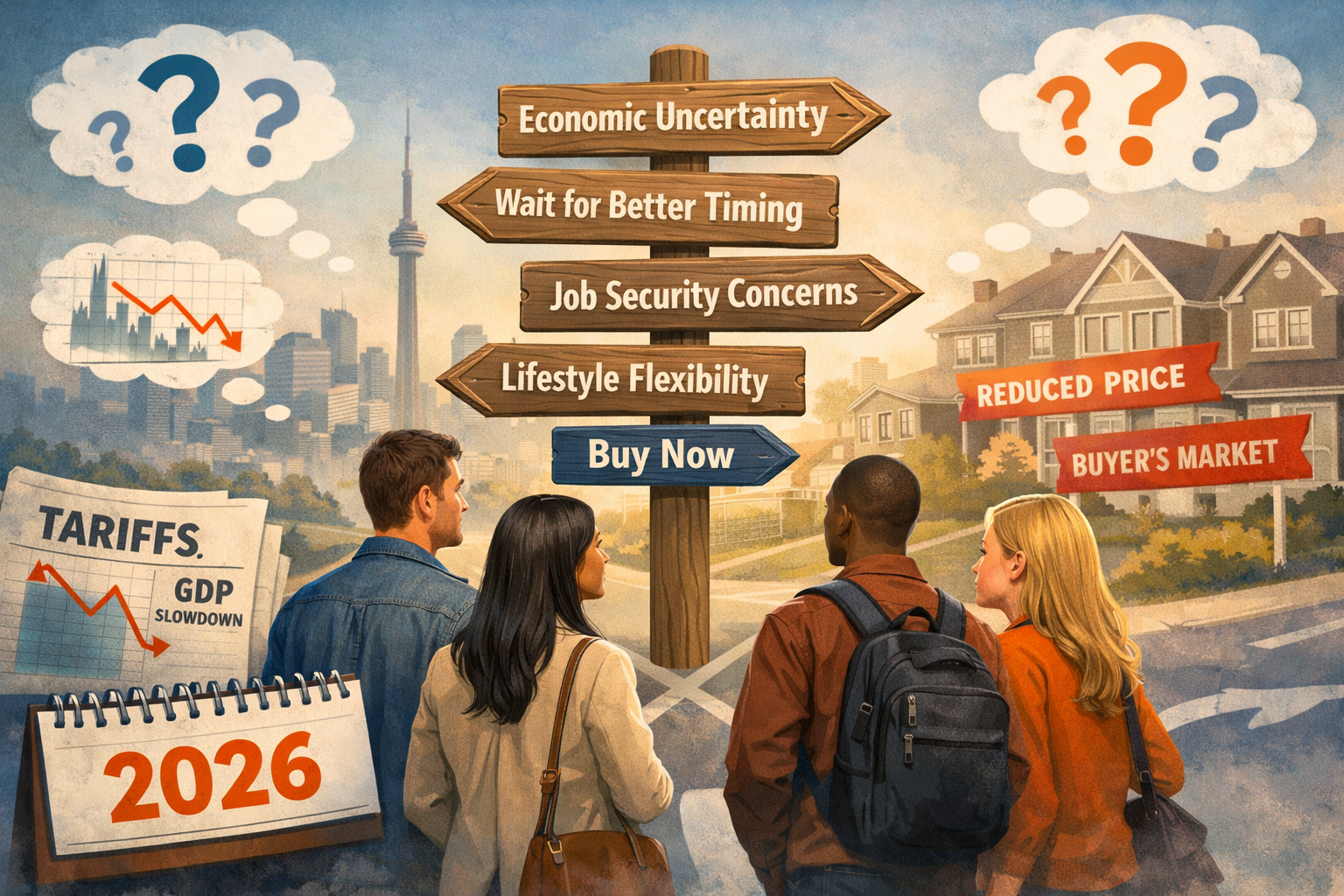
While psychological barriers feel real and valid, understanding the objective opportunity costs of continued hesitation provides important context for decision-making. The intersection of First-Time Buyer Psychology: Why 5% Fewer GTA Residents Are Buying in 2026 Despite Perfect Market Conditions creates both risks and opportunities.
Market Timing Risks and Recovery Patterns
TRREB forecasts 60,000 to 70,000 GTA home sales in 2026, with most activity concentrated in the first half of the year, suggesting potential recovery if consumer confidence stabilizes[2][3][6]. Historical real estate cycles demonstrate that buyer’s markets typically don’t persist indefinitely.
When confidence returns—whether triggered by positive economic news, employment growth, or simply psychological adjustment—demand can increase rapidly, shifting market dynamics back toward seller advantage. First-time buyers waiting for “better” conditions may find themselves competing in a more challenging environment.
Equity Building vs. Rent Payment
Every month of hesitation represents continued rent payments that build zero equity. For a first-time buyer paying $2,500 monthly rent, that’s $30,000 annually directed toward a landlord’s mortgage rather than building personal wealth.
Even with modest appreciation, homeownership begins building equity immediately through:
- Principal reduction with each mortgage payment
- Property appreciation over time (historically averaging 4-6% annually in the GTA)
- Forced savings through mortgage obligations
- Potential rental income from basement apartments or future property use
Understanding how rate forecasts could make refinancing a smart move demonstrates how current purchasers can optimize their positions as market conditions evolve.
Inflation Hedge and Fixed Housing Costs
Homeownership with a fixed-rate mortgage provides protection against future rent increases. While property taxes and maintenance costs may rise, the largest housing expense—the mortgage payment—remains stable, providing predictability and protection against inflation.
Renters face annual increases that compound over time. A modest 3% annual rent increase on $2,500 monthly rent results in:
- Year 1: $2,500/month ($30,000 annually)
- Year 5: $2,898/month ($34,776 annually)
- Year 10: $3,362/month ($40,344 annually)
- Year 20: $4,515/month ($54,180 annually)
Over 20 years, this represents $844,200 in total rent payments with zero equity accumulation, compared to a mortgage that builds ownership with each payment.
Tax Advantages and Government Programs
First-time buyers in 2026 have access to various programs that reduce the financial burden of homeownership:
✅ First-Time Home Buyer Incentive: Shared equity program reducing monthly payments[3]
✅ Home Buyers’ Plan (HBP): Withdraw up to $35,000 from RRSPs tax-free for down payment
✅ First Home Savings Account (FHSA): Tax-free savings and withdrawals for first home purchase
✅ Land Transfer Tax Rebates: Significant savings on closing costs in Ontario
✅ GST/HST New Housing Rebate: For qualifying new construction purchases
These programs specifically target first-time buyers, providing advantages that disappear once someone has owned property. Delaying purchase means delaying access to these benefits.
Negotiating Power in Current Market
The 5.8-month inventory supply creates exceptional negotiating leverage that may not persist[2][4]. Current buyers can:
- Negotiate price reductions beyond list prices
- Request seller concessions for repairs, closing costs, or appliances
- Take time for thorough inspections without competitive pressure
- Include favorable conditions in purchase agreements
- Avoid bidding wars that characterized previous market cycles
This negotiating power represents tangible financial value that translates to thousands of dollars in savings—value that evaporates when market conditions tighten.
Overcoming Psychological Barriers: Strategic Approaches for Confident First-Time Buying
Understanding the psychological barriers is the first step; developing strategies to overcome them enables action. For first-time buyers experiencing the hesitation reflected in First-Time Buyer Psychology: Why 5% Fewer GTA Residents Are Buying in 2026 Despite Perfect Market Conditions, several evidence-based approaches can restore confidence.
Reframe Economic Uncertainty as Opportunity
Perspective shift: Every period of economic uncertainty in real estate history has eventually been viewed as an opportunity by those who acted. The 2008 financial crisis, the 1990s recession, and the 2017-2018 interest rate increases all created temporary buyer hesitation—followed by regret from those who waited.
Rather than viewing uncertainty as a reason to delay, reframe it as:
- Reduced competition from other buyers experiencing the same hesitation
- Motivated sellers willing to negotiate in uncertain times
- Price discovery that reveals true market values rather than speculation-driven inflation
- Long-term thinking that recognizes homeownership as a 5-10+ year commitment, not a short-term bet
Establish Clear Personal Criteria and Boundaries
Combat decision paralysis by establishing non-negotiable criteria before beginning the search:
- Maximum budget based on conservative income projections
- Minimum property requirements (bedrooms, location, amenities)
- Deal-breaker list (what you absolutely won’t compromise on)
- Nice-to-have features (desirable but not essential)
- Timeline parameters (when you’ll make a decision by)
This framework transforms overwhelming choice into manageable evaluation, reducing anxiety and enabling decisive action when suitable properties appear.
Working with professionals who understand the mortgage stress test requirements ensures your budget criteria reflect realistic approval thresholds.
Focus on Personal Readiness Rather Than Perfect Timing
Market timing is nearly impossible; personal readiness is controllable. Shift focus from “Is this the perfect market moment?” to “Am I personally ready for homeownership?”
Personal readiness indicators include:
✅ Stable employment with consistent income (typically 2+ years in field)
✅ Emergency fund covering 3-6 months of expenses beyond down payment
✅ Credit score above 680 (ideally 700+) for optimal mortgage rates
✅ Down payment saved meeting minimum requirements (5-20% depending on price)
✅ Debt-to-income ratio within acceptable ranges (typically under 43%)
✅ Lifestyle stability expecting to remain in the area for 5+ years
If these personal indicators align, current market conditions provide favorable execution timing regardless of broader economic uncertainty.
Leverage Professional Expertise to Reduce Anxiety
Professional guidance directly addresses confidence gaps that create hesitation. Working with experienced mortgage brokers, real estate agents, and financial advisors provides:
- Expert market interpretation that cuts through conflicting information
- Personalized financial analysis showing what you can realistically afford
- Risk assessment addressing specific concerns about your situation
- Process navigation reducing stress of unfamiliar transactions
- Negotiation expertise maximizing value in current buyer’s market
Many first-time buyers don’t realize that mortgage broker consultations are typically free, providing professional guidance without upfront costs.
Implement a “Test and Learn” Approach
Rather than making an all-or-nothing decision, adopt an incremental approach:
Phase 1: Information Gathering (1-2 months)
- Attend open houses without obligation
- Get pre-approved to understand real budget
- Research neighborhoods and property types
- Interview real estate professionals
Phase 2: Active Observation (1-2 months)
- Monitor specific properties matching criteria
- Track price changes and market trends
- Refine understanding of value in target areas
- Build confidence through familiarity
Phase 3: Conditional Engagement (1-3 months)
- Make offers with appropriate conditions
- Conduct inspections and due diligence
- Experience negotiation process
- Make final decision with full information
This approach reduces the psychological weight of a single “yes or no” decision, replacing it with a series of smaller, reversible steps that build confidence progressively.
Address Lifestyle Flexibility Through Strategic Property Selection
For buyers valuing flexibility, strategic property choices can provide homeownership benefits while maintaining options:
🏠 Condos with strong rental demand: Easy to rent if relocation becomes necessary
🏠 Properties near major transit: Appeal to broader buyer pool for future resale
🏠 Homes with secondary suite potential: Income generation and mortgage assistance
🏠 Emerging neighborhoods: Balance affordability with appreciation potential
🏠 Properties below maximum budget: Financial flexibility for life changes
Understanding options like refinancing for legal basement apartments demonstrates how property choices can evolve with changing needs.
First-Time Buyer Psychology in 2026: Taking Action Despite Uncertainty

The 5% decline in GTA homebuying intentions despite perfect market conditions reveals that real estate decisions are fundamentally psychological, not purely financial[5]. Understanding First-Time Buyer Psychology: Why 5% Fewer GTA Residents Are Buying in 2026 Despite Perfect Market Conditions provides the insight needed to make confident, informed decisions.
The Confidence Gap Represents Competitive Advantage
Ironically, widespread hesitation creates opportunity for those who overcome psychological barriers. When 78% of GTA residents aren’t planning to purchase, the 22% who do face:
- Reduced competition for desirable properties
- Motivated sellers willing to negotiate favorable terms
- Professional attention from agents and brokers less overwhelmed by volume
- Time for due diligence without pressure from competing offers
The confidence gap becomes a competitive advantage for prepared, decisive buyers.
Long-Term Perspective Overcomes Short-Term Uncertainty
Real estate remains a long-term wealth-building strategy regardless of short-term economic fluctuations. Historical data demonstrates that:
- GTA property values have appreciated consistently over 20+ year periods
- Homeownership rates correlate strongly with household wealth accumulation
- Market cycles create temporary opportunities that long-term holders benefit from
- Forced savings through mortgage payments builds equity regardless of market conditions
First-time buyers focused on 10+ year horizons can weather short-term uncertainty that paralyzes those thinking in 1-2 year timeframes.
Professional Partnership Transforms Uncertainty Into Strategy
The difference between hesitation and action often comes down to professional guidance that addresses specific concerns. Experienced mortgage professionals provide:
✅ Realistic affordability analysis based on your unique financial situation
✅ Stress test preparation ensuring you qualify comfortably, not marginally
✅ Program optimization maximizing available first-time buyer benefits
✅ Market timing insights specific to your target neighborhoods and property types
✅ Risk mitigation strategies addressing your particular concerns about homeownership
This personalized approach replaces generalized anxiety with specific, actionable plans.
The 2026 Window: Temporary Opportunity or New Normal?
TRREB projects mid to high single-digit year-over-year price declines in the first half of 2026, with the GTA average price expected to settle between $1 million and $1.03 million for the full year[2]. This suggests current conditions represent a temporary market adjustment rather than a permanent new baseline.
As economic uncertainty gradually resolves—whether through GDP growth, employment stability, or simply psychological adjustment—buyer confidence typically returns, increasing demand and shifting market dynamics back toward seller advantage.
The question for hesitant first-time buyers becomes: Will you view 2026 as the opportunity you seized, or the opportunity you missed?
Conclusion: Turning Psychological Insight Into Homeownership Action
The paradox of First-Time Buyer Psychology: Why 5% Fewer GTA Residents Are Buying in 2026 Despite Perfect Market Conditions reveals a fundamental truth: real estate decisions are emotional as much as financial. Understanding this psychology provides the framework for overcoming barriers that prevent action.
With average prices below $1 million for the first time in five years, 5.8 months of buyer-friendly inventory, and improved mortgage accessibility, 2026 offers conditions that first-time buyers have waited years to see[2][4][5]. The 18.5% decline in purchase intentions creates reduced competition for those ready to act.
Your Next Steps: From Hesitation to Homeownership
Immediate Actions (This Week):
- Get pre-approved to understand your real purchasing power and budget
- Calculate total costs including down payment, closing costs, and monthly obligations
- Assess personal readiness using the criteria outlined above
- Identify 2-3 target neighborhoods matching your lifestyle and budget
Short-Term Actions (This Month):
- Attend open houses to familiarize yourself with current market values
- Consult with a mortgage broker to optimize your financing strategy
- Review credit reports and address any issues affecting approval
- Maximize FHSA contributions if eligible for tax-advantaged savings
Medium-Term Actions (Next 3 Months):
- Develop specific property criteria to guide your search efficiently
- Build your professional team (mortgage broker, real estate agent, lawyer)
- Monitor target properties to understand pricing trends and value
- Make your first offer with appropriate conditions when suitable property appears
The psychological barriers are real, but they’re not insurmountable. Economic uncertainty will always exist in some form—waiting for perfect certainty means waiting forever. The first-time buyers who overcome hesitation in 2026 will likely look back on this period as the opportunity that launched their homeownership journey.
The market has created the conditions. Your personal readiness determines the outcome. Professional guidance bridges the gap between hesitation and action.
Don’t let the psychology that’s affecting 5% fewer GTA residents prevent you from capitalizing on the best buyer’s market in years. Schedule a free mortgage consultation to transform uncertainty into a personalized homeownership strategy tailored to your unique situation and goals.
The perfect market conditions are here. The question is whether you’ll be among the confident 22% who act, or the hesitant 78% who wait and wonder.
References
[1] First Time Home Buyer Ontario – https://rcibrealestate.ca/first-time-home-buyer-ontario/
[2] Buying Your First Home In Torontos 2026 Buyers Market A Step By Step Guide – https://everythingmortgages.ca/blog/buying-your-first-home-in-torontos-2026-buyers-market-a-step-by-step-guide/
[3] Trreb 2026 Market Outlook Year In Review What Gta Home Buyers Sellers And Realtors Need To Know – https://keystonera.ca/trreb-2026-market-outlook-year-in-review-what-gta-home-buyers-sellers-and-realtors-need-to-know/
[4] Toronto Housing Market – https://wowa.ca/toronto-housing-market
[5] Gta Home Sales And Prices Expected To Remain Stable In 2026 Amid Ongoing Affordability Pressures – https://trreb.ca/gta-home-sales-and-prices-expected-to-remain-stable-in-2026-amid-ongoing-affordability-pressures/
[6] Gta Analysts Forecast Stable Homes Prices In 2026 – https://www.reminetwork.com/articles/gta-analysts-forecast-stable-homes-prices-in-2026/
 Previous Page