February 18, 2026
Working with a Real Estate Agent vs. Going Solo: Toronto First-Time Buyer Comparison in 2026
Share this article:



Manzeel is an award-winning Mortgage Broker and the Owner of the Toronto-based mortgage, Everything Mortgages.
With 16 years of experience in the Canadian mortgage industry and a formal background in mortgage underwriting, Manzeel’s lending expertise gives him unique insight into whether a deal is feasible which empowers his clients to make more informed lending decisions faster.
He has been recognized as one of Canada’s Top 10 Mortgage Brokers by the national Canadian Mortgage Professionals (CMP) Association. Him and his team of 18 mortgage agents are proud to offer a mortgage experience that's built on honesty, trust, and integrity. He prides himself on the brokerage’s dedication to deliver an excellent client experience throughout the entire home loan process from pre-approval to post-funding.
Since moving to Toronto in 1998, Manzeel has successfully launched and scaled several businesses from the ground up, ranging from a mortgage brokerage and a vast real estate investment portfolio to a private financing eCommerce platform. He continues to be a leader in the real estate industry as he uses his analytical expertise to seek new real estate investment opportunities.
As a tech junkie and avid sports enthusiast, when Manzeel’s not working with clients, you can find him reading technology blogs, playing squash or watching tennis with his two boys.
nn

Toronto’s real estate landscape in 2026 presents a unique opportunity for first-time buyers. With motivated sellers and complex negotiations defining the current buyer’s market, one critical decision stands between aspiring homeowners and their dream property: should they hire a real estate agent or navigate the purchase independently? This comprehensive analysis of Working with a Real Estate Agent vs. Going Solo: Toronto First-Time Buyer Comparison in 2026 examines the financial implications, strategic advantages, and potential pitfalls of each approach in today’s evolving market conditions.
The Toronto real estate market has transformed significantly, with home sales and prices expected to remain stable throughout 2026 amid ongoing affordability pressures [4]. For first-time buyers entering this market, understanding whether professional representation justifies the associated costs has never been more crucial. This decision impacts not just immediate expenses but long-term financial outcomes, negotiation success, and overall homeownership satisfaction.
Key Takeaways
✅ Agent representation typically costs 2.5% of purchase price but provides access to exclusive MLS listings, professional negotiation expertise, and legal protection that solo buyers must secure independently
✅ Solo purchases can save thousands in commission costs but require significant time investment, market knowledge, and understanding of complex legal documentation and negotiation strategies
✅ Toronto’s 2026 buyer’s market creates opportunities for both approaches, with motivated sellers potentially more willing to work directly with buyers while complex negotiations favor experienced agent representation
✅ First-time buyer programs and tax credits apply equally to both methods, though agents often provide valuable guidance on maximizing these benefits and avoiding costly qualification mistakes
✅ The optimal choice depends on individual circumstances including available time, market knowledge, negotiation confidence, property complexity, and financial resources for professional services
Understanding Toronto’s 2026 Real Estate Landscape for First-Time Buyers
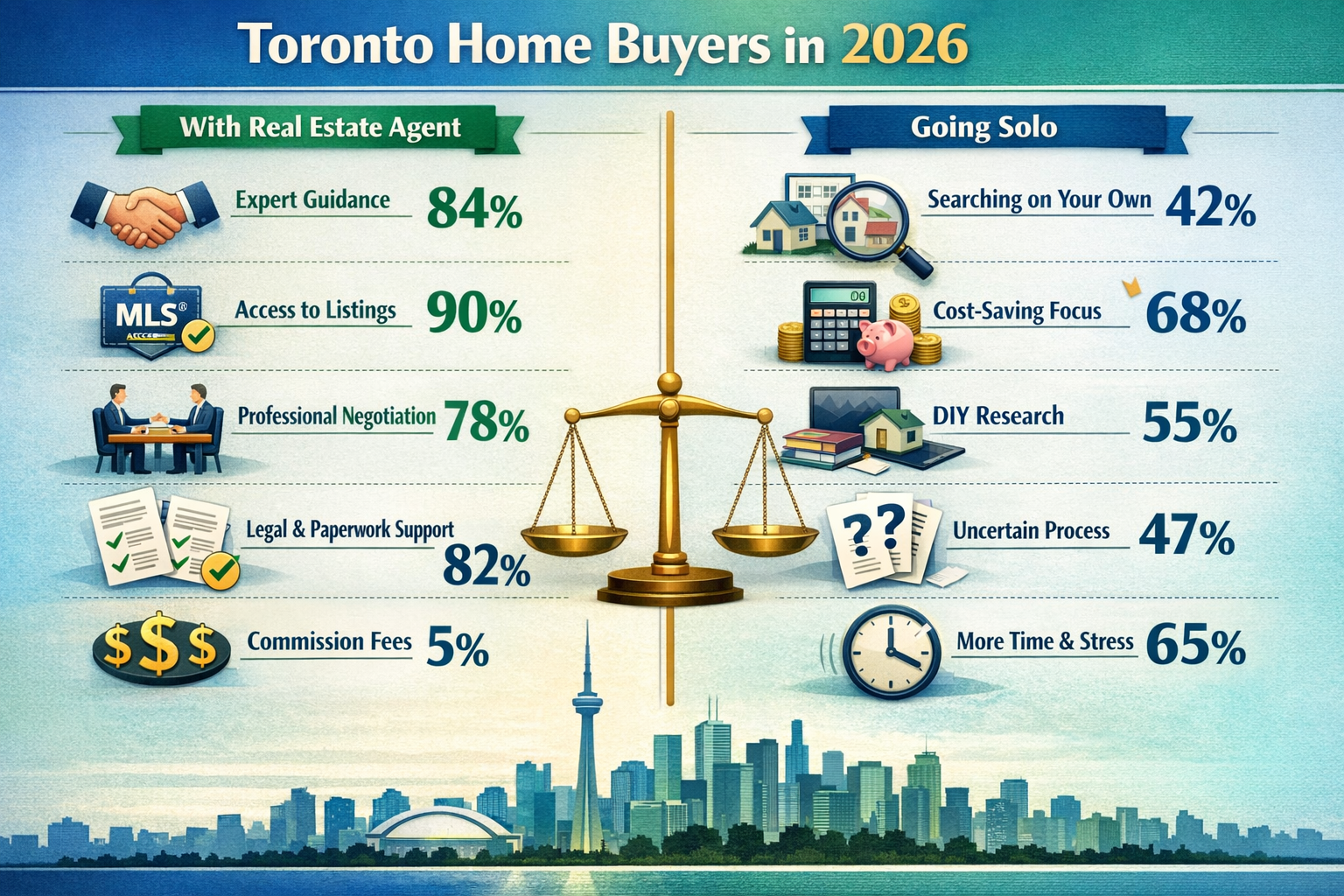
The Greater Toronto Area housing market in 2026 operates under distinctly different conditions than previous years. According to the Toronto Regional Real Estate Board (TRREB), home sales and prices are expected to remain stable throughout 2026, with ongoing affordability pressures continuing to shape buyer decisions [4]. This stability creates both opportunities and challenges for first-time buyers considering whether to work with an agent or go solo.
Current Market Conditions
Toronto’s average home prices have stabilized after years of volatility, with forecasts suggesting continued equilibrium rather than dramatic increases or decreases [5]. This stable environment means first-time buyers face less urgency than during previous seller’s markets, allowing more time for careful decision-making about representation.
Key 2026 Market Statistics:
- Average home prices remain relatively stable year-over-year
- Inventory levels have increased, creating more buyer choice
- Days on market have extended, reducing bidding war frequency
- Motivated sellers are more common due to economic pressures
- Interest rates have stabilized but remain elevated compared to historical lows
Canadian first-time buyers are now among the oldest in the world, with the average age increasing significantly due to affordability challenges [6]. This demographic shift means today’s first-time buyers often have more financial sophistication and research capabilities than previous generations, potentially making solo purchases more feasible.
The Buyer’s Market Advantage
A buyer’s market fundamentally changes the dynamics of real estate transactions. With more properties available and fewer competing buyers, first-time purchasers gain negotiating leverage regardless of their chosen approach. However, this advantage manifests differently depending on whether buyers work with agents or navigate independently.
Understanding the hunt for affordability in Toronto area real estate requires examining how different purchasing strategies impact your ability to secure favorable terms. In 2026’s market conditions, both agent-assisted and solo buyers can potentially negotiate price reductions, request repairs, or secure favorable closing terms—but the execution differs significantly.
The Real Estate Agent Advantage: Professional Representation in 2026
Working with a licensed real estate agent provides first-time Toronto buyers with professional expertise, market access, and negotiation support that can prove invaluable in complex transactions. Understanding the specific advantages helps buyers evaluate whether these benefits justify the associated costs.
Exclusive Market Access and MLS Listings
Real estate agents provide access to the Multiple Listing Service (MLS), which contains comprehensive property information unavailable to the general public. While some listings appear on public websites, agents see detailed histories, price changes, days on market, and comparable sales data that inform strategic decisions.
What Agents Access That Solo Buyers Don’t:
- 📊 Complete property history including all previous listings
- 💰 Detailed comparable sales analysis with adjustment factors
- 🏠 Off-market properties and pocket listings
- 📈 Real-time market trend data and neighborhood analytics
- 🔍 Property disclosure statements and inspection reports from previous deals
This information advantage becomes particularly valuable when evaluating fair market value and identifying properties with negotiation potential. Agents can spot overpriced listings, identify motivated sellers, and recognize red flags that inexperienced buyers might miss.
Professional Negotiation Expertise
Perhaps the most significant advantage of agent representation lies in professional negotiation capabilities. Experienced Toronto real estate agents negotiate dozens of transactions annually, developing skills and strategies that first-time buyers simply cannot replicate.
“In Toronto’s 2026 market, skilled negotiation can save buyers tens of thousands of dollars—far exceeding typical agent commission costs. The question isn’t whether negotiation matters, but whether you have the expertise to execute effectively.” [1]
Agents understand psychological negotiation tactics, timing strategies, and creative solutions that maximize buyer outcomes. They know when to push aggressively, when to compromise strategically, and how to structure offers that appeal to specific seller motivations.
Negotiation Areas Where Agents Excel:
- Purchase price optimization – Crafting competitive yet favorable offers
- Conditional periods – Securing adequate time for inspections and financing
- Closing date flexibility – Accommodating seller needs while protecting buyer interests
- Repair negotiations – Addressing inspection findings effectively
- Contract terms – Including protective clauses and contingencies
Legal Protection and Documentation
Real estate transactions involve complex legal documentation with significant financial consequences. Agents ensure contracts comply with Ontario real estate law, include necessary protective clauses, and accurately reflect negotiated terms.
While buyers must still retain real estate lawyers for closing, agents handle the preliminary legal framework that governs the transaction. This includes drafting offers, managing amendments, coordinating conditions, and ensuring all regulatory requirements are met.
Time Savings and Convenience
First-time buyers often underestimate the time investment required for property searches, viewings, research, and negotiations. Agents handle scheduling, coordinate showings, conduct preliminary property assessments, and manage communication with sellers and their representatives.
For buyers with demanding careers or limited availability, this time savings alone can justify agent costs. Agents work when buyers cannot, ensuring opportunities aren’t missed due to scheduling conflicts.
Cost Considerations for Agent Representation
In Toronto’s 2026 market, buyer’s agents typically receive 2.5% of the purchase price as commission, paid by the seller from sale proceeds. However, this arrangement means the cost is effectively built into property prices.
Commission Cost Example:
- $800,000 purchase price
- 2.5% buyer agent commission = $20,000
- Paid by seller, but reflected in negotiated price
Some buyers negotiate commission rebates or reduced rates, particularly when purchasing higher-priced properties. However, this approach may limit agent motivation or service quality.
Going Solo: The Independent First-Time Buyer Approach in Toronto 2026
Purchasing property without agent representation offers potential cost savings and direct control but requires significant knowledge, time, and confidence. Understanding the solo buyer approach helps first-time purchasers evaluate whether this path aligns with their capabilities and circumstances.
Financial Savings Potential
The primary motivation for going solo centers on eliminating agent commission costs. In theory, buyers can negotiate lower purchase prices when sellers don’t need to pay buyer agent commissions, keeping these savings for themselves.
Potential Solo Buyer Savings:
💵 Commission savings: 2.5% of purchase price (potentially negotiable)
💵 Direct negotiation: No intermediary markup or communication delays
💵 Flexible terms: Ability to structure creative deals without agent limitations
However, realizing these savings requires sophisticated negotiation skills. Sellers and their agents often resist reducing prices by the full commission amount, arguing that marketing costs, legal fees, and other expenses remain constant regardless of buyer representation.
Required Knowledge and Skills
Solo buyers must develop or possess extensive knowledge across multiple domains to navigate transactions successfully. This learning curve can be steep for first-time buyers unfamiliar with real estate processes.
Essential Solo Buyer Competencies:
- Market analysis – Understanding neighborhood values, price trends, and fair market pricing
- Property evaluation – Identifying structural issues, renovation needs, and hidden problems
- Legal documentation – Comprehending contracts, offers, and binding agreements
- Negotiation strategy – Developing effective tactics without professional training
- Process management – Coordinating inspections, appraisals, financing, and closing
First-time buyers considering the solo approach should honestly assess their capabilities in each area. Deficiencies in any domain can lead to costly mistakes that exceed potential commission savings.
Time Investment Requirements
Independent property searches demand substantial time commitments that many first-time buyers underestimate. Without agent support, buyers personally handle every aspect of the search and purchase process.
Time-Intensive Solo Buyer Activities:
⏰ Property research: Analyzing listings, neighborhoods, and market data (10-20 hours weekly)
⏰ Viewing coordination: Scheduling and attending showings independently (5-15 hours weekly)
⏰ Due diligence: Researching property histories, permits, and potential issues (8-12 hours per property)
⏰ Negotiation preparation: Developing strategies and researching comparable sales (5-10 hours per offer)
⏰ Transaction management: Coordinating professionals, managing deadlines, and handling documentation (10-20 hours during closing)
For buyers with flexible schedules or those treating the search as a learning opportunity, this time investment may prove worthwhile. However, professionals with limited availability may find the commitment unsustainable.
Access Limitations and Information Gaps
Solo buyers face restricted access to certain market information and properties. While public listing websites provide basic property details, they lack the comprehensive data available through MLS and agent networks.
Information Gaps for Solo Buyers:
- Limited access to complete property histories and previous listing details
- No access to agent-only showing systems or pocket listings
- Reduced visibility into comparable sales with adjustment factors
- Limited insight into seller motivations and circumstances
- No professional network for referrals to inspectors, lawyers, and other service providers
These limitations don’t make solo purchases impossible, but they create disadvantages in competitive situations or when evaluating complex properties. Solo buyers must work harder to gather equivalent information through public records, independent research, and creative networking.
Legal and Contractual Risks
Without professional guidance, solo buyers face increased legal exposure from documentation errors, missing protective clauses, or misunderstood contract terms. While real estate lawyers review final agreements, they typically don’t participate in offer drafting or preliminary negotiations.
Common legal pitfalls for solo buyers include:
- ⚠️ Inadequate conditional periods for inspections or financing
- ⚠️ Missing protective clauses for title issues or property defects
- ⚠️ Poorly worded offers that create unintended obligations
- ⚠️ Misunderstood deposit structures and forfeiture conditions
- ⚠️ Insufficient contingencies for material property changes
These risks can be mitigated through careful research, legal consultation before making offers, and conservative contract terms. However, first-time buyers may not recognize potential issues until problems arise.
When Solo Purchases Make Sense
Despite the challenges, certain circumstances favor the independent buyer approach. Understanding these scenarios helps first-time buyers make informed decisions about representation.
Ideal Solo Buyer Profiles:
✓ Experienced professionals with real estate, legal, or financial backgrounds
✓ Highly motivated learners willing to invest significant time in education
✓ Buyers with flexible schedules who can dedicate substantial time to the process
✓ Simple transactions involving straightforward properties without complications
✓ Strong negotiators with proven track records in high-stakes discussions
Buyers considering solo purchases should also explore navigating the first time home buyer tax credit in Canada to ensure they maximize available benefits without professional guidance.
Working with a Real Estate Agent vs. Going Solo: Toronto First-Time Buyer Comparison in 2026 – Head-to-Head Analysis
Comparing agent-assisted and solo purchases across key dimensions reveals the trade-offs first-time Toronto buyers face. This detailed analysis examines financial implications, success rates, and strategic considerations for each approach in 2026’s market conditions.
Financial Comparison: Total Cost Analysis
Understanding the complete financial picture requires examining both direct costs and potential savings or losses from negotiation outcomes.
| Cost Category | With Agent | Going Solo |
|---|---|---|
| Agent Commission | $20,000 (2.5% of $800K) | $0 |
| Legal Fees | $1,500-2,500 | $2,000-3,500 (more complex) |
| Home Inspection | $500-800 | $500-800 |
| Appraisal | $300-500 | $300-500 |
| Potential Overpayment Risk | Lower (expert pricing) | Higher (inexperienced valuation) |
| Negotiation Savings | Potentially higher | Potentially lower |
| Time Value | Minimal personal time | 50-100+ hours |
While solo buyers eliminate direct commission costs, the total financial outcome depends heavily on negotiation effectiveness and pricing accuracy. Overpaying by even 2-3% on an $800,000 property ($16,000-24,000) can exceed commission savings, particularly if the seller doesn’t reduce the price by the full commission amount.
Success Rate Comparison
Although comprehensive statistics specifically comparing agent-assisted versus solo first-time buyer outcomes in Toronto remain limited, industry data suggests significant differences in transaction success rates and buyer satisfaction.
Agent-Assisted Buyer Outcomes:
📈 Higher offer acceptance rates – Professional presentation and terms
📈 Fewer deal failures – Proper conditional structuring and due diligence
📈 Better price negotiation – Average 3-5% below asking in buyer’s markets
📈 Reduced legal issues – Proper documentation and protective clauses
📈 Higher satisfaction rates – Professional support throughout process
Solo Buyer Outcomes:
📉 Lower initial offer acceptance – Less professional presentation
📉 Higher deal failure rates – Inadequate conditions or financing issues
📉 Variable price outcomes – Depends heavily on individual negotiation skills
📉 Increased legal complications – Documentation errors and missing protections
📉 Mixed satisfaction – Highly dependent on individual experience and outcomes
These patterns suggest that while solo purchases can succeed, they carry higher risk profiles, particularly for first-time buyers without previous real estate experience.
Strategic Advantages by Scenario
Different property types and transaction scenarios favor different approaches. Understanding these nuances helps buyers choose the optimal strategy for their specific circumstances.
Scenarios Favoring Agent Representation:
🏘️ Competitive neighborhoods with multiple interested buyers
🏘️ Complex properties requiring extensive due diligence (older homes, unique features)
🏘️ Negotiation-intensive situations with motivated but sophisticated sellers
🏘️ Time-sensitive purchases requiring rapid response and coordination
🏘️ First-time buyers with limited real estate knowledge or experience
Scenarios Favoring Solo Approaches:
🏡 Simple condos with straightforward condo corporations and recent inspections
🏡 Extended timelines allowing thorough independent research
🏡 Highly motivated sellers willing to work directly with buyers
🏡 Buyers with relevant expertise in real estate, law, or finance
🏡 Properties requiring creative deals that benefit from direct negotiation
First-time buyers should honestly evaluate which scenario matches their situation before committing to either approach.
Hybrid Approaches and Alternative Models
Some Toronto buyers explore hybrid strategies that combine elements of both approaches, seeking to capture benefits while minimizing drawbacks.
Hybrid Strategy Options:
- Flat-fee agent services – Pay fixed amounts for specific services (showing access, document review)
- Commission rebate agreements – Negotiate partial commission returns after closing
- Consulting arrangements – Hire agents as advisors without full representation
- Dual agency situations – Work with listing agents who represent both parties
- Limited service brokerages – Receive basic support at reduced commission rates
Each hybrid approach carries unique advantages and limitations. Flat-fee services provide specific expertise without full commission costs but may lack comprehensive support. Dual agency creates potential conflicts of interest despite cost savings. Buyers should carefully evaluate these alternatives against their specific needs.
Understanding how 2026 rate forecasts could make refinancing a smart move also factors into the decision, as buyers who plan to refinance within a few years may prioritize different factors than those planning long-term ownership.
Practical Decision Framework: Choosing Your Approach for Toronto 2026

First-time buyers need a structured framework for evaluating whether agent representation or solo purchase aligns with their circumstances, capabilities, and goals. This decision matrix provides practical guidance for making this critical choice.
Self-Assessment Questions
Before choosing an approach, buyers should honestly answer these key questions:
Financial Considerations:
💭 Can you afford potential mistakes? Solo buyers risk overpaying or missing issues that could cost more than agent commissions.
💭 What’s your time worth? Calculate the opportunity cost of 50-100+ hours spent on independent research and coordination.
💭 Do you have emergency reserves? Unexpected issues discovered after purchase can be more costly without professional pre-purchase evaluation.
Knowledge and Skills:
💭 Do you understand real estate contracts? Can you identify problematic clauses or missing protections?
💭 Can you accurately evaluate property values? Do you know how to analyze comparable sales and adjust for differences?
💭 Are you a confident negotiator? Have you successfully negotiated high-stakes transactions previously?
Practical Factors:
💭 How much time can you dedicate? Do you have flexible availability for viewings, research, and coordination?
💭 What’s your risk tolerance? Are you comfortable with uncertainty and potential complications?
💭 How complex is your target property? Older homes, unique features, or complicated situations favor professional help.
Decision Matrix
Use this scoring system to evaluate your optimal approach:
Score each factor from 1-5 (1 = strongly favors solo, 5 = strongly favors agent):
| Factor | Score (1-5) | Weight | Weighted Score |
|---|---|---|---|
| Market knowledge | ___ | 3x | ___ |
| Available time | ___ | 2x | ___ |
| Negotiation confidence | ___ | 3x | ___ |
| Property complexity | ___ | 2x | ___ |
| Legal understanding | ___ | 2x | ___ |
| Risk tolerance | ___ | 1x | ___ |
| Financial reserves | ___ | 2x | ___ |
Total Weighted Score Interpretation:
- 15-30: Strong candidate for solo purchase
- 31-45: Consider hybrid approach or limited services
- 46-60: Moderate fit for agent representation
- 61-75: Strong candidate for full agent representation
This framework provides guidance, but individual circumstances may warrant exceptions. Buyers scoring in middle ranges should explore hybrid options or seek additional consultation.
Professional Resources Beyond Agents
Regardless of chosen approach, first-time buyers benefit from assembling a professional support team. Even solo buyers should engage specialists in specific domains.
Essential Professional Team Members:
👔 Real estate lawyer – Reviews contracts, conducts title searches, manages closing (required for all buyers)
👔 Home inspector – Evaluates property condition and identifies potential issues ($500-800)
👔 Mortgage broker – Secures optimal financing and navigates lender requirements (typically free to buyers)
👔 Appraiser – Provides independent property valuation for financing purposes ($300-500)
👔 Insurance broker – Arranges appropriate property insurance coverage (free consultation)
Working with mortgage brokers provides significant benefits in the current market, particularly for first-time buyers navigating complex financing requirements. Mortgage brokers access multiple lenders, secure competitive rates, and guide buyers through qualification processes—all at no direct cost to buyers.
Common Mistakes to Avoid
Both agent-assisted and solo buyers make predictable errors that compromise outcomes. Awareness of these pitfalls helps first-time buyers avoid costly mistakes.
Agent-Assisted Buyer Mistakes:
❌ Choosing agents based solely on commission rates – Lowest cost rarely means best value
❌ Failing to interview multiple agents – First agent isn’t always the best fit
❌ Not clarifying service expectations – Assumptions about agent responsibilities create conflicts
❌ Ignoring agent advice – Hiring experts then disregarding recommendations wastes resources
❌ Expecting agents to make decisions – Agents advise, but buyers must decide
Solo Buyer Mistakes:
❌ Underestimating time requirements – Independent searches consume far more time than anticipated
❌ Skipping professional inspections – False economy that risks expensive surprises
❌ Using inadequate contracts – Generic templates lack necessary protections
❌ Negotiating emotionally – Personal attachment compromises strategic decision-making
❌ Failing to research comparable sales – Inaccurate pricing leads to overpayment
Understanding these common errors helps buyers proactively avoid them regardless of chosen approach.
Maximizing Success: Best Practices for Each Approach
Whether working with agents or going solo, first-time Toronto buyers can optimize outcomes by following proven best practices tailored to their chosen strategy.
Best Practices for Agent-Assisted Buyers
Maximize the value of professional representation by actively engaging in the process and leveraging agent expertise effectively.
Selecting the Right Agent:
🎯 Interview at least 3-5 agents before choosing representation
🎯 Verify credentials and experience – Check licensing, designations, and transaction history
🎯 Request client references – Speak with previous first-time buyers they’ve represented
🎯 Evaluate neighborhood expertise – Choose agents with deep knowledge of target areas
🎯 Assess communication style – Ensure compatibility with your preferences and availability
Working Effectively with Your Agent:
✅ Communicate clearly and frequently – Share priorities, concerns, and changing circumstances
✅ Respect their expertise – Listen to professional advice even when it contradicts preferences
✅ Respond promptly – Quick decisions matter in competitive situations
✅ Ask questions – Seek explanations for recommendations and strategies
✅ Provide honest feedback – Help agents refine searches and strategies based on your reactions
Protecting Your Interests:
🛡️ Review all documents carefully – Don’t sign anything without understanding completely
🛡️ Maintain independent judgment – Agents advise, but you make final decisions
🛡️ Verify information – Trust but verify agent claims about properties and market conditions
🛡️ Understand commission structures – Know how your agent is compensated and any potential conflicts
🛡️ Document everything – Keep records of communications, agreements, and commitments
First-time buyers should also explore available programs and benefits, including the First-Time Home Buyers Incentive program, which agents can help navigate effectively.
Best Practices for Solo Buyers
Independent buyers must develop systematic approaches that compensate for lack of professional representation while capitalizing on direct control and potential cost savings.
Building Knowledge and Skills:
📚 Invest in education – Take real estate courses, attend seminars, read extensively
📚 Study market data – Regularly review Toronto market reports, price trends, and inventory levels
📚 Learn contract law basics – Understand Ontario real estate legal requirements and standard terms
📚 Practice negotiation – Develop skills through courses, books, and lower-stakes practice
📚 Network with professionals – Build relationships with lawyers, inspectors, and other experts
Conducting Effective Property Searches:
🔍 Create systematic evaluation criteria – Develop consistent frameworks for comparing properties
🔍 Research neighborhoods thoroughly – Visit areas at different times, talk to residents, check crime statistics
🔍 Analyze comparable sales – Study recent transactions to understand fair market values
🔍 Attend open houses – Gain experience viewing properties and asking questions
🔍 Document everything – Maintain detailed notes, photos, and comparisons for all properties
Managing Transactions Professionally:
📋 Use professional contracts – Obtain proper legal templates from lawyers, not generic online forms
📋 Schedule adequate conditional periods – Allow sufficient time for inspections, financing, and due diligence
📋 Hire quality inspectors – Don’t economize on property evaluation
📋 Consult lawyers early – Review contracts before signing, not just at closing
📋 Maintain professional communication – Keep emotions separate from business negotiations
Negotiation Strategies:
💪 Research seller motivations – Understanding why they’re selling informs strategy
💪 Make strong initial offers – Lowball offers often backfire, especially in balanced markets
💪 Use objective data – Support positions with comparable sales and market analysis
💪 Remain flexible – Identify creative solutions that address both parties’ needs
💪 Know your walk-away point – Establish maximum price and stick to it
Solo buyers should also stay informed about market conditions by reviewing resources like Toronto housing market outlooks [3] to make data-driven decisions.
Leveraging Technology and Resources
Both agent-assisted and solo buyers benefit from modern technology tools that streamline searches, analysis, and decision-making.
Essential Technology Tools:
💻 Property listing aggregators – Realtor.ca, Zillow, and specialized Toronto platforms
💻 Market analysis tools – WOWA, Zolo, and HouseSigma for price trends and statistics
💻 Mortgage calculators – Evaluate affordability and compare financing scenarios
💻 Neighborhood research platforms – Walk Score, school ratings, crime statistics
💻 Document management systems – Organize contracts, inspections, and communications
Data Sources for Market Intelligence:
📊 Toronto Regional Real Estate Board (TRREB) market reports [4]
📊 WOWA Toronto housing market analysis [2]
📊 Canada Mortgage and Housing Corporation (CMHC) data
📊 Bank of Canada interest rate forecasts
📊 Municipal property tax and assessment records
Technology empowers both approaches but cannot replace professional judgment or legal expertise. Use these tools to inform decisions, not make them automatically.
Real-World Scenarios: Case Studies from Toronto’s 2026 Market
Examining specific examples illustrates how different approaches play out in actual Toronto first-time buyer situations. These scenarios demonstrate the practical implications of choosing agent representation versus going solo.
Case Study 1: The Successful Solo Purchase
Buyer Profile:
Sarah, 32-year-old financial analyst with strong research skills and flexible work schedule. Searching for a one-bedroom condo in North York with budget of $550,000.
Approach:
Solo purchase with extensive independent research and professional legal support.
Process:
- Research phase (6 weeks): Analyzed 150+ listings, attended 25 open houses, studied 40 comparable sales
- Property identification: Found well-maintained condo in established building with motivated seller
- Negotiation: Made initial offer at $525,000 (asking $549,000), negotiated to $535,000
- Due diligence: Hired professional inspector ($650), reviewed condo documents with lawyer ($2,200)
- Closing: Smooth transaction with no complications
Outcome:
✅ Total savings: Approximately $13,750 in avoided commission costs
✅ Final price: $14,000 below asking, fair market value based on comparables
✅ Time investment: Approximately 80 hours over 8 weeks
✅ Satisfaction: High – felt empowered and educated about real estate
Key Success Factors:
- Strong analytical skills and financial background
- Simple property type (condo) with recent inspection and good documentation
- Motivated seller willing to work directly with buyer
- Adequate time for thorough research and due diligence
- Conservative approach with professional legal support
Case Study 2: The Challenging Solo Attempt
Buyer Profile:
Michael and Jennifer, both 29, working full-time with limited real estate knowledge. Searching for a detached home in East York with budget of $950,000.
Approach:
Initially attempted solo purchase but switched to agent representation after difficulties.
Process:
- Initial solo phase (4 weeks): Viewed 12 properties, made two unsuccessful offers
- Challenges encountered: Offers rejected without counteroffers, missed inspection issues, overwhelmed by complexity
- Agent engagement: Hired experienced buyer’s agent after frustrating experiences
- Agent-assisted phase (3 weeks): Viewed 8 additional properties with professional guidance
- Successful purchase: Agent identified off-market property, negotiated effectively, managed complex inspection findings
Outcome:
⚠️ Time lost: 4 weeks of unsuccessful solo attempts
✅ Final price: $925,000 for property initially listed at $949,000
✅ Agent value: Identified foundation issues during inspection, negotiated $15,000 repair credit
✅ Satisfaction: Moderate – relieved but wished they’d hired agent initially
Key Lessons:
- Complex properties require professional expertise
- Limited time availability makes solo searches challenging
- Negotiation experience matters significantly
- Agent networks provide access to off-market opportunities
- Professional inspection interpretation prevents costly mistakes
Case Study 3: The Optimal Agent Partnership
Buyer Profile:
David, 35-year-old teacher, first-time buyer searching for a townhouse in Scarborough with budget of $750,000.
Approach:
Engaged experienced buyer’s agent from the start with clear expectations and active participation.
Process:
- Agent selection (2 weeks): Interviewed 4 agents, selected one with strong Scarborough expertise
- Search phase (5 weeks): Agent identified 15 suitable properties, David viewed 12
- Offer strategy: Agent developed competitive approach for desired property in multiple-offer situation
- Negotiation: Won competitive bid at $745,000 (asking $739,000) with favorable terms
- Due diligence: Agent coordinated inspection, identified minor issues, negotiated resolution
Outcome:
✅ Purchase price: Fair market value in competitive situation
✅ Time investment: Minimal personal time (approximately 20 hours)
✅ Agent value: Won competitive bid, secured favorable conditional periods, identified and resolved issues
✅ Satisfaction: Very high – felt supported and confident throughout process
Key Success Factors:
- Careful agent selection based on expertise and compatibility
- Clear communication and realistic expectations
- Active buyer participation while leveraging professional expertise
- Agent’s negotiation skills secured property in competitive situation
- Comprehensive support from search through closing
These case studies illustrate that success depends not just on choosing agent representation or going solo, but on matching the approach to individual circumstances, property complexity, and buyer capabilities.
The Financial Reality: Breaking Down True Costs in Toronto 2026
Understanding the complete financial picture requires examining both obvious costs and hidden expenses associated with each approach. This comprehensive cost analysis helps first-time buyers make informed decisions based on total economic impact.
Agent-Assisted Purchase: Complete Cost Breakdown
Direct Costs (Typical $800,000 Purchase):
| Expense Category | Cost Range | Notes |
|---|---|---|
| Buyer’s Agent Commission | $20,000 | 2.5% paid by seller from proceeds |
| Real Estate Lawyer | $1,500-2,500 | Standard legal services |
| Home Inspection | $500-800 | Professional property evaluation |
| Appraisal | $300-500 | Required by lenders |
| Property Insurance | $1,200-2,000/year | Standard coverage |
| Land Transfer Tax | $24,475 | Ontario + Toronto (rebate available) |
| Title Insurance | $250-400 | Protects against title defects |
Hidden Value Provided:
💎 Negotiation expertise – Average 3-5% price reduction in buyer’s markets
💎 Time savings – 50-80 hours of buyer time
💎 Risk mitigation – Professional identification of issues and protective clauses
💎 Market access – Full MLS data and off-market opportunities
💎 Transaction coordination – Management of complex closing process
Total Financial Impact:
While commission appears as a $20,000 cost, effective agents often negotiate savings exceeding this amount. On an $800,000 property, a 3% negotiated reduction ($24,000) exceeds typical commission costs, creating net positive value.
Solo Purchase: Complete Cost Breakdown
Direct Costs (Typical $800,000 Purchase):
| Expense Category | Cost Range | Notes |
|---|---|---|
| Buyer’s Agent Commission | $0 | Eliminated expense |
| Real Estate Lawyer | $2,000-3,500 | More complex without agent |
| Home Inspection | $500-800 | Essential for solo buyers |
| Appraisal | $300-500 | Required by lenders |
| Property Insurance | $1,200-2,000/year | Standard coverage |
| Land Transfer Tax | $24,475 | Ontario + Toronto (rebate available) |
| Title Insurance | $250-400 | Protects against title defects |
| Additional Legal Consultation | $500-1,500 | Pre-offer contract review |
Hidden Costs:
⚠️ Time investment – 50-100+ hours valued at opportunity cost
⚠️ Potential overpayment – Risk of 1-3% above optimal price without expert negotiation
⚠️ Missed issues – Potential for overlooking problems that agents would identify
⚠️ Limited access – Reduced visibility to off-market opportunities
⚠️ Learning curve – Mistakes from inexperience can be costly
Total Financial Impact:
Solo buyers save $20,000 in commission but face risks of overpayment and increased legal costs. If negotiation skills result in paying even 2% more than optimal ($16,000 on $800,000 property), savings diminish significantly. Time investment of 80 hours at a $50/hour opportunity cost adds another $4,000 in hidden expenses.
The Break-Even Analysis
Determining when solo purchases generate actual savings requires comparing all costs and potential outcomes:
Solo Purchase Generates Net Savings When:
✅ Buyer negotiates within 1-2% of optimal price
✅ No major issues are missed that agents would have identified
✅ Time investment is minimal or valued at low opportunity cost
✅ Transaction proceeds smoothly without complications
✅ Legal costs remain reasonable despite additional complexity
Agent Representation Generates Net Value When:
✅ Negotiation saves 3%+ on purchase price
✅ Agent identifies issues preventing costly future problems
✅ Time savings are valued at high opportunity cost
✅ Access to off-market or exclusive listings
✅ Complex transaction requires professional coordination
For most first-time Toronto buyers in 2026, the break-even point occurs when solo buyers can negotiate within 2-2.5% of the price an experienced agent would achieve. Given that experienced agents regularly negotiate 3-5% reductions in buyer’s markets, this represents a significant challenge for inexperienced buyers.
Understanding how to navigate Toronto’s affordability challenges requires realistic assessment of both approaches’ true costs and potential outcomes.
Making Your Decision: A Step-by-Step Action Plan

Armed with comprehensive information about Working with a Real Estate Agent vs. Going Solo: Toronto First-Time Buyer Comparison in 2026, first-time buyers need a practical action plan for making this critical decision and moving forward effectively.
Step 1: Conduct Honest Self-Assessment (Week 1)
Begin by objectively evaluating your capabilities, resources, and circumstances using the decision framework provided earlier.
Action Items:
📝 Complete the decision matrix scoring system
📝 Calculate your realistic time availability over the next 2-3 months
📝 Assess your negotiation experience and confidence level
📝 Evaluate your understanding of real estate contracts and processes
📝 Determine your risk tolerance for potential mistakes or complications
Outcome: Clear indication of which approach aligns with your profile, or identification of hybrid options worth exploring.
Step 2: Research Your Target Market (Week 2-3)
Regardless of chosen approach, develop deep understanding of your target neighborhoods and property types.
Action Items:
🔍 Study recent sales data for target areas using WOWA [2] and TRREB reports [4]
🔍 Attend open houses to gain property viewing experience
🔍 Research neighborhood characteristics, amenities, and future development
🔍 Analyze price trends and inventory levels in desired areas
🔍 Identify typical property features and conditions at your price point
Outcome: Market knowledge foundation that informs decisions whether working with agents or independently.
Step 3: Build Your Professional Team (Week 3-4)
Assemble essential professionals regardless of representation choice.
For Agent-Assisted Buyers:
👥 Interview and select buyer’s agent (3-5 candidates)
👥 Identify real estate lawyer for closing (get recommendations from agent)
👥 Connect with mortgage broker for financing pre-approval
👥 Research home inspectors (agent will provide recommendations)
For Solo Buyers:
👥 Engage real estate lawyer for contract review and closing
👥 Connect with mortgage broker for financing pre-approval
👥 Identify and vet home inspectors independently
👥 Build network of professionals for questions and guidance
Outcome: Professional support team ready to assist throughout the purchase process.
Step 4: Secure Financing Pre-Approval (Week 4-5)
Obtain mortgage pre-approval to understand budget and demonstrate seriousness to sellers.
Action Items:
💰 Gather required documentation (income verification, credit reports, down payment proof)
💰 Meet with mortgage broker to explore financing options
💰 Obtain pre-approval letter specifying maximum purchase amount
💰 Understand monthly payment obligations and affordability limits
💰 Explore first-time buyer programs and incentives
Working with mortgage brokers provides significant advantages in securing competitive rates and navigating qualification requirements, particularly for first-time buyers.
Outcome: Clear budget parameters and pre-approval documentation for making offers.
Step 5: Execute Your Search Strategy (Week 5+)
Implement systematic property search aligned with your chosen approach.
Agent-Assisted Strategy:
🏘️ Communicate priorities and preferences clearly to agent
🏘️ Review agent-recommended properties promptly
🏘️ Attend viewings and provide honest feedback
🏘️ Leverage agent’s market knowledge and insights
🏘️ Make decisions efficiently when suitable properties appear
Solo Strategy:
🏘️ Set up automated listing alerts for target criteria
🏘️ Dedicate specific time blocks for property research and viewings
🏘️ Maintain detailed comparison spreadsheets
🏘️ Attend open houses and schedule private viewings
🏘️ Conduct thorough due diligence on promising properties
Outcome: Identification of suitable properties aligned with budget and preferences.
Step 6: Make Strategic Offers (Timing Varies)
When ideal properties appear, execute offers strategically based on your approach.
Agent-Assisted Approach:
📄 Collaborate with agent on offer strategy and pricing
📄 Review all contract terms and conditions carefully
📄 Leverage agent’s negotiation expertise
📄 Maintain clear communication throughout negotiations
📄 Make timely decisions to avoid losing opportunities
Solo Approach:
📄 Have lawyer review offer before submission
📄 Research comparable sales thoroughly to inform pricing
📄 Include adequate conditional periods for inspection and financing
📄 Communicate professionally and promptly with sellers
📄 Document all negotiations and agreements in writing
Outcome: Accepted offer on suitable property with favorable terms and appropriate protections.
Step 7: Complete Due Diligence (Conditional Period)
Use conditional periods to verify property condition and finalize financing.
Critical Activities:
🔎 Schedule and attend professional home inspection
🔎 Review inspection report thoroughly with inspector
🔎 Finalize mortgage approval with lender
🔎 Review condo documents (if applicable) with lawyer
🔎 Negotiate repairs or price adjustments based on findings
🔎 Ensure all conditions are satisfied or waived appropriately
Outcome: Confidence in property condition and confirmed financing before firm commitment.
Step 8: Close the Transaction (Final Weeks)
Complete all remaining requirements and take possession of your new home.
Final Steps:
✅ Complete final walkthrough before closing
✅ Transfer down payment and closing costs to lawyer
✅ Review and sign all closing documents
✅ Arrange property insurance effective closing date
✅ Coordinate moving and utility transfers
✅ Receive keys and take possession
Outcome: Successful completion of your first Toronto home purchase!
Conclusion: Making the Right Choice for Your Toronto First-Time Home Purchase
The decision between Working with a Real Estate Agent vs. Going Solo: Toronto First-Time Buyer Comparison in 2026 represents one of the most significant strategic choices first-time buyers face. As this comprehensive analysis demonstrates, neither approach is universally superior—the optimal choice depends entirely on individual circumstances, capabilities, and property characteristics.
Key Decision Factors Summarized
Choose Agent Representation When:
✅ You have limited real estate knowledge or experience
✅ Time constraints prevent extensive independent research
✅ Target properties are complex or in competitive neighborhoods
✅ You value professional negotiation expertise and risk mitigation
✅ Access to comprehensive MLS data and off-market opportunities matters
✅ You prefer coordinated support throughout the transaction process
Choose Solo Purchase When:
✅ You possess strong research, analytical, and negotiation skills
✅ Flexible schedule allows substantial time investment (50-100+ hours)
✅ Target properties are straightforward (e.g., well-documented condos)
✅ You’re comfortable with legal complexity and documentation requirements
✅ Commission savings justify the additional effort and risk
✅ You view the process as valuable learning experience
Consider Hybrid Approaches When:
⚖️ You have some expertise but want specific professional support
⚖️ Budget constraints make full commission challenging
⚖️ You need access to MLS but can handle other aspects independently
⚖️ Flat-fee or limited service models align with your needs
The 2026 Toronto Market Context
Toronto’s current market conditions create unique opportunities for both approaches. With stable prices, increased inventory, and motivated sellers characterizing 2026’s buyer’s market [4][5], first-time buyers enjoy more favorable negotiating positions regardless of representation choice. However, this same environment increases the value of professional negotiation expertise, as motivated sellers respond to skilled tactics that inexperienced buyers may not employ effectively.
The rising age of Canadian first-time buyers [6] suggests today’s purchasers bring more financial sophistication than previous generations, potentially making solo purchases more viable for qualified individuals. Yet this same demographic often faces time constraints from established careers that limit availability for extensive property searches and transaction management.
Financial Considerations in Perspective
While commission costs appear substantial—$20,000 on an $800,000 purchase—the total financial outcome depends on negotiation effectiveness, pricing accuracy, and avoided mistakes. Experienced agents who negotiate 3-5% price reductions in buyer’s markets often generate value exceeding their commission costs. Conversely, solo buyers who overpay by even 2% eliminate most commission savings while assuming additional risks.
The break-even analysis reveals that solo purchases generate actual savings only when buyers can negotiate within 1-2% of optimal pricing while avoiding costly mistakes. For most first-time buyers without previous real estate experience, achieving this benchmark represents a significant challenge.
Your Next Steps
Regardless of your chosen approach, success requires:
- Honest self-assessment of capabilities and resources
- Thorough market research in target neighborhoods
- Professional support team including lawyer and mortgage broker
- Systematic search process aligned with your approach
- Conservative risk management through adequate due diligence
First-time Toronto buyers should also maximize available benefits by understanding first-time home buyer tax credits and exploring first-time buyer incentive programs that can reduce costs regardless of representation choice.
Final Recommendations
For most first-time Toronto buyers in 2026, agent representation offers superior value through professional expertise, time savings, risk mitigation, and negotiation skills that typically generate savings exceeding commission costs. The complexity of Toronto’s real estate market, legal requirements, and high financial stakes make professional guidance a worthwhile investment for buyers without previous experience.
However, highly motivated buyers with relevant professional backgrounds, substantial available time, and simple target properties can successfully navigate solo purchases while capturing genuine cost savings. These buyers should engage legal professionals early, invest heavily in market research, and maintain conservative approaches to risk management.
Hybrid approaches deserve serious consideration from buyers who possess some expertise but recognize gaps in specific areas. Flat-fee services, consulting arrangements, or limited representation models can provide targeted professional support while reducing total costs.
Ultimately, the choice between working with a real estate agent or going solo should reflect realistic assessment of your capabilities, honest evaluation of available time and resources, and clear understanding of the specific properties and neighborhoods you’re targeting. By carefully weighing the factors outlined in this comprehensive comparison, first-time Toronto buyers can make informed decisions that optimize both financial outcomes and overall satisfaction with their first home purchase.
The Toronto real estate market in 2026 offers opportunities for both agent-assisted and solo buyers. Your success depends not on which approach is theoretically superior, but on which strategy aligns with your individual circumstances and maximizes your chances of securing the right property at the right price with appropriate protections. Take time to assess your situation honestly, research your options thoroughly, and choose the approach that positions you for success in achieving your homeownership goals.
References
[1] Buying Your First Home In Torontos 2026 Buyers Market A Step By Step Guide – https://everythingmortgages.ca/blog/buying-your-first-home-in-torontos-2026-buyers-market-a-step-by-step-guide/
[2] Toronto Housing Market – https://wowa.ca/toronto-housing-market
[3] Toronto Housing Market Outlook – https://blog.remax.ca/toronto-housing-market-outlook/
[4] Gta Home Sales And Prices Expected To Remain Stable In 2026 Amid Ongoing Affordability Pressures – https://trreb.ca/gta-home-sales-and-prices-expected-to-remain-stable-in-2026-amid-ongoing-affordability-pressures/
[5] Gta Analysts Forecast Stable Homes Prices In 2026 – https://www.reminetwork.com/articles/gta-analysts-forecast-stable-homes-prices-in-2026/
[6] Canadian First Time Buyers Are Now Among The Oldest In The World – https://www.canadianmortgagetrends.com/2025/11/canadian-first-time-buyers-are-now-among-the-oldest-in-the-world/
[7] Gta Home Sales And Prices Expected To Remain Stable In 2026 Amid Ongoing Affordability Pressures 1035783929 – https://markets.businessinsider.com/news/stocks/gta-home-sales-and-prices-expected-to-remain-stable-in-2026-amid-ongoing-affordability-pressures-1035783929
 Previous Page