February 24, 2026
Hybrid SaaS Pricing Models: Why They Drive 21% Median Growth and Top Tools to Watch
Share this article:



Manzeel is an award-winning Mortgage Broker and the Owner of the Toronto-based mortgage, Everything Mortgages.
With 16 years of experience in the Canadian mortgage industry and a formal background in mortgage underwriting, Manzeel’s lending expertise gives him unique insight into whether a deal is feasible which empowers his clients to make more informed lending decisions faster.
He has been recognized as one of Canada’s Top 10 Mortgage Brokers by the national Canadian Mortgage Professionals (CMP) Association. Him and his team of 18 mortgage agents are proud to offer a mortgage experience that's built on honesty, trust, and integrity. He prides himself on the brokerage’s dedication to deliver an excellent client experience throughout the entire home loan process from pre-approval to post-funding.
Since moving to Toronto in 1998, Manzeel has successfully launched and scaled several businesses from the ground up, ranging from a mortgage brokerage and a vast real estate investment portfolio to a private financing eCommerce platform. He continues to be a leader in the real estate industry as he uses his analytical expertise to seek new real estate investment opportunities.
As a tech junkie and avid sports enthusiast, when Manzeel’s not working with clients, you can find him reading technology blogs, playing squash or watching tennis with his two boys.
The SaaS landscape has undergone a seismic shift in 2026, and the numbers tell a compelling story. Companies embracing Hybrid SaaS Pricing Models: Why They Drive 21% Median Growth and Top Tools to Watch are outperforming their competitors by significant margins. While traditional subscription-only models once dominated the software industry, a new era has arrived—one where blending predictable subscriptions with flexible usage-based components creates the perfect formula for sustainable revenue expansion.
By 2025, 61% of SaaS companies had already adopted hybrid pricing models[3], and the trend shows no signs of slowing. Industry leaders like MongoDB, Buffer, GitHub, and Vercel have demonstrated that combining baseline subscription fees with consumption-based variables doesn’t just satisfy customers—it drives remarkable growth. The global SaaS market itself reflects this transformation, surging from $266 billion in 2024 to a projected $315 billion by early 2026[2], powered by a robust 20% compound annual growth rate.
What makes hybrid pricing so effective? The answer lies in its ability to balance predictability with fairness. Customers appreciate knowing their baseline costs while only paying more when they extract greater value. Vendors, meanwhile, capture expansion revenue automatically as usage scales, without constant manual intervention from sales teams. This alignment of interests creates a win-win scenario that pure subscription or pure consumption models struggle to match.
Key Takeaways
- 📊 Hybrid pricing models deliver 21% median growth by combining predictable subscription revenue with usage-based expansion opportunities
- 🚀 61% of SaaS companies adopted hybrid approaches by 2025, with 85% of leaders incorporating consumption-based elements into their pricing strategies
- 💡 Multiple pricing metrics are now standard: 59% of providers combine user-based billing with additional variables like API volume, compute power, or credits
- 🤖 AI features accelerate usage-based adoption: For AI-specific capabilities, usage-based pricing jumped from 37% to 69% in just one year
- 🎯 Top tools to watch include GitHub, Vercel, MongoDB, and Buffer, each demonstrating unique hybrid approaches that optimize customer value alignment and revenue retention
Understanding Hybrid SaaS Pricing Models and Their Components
What Makes a Pricing Model “Hybrid”?
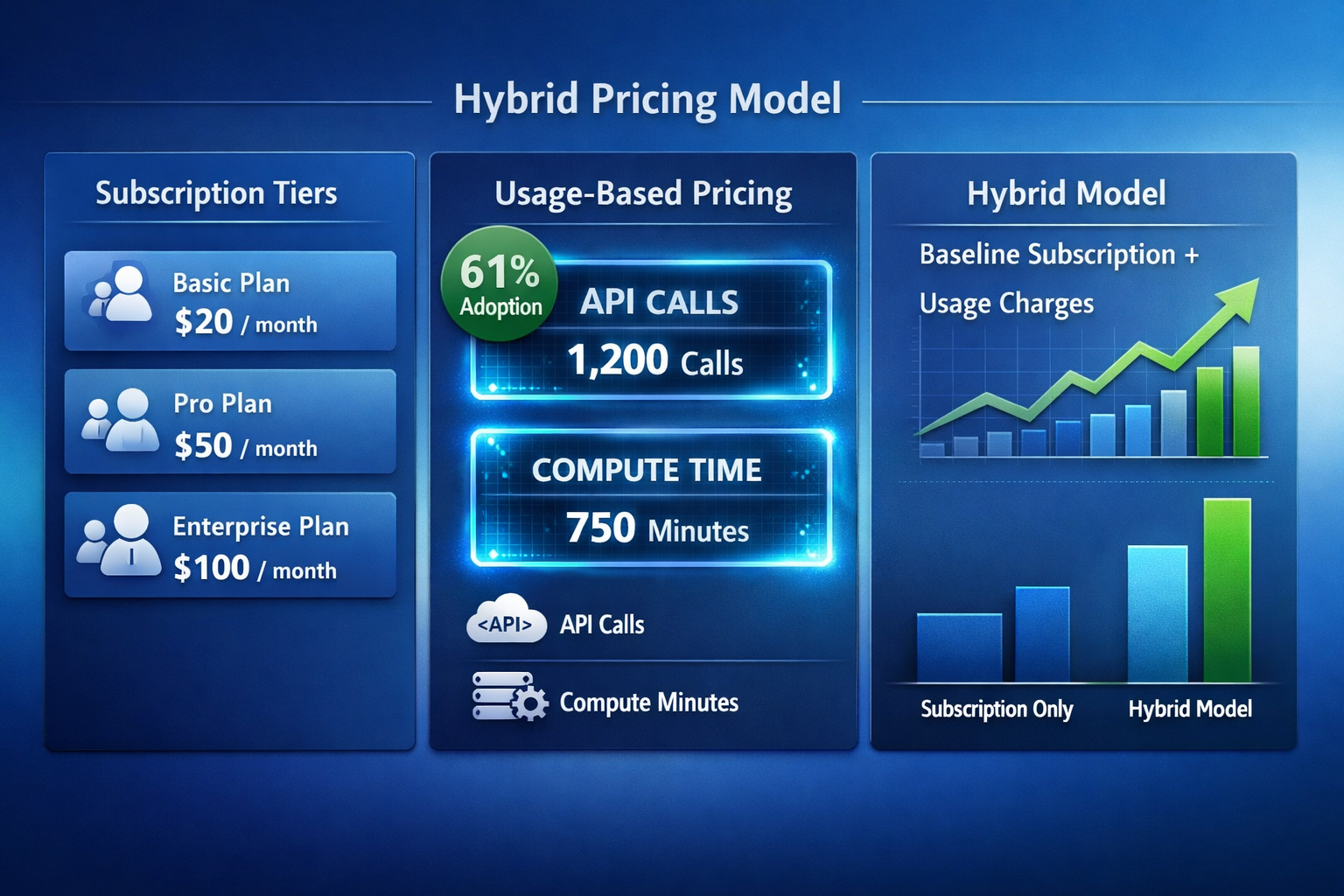
A hybrid SaaS pricing model combines two or more pricing approaches to create a flexible, value-aligned revenue structure. The most common configuration pairs a base subscription fee (providing predictable monthly or annual revenue) with usage-based variables that scale according to customer consumption[1].
These usage-based components can take many forms:
- Metered charges based on API calls, transactions, or data processing volume
- Compute minutes or processing power consumed
- Credit systems that customers purchase and spend on various features
- Storage capacity beyond baseline allowances
- Advanced feature access triggered by usage thresholds
The brilliance of this approach lies in its dual revenue streams. The subscription component covers baseline operational costs and provides revenue predictability for financial planning. Meanwhile, the usage component captures expansion revenue as customers grow, creating what industry analysts call “automatic upsell”[6].
The Evolution from Pure Models to Hybrid Approaches
Traditional SaaS pricing followed a straightforward path: charge per user seat, per month. This seat-based model worked well for decades, particularly for collaboration tools and productivity software. However, several market forces have driven the shift toward hybrid approaches:
AI workload requirements have fundamentally changed consumption patterns. AI-augmented features create nonlinear usage that cannot be effectively priced per seat. A single user might generate thousands of AI-powered analyses in one month and barely any the next. Token-based, credit-based, or compute-minute pricing better reflects this reality[3].
Enterprise customer demands for cost predictability combined with usage flexibility pushed vendors toward pragmatic middle-ground solutions. According to recent data, 41% of enterprise SaaS companies implemented hybrid approaches as a bridge toward outcome-based pricing, balancing vendor cost coverage with customer value alignment[5].
Revenue optimization insights revealed that pricing strategy represents the single most powerful profit lever. Research shows that a 1% improvement in pricing increases profits by 11% on average[1], making the choice of pricing model a strategic imperative rather than a tactical decision.
Core Components That Drive Success
Successful hybrid models share several critical characteristics:
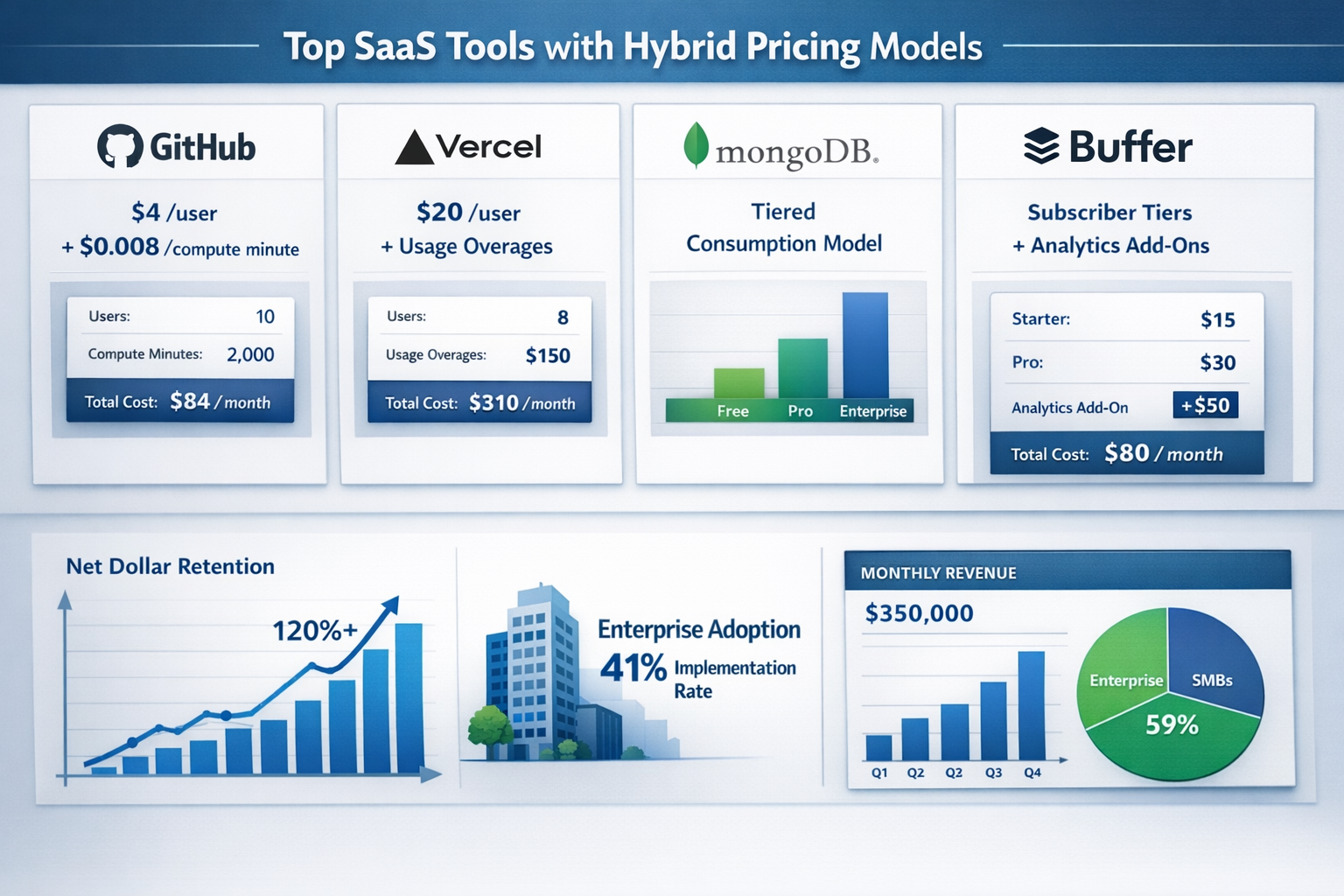
Value metric alignment stands as the most important factor. The effectiveness of hybrid pricing depends on choosing metrics that clearly reflect perceived customer value—a strategic rather than technical decision[4]. For example, GitHub charges $4 per user per month plus $0.008 per compute minute[1], aligning costs with both team size and actual CI/CD workload.
Multiple pricing dimensions have become standard practice. By 2025, 59% of providers combined multiple pricing metrics[4], such as user-based billing paired with API volume or computing power. This multidimensional approach captures value across different customer segments and use cases.
Transparent consumption tracking enables customers to monitor their usage in real-time, preventing bill shock and building trust. Leading platforms provide detailed dashboards showing consumption trends, projected costs, and optimization recommendations.
For businesses navigating complex financial decisions, understanding flexible pricing structures can be valuable—similar to how alternative mortgage lending options provide customized solutions for different borrower situations.
Why Hybrid SaaS Pricing Models Drive 21% Median Growth
Superior Revenue Retention and Expansion
The growth advantage of hybrid pricing models stems primarily from their superior net dollar retention (NDR) rates. NDR measures how much revenue a cohort of customers generates over time, accounting for upgrades, downgrades, and churn. Hybrid models consistently outperform pure subscription approaches on this critical metric[6].
Here’s why: with traditional subscription pricing, revenue expansion requires active sales intervention—upgrading customers to higher tiers, adding seats, or cross-selling additional products. Each expansion opportunity demands sales resources, time, and customer decision-making.
Hybrid models, by contrast, enable automatic expansion revenue. As customers use more API calls, consume more compute minutes, or process more data, revenue grows organically without manual intervention. This creates a frictionless expansion mechanism that scales with customer success.
Consider these real-world examples:
| Company | Hybrid Model Structure | Growth Impact |
|---|---|---|
| GitHub | $4/user/month + $0.008/compute-minute | Captures CI/CD scaling automatically as development teams grow |
| Vercel | $20/user + usage overages | Revenue expands with deployment frequency and bandwidth |
| MongoDB | Tiered consumption model | Database usage scales with application growth |
| Buffer | Subscription tiers + analytics add-ons | Social media management scales with account volume |
Alignment with Customer Value Perception
The value alignment principle represents perhaps the most compelling advantage of hybrid pricing. When customers pay more only as they extract more value, pricing feels fair and transparent. This psychological alignment reduces friction in the buying process and increases customer satisfaction[4].
For AI-specific features, this alignment becomes even more critical. Usage-based adoption for AI capabilities jumped from 37% to 69% in a single year[4], while traditional subscriptions for these features declined from 92% to 83%. Why? Because AI workloads vary dramatically based on use case, making per-seat pricing feel arbitrary and unfair.
A marketing team might use AI content generation heavily during campaign launches but minimally during planning phases. A development team might consume massive compute resources during major releases but little during maintenance periods. Hybrid pricing accommodates these natural usage patterns without penalizing customers for their busiest periods.
Reduced Customer Acquisition Friction
Hybrid models lower barriers to entry by offering affordable baseline pricing that reduces initial commitment. A prospect hesitant to commit $50 per user monthly might readily start with a $10 base subscription plus usage charges, knowing their costs will scale proportionally with value received.
This approach particularly benefits small and medium-sized businesses that need enterprise-grade tools but lack predictable budgets. They can start small, validate value, and scale naturally—creating a smoother customer acquisition funnel.
The data supports this advantage. The SaaS market’s 20% compound annual growth rate[2] correlates strongly with the widespread adoption of flexible pricing models that reduce entry barriers while maintaining revenue potential.
Much like how mortgage solutions for different borrower profiles provide accessible entry points with scalable terms, hybrid SaaS pricing creates pathways for diverse customer segments.
Competitive Differentiation in Crowded Markets
In 2026’s saturated SaaS landscape, pricing model itself has become a competitive differentiator. Companies offering hybrid approaches signal customer-centricity, flexibility, and confidence in their value proposition.
When prospects compare solutions, pricing transparency and fairness increasingly influence decisions. A vendor offering hybrid pricing demonstrates willingness to align their success with customer success—a powerful message in an era of subscription fatigue.
Outcome-based components further enhance this differentiation. By 2025, 30% of enterprise SaaS solutions incorporated outcome-based elements[5], up from approximately 15% in 2022. These models combine subscriptions, usage, and performance-based pricing, creating sophisticated value alignment that pure models cannot match.
Top Tools Excelling with Hybrid Pricing in 2026
GitHub: Developer Infrastructure at Scale
GitHub’s hybrid model exemplifies how to balance team-based subscriptions with infrastructure usage. The platform charges $4 per user per month for its Team plan, covering core collaboration features like repositories, pull requests, and code review tools. However, the real innovation lies in its $0.008 per compute-minute pricing for GitHub Actions[1].
This structure perfectly aligns with developer workflows. Small teams with minimal CI/CD automation pay little beyond their base subscription. As teams mature and implement sophisticated automated testing, deployment pipelines, and continuous integration workflows, their compute consumption—and GitHub’s revenue—scales proportionally.
Key advantages of GitHub’s approach:
- 💰 Predictable baseline costs for team collaboration
- 📈 Automatic revenue expansion with DevOps maturity
- 🎯 Clear value metric (compute minutes) tied to customer outcomes
- 🔄 No sales intervention required for expansion
Vercel: Frontend Deployment with Usage Overages
Vercel’s pricing strategy targets modern web development teams with a $20 per user base subscription plus usage-based charges for bandwidth, serverless function invocations, and build minutes. This hybrid approach recognizes that deployment frequency and traffic volume vary dramatically across projects and development cycles.
During quiet periods, teams pay only their baseline subscription. When launching new features or experiencing traffic spikes, usage charges reflect the additional infrastructure value Vercel provides. This elasticity makes Vercel attractive to startups and enterprises alike.
The platform’s transparent usage dashboard shows real-time consumption, projected monthly costs, and optimization recommendations—building trust and preventing surprise bills.
MongoDB: Database Consumption Tiers
MongoDB Atlas pioneered consumption-based database pricing with its tiered model that charges based on cluster size, storage volume, and data transfer. While not purely hybrid in the traditional sense, MongoDB’s approach combines reserved capacity subscriptions with elastic scaling charges that exemplify hybrid principles.
Customers select a baseline cluster configuration (providing predictable costs) but pay additional charges when their application demands exceed reserved capacity. This model perfectly suits modern application development, where database loads fluctuate with user growth, feature releases, and seasonal patterns.
MongoDB’s success metrics:
- Enables startups to begin with minimal costs
- Captures expansion revenue as applications scale
- Aligns database costs with application success
- Reduces over-provisioning waste common in fixed-tier models
Buffer: Social Media Management with Tiered Add-ons
Buffer’s hybrid approach combines traditional subscription tiers (Essentials, Team, Agency) with usage-based add-ons for advanced analytics, additional social accounts, and team members. This structure recognizes that social media management needs vary widely across customer segments.
A freelance consultant might need only the Essentials tier with one or two social accounts, while an agency managing dozens of clients requires the Agency tier plus numerous add-ons. Buffer’s pricing scales naturally with customer business growth, creating alignment between their success and Buffer’s revenue.
The platform’s clear tier differentiation combined with transparent add-on pricing eliminates confusion while providing flexibility—a balance many SaaS companies struggle to achieve.
Similar to how different mortgage products serve different borrower needs, these SaaS tools demonstrate that hybrid pricing can be customized to specific market segments while maintaining core value alignment principles.
Emerging Leaders: Snowflake and AI Platforms
Snowflake represents the pure consumption extreme of the hybrid spectrum, charging entirely based on compute and storage consumption with no seat-based fees. While not hybrid in structure, Snowflake’s success ($2+ billion annual revenue) validates consumption-based approaches for infrastructure services.
OpenAI and Anthropic exemplify AI-era pricing with token-based billing featuring distinct input and output rates[3]. GPT-4 charges different rates for prompt tokens versus completion tokens, reflecting the actual computational costs of language model inference. This granular usage pricing has become the standard for AI API services.
These platforms demonstrate that hybrid and consumption models work across the SaaS spectrum—from developer tools to databases to AI infrastructure—when properly aligned with customer value perception.
Strategic Guide: Switching to Hybrid Pricing for Optimal ROI
Assessing Your Current Pricing Structure
Before transitioning to a hybrid model, conduct a comprehensive pricing audit:
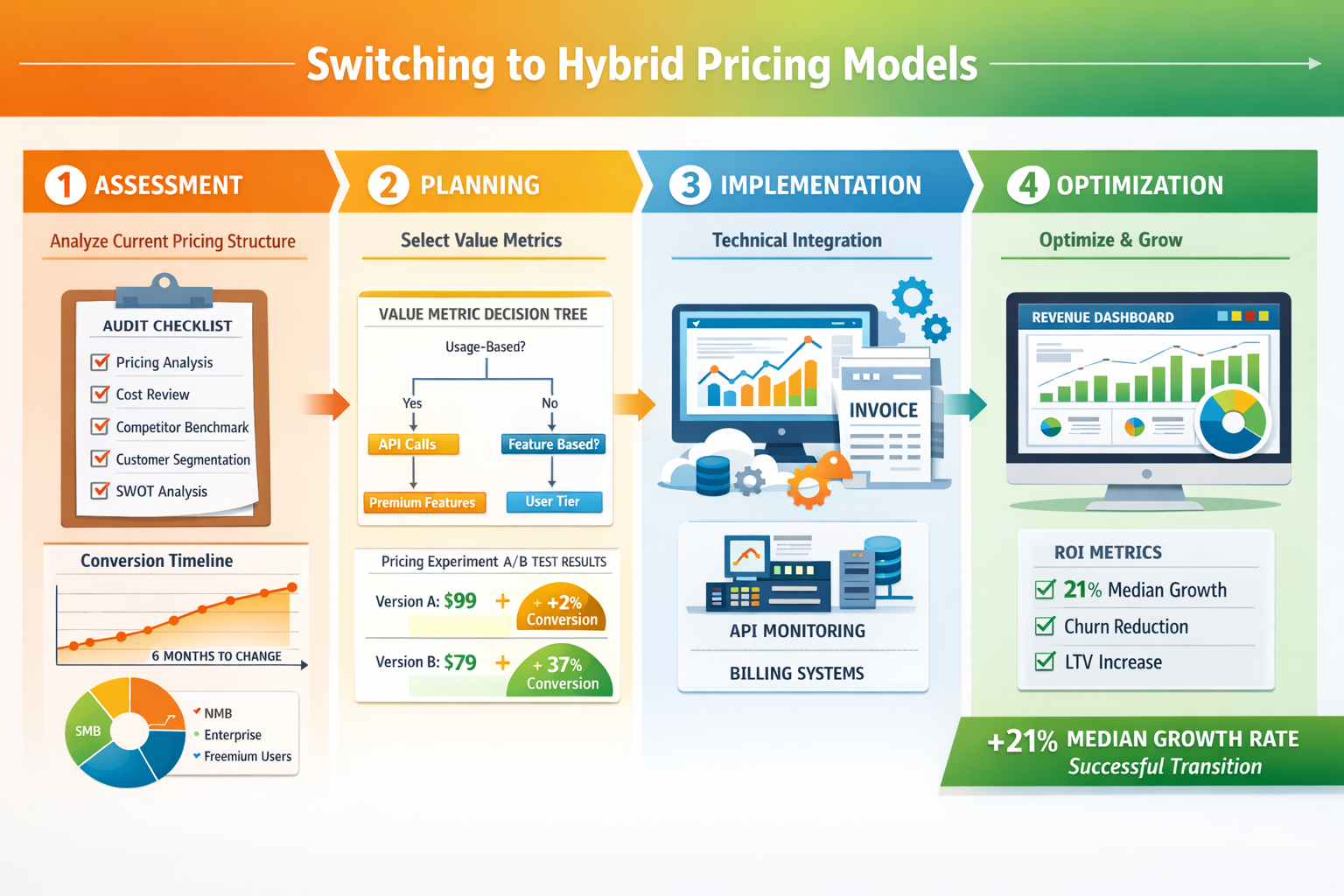
Analyze customer usage patterns across your existing base. Identify which features drive the most value, which customers consume disproportionate resources, and where usage correlates with customer success. Tools like product analytics platforms and usage monitoring dashboards provide essential data.
Evaluate revenue concentration. If 20% of customers generate 80% of revenue through heavy usage, you’re likely leaving money on the table with flat subscription pricing. Hybrid models help capture this value differential fairly.
Survey customer price sensitivity. Understanding how customers perceive value—whether through seats, transactions, storage, compute power, or outcomes—guides metric selection. The most successful hybrid models choose metrics that customers intuitively understand and accept[4].
Calculate current customer acquisition cost (CAC) and lifetime value (LTV). Hybrid models should improve both metrics: lowering CAC through reduced entry barriers and increasing LTV through automatic expansion revenue.
Selecting the Right Value Metrics
The value metric represents the most critical decision in hybrid pricing design. Consider these criteria:
Alignment with customer outcomes: Choose metrics that correlate with customer success. If customers succeed when they process more transactions, transaction-based pricing makes sense. If success means more users collaborating, seat-based pricing works.
Measurability and transparency: Customers must be able to track consumption easily. Opaque or complex metrics create distrust and billing disputes. Leading platforms provide real-time dashboards showing current usage, trends, and projected costs.
Predictability for customers: While usage-based components introduce variability, customers should be able to forecast costs reasonably. Provide historical usage data, forecasting tools, and spending alerts to maintain predictability.
Scalability for your business: Ensure your infrastructure can accurately measure and bill for chosen metrics without excessive overhead. API calls, compute minutes, and storage are easily metered; vague concepts like “value delivered” are not.
Common hybrid metric combinations:
- Base subscription + API calls (developer tools)
- Per-user licensing + storage/bandwidth (collaboration platforms)
- Tiered subscriptions + premium feature credits (marketing tools)
- Minimum commitment + overage charges (infrastructure services)
Implementation Timeline and Technical Requirements
Transitioning to hybrid pricing requires careful planning and execution:
Phase 1: Infrastructure Preparation (2-3 months)
Implement usage tracking and metering systems. Modern billing platforms like Stripe Billing, Chargebee, or Recurly offer hybrid pricing support, but you’ll need to instrument your application to report consumption data accurately.
Build customer-facing usage dashboards. Transparency builds trust and reduces support burden. Customers should see real-time consumption, historical trends, and projected monthly costs.
Phase 2: Pricing Model Design (1-2 months)
Design tier structures and usage pricing. Run financial models projecting revenue impact across different customer segments. Ensure the model improves unit economics while remaining competitive.
Create grandfathering strategies for existing customers. Forced migrations create churn; thoughtful transition plans maintain relationships. Consider offering existing customers choice between old and new pricing, or providing transition credits.
Phase 3: Soft Launch and Testing (2-3 months)
Launch hybrid pricing to new customers first. Monitor adoption rates, customer feedback, and revenue metrics. Adjust pricing parameters based on real-world data before migrating existing customers.
Conduct A/B testing where possible. Offer different pricing variations to similar customer segments and measure conversion rates, expansion revenue, and retention.
Phase 4: Full Migration (3-6 months)
Communicate changes clearly to existing customers, emphasizing benefits and providing transition support. Offer migration incentives like discounted rates for early adopters or usage credits.
Train sales and customer success teams on new pricing. They need to articulate value, handle objections, and help customers optimize their usage.
For businesses managing significant transitions, the process parallels how mortgage renewals require careful planning and timing to optimize financial outcomes.
Measuring Success and Optimizing ROI
Track these key performance indicators post-implementation:
Net Dollar Retention (NDR): The gold standard metric for SaaS success. Hybrid models should increase NDR by capturing expansion revenue automatically. Target NDR above 110% indicates healthy growth from existing customers.
Customer Acquisition Cost (CAC) Ratio: Monitor whether lower entry-point pricing reduces CAC by improving conversion rates. Calculate CAC payback period to ensure the model remains sustainable.
Revenue per Customer Trends: Track how revenue per customer evolves over time. Successful hybrid models show steady increases as customers expand usage.
Customer Satisfaction Scores: Monitor NPS, CSAT, and customer feedback specifically related to pricing. Fair, transparent pricing should improve satisfaction scores.
Churn Rate by Segment: Analyze whether hybrid pricing reduces churn, particularly among high-value customers who previously felt constrained by tier limitations.
Common Pitfalls to Avoid
Overly complex pricing: While multiple metrics can capture value, excessive complexity confuses customers and increases sales friction. Limit to 2-3 primary metrics maximum.
Unpredictable billing: Usage-based components should include spending alerts, caps, and forecasting tools. Surprise bills destroy trust and increase churn.
Misaligned value metrics: Charging for metrics that don’t correlate with customer value creates resentment. Validate metric selection through customer research, not internal assumptions.
Inadequate usage tracking: Billing disputes arising from measurement inaccuracies damage relationships. Invest in robust, auditable metering infrastructure.
Poor communication: Customers need clear explanations of how pricing works, what drives costs, and how to optimize usage. Comprehensive documentation, examples, and proactive support prevent confusion.
Much like how understanding mortgage penalties helps borrowers avoid costly mistakes, anticipating hybrid pricing challenges enables smoother implementation and better outcomes.
The Future of Hybrid Pricing: Trends to Watch in 2026 and Beyond
AI-Driven Dynamic Pricing
Artificial intelligence is transforming hybrid pricing from static models to dynamic, personalized approaches. Advanced SaaS platforms now use machine learning to:
- Predict customer usage patterns and recommend optimal tier selections
- Identify expansion opportunities based on consumption trends
- Personalize pricing offers based on customer segment, industry, and growth trajectory
- Optimize pricing parameters continuously based on market response
This evolution toward AI-augmented pricing represents the next frontier, where pricing becomes a real-time optimization problem rather than a quarterly strategic decision.
Outcome-Based Pricing Components
The 30% of enterprise SaaS solutions incorporating outcome-based elements[5] signals a broader trend toward value-based pricing. Future hybrid models will increasingly include components tied to customer results:
- Marketing platforms charging based on leads generated or revenue attributed
- Development tools pricing based on deployment success rates or uptime
- Analytics platforms tying fees to insights acted upon or decisions improved
These outcome-based components create the ultimate value alignment but require sophisticated measurement and attribution capabilities.
Vertical-Specific Hybrid Models
As SaaS markets mature, vertical-specific pricing models are emerging that reflect industry-specific value drivers:
- Healthcare SaaS pricing per patient encounter or clinical outcome
- Financial services platforms charging per transaction or AUM (assets under management)
- Real estate technology pricing per property, transaction, or square footage managed
This vertical specialization enables more precise value alignment than horizontal, one-size-fits-all approaches.
Ecosystem and Platform Pricing
Platform businesses with marketplace components are developing sophisticated hybrid models that account for multi-sided value creation:
- Base platform fees for access
- Transaction fees on marketplace exchanges
- Usage fees for platform infrastructure
- Revenue sharing on third-party integrations
These multi-dimensional models reflect the complex value flows in platform ecosystems.
Sustainability and Resource-Based Pricing
Growing environmental consciousness is driving carbon-aware pricing where cloud infrastructure costs reflect energy consumption and carbon footprint. Forward-thinking SaaS companies are incorporating sustainability metrics into hybrid models:
- Discounts for customers optimizing resource usage
- Premium charges for carbon-intensive workloads
- Transparency in energy consumption per unit of service
This trend aligns pricing with broader corporate social responsibility goals while incentivizing efficient resource usage.
For businesses planning long-term financial strategies, these pricing trends mirror how economic outlook affects mortgage planning, requiring adaptability and forward-thinking approaches.
Conclusion: Embracing Hybrid Pricing for Sustainable Growth
The evidence is clear: Hybrid SaaS Pricing Models: Why They Drive 21% Median Growth and Top Tools to Watch represents more than a passing trend—it’s a fundamental shift in how software companies align value with revenue. With 61% of SaaS companies already adopting hybrid approaches[3] and the global market surging toward $315 billion by early 2026[2], the question is no longer whether to embrace hybrid pricing, but how to implement it effectively.
The success stories of GitHub, Vercel, MongoDB, and Buffer demonstrate that hybrid models work across diverse SaaS categories—from developer tools to social media management. Their common thread? Value metric alignment that makes pricing feel fair, transparent, and proportional to customer success.
For SaaS leaders considering the transition, the path forward involves:
✅ Conducting thorough usage analysis to identify value metrics that correlate with customer outcomes
✅ Designing hybrid structures that balance predictability with flexibility, using proven combinations like base subscriptions plus consumption charges
✅ Implementing robust metering infrastructure that tracks usage accurately and transparently
✅ Communicating clearly with customers about pricing changes, emphasizing benefits and providing transition support
✅ Measuring success rigorously through NDR, CAC ratios, revenue per customer, and satisfaction scores
✅ Iterating continuously based on customer feedback, market response, and competitive dynamics
The 21% median growth advantage of hybrid pricing models isn’t magic—it’s the result of better alignment between vendor revenue and customer value. As AI workloads, consumption patterns, and customer expectations continue evolving, hybrid approaches provide the flexibility to adapt while maintaining sustainable unit economics.
The SaaS companies that thrive in 2026 and beyond will be those that recognize pricing as a strategic lever, not just a billing mechanism. By embracing hybrid models thoughtfully, measuring outcomes rigorously, and optimizing continuously, forward-thinking vendors can capture the growth advantages that industry leaders already enjoy.
The hybrid pricing era has arrived. The question is: will your SaaS business lead, follow, or fall behind?
References
[1] Saas Pricing Strategies 2026 Usage Based Seat Hybrid – https://zeonedge.com/blog/saas-pricing-strategies-2026-usage-based-seat-hybrid
[2] Saas Industry – https://www.bettercloud.com/monitor/saas-industry/
[3] From Seats To Consumption Why Saas Pricing Has Entered Its Hybrid Era – https://www.flexera.com/blog/saas-management/from-seats-to-consumption-why-saas-pricing-has-entered-its-hybrid-era/
[4] Saas Ai Pricing Report 2026 En – https://pricing.hy.co/saas-ai-pricing-report-2026-en/
[5] The 2026 Guide To Saas Ai And Agentic Pricing Models – https://www.getmonetizely.com/blogs/the-2026-guide-to-saas-ai-and-agentic-pricing-models
[6] Hybrid Pricing Strategies Saas Retention Revenue – https://www.withvayu.com/blog/hybrid-pricing-strategies-saas-retention-revenue
 Previous Page