March 8, 2026
best ai marketing tools of 2026
Share this article:



Manzeel is an award-winning Mortgage Broker and the Owner of the Toronto-based mortgage, Everything Mortgages.
With 16 years of experience in the Canadian mortgage industry and a formal background in mortgage underwriting, Manzeel’s lending expertise gives him unique insight into whether a deal is feasible which empowers his clients to make more informed lending decisions faster.
He has been recognized as one of Canada’s Top 10 Mortgage Brokers by the national Canadian Mortgage Professionals (CMP) Association. Him and his team of 18 mortgage agents are proud to offer a mortgage experience that's built on honesty, trust, and integrity. He prides himself on the brokerage’s dedication to deliver an excellent client experience throughout the entire home loan process from pre-approval to post-funding.
Since moving to Toronto in 1998, Manzeel has successfully launched and scaled several businesses from the ground up, ranging from a mortgage brokerage and a vast real estate investment portfolio to a private financing eCommerce platform. He continues to be a leader in the real estate industry as he uses his analytical expertise to seek new real estate investment opportunities.
As a tech junkie and avid sports enthusiast, when Manzeel’s not working with clients, you can find him reading technology blogs, playing squash or watching tennis with his two boys.

Marketing teams are no longer asking whether AI matters. In 2026, the real question is: which platforms actually help drive revenue, save time, and improve customer experience? The best ai marketing tools of 2026 are not just writing assistants. They now support campaign planning, SEO, paid media, customer journeys, analytics, and even autonomous optimization across channels.
AI is also changing how people discover brands. Google AI Mode has grown fast, ChatGPT has opened an ad pilot, Meta has added AI agents inside Ads Manager, and many brands are shifting from traffic-only KPIs toward AI visibility, citations, and conversions [1][3][6]. That means the right tool stack in 2026 can shape both efficiency and demand.
“The winners in 2026 are not using one AI app. They are building connected AI workflows.”
Introduction
The AI marketing landscape in 2026 is crowded, noisy, and full of overlap. Some tools are excellent for content but weak for analytics. Others are powerful in automation but hard to use. A few stand out because they combine speed, insight, governance, and real business value.
This guide breaks down the best ai marketing tools of 2026 by use case, not hype. It covers what each tool does best, who it fits, and how to choose a stack that works in the real world.
Key Takeaways
- AI marketing tools in 2026 go far beyond content writing and now handle research, workflows, personalization, reporting, and campaign optimization.
- The best stack depends on goals: B2B, ecommerce, local business, agency, and enterprise teams need different tools.
- Major platform shifts matter: ChatGPT ads, Google AI Mode, Meta agent workflows, and HubSpot GPT-5 upgrades are reshaping digital marketing [1][3][6].
- AI visibility is now a core KPI, not just clicks, as more search and purchase journeys begin inside AI assistants [1].
- A focused stack of 3-5 tools usually beats a bloated stack that creates overlap and confusion.
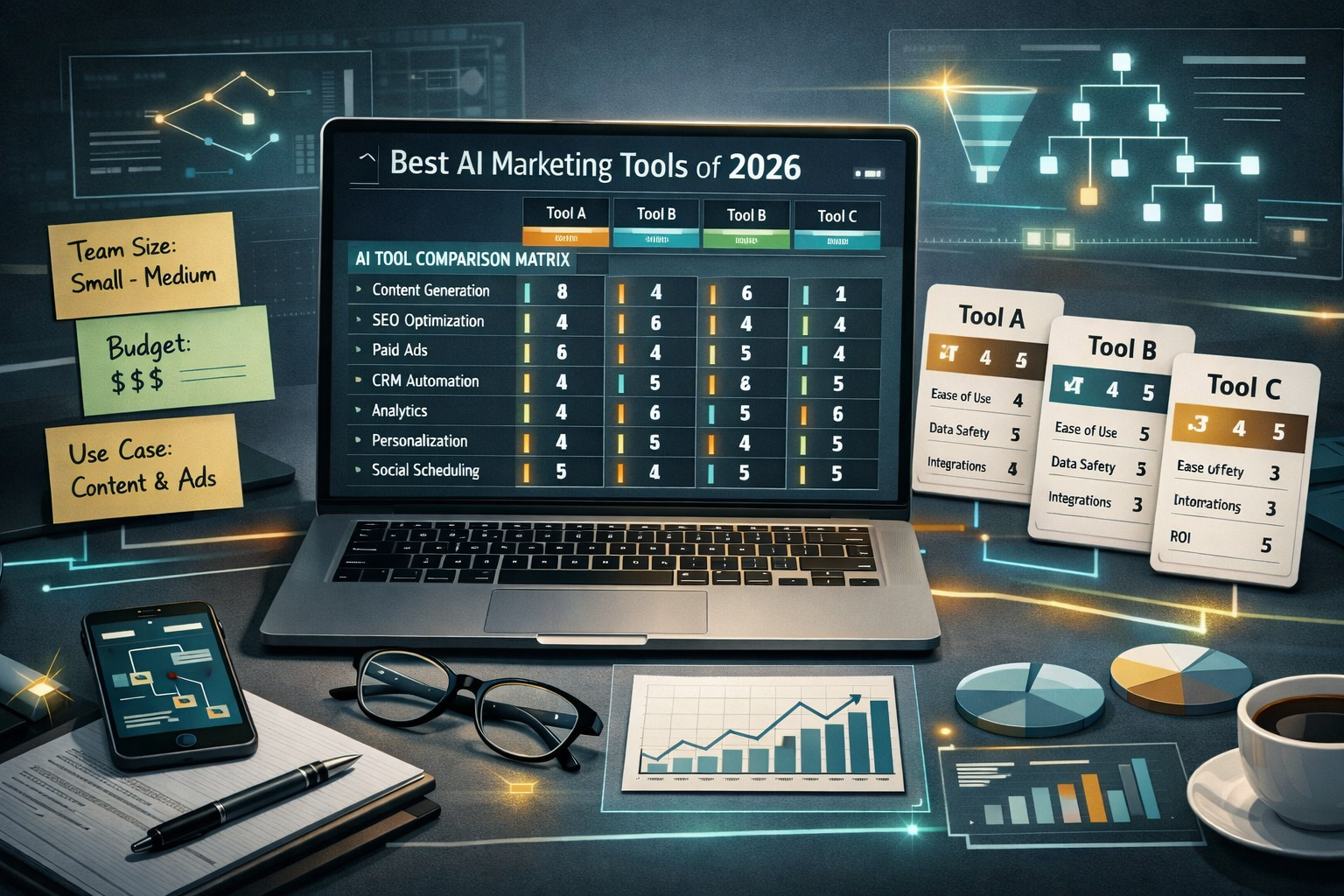
Why the best ai marketing tools of 2026 matter more than ever
AI adoption is not slowing down. According to 2026 industry reporting, AI agents are moving from experiments into core marketing systems, with autonomous optimization, predictive segmentation, and real-time creative generation becoming normal capabilities [3]. Gartner analysis cited in MarTech reporting also suggests that 25% of search volume may shift to AI agents by the end of 2026 [1].
That shift changes everything:
- Discovery is changing
- Search behavior is changing
- Paid media is changing
- Customer journeys are becoming more conversational
- Marketing teams are expected to do more with fewer manual steps
Kantar data cited in 2026 coverage found that 24% of AI users rely on AI assistants for purchasing decisions, while AI-driven discovery may account for around 40% of inbound leads for brands optimized for AI search, despite contributing a smaller share of traffic [1]. In simple terms: brands can get fewer visits, but better intent.
This is why marketers should think beyond “Which AI writer is best?” The better question is:
What should a 2026 AI marketing tool do?
The strongest tools now help with one or more of these functions:
| Capability | Why it matters in 2026 |
|---|---|
| Content generation | Speeds up ideation, drafting, and repurposing |
| SEO and AI visibility | Helps brands appear in AI answers, summaries, and search features |
| Workflow automation | Connects teams, channels, and repetitive tasks |
| Personalization | Improves relevance across email, web, and messaging |
| Campaign optimization | Uses live performance data to improve results |
| Analytics and reporting | Turns complex data into decisions fast |
| Multi-channel orchestration | Coordinates social, email, search, CRM, and ads |
For teams already using digital tools to improve efficiency, it also helps to think in systems. Businesses that value automation often benefit from structured workflows and calculators, much like the practical planning mindset seen in mortgage tools and resources that simplify major decisions.
How this list of the best ai marketing tools of 2026 was evaluated
To keep this guide useful, the ranking below focuses on real-world value instead of hype. Tools were assessed on:
- Core marketing use case
- Ease of use
- Quality of outputs
- Automation depth
- Integration strength
- Team collaboration
- Scalability
- Data/privacy controls
- Likelihood of ROI in 2026
A tool did not need to do everything to make the list. In fact, many top performers win because they do one job extremely well.
Quick buying checklist ✅
Before choosing any platform, answer these questions:
- What is the main bottleneck: content, SEO, paid media, CRM, or analytics?
- Does the tool connect with existing systems?
- Can non-technical users operate it?
- Does it support governance and brand controls?
- Will it save enough time or money to justify the cost?
The best ai marketing tools of 2026 by category
1. HubSpot Breeze AI — best all-in-one AI marketing platform
HubSpot remains one of the strongest choices for teams that want AI inside a broader marketing system. In 2026, Breeze AI got a major boost when HubSpot migrated Breeze Studio agents to GPT-5 and expanded workflow actions and omnichannel support across more than nine channels, including SMS, WhatsApp, Instagram, Telegram, and LINE [1].
Best for: B2B companies, growth teams, inbound marketers, mid-sized businesses
Why it stands out:
- AI built into CRM and marketing workflows
- Better agent actions and automation
- Strong for email, lead nurturing, service, and reporting
- Good balance of power and usability
Pros
- Unified customer data
- Strong workflow automation
- Better omnichannel messaging support
- Easier for non-technical teams than many enterprise tools
Cons
- Costs can climb as contacts and hubs grow
- Advanced setups still need planning
Bottom line: If one platform needs to anchor the stack, HubSpot is one of the safest choices in 2026.
2. ChatGPT — best for strategy, ideation, and conversational marketing tasks
ChatGPT remains one of the most flexible AI tools for marketers. It supports idea generation, content briefs, message testing, audience research, repurposing, and customer-facing conversational experiences. It also became more important as a media environment in 2026 when OpenAI launched an advertising pilot on February 9 with pricing around $60 CPM and a $200,000 minimum commitment [1][6].
By early March, Criteo joined the pilot, giving many advertisers a path into the ecosystem through programmatic access [1].
Best for: Content teams, strategists, small businesses, agencies, experimentation
Why it stands out:
- Flexible across many marketing tasks
- Excellent for briefs, prompts, outlines, scripts, and positioning
- Growing role in brand discovery and ad inventory
- Useful as a daily assistant across departments
Pros
- Wide use case coverage
- Fast output
- Supports research and planning
- Helpful for summarizing reports and customer insights
Cons
- Needs strong prompting and review
- Not a full marketing operating system on its own
Bottom line: ChatGPT is one of the best ai marketing tools of 2026 because it acts as a high-speed strategic layer across almost every channel.
3. Semrush AI tools — best for SEO, content optimization, and search visibility
Semrush remains a leading choice for marketers who need AI-powered content planning with search data. Its content toolkit is especially valuable for keyword clustering, topic discovery, optimization guidance, and editorial workflows [10].
In 2026, SEO is no longer only about blue links. It now includes:
- visibility in AI summaries
- topical authority
- entity coverage
- citations
- answer readiness
This matters because brands are seeing changes in search traffic patterns. LinkedIn, for example, reported major declines in non-brand awareness traffic due to AI Overviews and shifted focus from classic SEO KPIs toward AI visibility [1].
Best for: SEO teams, content marketers, publishers, agencies
Why it stands out:
- Strong keyword and topic research
- Helpful optimization suggestions
- Useful for editorial planning
- Better than generic AI writers for search-led content
Pros
- Search data + content AI in one workflow
- Good for competitive research
- Supports scalable content production
Cons
- Best results still need human editorial judgment
- Can be overkill for tiny teams
Bottom line: If organic discovery matters, Semrush is a serious contender.
4. Jasper — best for brand-controlled content creation
Jasper still has a strong place in 2026 for companies that need repeatable content with brand controls. It is often used for ad copy, blog drafts, product messaging, campaign variants, and team templates [4][5].
Best for: Brand teams, agencies, multi-writer content teams
Why it stands out:
- Brand voice controls
- Templates and campaign workflows
- Good for scaling repeatable messaging
Pros
- Better governance than many generic tools
- Fast for content variants
- Good collaboration features
Cons
- Less broad than all-in-one platforms
- Output still needs fact-checking
Bottom line: Jasper is best when consistency matters more than experimentation.
5. Copy.ai — best for sales and go-to-market automation
Copy.ai has expanded beyond copy generation and is often positioned around revenue workflows, prospecting, and GTM automation [4][5]. It can help bridge marketing and sales, especially for outbound-heavy teams.
Best for: B2B teams, outbound sales, demand generation
Why it stands out:
- Strong workflow orientation
- Useful for outreach sequences and enablement
- Good fit for pipeline-focused teams
Pros
- Connects messaging with process
- Good for repetitive sales-marketing tasks
- Speeds campaign setup
Cons
- Less ideal as a pure SEO tool
- Workflow value depends on team setup
Bottom line: For revenue teams that need AI support beyond blogs and ads, Copy.ai is worth a close look.
6. Salesforce Einstein — best for enterprise personalization and CRM intelligence
Salesforce Einstein remains one of the strongest enterprise options for organizations that need AI deeply connected to customer data, journeys, segmentation, and sales pipelines [2][4].
Best for: Enterprise brands, large sales organizations, complex customer lifecycles
Why it stands out:
- Deep CRM integration
- Strong predictive capabilities
- Enterprise-grade scale and controls
Pros
- Excellent for personalization
- Strong forecasting and customer intelligence
- Built for large data environments
Cons
- Can be costly
- Setup can be complex
Bottom line: Einstein is powerful when a company already lives in Salesforce.
7. Adobe + Microsoft AI agents — best for creative and workflow orchestration
In January 2026, Microsoft and Adobe expanded their partnership to put AI agents directly into marketing workflows. Adobe Marketing Agent integration with Microsoft 365 Copilot was expected in Q2 2026, allowing campaign creation through natural language instructions [3].
This is a major signal for enterprise marketing operations.
Best for: Enterprise creative teams, retail brands, large campaign environments
Why it stands out:
- Deep workflow automation
- Strong creative ecosystem
- Better fit for coordinated enterprise execution
Pros
- Excellent for large asset operations
- Fits complex approvals and creative production
- Strong enterprise credibility
Cons
- More suited to larger teams
- Likely too heavy for most small businesses
Bottom line: This pairing is one to watch closely for enterprise teams that need scale and governance.
8. Meta Ads Manager with Manus AI — best for paid social optimization
Meta made a major move in late February 2026 by embedding autonomous agent technology directly into Ads Manager. This lets marketers use AI for market research, reporting, audience analysis, and campaign optimization inside the platform [1].
Best for: Paid social teams, ecommerce, performance marketers, agencies
Why it stands out:
- Native optimization inside the ad platform
- Faster insights and analysis
- Supports audience and performance decisions
Pros
- Great for media buyers
- Reduces manual reporting
- Can speed testing and optimization
Cons
- Best value is limited to Meta ecosystem
- Platform dependence is a risk
Bottom line: If Meta is a major acquisition channel, this becomes a high-value tool quickly.
9. Google AI marketing ecosystem — best for search, shopping, and intent capture
Google AI Mode crossed 75 million daily users and introduced Direct Offers ads in February 2026, allowing retailers to show personalized discounts in conversational search experiences [1][6]. Google also launched WebMCP, a protocol that lets AI agents interact with websites through defined tools for structured tasks such as product search and form completion [1].
Best for: Retailers, ecommerce brands, search marketers, lead generation
Why it stands out:
- Massive reach
- High intent discovery
- Growing AI search and shopping formats
- New agent-ready web interactions
Pros
- Strong for demand capture
- Important for shopping and search visibility
- Supports evolving AI-assisted discovery
Cons
- Constant changes require adaptation
- Harder for smaller teams to keep up
Bottom line: Marketers who ignore Google’s AI ecosystem in 2026 risk losing high-intent visibility.
10. Surfer SEO — best for content teams that want optimization simplicity
Surfer stays relevant for teams that want a more focused content optimization workflow without the broader complexity of enterprise suites [10].
Best for: Blog teams, niche publishers, freelancers, lean content operations
Why it stands out:
- Easier optimization workflows
- Good for on-page structure
- Helpful content scoring
Pros
- User-friendly
- Good for content briefs and optimization
- Faster to adopt than larger platforms
Cons
- Narrower use case
- Not a full marketing platform
Bottom line: Surfer is ideal for content-focused teams that want practical SEO help.
11. Pushwoosh AI capabilities — best for lifecycle messaging and mobile engagement
Pushwoosh highlights AI-driven support for messaging, personalization, and customer engagement, especially in mobile and retention-focused environments [2].
Best for: Apps, ecommerce, retention marketers, customer lifecycle teams
Why it stands out:
- Messaging automation
- Personalization support
- Useful for push, mobile, and customer retention
Pros
- Strong fit for lifecycle campaigns
- Helps with user re-engagement
- Good for omnichannel messaging use cases
Cons
- Less useful if mobile is not a key channel
- More specialized than broad marketing suites
Bottom line: This is a strong niche pick for retention and app-led growth.
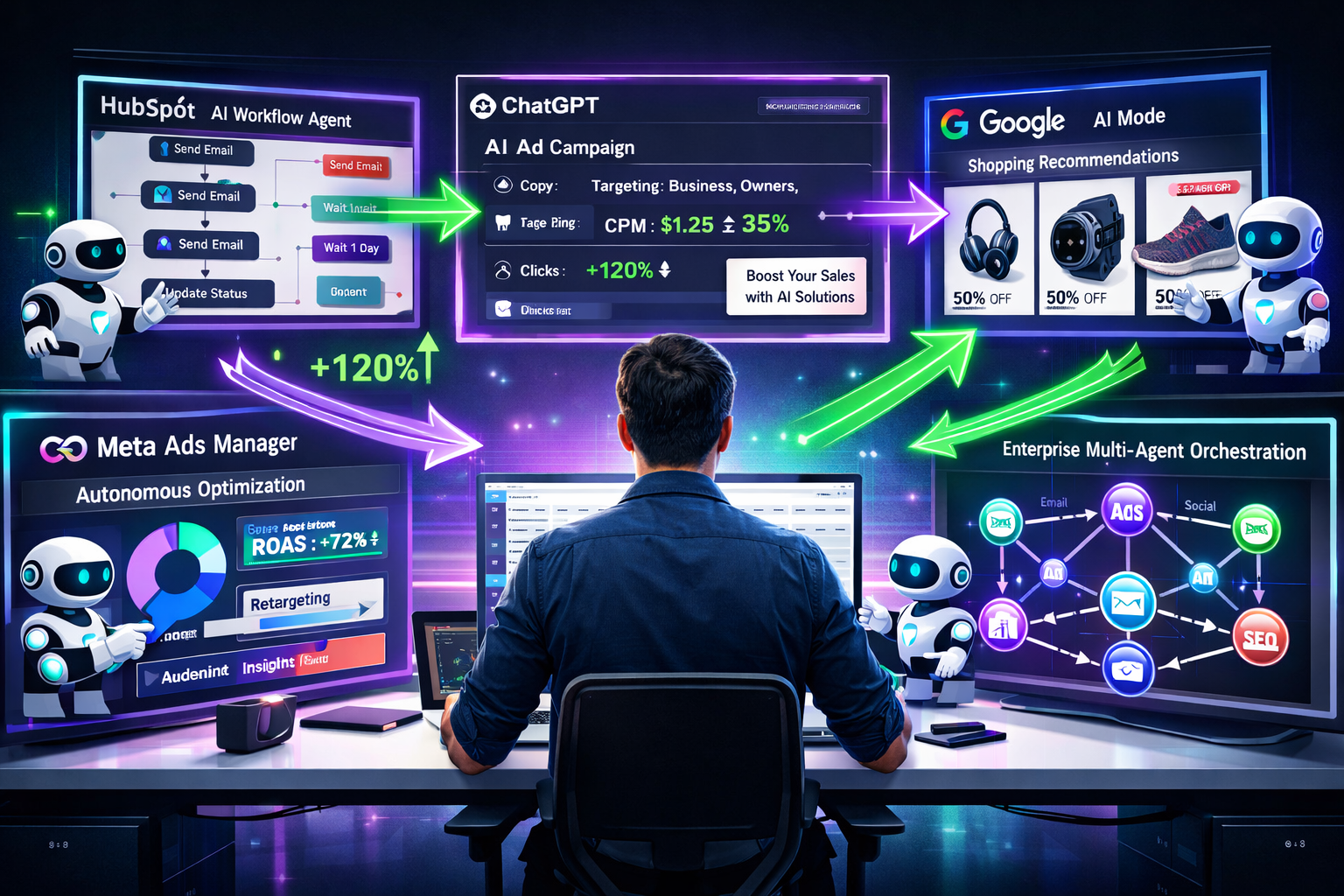
Best ai marketing tools of 2026 for different business types
The right choice depends on team size, budget, and goals.
For small businesses
Best options:
- ChatGPT
- Jasper
- Surfer SEO
Why: lower complexity, faster time to value, easier adoption
For B2B companies
Best options:
- HubSpot Breeze AI
- Copy.ai
- Semrush
Why: lead nurturing, sales alignment, search visibility, content workflows
For ecommerce brands
Best options:
- Meta Ads Manager with Manus AI
- Google AI ecosystem
- Pushwoosh
- Jasper
Why: product discovery, paid media, lifecycle messaging, conversion content
For enterprises
Best options:
- Salesforce Einstein
- Adobe + Microsoft AI agents
- HubSpot for selected business units
Why: governance, deep data integration, scale, workflow control
For agencies
Best options:
- ChatGPT
- Semrush
- Jasper
- Meta Ads Manager with Manus AI
Why: speed, repeatability, client reporting, campaign optimization
How to build a smart AI marketing stack in 2026
Many teams make the same mistake: they buy too many tools too fast. A better stack is modular.
A simple high-performing stack looks like this:
- Strategy and ideation: ChatGPT
- SEO and content planning: Semrush or Surfer
- CRM and automation: HubSpot
- Paid media optimization: Meta Ads Manager / Google tools
- Enterprise personalization: Salesforce Einstein or Adobe/Microsoft
Keep these rules in mind
1. Start with the bottleneck
If leads are weak, focus on acquisition tools. If speed is the issue, focus on automation.
2. Do not stack duplicates
Two AI writers and three analytics tools usually create waste.
3. Protect brand quality
AI speeds production, but human review protects trust.
4. Measure business outcomes
Track:
- qualified leads
- conversion rate
- CAC
- content production time
- pipeline influence
- retention lift
5. Prepare for AI-agent traffic
As AI systems influence more buyer journeys, websites and content should be easier for AI tools to understand and use. That is why Google’s WebMCP announcement matters [1].
For businesses that value process clarity before making major decisions, structured frameworks can reduce risk. The same principle applies in marketing tech as it does in planning with a step-by-step guide before committing to a major financial product.
Key trends shaping the best ai marketing tools of 2026
1. AI visibility is replacing traffic-only thinking
Brands are realizing that being cited, summarized, and surfaced in AI environments matters as much as raw visits [1].
2. Autonomous agents are entering daily workflows
Meta, Adobe, Microsoft, and HubSpot are all pushing AI agents into execution layers [1][3].
3. Conversational commerce is growing
Google AI Mode and shopping ads show how discovery and purchase are blending [1][6].
4. Trust is becoming a differentiator
Perplexity exited advertising to protect answer trust and shifted toward subscriptions and enterprise use [1]. That move highlights a growing tension between monetization and reliability.
5. Multi-agent systems are the next frontier
Gartner forecasts that organizations using multi-agent AI across customer-facing processes will gain major advantages by 2028 [3]. For marketers, that means orchestration will matter more than isolated prompts.
Common mistakes to avoid
Even the best ai marketing tools of 2026 can disappoint if implementation is weak.
Avoid these traps ❌
- Buying tools without a clear use case
- Letting AI publish unreviewed content
- Ignoring integrations
- Chasing novelty instead of ROI
- Measuring output volume instead of business impact
- Forgetting privacy, approvals, and governance
- Assuming one tool can replace the whole team
A practical mindset helps. In any high-stakes decision, from software procurement to a mortgage pre-approval process, success usually comes from matching the tool to the need, not just choosing the loudest brand.
How to choose the right tool in 30 days
Here is a simple rollout plan.
Week 1: Audit
List current tools, gaps, costs, and bottlenecks.
Week 2: Shortlist
Choose 3-4 tools based on a specific goal:
- more organic visibility
- better paid performance
- faster content production
- stronger lead nurturing
Week 3: Pilot
Run one controlled campaign or workflow.
Week 4: Measure
Compare against baseline:
- time saved
- cost saved
- content velocity
- conversion lift
- team adoption
If a tool does not improve one of those metrics, it may not belong in the stack.
A practical shortlist for most teams
If a business needs a compact, effective setup in 2026, this mix is a strong starting point:
| Need | Recommended tool |
|---|---|
| General AI assistant | ChatGPT |
| CRM + automation | HubSpot Breeze AI |
| SEO + content planning | Semrush |
| Paid social | Meta Ads Manager with Manus AI |
| Enterprise personalization | Salesforce Einstein |
For teams comparing long-term investments, market conditions, and future planning, it can help to learn from other decision-heavy industries where timing and fit matter, such as a 2025 Canadian housing market outlook or broader resource planning guides. The lesson is the same: pick tools based on your current position and next move.
Final verdict: which are the best ai marketing tools of 2026?
There is no single winner for every business. But a few platforms stand out clearly.
Best overall
HubSpot Breeze AI
Best flexible assistant
ChatGPT
Best for SEO and AI search visibility
Semrush
Best for paid social
Meta Ads Manager with Manus AI
Best for enterprise
Salesforce Einstein and Adobe + Microsoft AI agents
Best value for lean content teams
Surfer SEO
If a team can only adopt one or two tools, the strongest path is usually:
- ChatGPT for daily productivity and strategy
- HubSpot or Semrush depending on whether CRM automation or search growth matters more
Conclusion
The best ai marketing tools of 2026 are not just faster ways to write blog posts. They are becoming the operating layer of modern marketing. They help teams research faster, launch smarter campaigns, personalize experiences, and adapt to a world where AI assistants influence search, shopping, and buying decisions.
The smartest next steps are simple:
- Pick one core goal
- Choose one primary platform and one support tool
- Run a 30-day pilot
- Measure real business outcomes
- Expand only after proof
In 2026, the advantage will not come from using the most AI tools. It will come from using the right tools, with clear workflows, strong oversight, and a focus on results. 🚀
References
[1] Top Ai Marketing Tools – https://www.eesel.ai/blog/top-ai-marketing-tools
[2] Ai Marketing Tools – https://www.pushwoosh.com/blog/ai-marketing-tools/
[3] Digital Marketing News January 1 10 2026 – https://almcorp.com/blog/digital-marketing-news-january-1-10-2026/
[4] Ai Marketing Tools – https://thecmo.com/tools/ai-marketing-tools/
[5] Top 10 Ai Tools For Marketing Automation In 2026 – https://www.tractionkeys.com/post/top-10-ai-tools-for-marketing-automation-in-2026
[6] Digital Marketing News Feb 20 March 1 2026 – https://almcorp.com/blog/digital-marketing-news-feb-20-march-1-2026/
[10] Best Ai Content Marketing Tools – https://www.semrush.com/blog/best-ai-content-marketing-tools/
Meta Title
Best AI Marketing Tools of 2026: Top Picks & Guide
Meta Description
Discover the best ai marketing tools of 2026 for SEO, content, ads, CRM, and automation. Compare top platforms and choose the right stack fast.
best ai marketing tools of 2026, AI marketing, HubSpot Breeze AI, ChatGPT, Semrush, Meta Ads Manager, Salesforce Einstein, marketing automation, SEO tools, paid media, AI agents
 Previous Page