March 15, 2026
2026 BoC Rate Hold at 2.25%: Variable Rate Opportunities for Self-Employed Toronto Mortgages Under 3.5%
Share this article:



Manzeel is an award-winning Mortgage Broker and the Owner of the Toronto-based mortgage, Everything Mortgages.
With 16 years of experience in the Canadian mortgage industry and a formal background in mortgage underwriting, Manzeel’s lending expertise gives him unique insight into whether a deal is feasible which empowers his clients to make more informed lending decisions faster.
He has been recognized as one of Canada’s Top 10 Mortgage Brokers by the national Canadian Mortgage Professionals (CMP) Association. Him and his team of 18 mortgage agents are proud to offer a mortgage experience that's built on honesty, trust, and integrity. He prides himself on the brokerage’s dedication to deliver an excellent client experience throughout the entire home loan process from pre-approval to post-funding.
Since moving to Toronto in 1998, Manzeel has successfully launched and scaled several businesses from the ground up, ranging from a mortgage brokerage and a vast real estate investment portfolio to a private financing eCommerce platform. He continues to be a leader in the real estate industry as he uses his analytical expertise to seek new real estate investment opportunities.
As a tech junkie and avid sports enthusiast, when Manzeel’s not working with clients, you can find him reading technology blogs, playing squash or watching tennis with his two boys.
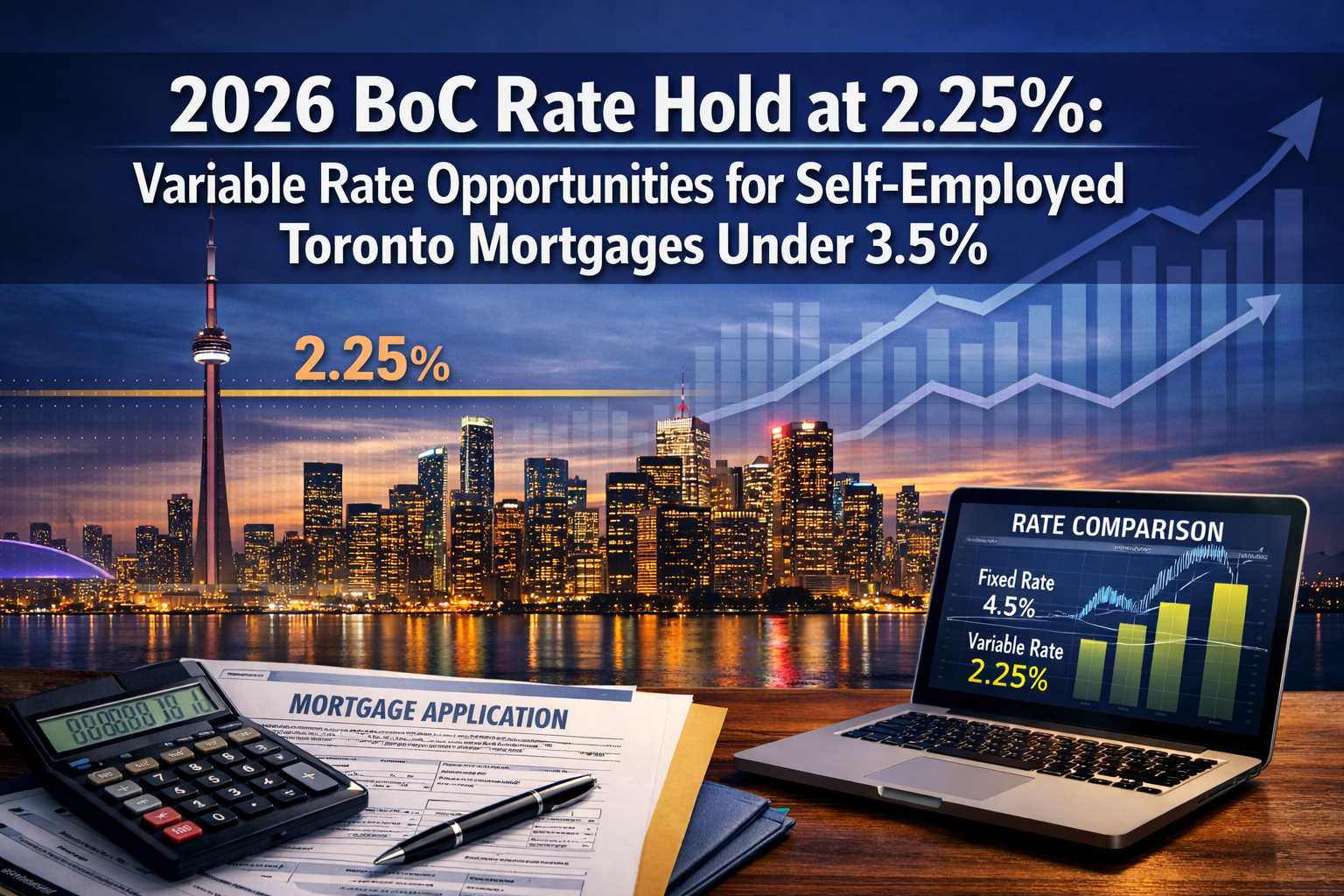
The Bank of Canada’s decision to maintain its overnight policy rate at 2.25% has created a unique window of opportunity for self-employed borrowers in Toronto’s housing market. With variable mortgage rates starting as low as 3.35%—well below the 3.5% threshold—self-employed professionals now have access to some of the most competitive borrowing costs in recent years. This rate stability, combined with specialized qualification methods using 12-month T3 tax return averages, positions 2026 as a strategic entry point before economists predict potential rate increases later in the year[1][2][3].
For self-employed Torontonians navigating fluctuating income streams, understanding how the 2026 BoC Rate Hold at 2.25%: Variable Rate Opportunities for Self-Employed Toronto Mortgages Under 3.5% creates unprecedented access to homeownership becomes essential. The current rate environment offers a rare combination: stable policy rates, competitive variable pricing, and lender flexibility that accommodates non-traditional income verification.
Key Takeaways
✅ Variable mortgage rates start at 3.35% for five-year terms, offering the lowest borrowing costs for self-employed borrowers willing to accept rate volatility[1]
✅ Bank of Canada maintains 2.25% policy rate with widespread economist consensus favoring stability through at least mid-2026, creating predictable borrowing conditions[2]
✅ Self-employed qualification using 12-month T3 averages provides accessible approval pathways for contractors, consultants, and professionals with variable income streams
✅ Fixed rates at 3.69% face upward pressure from rising bond yields breaching 3%, making variable rates increasingly attractive for cost-conscious borrowers[1]
✅ Strategic timing matters: Scotiabank predicts potential rate increases to 2.75% by Q4 2026, creating urgency for borrowers to lock in current variable rates[3]
Understanding the 2026 BoC Rate Hold at 2.25% and Its Impact on Variable Mortgages
The Bank of Canada’s January 2026 announcement confirmed that the 2.25% overnight policy rate “remains appropriate” based on current economic conditions[1]. This marks a continuation of the rate level established in October 2025, providing mortgage markets with rare stability after years of aggressive rate adjustments.
Why the Rate Hold Matters for Variable Mortgages
Variable mortgage rates directly correlate with the Bank of Canada’s policy rate, typically priced at a spread above the overnight rate. With the current hold at 2.25%, lenders are offering five-year variable rates starting at 3.35%—representing a spread of approximately 1.10% above the policy rate[1].
This pricing structure creates significant advantages:
- Monthly payment predictability in the short to medium term
- Lower initial borrowing costs compared to fixed-rate alternatives
- Flexibility to benefit if rates decline further (though unlikely in 2026)
- Opportunity to lock into fixed rates if economic conditions shift
For self-employed borrowers specifically, variable rates under 3.5% reduce the income qualification threshold. Lower rates mean smaller monthly payments, which translates to lower income verification requirements—a critical advantage when working with fluctuating self-employment earnings.
Economic Factors Supporting Rate Stability
Several economic indicators support the consensus that rates will remain stable through mid-2026:
Inflation Trends: CPI inflation reached 2.4% in December 2025, with core inflation measures easing to approximately 2.5%—close to the Bank’s 2% target[1]. This balanced inflation picture removes pressure for immediate rate increases.
GDP Growth Projections: Canadian economic growth likely stalled in Q4 2025, with modest 1.1% growth projected for 2026[1]. This tepid growth environment doesn’t warrant rate hikes that could further dampen economic activity.
Employment Conditions: Labour market softness continues, reducing wage pressure and supporting the Bank’s patient approach to monetary policy.
Major Canadian financial institutions—including RBC, TD, CIBC, BMO, Desjardins, and Scotiabank—all project policy rate stability through at least mid-2026[2]. This institutional consensus provides borrowers with confidence when selecting variable rate products.
Understanding mortgage rate options between fixed and variable becomes crucial in this environment, as the decision impacts both immediate affordability and long-term financial flexibility.
Variable Rate Opportunities for Self-Employed Toronto Mortgages: Qualification Strategies
Self-employed borrowers face unique challenges in mortgage qualification, but the 2026 BoC Rate Hold at 2.25%: Variable Rate Opportunities for Self-Employed Toronto Mortgages Under 3.5% creates accessible pathways through specialized income verification methods.
The 12-Month T3 Average Method
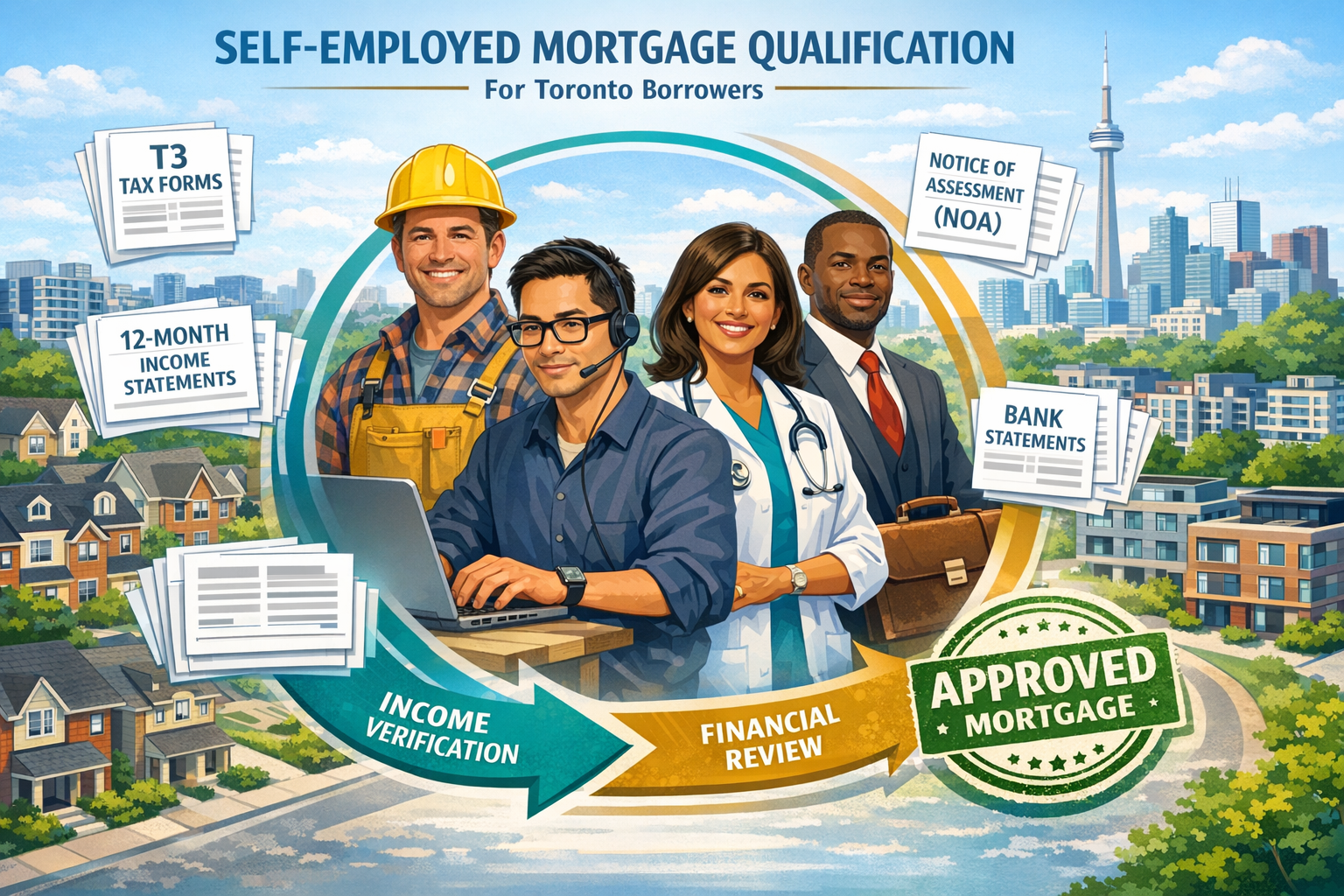
Traditional mortgage qualification relies on two years of consistent income documentation. For self-employed professionals with variable earnings—contractors, consultants, freelancers, and business owners—this standard approach often understates true income capacity.
The 12-month T3 average method offers an alternative:
📊 How It Works:
- Lenders review your most recent 12 months of T3 tax returns
- Income is averaged across the full year to smooth seasonal fluctuations
- Recent earnings carry more weight than older historical data
- Business deductions are added back in certain circumstances
This approach particularly benefits:
- IT consultants with project-based income cycles
- Construction contractors experiencing seasonal work patterns
- Healthcare professionals building new practices
- Legal professionals with contingency-based fee structures
For detailed guidance on contractor-specific qualification, review our comprehensive guide on self-employed mortgages for contractors.
Alternative Documentation Options
Beyond traditional T3 verification, self-employed Toronto borrowers can access variable rate mortgages under 3.5% through:
Bank Statement Programs: Lenders analyze 12-24 months of business bank deposits to verify income capacity without requiring full tax documentation.
Stated Income Programs: Available through alternative lenders for borrowers with strong credit (680+) and substantial down payments (20%+), though rates may be slightly higher.
Professional Programs: Specialized mortgage products for doctors, lawyers, and other licensed professionals often feature more flexible income verification. Learn more about self-employed mortgages for doctors and mortgage options for lawyers.
Qualification Requirements at Sub-3.5% Rates
To qualify for variable rates under 3.5% as a self-employed borrower in Toronto, expect these baseline requirements:
| Requirement | Minimum Standard | Competitive Profile |
|---|---|---|
| Credit Score | 650+ | 700+ |
| Down Payment | 5% (insured) / 20% (uninsured) | 20%+ |
| Income Documentation | 2 years T3 | 12-month average |
| Debt Service Ratios | GDS <39%, TDS <44% | GDS <32%, TDS <40% |
| Business History | 2+ years | 3+ years |
| Cash Reserves | 1.5% of purchase price | 3-6 months payments |
💡 Pro Tip: Variable rates under 3.5% significantly reduce your required income for qualification. A $600,000 mortgage at 3.35% requires approximately $15,000 less annual income to qualify compared to a 4.5% rate.
Understanding mortgages for self-employed borrowers provides additional context on navigating the qualification process with non-traditional income.
Comparing Variable vs. Fixed Rates: Why Sub-3.5% Variable Rates Stand Out in 2026
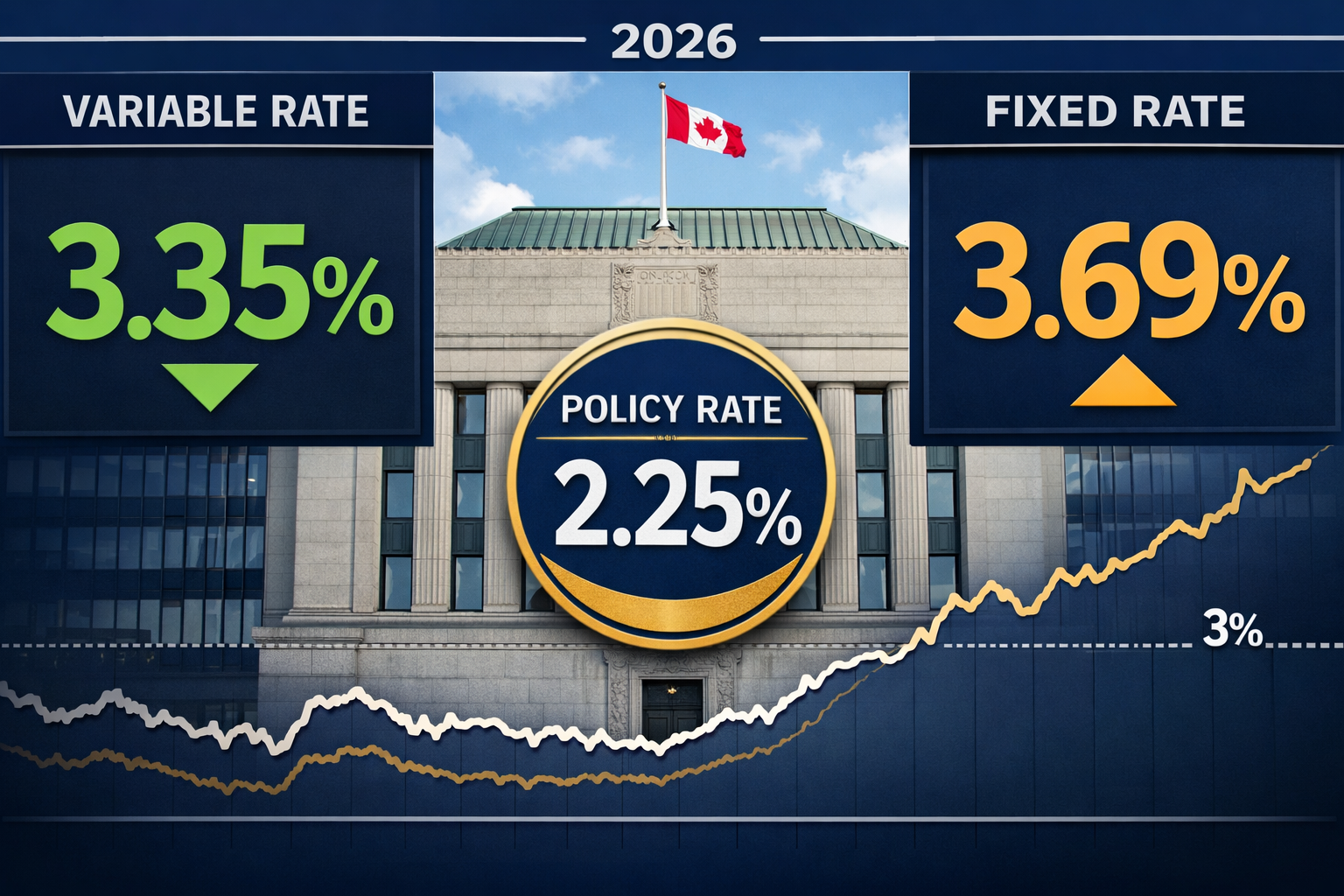
The current mortgage rate landscape presents self-employed Toronto borrowers with a critical decision: lock into fixed rates at 3.69% or embrace variable rates starting at 3.35%[1]. Understanding the 2026 BoC Rate Hold at 2.25%: Variable Rate Opportunities for Self-Employed Toronto Mortgages Under 3.5% requires analyzing both options through multiple lenses.
Current Rate Comparison
Variable Rates: Starting at 3.35% for five-year terms
- Directly tied to Bank of Canada policy rate (currently 2.25%)
- Monthly payment adjustments as prime rate changes
- Potential for savings if rates remain stable or decline
- Risk of payment increases if policy rates rise
Fixed Rates: Currently at 3.69% for five-year terms
- Locked payment amount for entire term
- Protection against rate increases
- Higher initial cost compared to variable
- No benefit if rates decline
The 0.34% spread between variable and fixed rates translates to meaningful monthly savings:
$500,000 Mortgage Example (25-year amortization):
- Variable at 3.35%: $2,441/month
- Fixed at 3.69%: $2,523/month
- Monthly savings: $82
- Annual savings: $984
- Five-year savings: $4,920
For self-employed borrowers managing fluctuating income, these savings create valuable financial flexibility during slower business periods.
Bond Yield Pressure on Fixed Rates
A critical factor favoring variable rates in 2026: Canadian five-year bond yields have breached the 3% mark[1]. Since fixed mortgage rates price off government bond yields plus a lender spread, this upward movement signals imminent increases for fixed-rate mortgages.
🔺 What Rising Bond Yields Mean:
- Fixed rates at 3.69% are unlikely to persist
- Lenders will adjust fixed pricing upward as bond yields climb
- The variable-to-fixed rate spread will likely widen further
- Early 2026 represents a temporary pricing anomaly
This bond yield pressure makes the current 3.35% variable rate increasingly attractive as a strategic entry point before fixed rates climb higher.
Risk Factors and Mitigation Strategies
While variable rates offer compelling savings, self-employed borrowers should understand the risks:
Geopolitical Uncertainty: Tensions between the US and Iran are raising oil prices, creating inflation pressures that could prevent further rate cuts[1].
US Trade Policy: Protectionism and trade uncertainty are disrupting Canadian economic growth, though this factor currently supports rate stability rather than increases[1].
Federal Reserve Influence: The US Federal Reserve’s rate-cut hesitation has pushed the 10-year Treasury yield above 4.1%, creating indirect pressure on Canadian rates[1].
Mitigation Strategies:
✅ Stress Test Your Budget: Ensure you can afford payments if rates increase by 2% ✅ Maintain Emergency Reserves: Keep 6-12 months of mortgage payments accessible ✅ Monitor Trigger Rates: Understand when payment adjustments occur (learn about trigger rates in variable mortgages) ✅ Plan Conversion Options: Know your lender’s terms for converting to fixed rates mid-term
Expert Perspective on Rate Direction
Mortgage expert analysis suggests no significant rate relief anticipated for the remainder of 2026[1]. This assessment implies:
- The 2.25% policy rate likely represents the floor
- Variable rate holders should have contingency plans
- Locking into fixed rates becomes advisable if the Bank initiates a hiking cycle
- Current variable rates offer optimal value before potential Q4 increases
Scotiabank’s forecast predicting a potential rise to 2.75% by Q4 2026 underscores the importance of timing[3]. Borrowers securing 3.35% variable rates in early 2026 position themselves advantageously before this projected increase.
For Toronto-specific analysis, explore our comparison of fixed vs. variable rates for Toronto first-time buyers.
Strategic Timing: Maximizing the 2026 BoC Rate Hold Before Predicted Q4 Increases
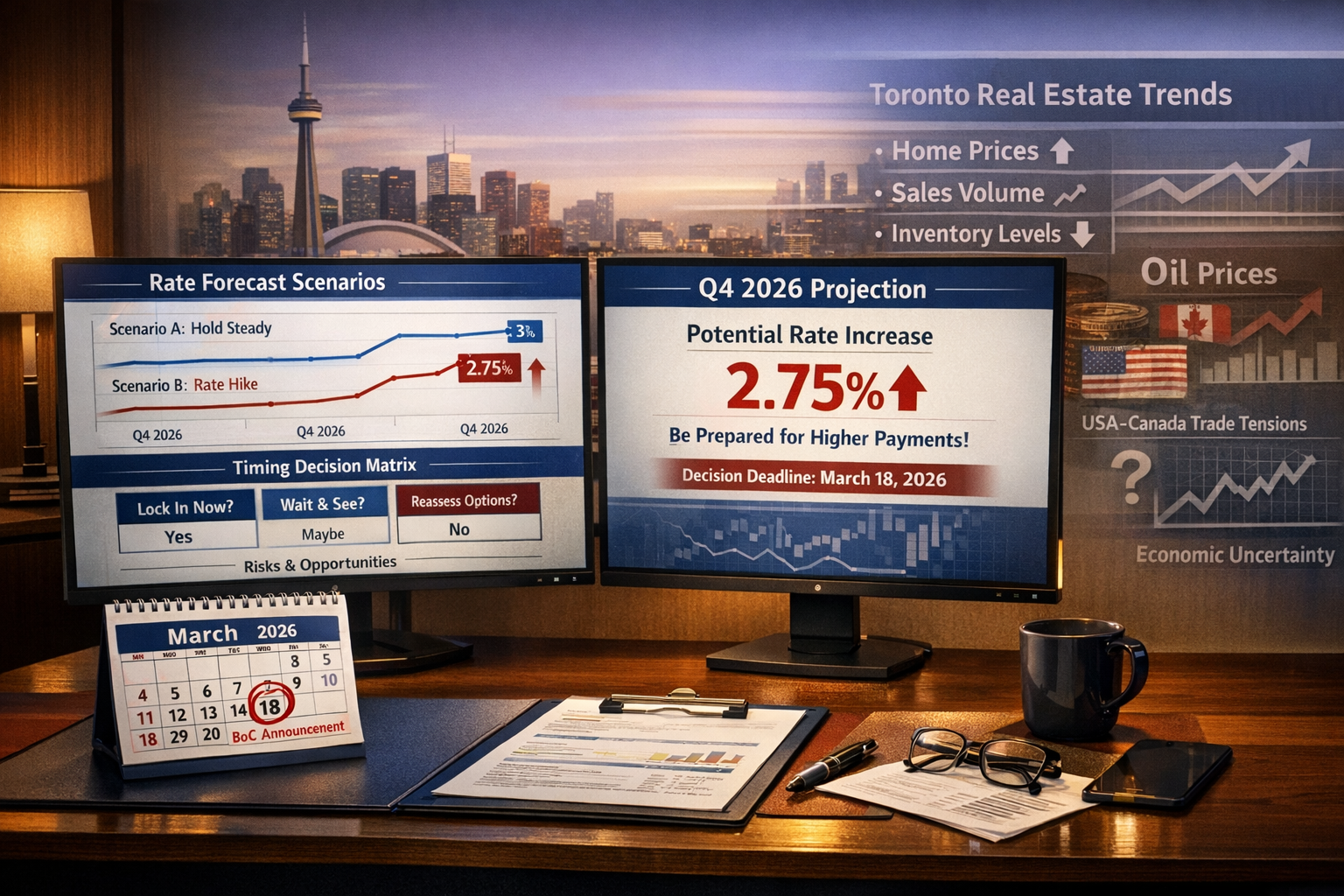
The 2026 BoC Rate Hold at 2.25%: Variable Rate Opportunities for Self-Employed Toronto Mortgages Under 3.5% creates a time-sensitive opportunity for self-employed borrowers. With the next Bank of Canada announcement scheduled for Wednesday, March 18, 2026[2], and economists predicting potential increases to 2.75% by Q4[3], strategic timing becomes crucial.
Key Dates and Decision Windows
March 18, 2026: Bank of Canada rate announcement
- Widespread consensus favors maintaining 2.25%[2]
- Any surprise increase would immediately impact variable rates
- Provides confirmation for spring mortgage planning
Spring 2026 (April-June): Optimal application window
- Rate stability confirmed through mid-year
- Toronto housing market activity increases seasonally
- Inventory levels favor motivated buyers
- Lenders compete aggressively for quality borrowers
Q3 2026 (July-September): Monitoring period
- Economic data will guide Q4 rate decisions
- Inflation trends become clearer
- US Federal Reserve policy direction solidifies
Q4 2026 (October-December): Potential rate increase period
- Scotiabank predicts possible rise to 2.75%[3]
- Variable mortgage rates could climb to 3.85-4.10%
- Monthly payment increases for existing variable holders
- Reduced affordability for new applicants
Pre-Approval Strategy for Self-Employed Borrowers
Given the documentation requirements for self-employed mortgages, starting the process early maximizes your ability to secure sub-3.5% variable rates:
90-Day Pre-Approval Timeline:
Days 1-30: Documentation gathering
- Collect 2 years of T3 tax returns (or 12-month average)
- Obtain Notice of Assessment from CRA
- Compile business financial statements
- Gather bank statements (12-24 months)
- Pull credit report and address any issues
Days 31-60: Lender submission and negotiation
- Submit applications to multiple lenders
- Compare variable rate offerings and terms
- Negotiate rate holds (typically 90-120 days)
- Clarify conversion options to fixed rates
- Understand trigger rate thresholds
Days 61-90: Property search and offer preparation
- Armed with firm pre-approval at sub-3.5% variable rate
- Clear understanding of maximum purchase price
- Competitive position in Toronto’s spring market
- Flexibility to act quickly on suitable properties
💼 Self-Employed Advantage: Starting early allows time to optimize your income presentation. If your most recent 12-month average shows stronger earnings than your two-year average, you can time your application to leverage the most favorable calculation method.
Toronto Market Conditions Supporting Variable Rate Strategy
The Toronto housing market in 2026 presents favorable conditions for self-employed buyers leveraging variable rates under 3.5%:
Ample Supply: Inventory levels remain elevated, reducing bidding war pressure and allowing thoughtful decision-making.
Softer Pricing: Home prices have stabilized or declined slightly from peak levels, improving affordability when combined with sub-3.5% rates.
Motivated Sellers: Extended listing times create negotiation opportunities for qualified buyers with firm financing.
Rate-Sensitive Competition: Many potential buyers remain on the sidelines waiting for further rate cuts, reducing competition for decisive buyers.
Spring 2026 Activity: The Canadian housing market is expected to see increased activity despite cautious sentiment, as motivated buyers capitalize on comparably good borrowing costs[1].
For self-employed professionals, these conditions create optimal timing to enter the market with competitive variable rate financing before potential Q4 rate increases reduce affordability.
Conversion Options and Exit Strategies
A critical component of variable rate strategy involves understanding your options if rates begin climbing:
Fixed Rate Conversion: Most variable mortgages allow conversion to fixed rates at any time without penalty. Key considerations:
- Conversion rate is typically the lender’s posted rate (higher than discounted rates)
- Converting locks in your remaining term at the new fixed rate
- Best executed before the Bank of Canada begins a hiking cycle
- Monitor bond yields as leading indicators for timing
Refinancing Options: If your lender’s conversion rates are uncompetitive:
- Shop competing lenders for better fixed rates
- Requires breaking your existing mortgage (potential penalties)
- Calculate break costs versus long-term savings
- Consider if your income documentation has strengthened
Accelerated Payment Strategy: If rates remain favorable:
- Make lump sum payments to reduce principal faster
- Increase payment frequency (weekly vs. monthly)
- Build equity cushion against potential rate increases
- Explore strategies for accelerated mortgage repayment
Understanding self-employed mortgage renewals in 2026 provides additional context for managing your mortgage through changing rate environments.
Lender Options and Application Process for Self-Employed Variable Mortgages
Securing the 2026 BoC Rate Hold at 2.25%: Variable Rate Opportunities for Self-Employed Toronto Mortgages Under 3.5% requires understanding which lenders offer the most competitive terms for self-employed borrowers and how to navigate their application processes.
A-Lenders vs. Alternative Lenders
A-Lenders (Major Banks and Credit Unions):
- Offer the lowest variable rates (3.35-3.50%)
- Require strongest documentation (2 years T3, NOA, financials)
- Strictest income calculation methods
- Best suited for established self-employed borrowers with clean tax returns
- Longest approval timelines (2-4 weeks)
B-Lenders (Alternative Mortgage Lenders):
- Variable rates typically 3.50-3.95%
- More flexible income verification (12-month averages, bank statements)
- Accept higher debt ratios and lower credit scores
- Faster approval processes (1-2 weeks)
- May require higher down payments (20-25%)
Private Lenders:
- Rates typically above 5% (less competitive for this strategy)
- Minimal income documentation required
- Asset-based lending approach
- Short-term bridge financing solution
- Not ideal for long-term variable rate strategy
For self-employed borrowers with strong financials, A-lenders provide the best access to sub-3.5% variable rates. Those with complex income structures or recent business transitions may find better approval odds with B-lenders at slightly higher rates.
Required Documentation Checklist
📋 Essential Documents for Self-Employed Variable Mortgage Application:
Personal Documentation:
- ✅ Government-issued photo ID (driver’s license, passport)
- ✅ Proof of down payment (90-day history of funds)
- ✅ Credit report authorization
- ✅ Void cheque for payment setup
Income Verification:
- ✅ Two years of complete T3 tax returns (or 12-month average)
- ✅ Two years of Notice of Assessment from CRA
- ✅ Current year-to-date income statement
- ✅ Business license or incorporation documents
- ✅ 12-24 months of business bank statements
Business Financial Documentation:
- ✅ Two years of business financial statements
- ✅ Accountant-prepared statements (preferred) or self-prepared
- ✅ Business tax returns (T2 for incorporated businesses)
- ✅ Accounts receivable aging report
- ✅ Proof of business continuity (contracts, client agreements)
Property Documentation:
- ✅ Purchase agreement (if property identified)
- ✅ MLS listing details
- ✅ Property tax statements (if applicable)
- ✅ Condo documents (status certificate, financials)
For comprehensive guidance on documentation requirements, review our detailed guide on documentation requirements for self-employed mortgage approval in Toronto.
Application Process Timeline
Week 1: Initial Consultation and Pre-Qualification
- Meet with mortgage broker or lender specialist
- Discuss income calculation methods (2-year vs. 12-month average)
- Review preliminary affordability based on self-employment income
- Identify optimal lender options for your profile
Week 2-3: Document Submission and Underwriting
- Submit complete documentation package
- Underwriter reviews income verification
- Credit assessment completed
- Property appraisal ordered (if property identified)
- Conditional approval issued with any outstanding requirements
Week 4: Final Approval and Rate Lock
- Address any conditional requirements
- Lock in variable rate (typically 90-120 day hold)
- Review mortgage commitment terms
- Finalize insurance requirements
- Schedule closing date
Closing Day:
- Legal review of mortgage documents
- Final walkthrough of property
- Signing of mortgage agreement
- Transfer of funds and property title
- First payment scheduled
Negotiation Strategies for Best Variable Rates
Self-employed borrowers can leverage several strategies to secure the most competitive variable rates under 3.5%:
🎯 Strengthen Your Application:
- Increase down payment: Moving from 20% to 25% down improves pricing
- Improve credit score: Each 20-point increase can reduce rates by 0.10-0.15%
- Reduce debt ratios: Pay down credit cards and loans before applying
- Add co-applicant: Spouse or partner with traditional employment strengthens profile
💰 Leverage Competition:
- Apply to 3-4 lenders simultaneously
- Use competing offers to negotiate better terms
- Consider broker access to multiple lender options
- Time applications during promotional periods (often Q1 and Q3)
📊 Optimize Income Presentation:
- Work with accountant to present income most favorably
- Add back legitimate business expenses (vehicle, home office)
- Highlight income growth trends year-over-year
- Provide context for any income fluctuations
For IT professionals navigating self-employed mortgage applications, our guide on IT consultant mortgages with alternative lenders provides profession-specific strategies.
Common Pitfalls to Avoid
❌ Writing Off Too Much Income: While tax minimization makes sense for reducing tax liability, excessive write-offs reduce your qualifying income for mortgages. Balance tax strategy with mortgage goals.
❌ Inconsistent Income Reporting: Ensure your T3 returns, bank statements, and financial statements tell a consistent income story. Discrepancies trigger additional scrutiny and delays.
❌ Inadequate Cash Reserves: Lenders want to see 1.5-3% of the purchase price in accessible reserves beyond your down payment. Don’t deplete all savings for the down payment.
❌ Ignoring Trigger Rates: Variable mortgages have trigger points where payment adjustments occur. Understand your trigger rate and budget accordingly.
❌ Timing Applications During Business Transitions: Avoid applying immediately after incorporating, changing business structures, or experiencing significant income changes. Wait for 12-24 months of stable documentation.
Conclusion: Seizing the 2026 Variable Rate Opportunity as a Self-Employed Toronto Borrower
The 2026 BoC Rate Hold at 2.25%: Variable Rate Opportunities for Self-Employed Toronto Mortgages Under 3.5% represents a strategic convergence of favorable conditions: stable monetary policy, competitive variable pricing, and specialized qualification pathways for self-employed professionals. With variable rates starting at 3.35%—significantly below the 3.5% threshold—self-employed Toronto borrowers have access to historically competitive borrowing costs that may not persist beyond Q4 2026.

Key Strategic Advantages
The current environment offers self-employed borrowers several compelling advantages:
🏆 Lowest Borrowing Costs: Variable rates at 3.35% provide monthly payment savings of $80-100+ compared to fixed alternatives, creating valuable cash flow flexibility for managing variable business income.
📈 Income Qualification Flexibility: The 12-month T3 average method and alternative documentation programs provide accessible approval pathways that recognize the reality of self-employment income patterns.
⏰ Time-Sensitive Opportunity: With widespread economist consensus supporting rate stability through mid-2026 but potential increases to 2.75% by Q4, the spring 2026 application window offers optimal timing.
🏘️ Favorable Market Conditions: Toronto’s elevated inventory, softer pricing, and reduced competition create negotiation leverage for qualified buyers with firm financing.
Actionable Next Steps
For self-employed professionals ready to capitalize on sub-3.5% variable mortgage opportunities:
Immediate Actions (This Week):
- Pull your credit report and address any issues that could impact qualification
- Gather 2 years of T3 returns and Notice of Assessment documents
- Calculate your 12-month income average to determine optimal qualification method
- Contact a mortgage broker specializing in self-employed borrowers
Short-Term Actions (Next 30 Days):
- Submit pre-approval applications to multiple lenders to compare variable rate offerings
- Lock in rate holds (90-120 days) to secure current pricing
- Clarify conversion options and trigger rate thresholds with your lender
- Build cash reserves to strengthen your application and provide payment buffer
Medium-Term Actions (Next 60-90 Days):
- Begin property search armed with firm pre-approval
- Monitor Bank of Canada announcements (March 18, 2026 and subsequent dates)
- Track bond yield movements as indicators of fixed rate direction
- Prepare for closing by organizing legal, insurance, and financial requirements
Final Considerations
While variable rates under 3.5% offer compelling value, self-employed borrowers should approach this strategy with eyes wide open to the risks. Ensure your budget can accommodate potential payment increases of 0.50-1.00% over your mortgage term. Maintain robust emergency reserves to weather both business income fluctuations and potential rate increases.
The combination of Bank of Canada rate stability, competitive variable pricing, and specialized self-employed qualification methods creates a unique opportunity in 2026. However, this window is time-limited. Economists project potential rate increases by Q4 2026, and rising bond yields are already pressuring fixed rates upward[1][2][3].
For self-employed Toronto professionals who have been building their businesses and waiting for favorable mortgage conditions, spring 2026 represents an optimal entry point. The 2026 BoC Rate Hold at 2.25%: Variable Rate Opportunities for Self-Employed Toronto Mortgages Under 3.5% provides the foundation for affordable homeownership—but only for those who act decisively while these conditions persist.
Take the first step today by gathering your documentation and connecting with a mortgage professional who understands the nuances of self-employed qualification. Your path to Toronto homeownership at sub-3.5% variable rates begins with informed action in this strategic window.
References
[1] Fad Press Release 2026 01 28 – https://www.bankofcanada.ca/2026/01/fad-press-release-2026-01-28/
[2] Bank Of Canada Rate Forecast For March 18 2026 What Economists Expect – https://ontariohousingmarket.com/2026/03/08/bank-of-canada-rate-forecast-for-march-18-2026-what-economists-expect/
[3] Bank Of Canada Interest Rate March 2026 – https://dailyhive.com/vancouver/bank-of-canada-interest-rate-march-2026
 Previous Page