March 21, 2026
2026 Renewal Shock for Self-Employed Toronto: Switching to Variable Rates at 3.45%-3.95% to Avoid 20% Fixed Hikes
Share this article:



Manzeel is an award-winning Mortgage Broker and the Owner of the Toronto-based mortgage, Everything Mortgages.
With 16 years of experience in the Canadian mortgage industry and a formal background in mortgage underwriting, Manzeel’s lending expertise gives him unique insight into whether a deal is feasible which empowers his clients to make more informed lending decisions faster.
He has been recognized as one of Canada’s Top 10 Mortgage Brokers by the national Canadian Mortgage Professionals (CMP) Association. Him and his team of 18 mortgage agents are proud to offer a mortgage experience that's built on honesty, trust, and integrity. He prides himself on the brokerage’s dedication to deliver an excellent client experience throughout the entire home loan process from pre-approval to post-funding.
Since moving to Toronto in 1998, Manzeel has successfully launched and scaled several businesses from the ground up, ranging from a mortgage brokerage and a vast real estate investment portfolio to a private financing eCommerce platform. He continues to be a leader in the real estate industry as he uses his analytical expertise to seek new real estate investment opportunities.
As a tech junkie and avid sports enthusiast, when Manzeel’s not working with clients, you can find him reading technology blogs, playing squash or watching tennis with his two boys.
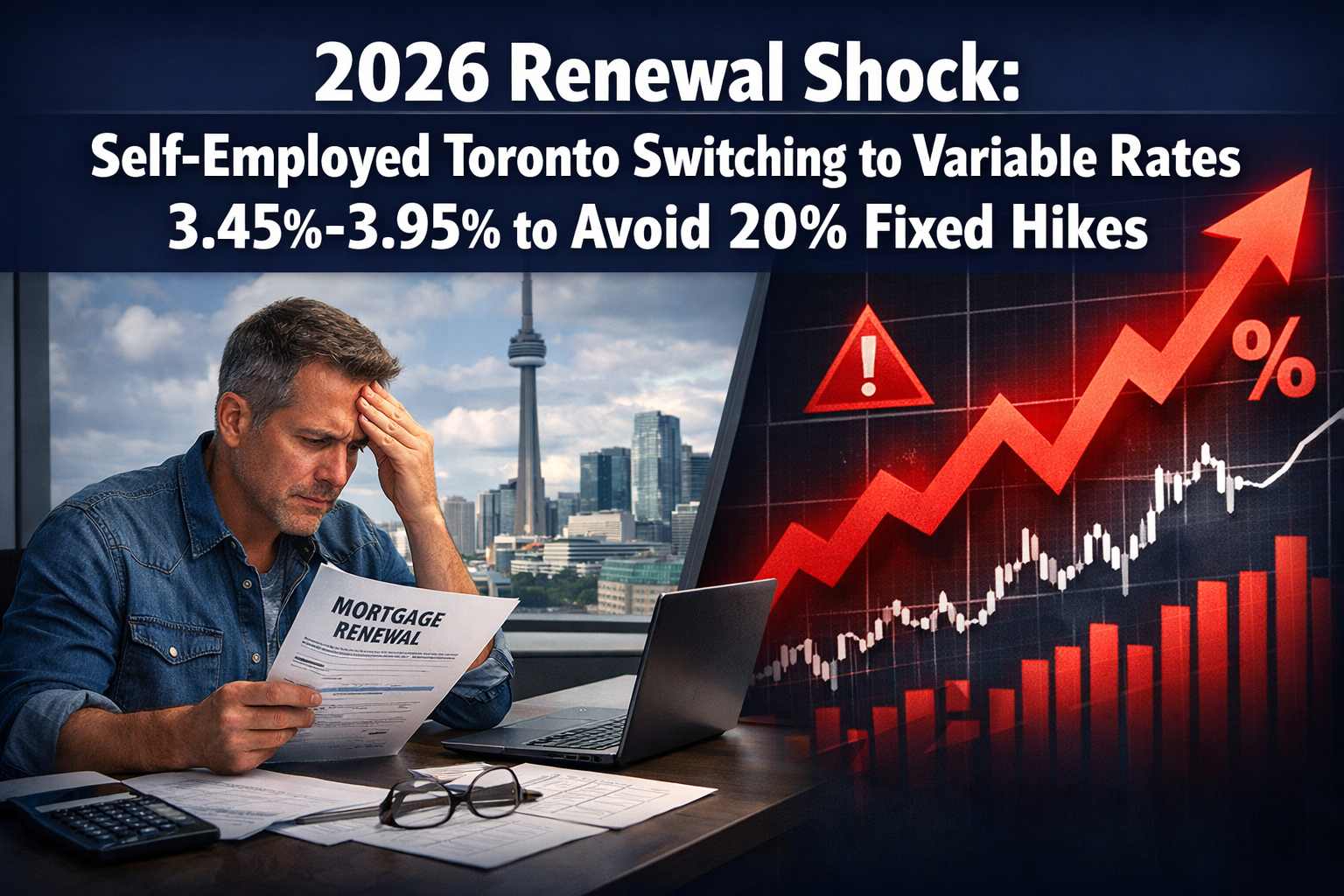
Self-Employed Homeowners in Toronto are facing an unprecedented mortgage renewal crisis in 2026. With fixed-rate renewals climbing by an average of 20% and monthly payments jumping by $576 or more, many entrepreneurs and business owners are discovering that their renewal offers feel more like financial punishment than routine paperwork. The 2026 renewal shock for self-employed Toronto borrowers has created a critical decision point: accept crushing fixed-rate increases or switch to variable rates at 3.45%-3.95% to avoid 20% fixed hikes.
The good news? Variable rate mortgages tied to the Bank of Canada’s current 2.25% overnight lending rate offer a viable escape route—often without the full income re-verification process that makes fixed-rate renewals so challenging for self-employed borrowers[7].
Key Takeaways
✅ Fixed-rate renewals are increasing by 20% on average, with monthly payments jumping $576+ for typical Toronto mortgages
✅ Variable rates currently range from 3.45%-3.95%, significantly lower than fixed renewal offers of 4.89%-5.24%
✅ Switching to variable rates often requires less income verification than renewing into a new fixed term, making it ideal for self-employed borrowers
✅ The Bank of Canada has held rates at 2.25% since March 2026, with markets pricing stability through October 2026[7]
✅ Over 340 mortgage brokers in Toronto specialize in helping self-employed borrowers navigate renewal options and avoid payment shock[1]
Understanding the 2026 Renewal Shock for Self-Employed Toronto Homeowners
The Mortgage Renewal landscape has shifted dramatically for self-employed Torontonians in 2026. Borrowers who locked in rates of 1.79%-2.49% during the 2021-2022 period are now facing renewal offers that represent staggering increases.
The Payment Shock Reality
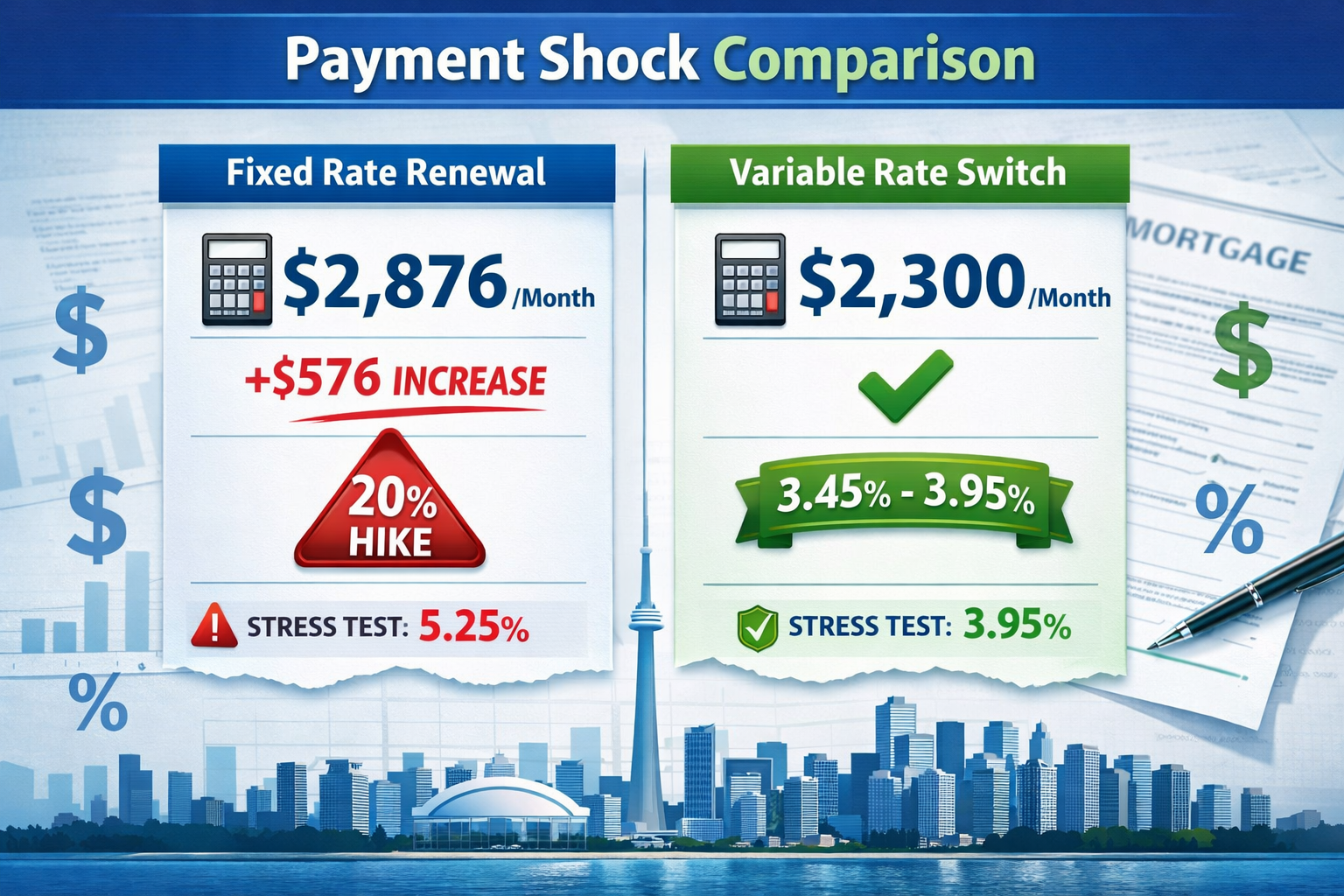
Consider a typical Toronto scenario: A self-employed graphic designer with a $600,000 mortgage balance at renewal is seeing their monthly payment increase from approximately $2,300 to $2,876—a jump of $576 monthly or nearly $7,000 annually[3]. For business owners whose income fluctuates seasonally, this represents a significant cash flow challenge.
With average detached home prices in Toronto exceeding $1,400,000, the stakes are even higher for those with larger mortgages[1]. A $1 million mortgage balance could see payment increases of $960+ per month when renewing from a 2021-era rate to current fixed offerings.
Why Self-Employed Borrowers Face Additional Hurdles
The 2026 renewal shock for self-employed Toronto residents is compounded by stricter qualification criteria that don’t affect traditional employees. While salaried workers can typically renew with minimal documentation, self-employed borrowers often face:
- Two years of tax returns showing consistent income
- Business financial statements and Notice of Assessments
- Credit score requirements above 620[6]
- Debt service ratio calculations that may disqualify those who qualified just five years ago
Many self-employed homeowners who easily qualified in 2021 now find themselves unable to meet current income verification standards—not because their businesses are failing, but because they’ve legitimately written off business expenses that reduce their taxable (and therefore “provable”) income.
For comprehensive strategies on securing mortgages as a self-employed Canadian, understanding these unique challenges is essential.
How Variable Rates at 3.45%-3.95% Provide Relief from Fixed Rate Increases
The solution to avoiding the 2026 renewal shock for self-employed Toronto borrowers lies in understanding how variable rate mortgages currently offer both lower rates and easier qualification paths.
Current Variable Rate Landscape
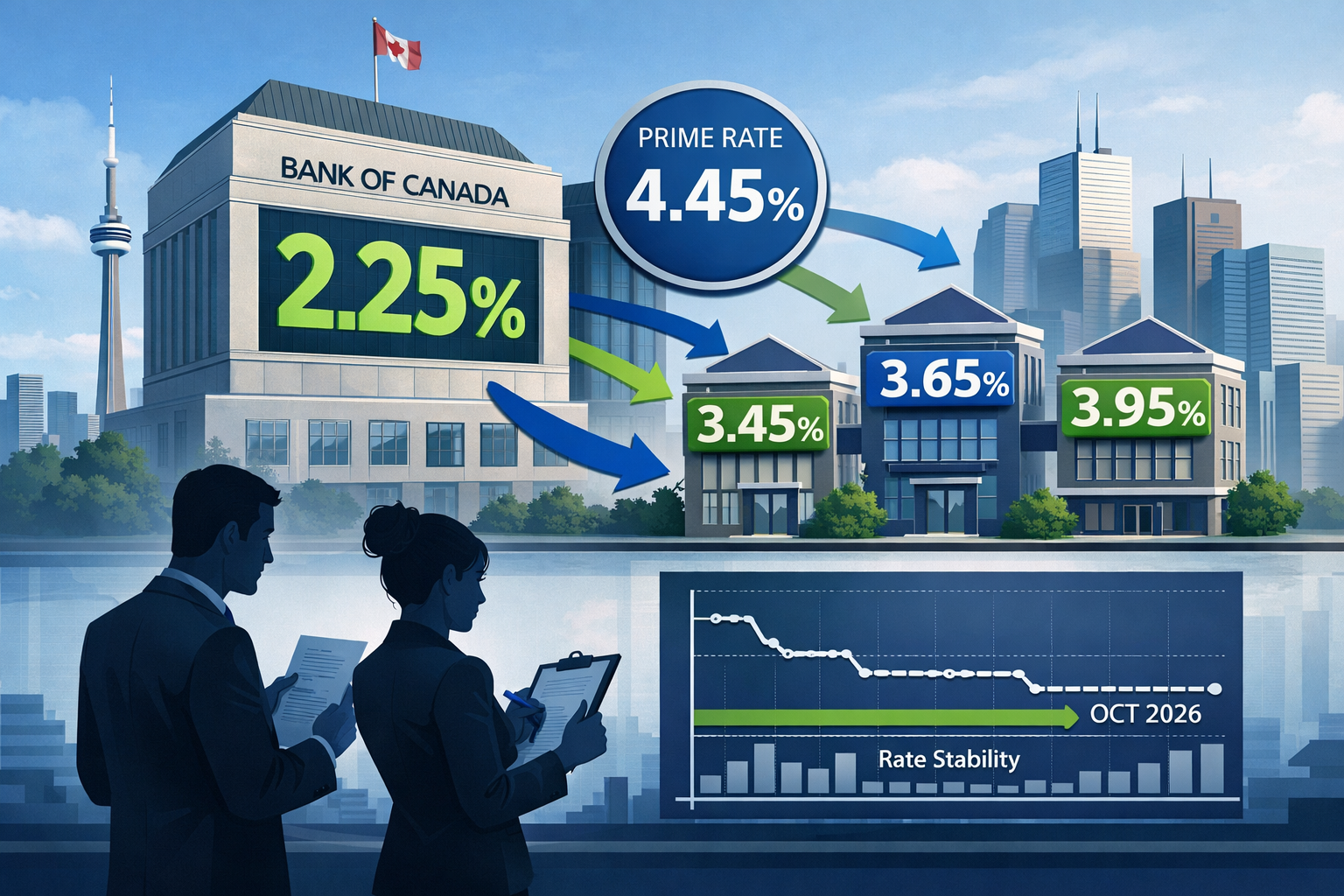
As of March 2026, variable mortgage rates in Toronto range from 3.45% to 3.95% depending on the lender and borrower profile[4]. These rates are tied to the prime rate of 4.45%, which moves in lockstep with the Bank of Canada’s overnight lending rate, currently held at 2.25%[7].
Compare this to fixed-rate renewal offers:
| Mortgage Type | Rate Range | Monthly Payment ($600K) | Annual Cost |
|---|---|---|---|
| 5-Year Fixed Renewal | 4.89%-5.24% | $3,276-$3,412 | $39,312-$40,944 |
| 3-Year Variable | 3.45%-3.95% | $2,676-$2,876 | $32,112-$34,512 |
| Savings with Variable | -1.44% to -1.29% | $600-$536 | $7,200-$6,432 |
The math is compelling: switching to a variable rate at 3.45%-3.95% to avoid 20% fixed hikes can save self-employed Toronto homeowners $6,000-$7,000 annually.
The Verification Advantage
Here’s the critical insight many self-employed borrowers miss: switching to a variable rate at renewal often requires significantly less income verification than renewing into a new fixed term.
Why? Because variable rates are perceived as lower risk to lenders—the rate adjusts with market conditions, protecting the lender’s margin. Many lenders will offer variable rate switches with:
- ✅ Simplified income verification (sometimes just recent bank statements)
- ✅ Faster approval timelines (10-14 days vs. 45-60 days)
- ✅ More flexible debt ratio calculations
- ✅ Alternative documentation options for self-employed income
This makes variable rates particularly attractive for self-employed borrowers who’ve strategically minimized their taxable income through legitimate business deductions. Learn more about self-employed mortgage renewals in 2026 and the specific documentation requirements.
Rate Stability Through 2026
The Bank of Canada has maintained its overnight lending rate at 2.25% for three consecutive announcements as of March 2026[7]. Market forecasts predict this rate will hold through October 2026[4], providing unusual stability for variable rate mortgages.
This “higher for longer” scenario actually favors variable rate borrowers in 2026. Unlike previous cycles where rates were expected to rise rapidly, current economic conditions suggest prolonged stability, reducing the traditional risk associated with variable mortgages.
For insights on current self-employed mortgage rates in Toronto, including lender-specific offerings, explore specialized rate comparisons.
Navigating the Switch: Practical Steps for Self-Employed Toronto Borrowers
Making the strategic move to variable rates at 3.45%-3.95% to avoid 20% fixed hikes requires careful planning. Here’s how self-employed Toronto homeowners can successfully navigate this transition.
Step 1: Review Your Renewal Notice Early
Most lenders send renewal notices 120 days before maturity. Don’t wait until the last minute. Self-employed borrowers need extra time to:
- 📋 Compare your lender’s renewal offer against current market rates
- 📋 Calculate your actual payment increase using online calculators
- 📋 Assess your current income documentation readiness
- 📋 Identify qualification challenges before they become problems
The best time to renew a mortgage is often 120 days before maturity, when you have maximum negotiating leverage.
Step 2: Engage a Mortgage Broker Specializing in Self-Employed Clients
Toronto has over 340 mortgage brokers and access to 50+ private mortgage lenders[1], but not all understand the unique challenges facing self-employed borrowers in 2026.
A specialized broker can:
- 🎯 Access lender programs specifically designed for self-employed income verification
- 🎯 Navigate alternative documentation options like bank statement mortgages
- 🎯 Compare variable rate offerings from multiple lenders simultaneously
- 🎯 Negotiate better terms than you’d receive going directly to your current lender
Consider bank statement mortgages for self-employed borrowers as an alternative verification method that can unlock better rates.
Step 3: Understand Your Variable Rate Options
Not all variable rates are created equal. When exploring options to avoid the 2026 renewal shock for self-employed Toronto borrowers, consider:
Adjustable Rate Mortgages (ARM)
- Payment changes immediately when prime rate changes
- Currently offering the lowest rates (3.45%-3.65%)
- Best for borrowers with flexible cash flow
Fixed-Payment Variable Rate Mortgages
- Payment stays the same, but principal/interest ratio adjusts
- Rates typically 0.10%-0.20% higher (3.65%-3.95%)
- Better for budgeting, but watch for trigger rate risks
Convertible Variable Rates
- Option to convert to fixed rate without penalty
- Slightly higher rates (3.75%-3.95%)
- Provides flexibility if rate environment changes
Step 4: Prepare Alternative Income Documentation
Even with simplified verification, having documentation ready accelerates approval:
- 💼 Recent bank statements (6-12 months of business account activity)
- 💼 Business registration documents and licenses
- 💼 Client contracts or invoices showing ongoing revenue
- 💼 CRA Notice of Assessments (even if showing lower income)
- 💼 Letter from accountant explaining business structure and income
For borrowers who’ve struggled with traditional verification, explore how self-employed borrowers in Toronto can qualify without T4 slips.
Step 5: Consider Switching Lenders
Your current lender has no obligation to offer you their best rate at renewal. In fact, many banks count on borrower inertia and offer renewal rates 0.50%-1.00% higher than what new customers receive.
Switching lenders at renewal can provide:
- ✨ Access to promotional variable rates (sometimes as low as 3.45%)
- ✨ Cash-back incentives ($1,000-$3,000 for larger mortgages)
- ✨ Legal fee coverage (typically $500-$1,200)
- ✨ Better mortgage features (prepayment privileges, portability)
Learn about mortgage refinancing and switching lenders at renewal and the specific advantages for self-employed borrowers.
Strategic Considerations: When Variable Rates Make Sense for Self-Employed Borrowers
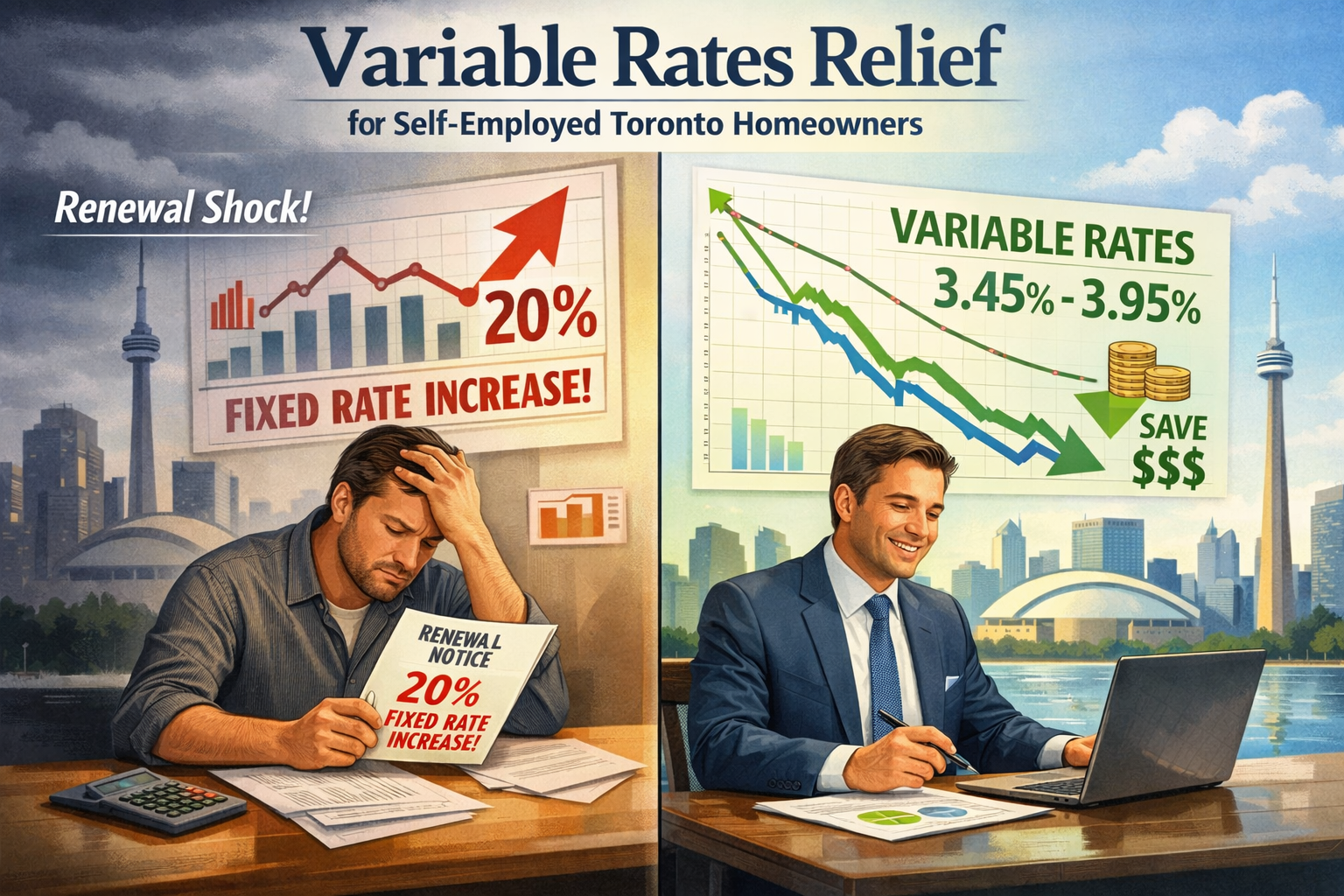
While switching to variable rates at 3.45%-3.95% to avoid 20% fixed hikes offers clear savings, it’s not the right choice for every self-employed Toronto homeowner. Here’s how to make an informed decision.
Your Risk Tolerance and Cash Flow Stability
Variable rates introduce payment uncertainty. Ask yourself:
- 🤔 Can your business absorb payment increases of $200-$400 monthly if rates rise?
- 🤔 Do you have emergency reserves covering 6-12 months of payments?
- 🤔 Is your business income stable or highly seasonal?
- 🤔 Are you planning major business investments that could strain cash flow?
Self-employed borrowers with consistent monthly revenue and strong cash reserves are better positioned to benefit from variable rates than those with unpredictable income patterns.
Your Mortgage Timeline
The 2026 renewal shock for self-employed Toronto borrowers is particularly acute for those with shorter remaining amortizations. Consider:
If you have 15+ years remaining:
- Variable rates offer maximum savings potential
- Time to weather rate fluctuations
- Opportunity to convert if rates spike
If you have 5-10 years remaining:
- Balance between savings and stability
- Consider fixed-payment variable options
- Monitor rate forecasts closely
If you have less than 5 years remaining:
- Fixed rates may provide peace of mind
- Payment certainty for final stretch
- Less time to recover from rate increases
Market Timing and Rate Forecasts
Current economic indicators suggest rate stability through late 2026[4][7], but several factors could shift this outlook:
- 📊 Inflation trends (currently moderating but unpredictable)
- 📊 Employment data (strong labor market supporting higher rates)
- 📊 Global economic conditions (trade tensions, geopolitical risks)
- 📊 Housing market activity (cooling demand reducing rate pressure)
For detailed analysis, review how 2026 mortgage rate forecasts impact self-employed homebuyers.
The Qualification Equation
Perhaps the most important consideration: Can you even qualify for the fixed rate you’re being offered?
If your current lender’s renewal offer requires full income verification and you’re uncertain about approval, switching to a variable rate with simplified verification might not just be the better financial choice—it might be your only viable option to avoid more expensive alternatives like:
- ⚠️ Private lenders at 7%-12% rates
- ⚠️ Forced sale in a challenging market
- ⚠️ Default and credit damage
For borrowers facing qualification challenges, easier qualification options for self-employed borrowers can provide alternative pathways.
Running the Numbers: Break-Even Analysis
Calculate your personal break-even point—the rate at which variable becomes more expensive than your fixed renewal offer:
Example Scenario:
- Current renewal offer: 5.09% fixed
- Variable rate offer: 3.65%
- Difference: 1.44%
Your variable rate would need to increase by 1.44% (approximately 6 Bank of Canada rate hikes of 0.25% each) before matching the fixed rate cost. Given current forecasts of rate stability through October 2026[4], the probability of six consecutive rate increases in the next 12-18 months is relatively low.
Even if rates do rise, you’d enjoy months of savings first, and many variable mortgages include conversion options allowing you to lock in a fixed rate if the environment changes.

Taking Action: Your Next Steps to Avoid the 2026 Renewal Shock
The 2026 renewal shock for self-employed Toronto borrowers is real, but it’s not insurmountable. By strategically switching to variable rates at 3.45%-3.95% to avoid 20% fixed hikes, self-employed homeowners can save thousands annually while maintaining financial flexibility.
Immediate Action Items
If your renewal is 90-120 days away:
- ✅ Contact a mortgage broker specializing in self-employed clients today
- ✅ Request rate quotes from at least 3-5 lenders for variable options
- ✅ Gather income documentation even if you plan simplified verification
- ✅ Calculate your break-even point using current rate forecasts
- ✅ Review your business cash flow to assess payment flexibility
If your renewal is 30-90 days away:
- ⚡ Act immediately—processing times can extend to 45-60 days
- ⚡ Prioritize lenders offering simplified verification for self-employed
- ⚡ Consider alternative documentation like bank statement programs
- ⚡ Be prepared to switch lenders if your current bank won’t negotiate
- ⚡ Have a backup plan (private lenders, extended renewal terms)
If your renewal is less than 30 days away:
- 🚨 Contact multiple brokers immediately—some can expedite processing
- 🚨 Accept your lender’s renewal offer temporarily to avoid default
- 🚨 Refinance within 3-6 months to better terms when time permits
- 🚨 Explore bridge financing if facing qualification challenges
- 🚨 Consult with a financial advisor about restructuring business income
Resources and Support
Toronto’s robust mortgage broker network provides specialized support for self-employed borrowers. Key resources include:
- 🔍 Specialized self-employed mortgage programs through alternative lenders
- 🔍 Bank statement verification options requiring minimal tax documentation
- 🔍 Private lending solutions for complex income situations
- 🔍 Financial planning services to optimize business income structure
For comprehensive guidance on self-employed mortgage rates in Toronto 2026, including current fixed and variable options under 4%, explore specialized rate comparisons.
Long-Term Planning
Beyond navigating your immediate renewal, consider these strategies for future financial stability:
Optimize Your Income Documentation
- Work with an accountant to balance tax efficiency with mortgage qualification
- Maintain detailed business records showing consistent revenue
- Consider salary vs. dividend strategies for incorporated businesses
Build Financial Reserves
- Target 12 months of mortgage payments in emergency savings
- Create separate accounts for business and personal expenses
- Establish lines of credit during strong income years
Monitor Rate Environment
- Subscribe to Bank of Canada rate announcements
- Review quarterly rate forecasts from major banks
- Maintain relationship with mortgage broker for ongoing advice
Plan Your Next Renewal
- Mark your calendar for 120 days before next maturity
- Review mortgage features and penalties annually
- Consider rate-lock options when favorable rates emerge
Conclusion
The 2026 renewal shock for self-employed Toronto homeowners represents a significant financial challenge, with fixed-rate renewals increasing by an average of 20% and monthly payments jumping $576 or more. However, by strategically switching to variable rates at 3.45%-3.95% to avoid 20% fixed hikes, self-employed borrowers can achieve substantial savings while often benefiting from simplified income verification requirements.
With the Bank of Canada holding rates at 2.25% and market forecasts predicting stability through October 2026[7], variable rate mortgages offer an attractive combination of lower costs and reduced qualification barriers—particularly valuable for self-employed borrowers whose income documentation may not reflect their true financial strength.
The key to success lies in early action, professional guidance, and informed decision-making. Don’t accept your lender’s renewal offer without exploring alternatives. Engage a mortgage broker who understands self-employed income verification, compare multiple variable rate options, and calculate your personal break-even point based on your unique financial situation.
For self-employed Toronto homeowners facing renewal in 2026, the choice is clear: take control of your mortgage strategy now, or face payment increases that could strain your business cash flow for years to come. The tools, resources, and competitive rates are available—the only question is whether you’ll take advantage of them.
Ready to explore your variable rate options? Connect with a mortgage broker specializing in self-employed borrowers today and start your journey toward lower payments and greater financial flexibility. Your business worked hard to afford your Toronto home—make sure your mortgage renewal strategy protects that investment.
References
[1] Toronto Ontario – https://myperch.io/mortgage-rates-canada/toronto-ontario/
[3] Mortgages – https://www.ratehub.ca/mortgages
[4] Interest Rate Forecast – https://wowa.ca/interest-rate-forecast
[6] Mortgage Rates Toronto – https://citadelmortgages.ca/mortgage-rates-toronto/
[7] Bank Of Canada Holds Rate At 2 25 March 18 2026 – https://www.hallettmortgage.com/bank-of-canada-holds-rate-at-2-25-march-18-2026
 Previous Page