March 24, 2026
B Lender Mortgage Rates for Self-Employed Toronto Borrowers: Hometrust, MCAN, and MCAP Offers at 3.7%-4.5% in 2026
Share this article:



Manzeel is an award-winning Mortgage Broker and the Owner of the Toronto-based mortgage, Everything Mortgages.
With 16 years of experience in the Canadian mortgage industry and a formal background in mortgage underwriting, Manzeel’s lending expertise gives him unique insight into whether a deal is feasible which empowers his clients to make more informed lending decisions faster.
He has been recognized as one of Canada’s Top 10 Mortgage Brokers by the national Canadian Mortgage Professionals (CMP) Association. Him and his team of 18 mortgage agents are proud to offer a mortgage experience that's built on honesty, trust, and integrity. He prides himself on the brokerage’s dedication to deliver an excellent client experience throughout the entire home loan process from pre-approval to post-funding.
Since moving to Toronto in 1998, Manzeel has successfully launched and scaled several businesses from the ground up, ranging from a mortgage brokerage and a vast real estate investment portfolio to a private financing eCommerce platform. He continues to be a leader in the real estate industry as he uses his analytical expertise to seek new real estate investment opportunities.
As a tech junkie and avid sports enthusiast, when Manzeel’s not working with clients, you can find him reading technology blogs, playing squash or watching tennis with his two boys.
Self-employed Borrowers in Toronto face a unique challenge when securing mortgage financing. Traditional A lenders often require extensive documentation that many entrepreneurs, freelancers, and small business owners struggle to provide. The good news? B Lender Mortgage Rates for Self-Employed Toronto Borrowers: Hometrust, MCAN, and MCAP Offers at 3.7%-4.5% in 2026 are creating accessible pathways to homeownership without the rigid requirements of major banks.
B Lenders specialize in alternative lending solutions that recognize the reality of self-employment income. While rates are slightly higher than traditional lenders, they offer flexibility that can make the difference between approval and rejection. For Toronto borrowers with credit scores above 620 or high Gross Debt Service (GDS) ratios, these lenders provide competitive options that work with bank statements rather than traditional income verification.
Key Takeaways
✅ B lenders like Hometrust, MCAN, and MCAP offer mortgage rates between 3.7%-4.5% for self-employed Toronto borrowers in 2026, providing competitive alternatives to traditional banks
✅ Credit scores of 620+ qualify for preferred B lender rates, with flexible documentation requirements including bank statement mortgages instead of traditional T4 slips
✅ Bank statement qualification uses 24-month deposit history to calculate income, making approval easier for entrepreneurs who write off significant business expenses
✅ Rate premiums of 0.5%-1.5% above A lenders are offset by higher approval rates and reduced documentation stress for self-employed applicants
✅ Strategic use of B lenders can build credit and equity for future refinancing to A lender rates once traditional income documentation improves
Understanding B Lender Mortgage Rates for Self-Employed Toronto Borrowers in 2026
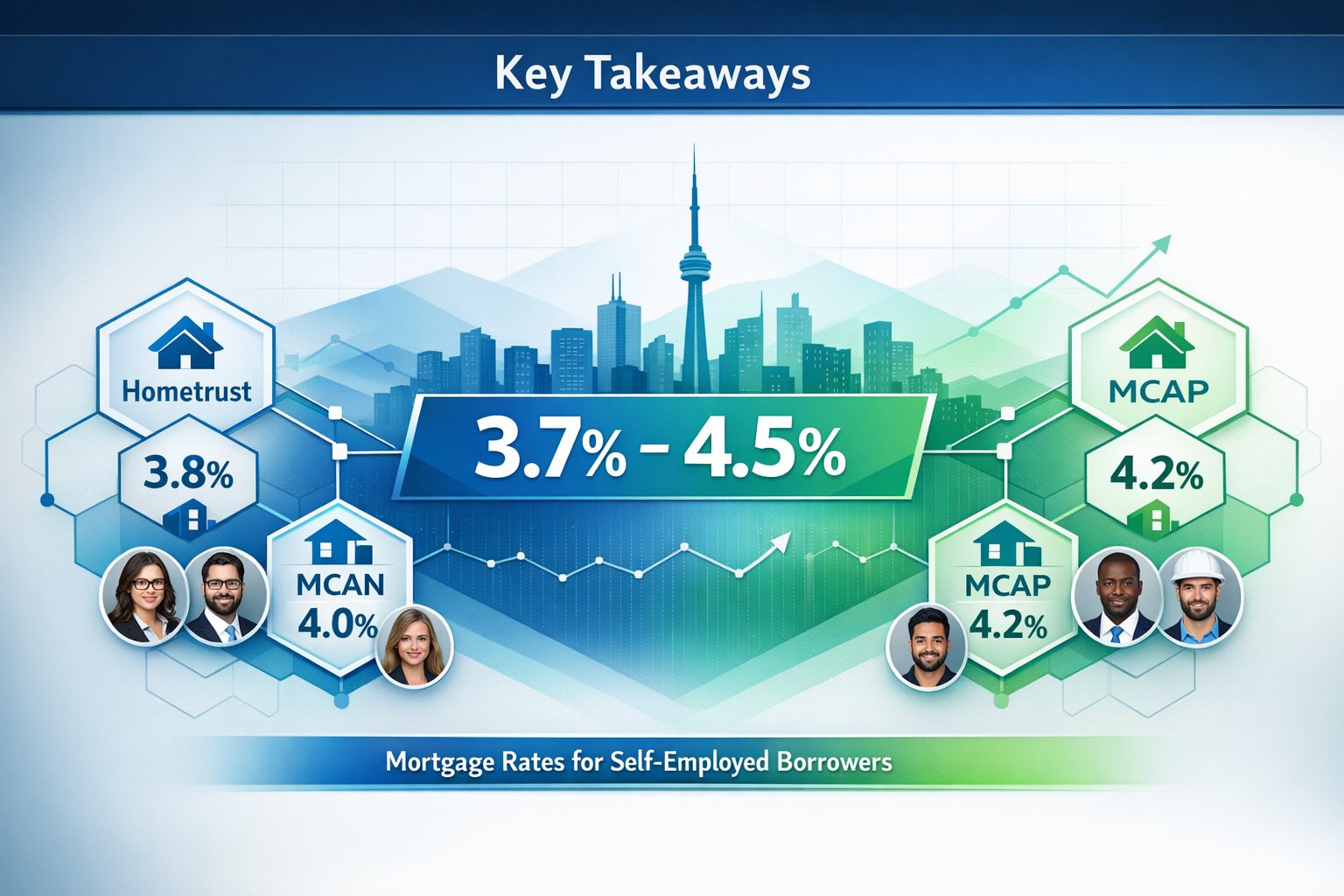
B lenders occupy a crucial middle ground in Canada’s mortgage landscape. They’re not traditional banks (A lenders), nor are they private lenders charging double-digit rates. Instead, B lenders are regulated financial institutions that offer more flexible qualification criteria while maintaining competitive interest rates[1].
What Makes B Lenders Different?
The distinction between A and B lenders centers on their qualification requirements and risk tolerance. A lenders—the Big 6 banks and major credit unions—follow strict federal guidelines and require traditional income verification. B lenders take a more holistic approach to assessing borrower risk.
Key B Lender Characteristics:
- 📊 Credit score flexibility: Accept scores as low as 600-620 (vs. 680+ for A lenders)
- 💼 Alternative income verification: Bank statements, contracts, and business financials
- 🏠 Higher loan-to-value ratios: Up to 80% LTV on some properties
- ⚡ Faster approval processes: Less bureaucracy than traditional banks
- 💰 Competitive rates: Typically 0.5%-1.5% above prime lenders
Current B Lender Rate Landscape in 2026
The B Lender Mortgage Rates for Self-Employed Toronto Borrowers: Hometrust, MCAN, and MCAP Offers at 3.7%-4.5% in 2026 reflect a favorable lending environment. With the Bank of Canada’s benchmark rate stabilizing and inflation pressures easing, B lenders have become increasingly competitive[3].
| Lender | 5-Year Fixed Rate | Variable Rate | Minimum Credit Score | Maximum LTV |
|---|---|---|---|---|
| Hometrust | 3.7%-4.2% | 3.9%-4.4% | 620 | 80% |
| MCAN | 3.8%-4.3% | 4.0%-4.5% | 620 | 80% |
| MCAP | 3.9%-4.5% | 4.1%-4.6% | 600 | 75% |
These rates compare favorably to private lenders (typically 7%-12%) while offering significantly more flexible qualification than A lenders currently offering 2.9%-3.5%[2]. For self-employed borrowers who might face rejection from traditional banks, the modest rate premium is often worthwhile.
Who Benefits Most from B Lenders?
B lenders serve specific borrower profiles particularly well:
✅ Self-employed professionals who write off substantial business expenses, reducing their taxable income below actual earnings
✅ New business owners without two years of established business history required by A lenders
✅ High-income earners with recent credit challenges (past bankruptcy, consumer proposal, or late payments now resolved)
✅ Borrowers with high GDS ratios due to property taxes, condo fees, or other housing costs in Toronto’s expensive market
✅ Those with non-traditional income sources including contract work, commission-based earnings, or multiple income streams
For Toronto’s self-employed population—which represents over 15% of the workforce—B lenders provide essential access to homeownership that might otherwise remain out of reach.
How Self-Employed Borrowers Qualify for B Lender Rates: Hometrust, MCAN, and MCAP Requirements
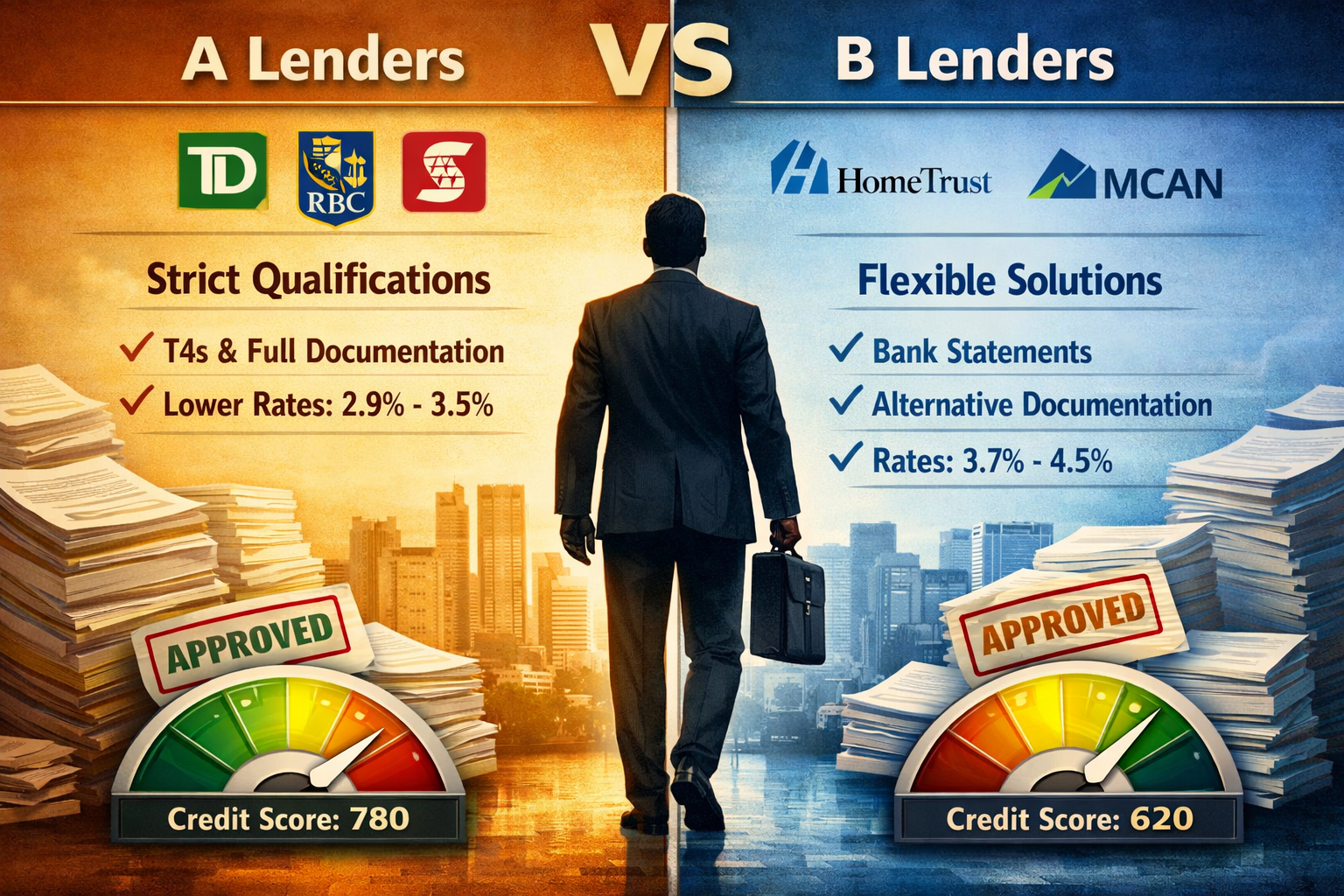
Qualifying for B Lender Mortgage Rates for Self-Employed Toronto Borrowers: Hometrust, MCAN, and MCAP Offers at 3.7%-4.5% in 2026 requires understanding the specific criteria these lenders use to assess self-employed applicants. Unlike traditional banks that rely heavily on Notice of Assessment (NOA) documents, B lenders take a more comprehensive approach.
Credit Score Requirements
Credit scores remain the foundation of B lender qualification, but the thresholds are more accessible than A lenders:
Hometrust: Minimum 620 credit score for standard programs; 600-619 considered with compensating factors (larger down payment, lower LTV)
MCAN: Minimum 620 credit score with clean payment history for past 12 months; previous credit issues acceptable if resolved
MCAP: Minimum 600 credit score; tiered pricing based on score ranges (600-649, 650-679, 680+)
While understanding credit scores is crucial for all mortgage applications, B lenders focus more on recent payment patterns than historical issues. A bankruptcy from three years ago won’t automatically disqualify you if you’ve demonstrated responsible credit behavior since.
Income Verification: The Bank Statement Approach
The game-changer for self-employed borrowers is bank statement mortgage qualification. This method recognizes that many entrepreneurs show lower taxable income than they actually earn due to legitimate business deductions.
How Bank Statement Mortgages Work:
- Collect 24 months of business bank statements (some lenders accept 12 months with strong compensating factors)
- Calculate average monthly deposits across the period
- Apply expense ratio (typically 25%-50% depending on industry)
- Determine qualifying income used for debt service calculations
Example Calculation:
- Average monthly deposits: $12,000
- Expense ratio applied: 35%
- Qualifying monthly income: $7,800
- Annual qualifying income: $93,600
This approach often yields significantly higher qualifying income than NOA documents show. For more details on this process, see our guide on bank statement mortgages for self-employed borrowers.
Down Payment and Equity Requirements
B lenders typically require larger down payments than A lenders offering insured mortgages:
- Minimum 20% down payment for most programs (no mortgage insurance available)
- 25% down for credit scores 600-619 or properties over $1 million
- Equity requirements for refinances: Minimum 20% equity remaining after refinance
Toronto’s high property values mean these down payments represent substantial capital. A $900,000 condo requires $180,000 down (20%), while a $1.4 million house needs $350,000 (25%). However, for self-employed borrowers who’ve built business equity or savings, this is often more achievable than meeting traditional income documentation requirements.
Debt Service Ratios: GDS and TDS
B lenders assess affordability using the same debt service ratios as A lenders, but with more flexibility:
Gross Debt Service (GDS): Maximum 39-44% (vs. 32-39% for A lenders)
- Includes: mortgage payment, property taxes, heating, 50% of condo fees
Total Debt Service (TDS): Maximum 44-49% (vs. 40-44% for A lenders)
- Includes: GDS plus all other debt obligations (car loans, credit cards, lines of credit)
Toronto’s high property taxes and condo fees often push borrowers into higher GDS ratios. B lenders accommodate this reality while still ensuring sustainable debt loads. Understanding the mortgage stress test remains important, as B lenders still apply qualifying rate tests.
Additional Documentation Requirements
Beyond bank statements, B lenders typically request:
✔️ Business license or registration proving self-employment status ✔️ Letter from accountant confirming business viability and income stability ✔️ Client contracts or invoices demonstrating ongoing business relationships ✔️ Personal and business tax returns (2 years, though not primary income verification) ✔️ Proof of down payment source (90-day bank statement trail)
The documentation burden is still significant, but focuses on demonstrating business stability and income consistency rather than traditional employment verification.
Bank Statement Qualification Paths for Non-Insurable Deals in Toronto
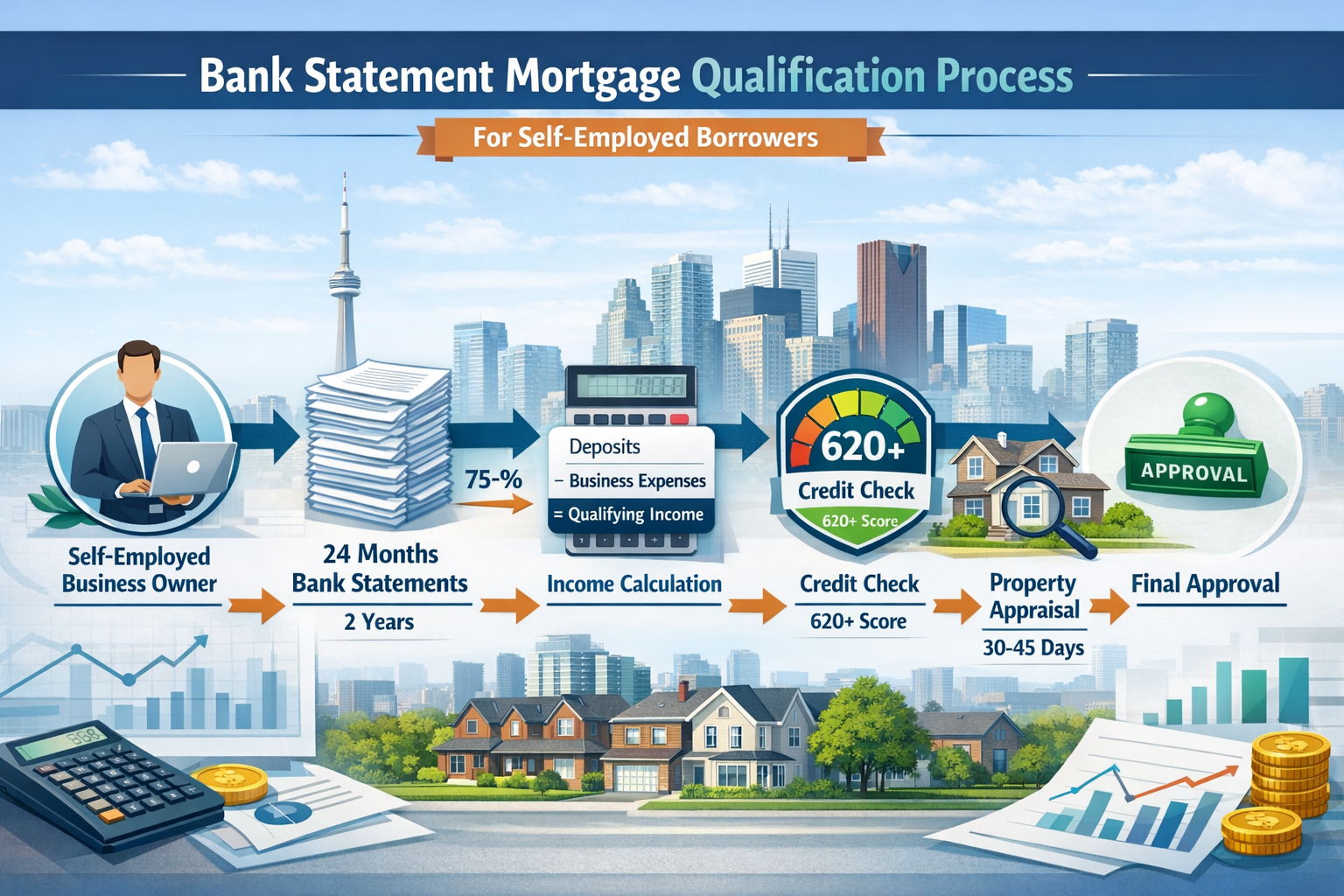
Non-insurable mortgages—those with 20% or greater down payments—represent the sweet spot for self-employed Toronto borrowers accessing B Lender Mortgage Rates for Self-Employed Toronto Borrowers: Hometrust, MCAN, and MCAP Offers at 3.7%-4.5% in 2026. These deals avoid mortgage insurance premiums while leveraging flexible qualification methods.
Understanding Non-Insurable Mortgages
Canada Mortgage and Housing Corporation (CMHC) and other mortgage insurers have strict qualification criteria that exclude most self-employed borrowers who can’t provide traditional income documentation. Non-insurable mortgages bypass this requirement entirely[1].
Non-Insurable Mortgage Characteristics:
- 🏦 Minimum 20% down payment: No insurance premiums (saving 2.8%-4% of mortgage amount)
- 📋 Lender holds full risk: More flexibility in qualification criteria
- 💵 Higher mortgage amounts: No $1 million cap that applies to insured mortgages
- ⚖️ Alternative documentation accepted: Bank statements, stated income programs
For self-employed borrowers, the 20% down payment requirement is often easier to meet than traditional income documentation. Many entrepreneurs have built substantial savings or business equity, making the larger down payment preferable to navigating A lender requirements.
Three Bank Statement Qualification Pathways
B lenders offer multiple approaches to bank statement qualification, each suited to different borrower situations:
1. Full Bank Statement Program (24 Months)
Best for: Established businesses with consistent deposit patterns
Requirements:
- 24 consecutive months of business bank statements
- Minimum 620 credit score
- Clear separation between business and personal accounts
- Consistent monthly deposits (less than 30% variance preferred)
Rate advantage: Lowest rates in the 3.7%-4.0% range
Income calculation: Average monthly deposits × (1 – expense ratio) × 12
This pathway provides the strongest income documentation and typically qualifies for the best rates. Lenders like Hometrust and MCAN prefer this approach for straightforward approvals.
2. Abbreviated Bank Statement Program (12 Months)
Best for: Newer businesses or those with improving income trends
Requirements:
- 12 consecutive months of business bank statements
- Minimum 650 credit score (higher threshold compensates for shorter history)
- Larger down payment (25% minimum)
- Additional compensating factors (strong credit, low TDS, substantial reserves)
Rate range: Mid-tier rates in the 4.0%-4.3% range
Income calculation: Average monthly deposits × (1 – expense ratio) × 12, with additional scrutiny on consistency
This option works well for self-employed borrowers whose businesses are growing or who’ve recently transitioned from traditional employment. The shorter timeframe requires stronger compensating factors but remains accessible.
3. Alternative Documentation Program
Best for: Complex income situations with multiple revenue streams
Requirements:
- Combination of bank statements, contracts, invoices, and tax returns
- Minimum 620 credit score
- Detailed letter from accountant
- Proof of business viability and ongoing client relationships
Rate range: Higher rates in the 4.2%-4.5% range
Income calculation: Lender-specific formulas considering all income sources
This pathway accommodates self-employed borrowers with seasonal income, multiple businesses, or significant investment income alongside business earnings. MCAP particularly specializes in these complex scenarios.
Industry-Specific Considerations
B lenders apply different expense ratios based on business type, recognizing that operating costs vary significantly across industries:
| Industry | Typical Expense Ratio | Qualifying Income Percentage |
|---|---|---|
| Consulting/Professional Services | 25-35% | 65-75% of deposits |
| Real Estate Agents | 35-45% | 55-65% of deposits |
| Construction/Trades | 40-50% | 50-60% of deposits |
| Retail/E-commerce | 50-60% | 40-50% of deposits |
| Restaurants/Food Services | 60-70% | 30-40% of deposits |
Understanding your industry’s typical expense profile helps set realistic expectations for qualifying income. A consultant with $10,000 monthly deposits might qualify based on $7,000 income, while a restaurant owner with the same deposits might qualify based on $3,500 income.
For those exploring alternative income documentation strategies, our article on non-QM loans for self-employed borrowers provides additional context on these specialized programs.
Toronto Market Considerations
Toronto’s unique real estate market adds specific considerations for self-employed borrowers:
High property values mean larger mortgages even with 20% down. A typical Toronto detached home at $1.4 million requires qualifying for a $1.12 million mortgage.
Property tax burden in Toronto averages 0.6%-0.7% of property value annually, significantly impacting GDS ratios compared to other Canadian cities.
Condo fees in Toronto average $600-$900 monthly for typical units, with 50% counting toward GDS calculations.
Competition in desirable neighborhoods means conditional offers may be less attractive. Pre-approval from B lenders provides certainty that helps in competitive bidding situations.
These factors make working with experienced mortgage professionals essential. Understanding how self-employed borrowers in Toronto can secure favorable mortgage rates requires navigating both lender requirements and market realities.
Strategic Considerations: When B Lenders Make Sense vs. Alternative Options

Choosing between B lenders, traditional banks, or other alternatives requires strategic thinking about both immediate needs and long-term financial goals. B Lender Mortgage Rates for Self-Employed Toronto Borrowers: Hometrust, MCAN, and MCAP Offers at 3.7%-4.5% in 2026 represent one tool in a broader mortgage strategy.
Comparing B Lenders to A Lenders
The rate difference between A and B lenders typically ranges from 0.5%-1.5%, which translates to real dollars over a mortgage term:
Example: $800,000 Mortgage, 5-Year Term
| Lender Type | Rate | Monthly Payment | Total Interest (5 Years) | Difference |
|---|---|---|---|---|
| A Lender | 3.2% | $3,862 | $79,800 | Baseline |
| B Lender | 4.0% | $4,194 | $103,400 | +$23,600 |
| B Lender | 4.5% | $4,430 | $117,800 | +$38,000 |
These numbers seem significant, but consider the alternative scenarios:
❌ Rejection from A lenders means no mortgage at all, potentially missing out on property appreciation and equity building
❌ Delaying purchase to improve documentation could mean rising property prices that outpace any interest savings
❌ Private lenders at 7%-12% would cost $50,000-$150,000+ more in interest over the same period
For many self-employed Toronto borrowers, the B lender premium is an investment in homeownership access that pays dividends through property appreciation and equity accumulation.
The Refinancing Strategy
Many savvy borrowers use B lenders as a stepping stone rather than a permanent solution:
Year 1-2: Secure property with B lender using bank statement qualification
- Build equity through payments and property appreciation
- Establish consistent income documentation
- Improve credit score if needed
Year 3-5: Position for A lender refinancing
- Prepare traditional income documentation (NOAs, T4s if incorporated)
- Demonstrate 2+ years of consistent business income
- Leverage increased property equity
At Renewal: Refinance to A lender at lower rates
- Save 0.5%-1.5% on interest rate
- Recoup initial B lender premium through lower future payments
- Maintain flexibility for future borrowing needs
This strategy works particularly well in Toronto’s appreciating market. A property purchased at $900,000 might appraise at $1,050,000 three years later, providing additional equity that strengthens the A lender application.
Alternative Lending Options
Self-employed Toronto borrowers should understand the full spectrum of options:
Traditional A Lenders with Alternative Programs
Some A lenders offer specialized self-employed programs that bridge the gap:
- Stated income programs: For borrowers with 680+ credit and 35%+ down payment
- Business-for-self programs: Simplified documentation for established professionals
- Relationship-based lending: Existing banking relationships can unlock flexibility
These programs offer A lender rates (2.9%-3.5%) but require stronger compensating factors than B lenders.
Credit Unions
Ontario credit unions like Meridian and Alterna sometimes offer middle-ground solutions:
- More flexible documentation than big banks
- Relationship-based underwriting considering full financial picture
- Rates between A and B lenders (typically 3.5%-4.0%)
Credit unions work well for borrowers with strong credit but non-traditional income documentation.
Private Lenders
Private lenders should be considered only when B lenders aren’t viable:
- Rates 7%-12%+: Significantly more expensive
- Short terms: Typically 1-2 years maximum
- Higher fees: Lender fees, broker fees, legal costs
- Equity-focused: Less concerned with income, more with property value
Private lending makes sense for very short-term bridges or when credit/income issues preclude B lender approval. For more information, see our guide on private mortgage rates in Ontario.
Investment Property Considerations
Self-employed borrowers often explore investing in rental properties as part of their wealth-building strategy. B lenders approach investment properties differently:
Rental Income Treatment:
- Most B lenders use 80% of gross rents for qualifying income
- Some require 12-month rental history before considering income
- Negative cash flow properties face additional scrutiny
Down Payment Requirements:
- Minimum 25-30% down for investment properties (vs. 20% for owner-occupied)
- Higher rates (add 0.25%-0.5% to owner-occupied rates)
Portfolio Considerations:
- Multiple properties increase complexity and rates
- Strong business income helps offset rental property risk
For self-employed borrowers building real estate portfolios, B lenders provide crucial access to financing that traditional banks often deny.
Fixed vs. Variable Rate Decisions
The fixed versus variable rate decision takes on additional nuance with B lenders:
Fixed Rate Advantages: ✅ Payment certainty crucial for budgeting with variable self-employment income ✅ Easier refinancing planning knowing exact costs through term ✅ Protection against rate increases during term
Variable Rate Advantages: ✅ Lower starting rates (typically 0.1%-0.3% below fixed) ✅ Flexibility if planning to refinance to A lender within 2-3 years ✅ Potential savings if rates decline further
For 2026, most economists project stable or slightly declining rates[3][6], suggesting variable rates might offer savings. However, self-employed borrowers often prefer fixed-rate certainty given income variability.
Working with Mortgage Professionals
Navigating B lender options requires expertise that most borrowers don’t possess. The benefits of using a mortgage broker include:
🎯 Access to multiple B lenders: Brokers work with Hometrust, MCAN, MCAP, and others simultaneously 🎯 Program expertise: Understanding which lender suits your specific situation 🎯 Documentation guidance: Helping prepare bank statements and supporting documents 🎯 Rate negotiation: Leveraging lender relationships for best possible terms 🎯 Strategic planning: Positioning for future refinancing to A lenders
For self-employed borrowers, professional guidance often makes the difference between approval and rejection—or between good rates and great rates.
Conclusion
B Lender Mortgage Rates for Self-Employed Toronto Borrowers: Hometrust, MCAN, and MCAP Offers at 3.7%-4.5% in 2026 represent a powerful solution for entrepreneurs, freelancers, and small business owners who struggle with traditional bank requirements. These lenders recognize that self-employment income doesn’t fit neatly into conventional documentation boxes, offering bank statement qualification and flexible underwriting that makes homeownership accessible.
The modest rate premium—typically 0.5%-1.5% above A lenders—is a worthwhile investment for borrowers who would otherwise face rejection or significantly higher private lender costs. With credit scores of 620+, 20% down payments, and 24 months of bank statements, self-employed Toronto borrowers can secure competitive financing that builds equity and establishes a foundation for future refinancing to even better rates.
Actionable Next Steps
Ready to explore B lender options for your Toronto property purchase or refinance? Take these steps:
- Gather 24 months of business bank statements to assess your qualifying income potential
- Check your credit score and address any issues that might impact your rate tier
- Calculate your debt service ratios to understand affordability within B lender guidelines
- Research current rates from Hometrust, MCAN, and MCAP to compare offers
- Consult with a mortgage broker experienced in self-employed lending to identify the best program for your situation
- Prepare supporting documentation including business licenses, accountant letters, and proof of down payment
- Get pre-approved before house hunting to strengthen your negotiating position in Toronto’s competitive market
The path to homeownership as a self-employed borrower may require more documentation and slightly higher rates, but it’s absolutely achievable. B lenders have created specialized programs specifically designed for your situation, and 2026’s favorable rate environment makes this an opportune time to act.
Don’t let traditional bank rejections discourage you. The flexibility and accessibility of B lender programs mean your entrepreneurial success can translate into real estate ownership—building wealth through property equity while enjoying the stability of homeownership in one of Canada’s most dynamic cities.
References
[1] Self Employed – https://rates.ca/guides/mortgage/self-employed
[2] Mortgages – https://www.ratehub.ca/mortgages
[3] Interest Rate Forecast – https://wowa.ca/interest-rate-forecast
[4] Mortgage Rates Toronto – https://citadelmortgages.ca/mortgage-rates-toronto/
[5] Posted Interest Rates Offered By Chartered Banks – https://www.bankofcanada.ca/rates/banking-and-financial-statistics/posted-interest-rates-offered-by-chartered-banks/
[6] Mortgage Rate Forecast – https://www.truenorthmortgage.ca/blog/mortgage-rate-forecast
[7] Mortgage Interest Rate Forecast – https://www.mortgagesandbox.com/mortgage-interest-rate-forecast
 Previous Page