May 22, 2026
metal 3d printer
Share this article:



Manzeel is an award-winning Mortgage Broker and the Owner of the Toronto-based mortgage, Everything Mortgages.
With 16 years of experience in the Canadian mortgage industry and a formal background in mortgage underwriting, Manzeel’s lending expertise gives him unique insight into whether a deal is feasible which empowers his clients to make more informed lending decisions faster.
He has been recognized as one of Canada’s Top 10 Mortgage Brokers by the national Canadian Mortgage Professionals (CMP) Association. Him and his team of 18 mortgage agents are proud to offer a mortgage experience that's built on honesty, trust, and integrity. He prides himself on the brokerage’s dedication to deliver an excellent client experience throughout the entire home loan process from pre-approval to post-funding.
Since moving to Toronto in 1998, Manzeel has successfully launched and scaled several businesses from the ground up, ranging from a mortgage brokerage and a vast real estate investment portfolio to a private financing eCommerce platform. He continues to be a leader in the real estate industry as he uses his analytical expertise to seek new real estate investment opportunities.
As a tech junkie and avid sports enthusiast, when Manzeel’s not working with clients, you can find him reading technology blogs, playing squash or watching tennis with his two boys.
By 2026, the global metal additive manufacturing market has surpassed $8 billion, growing at nearly 20% annually — and the technology is no longer reserved for aerospace giants or elite research labs. A metal 3D printer is now a viable, cost-effective tool for manufacturers, engineers, and product designers across dozens of industries.
This guide covers everything you need to know: how metal 3D printing works, which technologies exist, real-world applications, how to choose the right machine, and what the future holds.
Key Takeaways 📌
- A metal 3D printer builds parts layer by layer from metal powder or wire, enabling geometries impossible with traditional machining.
- Multiple technologies exist — DMLS, SLM, EBM, and WAAM — each suited to different materials and applications.
- Industries from aerospace to medicine rely on metal additive manufacturing for complex, lightweight, and customized parts.
- Total cost of ownership goes beyond machine price — factor in materials, post-processing, and operator training.
- Choosing the right metal 3D printer depends on part size, material requirements, resolution needs, and production volume.
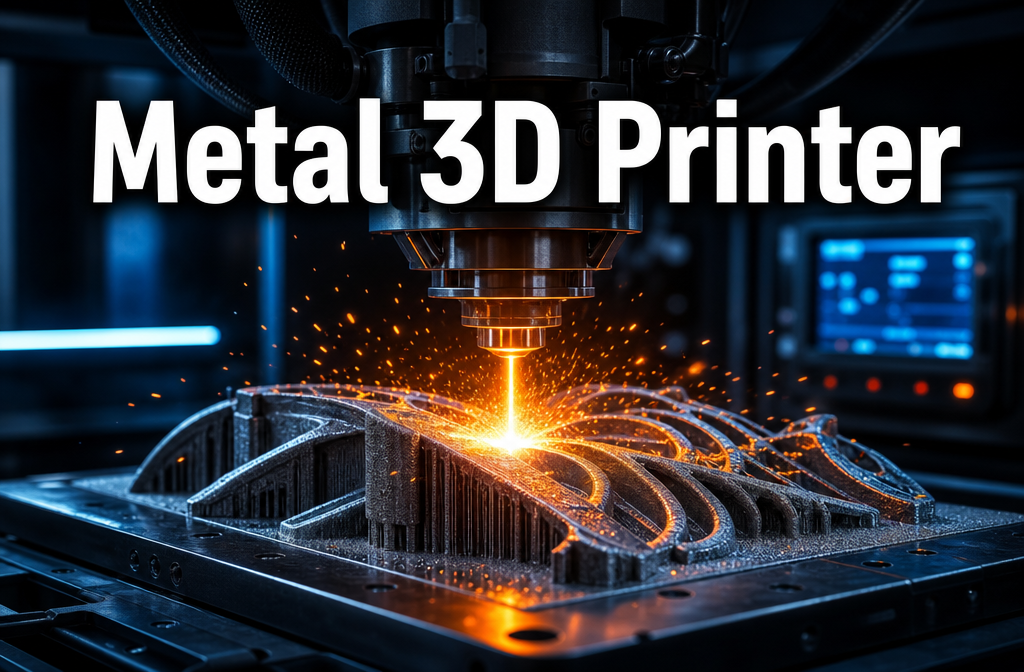
What Is a Metal 3D Printer and How Does It Work?
A metal 3D printer is an additive manufacturing system that builds solid metal components by fusing metal powder or wire, layer by layer, using a heat source such as a laser, electron beam, or electric arc.
Unlike subtractive manufacturing — where material is cut away from a solid block — metal additive manufacturing adds material only where it is needed. This reduces waste dramatically and enables internal channels, lattice structures, and organic geometries that CNC machining simply cannot produce.
The Core Process
Most metal 3D printing systems follow this general workflow:
- Design — A 3D CAD model is created and sliced into thin horizontal layers (typically 20–100 microns thick).
- Preparation — Support structures are added where overhangs exist. The build platform is set up inside the machine.
- Printing — The heat source (laser, electron beam, or arc) fuses each layer of metal powder or wire.
- Post-processing — Parts are removed, supports are cut away, and finishing operations (heat treatment, machining, polishing) are applied.
The Four Main Metal 3D Printing Technologies
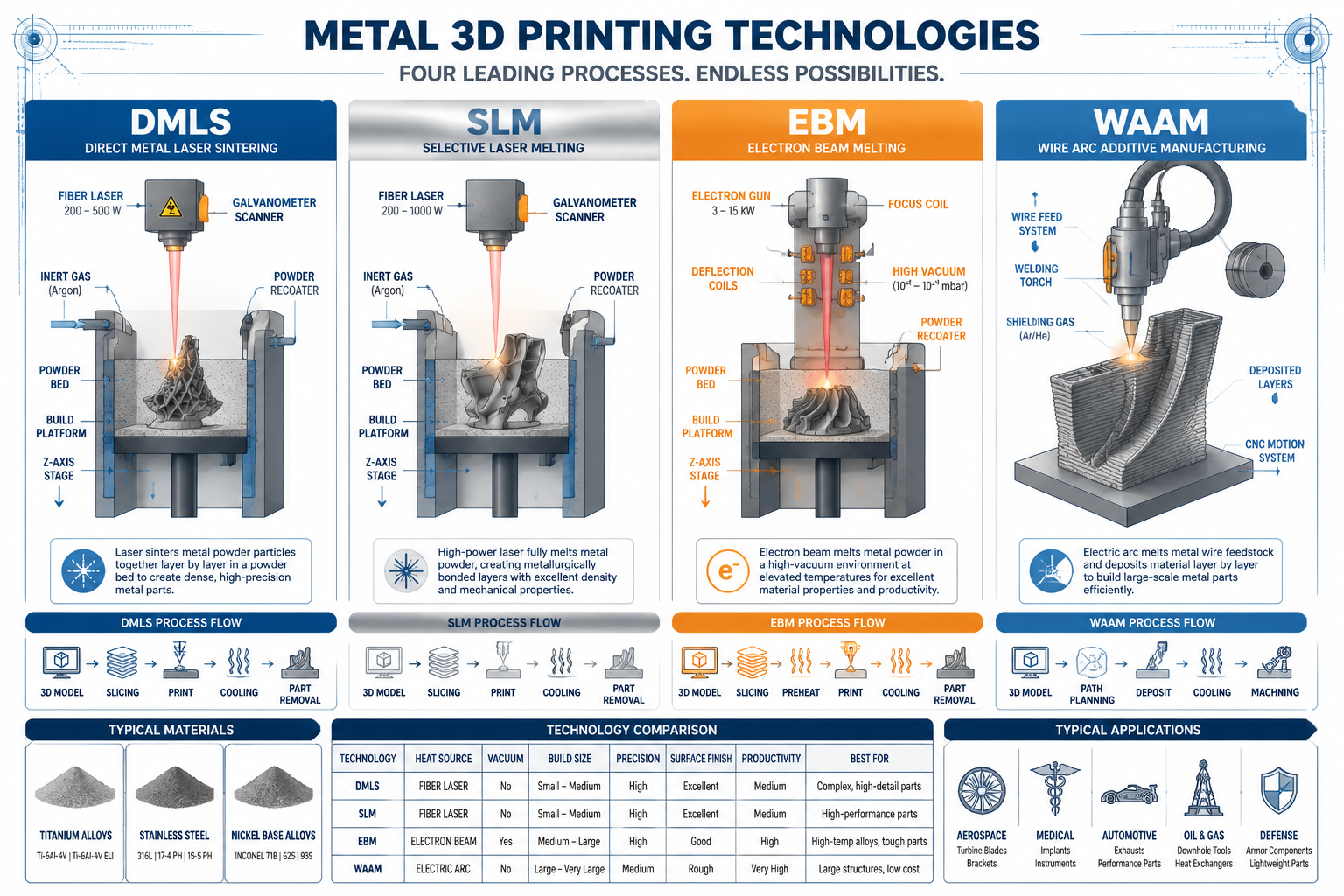
Not all metal 3D printers are the same. The technology chosen determines the materials available, part quality, speed, and cost.
1. 🔵 Direct Metal Laser Sintering (DMLS) & Selective Laser Melting (SLM)
These two technologies are closely related and often used interchangeably. Both use a high-powered laser to fuse metal powder in a sealed, inert-gas chamber.
| Feature | DMLS | SLM |
|---|---|---|
| Melting method | Partial melting (sintering) | Full melting |
| Density | ~95–99% | ~99–100% |
| Common materials | Stainless steel, titanium, Inconel | Aluminum, steel, titanium |
| Best for | Complex, high-detail parts | Fully dense structural parts |
💡 Pull Quote: “SLM-produced titanium implants can achieve bone-matching porosity levels that traditional manufacturing cannot replicate.”
2. 🟠 Electron Beam Melting (EBM)
EBM uses a focused electron beam in a vacuum environment to melt metal powder. Because it operates in a vacuum and at higher temperatures, EBM produces parts with very low residual stress — ideal for reactive metals like titanium and cobalt-chrome.
Key advantages of EBM:
- Excellent for biomedical implants
- Faster build speeds than laser-based systems
- Reduced need for heat treatment post-process
3. 🟢 Wire Arc Additive Manufacturing (WAAM)
WAAM uses an electric arc to melt metal wire feedstock, depositing material layer by layer. It is the most cost-effective option for large-scale metal parts — think ship propellers, aerospace structural frames, and tooling.
- ✅ Very fast deposition rates
- ✅ Low material cost (wire vs. powder)
- ✅ Suitable for large build volumes
- ❌ Lower resolution than powder-bed methods
- ❌ Requires more post-processing machining
4. Binder Jetting for Metal
Binder jetting deposits a liquid binding agent onto metal powder layers, then sinters the “green part” in a furnace. This method is highly scalable and cost-competitive for medium-to-high volume production runs.
Real-World Applications of Metal 3D Printers
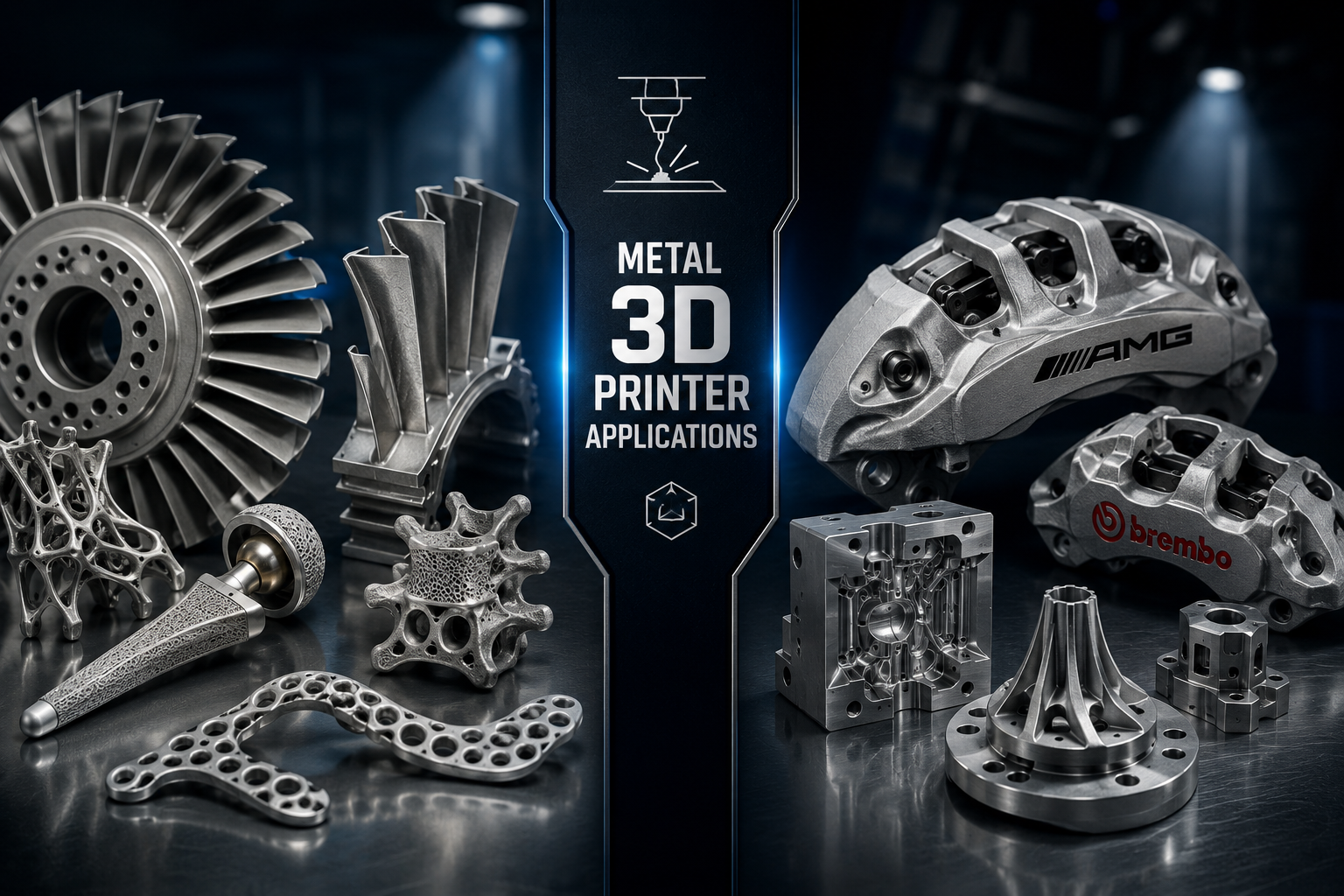
The versatility of a metal 3D printer has driven adoption across multiple high-stakes industries.
🚀 Aerospace & Defense
Aerospace was among the earliest adopters. Metal additive manufacturing enables:
- Topology-optimized brackets that are 40–60% lighter than machined equivalents
- Combustion chambers and nozzles with internal cooling channels
- Rapid prototyping of flight-critical components
🏥 Medical & Dental
Custom implants, surgical instruments, and dental crowns are now routinely produced on metal 3D printers. Titanium’s biocompatibility makes it the material of choice for:
- Orthopedic implants (hip, knee, spine)
- Patient-specific cranial plates
- Dental bridges and frameworks
🏎️ Automotive & Motorsport
Formula 1 teams and high-performance vehicle manufacturers use metal printing to produce:
- Brake calipers and suspension components
- Lightweight exhaust manifolds
- Rapid tooling and jigs
🏭 Industrial Tooling
Injection mold inserts with conformal cooling channels — impossible to drill conventionally — dramatically reduce cycle times and improve part quality.
How to Choose the Right Metal 3D Printer
Selecting a metal 3D printer is a significant investment decision. The wrong choice can result in wasted budget, poor part quality, or a machine that doesn’t scale with your needs.
Step 1: Define Your Material Requirements
Different machines support different alloys. Common metal 3D printing materials include:
| Material | Common Use Cases | Compatible Technologies |
|---|---|---|
| Titanium (Ti-6Al-4V) | Medical, aerospace | DMLS, SLM, EBM |
| Stainless Steel (316L) | Industrial, medical | DMLS, SLM, Binder Jetting |
| Inconel 718 | High-temp aerospace | DMLS, SLM |
| Aluminum (AlSi10Mg) | Lightweight structures | DMLS, SLM |
| Cobalt-Chrome | Dental, orthopedics | EBM, SLM |
Step 2: Consider Build Volume
Build volume directly determines the maximum part size. Entry-level machines may offer a build envelope of 100 × 100 × 100 mm, while industrial systems can exceed 400 × 400 × 400 mm. WAAM systems can produce parts measured in meters.
Step 3: Evaluate Resolution and Surface Finish
Applications like dental prosthetics and turbine blades demand tight tolerances (±0.05 mm or better). High-resolution powder-bed systems (DMLS/SLM) are preferred. For structural parts where post-machining is planned, WAAM or binder jetting may suffice.
Step 4: Calculate Total Cost of Ownership
The machine purchase price is only part of the equation:
- Metal powder cost: $50–$600+ per kg depending on alloy
- Inert gas consumption (argon/nitrogen)
- Post-processing equipment: furnaces, HIP machines, CNC finishing
- Operator training and certification
- Maintenance and service contracts
⚠️ Important: A $500,000 industrial metal 3D printer may cost an additional $200,000–$400,000 per year to operate at full capacity.
Step 5: Match Machine to Production Volume
| Production Need | Recommended Approach |
|---|---|
| Prototyping / R&D | Entry-to-mid level DMLS/SLM system |
| Low-volume production (1–100 parts) | Mid-range SLM or EBM |
| Medium-volume production | Binder jetting or multi-laser SLM |
| Large structural parts | WAAM systems |
Leading Metal 3D Printer Manufacturers in 2026
The market is led by a handful of established players, each with distinct strengths:
- EOS — Pioneer in DMLS, wide material portfolio, strong in aerospace and medical
- Trumpf — High-speed laser metal fusion systems, strong European industrial base
- GE Additive (Concept Laser & Arcam) — Covers both laser and EBM technologies
- Desktop Metal — Binder jetting systems designed for production scalability
- Markforged — Accessible metal FDM systems for engineering teams
- WAAM3D — Specialized large-format wire arc systems
Common Challenges and How to Overcome Them
Even the best metal 3D printer comes with operational challenges:
🔴 Residual Stress and Warping Rapid heating and cooling cycles create internal stress. Solution: Optimize support structures, use stress-relief heat treatment, and consider EBM for stress-sensitive alloys.
🔴 Powder Handling Safety Fine metal powders are combustible and pose inhalation risks. Solution: Use closed-loop powder handling systems, proper PPE, and follow OSHA/ISO safety standards.
🔴 Post-Processing Complexity Metal printed parts almost always require additional steps. Solution: Plan the full production chain — including HIP (Hot Isostatic Pressing), heat treatment, and surface finishing — before purchasing a machine.
🔴 Design Expertise Gap Designing for metal additive manufacturing is different from designing for machining. Solution: Invest in Design for Additive Manufacturing (DfAM) training for engineering teams.
The Future of Metal 3D Printing
The trajectory of metal additive manufacturing points toward faster speeds, lower costs, and broader material availability. Key trends shaping the industry through 2026 and beyond:
- Multi-laser systems with 4–12 lasers printing simultaneously, dramatically cutting build times
- AI-driven process monitoring that detects defects in real time and adjusts parameters automatically
- New alloys developed specifically for additive processes, not adapted from traditional manufacturing
- Hybrid machines combining additive deposition with CNC machining in a single platform
- Decentralized manufacturing enabled by digital part libraries and on-demand local printing
Conclusion: Your Next Steps with a Metal 3D Printer
A metal 3D printer is one of the most transformative tools available to modern manufacturers and engineers. Whether the goal is producing patient-specific implants, lightweight aerospace brackets, or complex industrial tooling, metal additive manufacturing delivers capabilities that no other process can match.
Actionable next steps:
- ✅ Audit your current parts — Identify components that are expensive to machine, have long lead times, or require complex internal geometries. These are prime candidates for metal 3D printing.
- ✅ Run a pilot project — Before investing in equipment, partner with a metal printing service bureau to validate the technology for your specific application.
- ✅ Train your team — DfAM knowledge is the single biggest factor separating successful implementations from costly failures.
- ✅ Build a business case — Compare total cost of ownership against current manufacturing costs, including material waste, lead time, and tooling expenses.
- ✅ Stay current — The technology evolves rapidly. Follow industry publications and attend events like Formnext to track emerging capabilities.
Metal additive manufacturing is no longer a niche research tool — it is a production-ready technology reshaping global supply chains. The organizations that invest in understanding and deploying it today will hold a significant competitive advantage tomorrow.
 Previous Page