May 23, 2026
bambu 3d printer
Share this article:



Manzeel is an award-winning Mortgage Broker and the Owner of the Toronto-based mortgage, Everything Mortgages.
With 16 years of experience in the Canadian mortgage industry and a formal background in mortgage underwriting, Manzeel’s lending expertise gives him unique insight into whether a deal is feasible which empowers his clients to make more informed lending decisions faster.
He has been recognized as one of Canada’s Top 10 Mortgage Brokers by the national Canadian Mortgage Professionals (CMP) Association. Him and his team of 18 mortgage agents are proud to offer a mortgage experience that's built on honesty, trust, and integrity. He prides himself on the brokerage’s dedication to deliver an excellent client experience throughout the entire home loan process from pre-approval to post-funding.
Since moving to Toronto in 1998, Manzeel has successfully launched and scaled several businesses from the ground up, ranging from a mortgage brokerage and a vast real estate investment portfolio to a private financing eCommerce platform. He continues to be a leader in the real estate industry as he uses his analytical expertise to seek new real estate investment opportunities.
As a tech junkie and avid sports enthusiast, when Manzeel’s not working with clients, you can find him reading technology blogs, playing squash or watching tennis with his two boys.
By 2026, the desktop 3D printing market has grown into a multi-billion-dollar industry — and no single brand has disrupted it more decisively than Bambu Lab. Within just two years of its first product launch, the Bambu 3D printer lineup redefined what hobbyists, engineers, and small businesses expect from a consumer-grade machine. Speed, automation, and multi-material printing — once reserved for industrial systems — arrived on desktops at a fraction of the cost.
This guide breaks down everything worth knowing about the Bambu 3D printer ecosystem: its key models, standout features, material capabilities, software, and who each machine is best suited for.
Key Takeaways 📌
- Bambu Lab printers are among the fastest consumer FDM machines available, with print speeds up to 500 mm/s.
- The AMS (Automatic Material System) enables multi-color and multi-material printing with minimal manual intervention.
- The lineup spans entry-level to professional tiers, covering budgets from ~$300 to ~$1,500.
- Bambu Studio slicer software is beginner-friendly yet powerful enough for advanced users.
- Bambu printers are best suited for users who value speed, reliability, and automation over deep DIY customization.
Understanding the Bambu 3D Printer Lineup
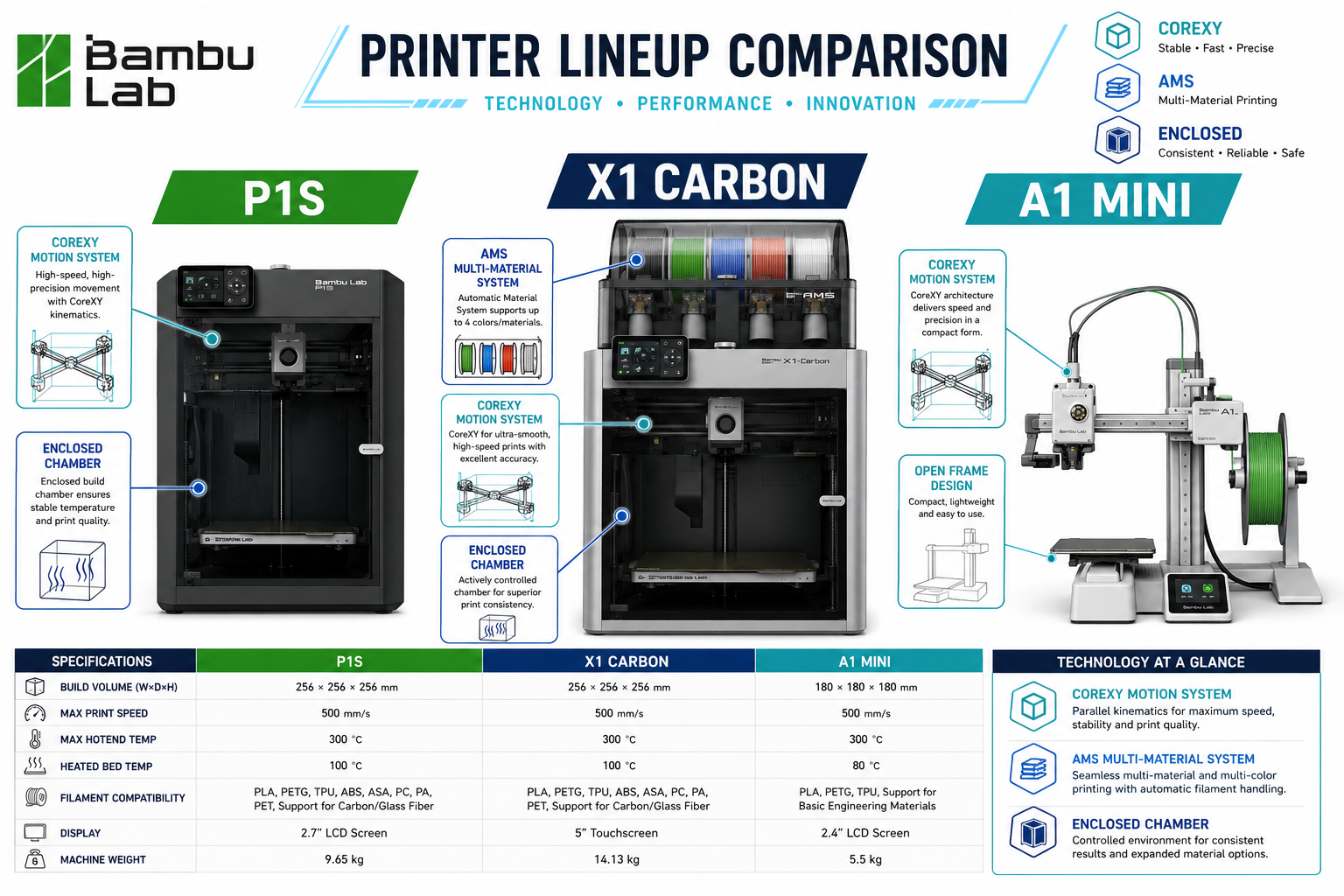
Bambu Lab offers a focused but well-structured range of printers. Rather than flooding the market with dozens of SKUs, the company maintains four core models, each targeting a distinct user segment.
Bambu Lab A1 Mini — Best Entry-Level Bambu 3D Printer
The A1 Mini is the most affordable entry point into the Bambu ecosystem. It features an open-frame design, a 180 × 180 × 180 mm build volume, and is compatible with the AMS Lite for multi-color printing. At roughly $300–$350, it’s aimed at beginners and casual makers who want Bambu’s speed and reliability without a large upfront investment.
Best for: Students, hobbyists, first-time 3D printer buyers.
Bambu Lab A1 — The Versatile Mid-Range Option
Stepping up from the Mini, the A1 offers a larger 256 × 256 × 256 mm build volume and supports the full AMS Lite system. It retains the open-frame design but delivers faster print speeds and improved vibration compensation through its built-in accelerometer.
Best for: Makers who need larger prints and occasional multi-color work.
Bambu Lab P1S — Enclosed Performance
The P1S is an enclosed, fully automated machine that bridges the gap between consumer and prosumer. It supports an active temperature chamber, enabling reliable printing with engineering-grade filaments like ABS, ASA, and PA (nylon). It connects to the full AMS system for up to 16-color printing when four AMS units are chained together.
Best for: Engineers, product designers, small businesses.
Bambu Lab X1 Carbon — The Flagship Bambu 3D Printer
The X1 Carbon sits at the top of the lineup. It adds a multi-spectral sensor for first-layer inspection, a LiDAR scanner for real-time calibration, and an AI-powered camera system. Print speeds reach up to 500 mm/s, and the CoreXY motion system maintains exceptional dimensional accuracy even at high velocities.
Best for: Power users, professionals, and anyone who demands the absolute best from a desktop machine.
| Model | Build Volume | Max Speed | Enclosure | Starting Price (2026) |
|---|---|---|---|---|
| A1 Mini | 180³ mm | 500 mm/s | ❌ Open | ~$300 |
| A1 | 256³ mm | 500 mm/s | ❌ Open | ~$450 |
| P1S | 256³ mm | 500 mm/s | ✅ Yes | ~$700 |
| X1 Carbon | 256³ mm | 500 mm/s | ✅ Yes | ~$1,200 |
What Makes the Bambu 3D Printer Stand Out? 🚀
Several technical decisions separate Bambu machines from competitors like Prusa, Creality, and AnkerMake.
CoreXY Motion System
Traditional bed-slinger printers move the print bed back and forth, which limits speed and introduces ringing artifacts. Bambu’s CoreXY architecture moves only the lightweight print head in the XY plane, dramatically reducing moving mass. This is what enables the 500 mm/s headline speed without sacrificing print quality.
“The CoreXY system, combined with input shaping algorithms, is the single biggest reason Bambu prints look clean at speeds that would destroy quality on a conventional printer.”
Automatic Material System (AMS)
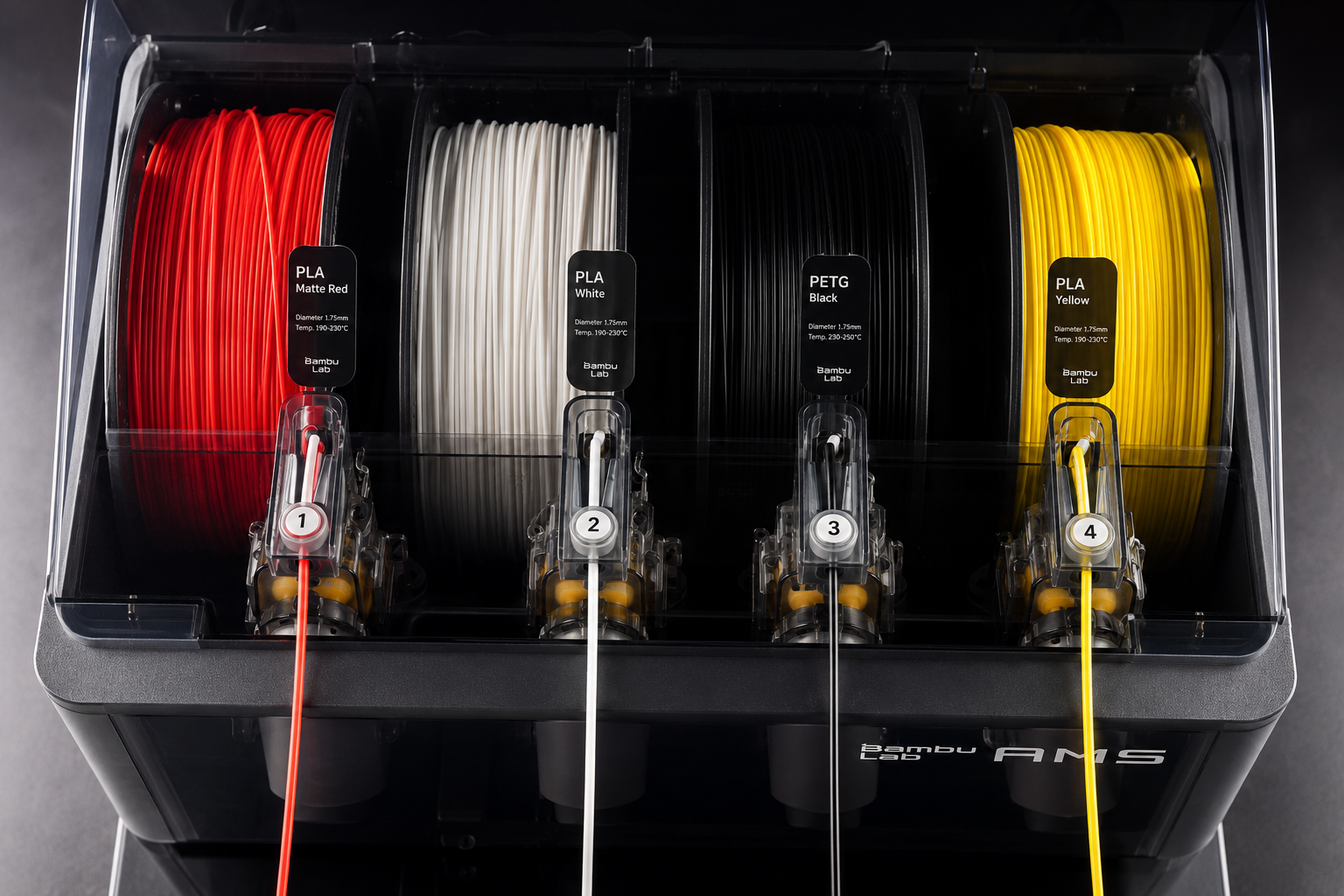
The AMS is arguably Bambu’s most innovative feature. It holds up to four spools and automatically switches filaments during a print, enabling multi-color and multi-material objects without manual intervention. Four AMS units can be chained for up to 16 simultaneous colors — a capability that was previously exclusive to industrial equipment.
Built-In Calibration & AI Features
Every Bambu 3D printer includes automatic bed leveling, vibration compensation, and flow rate calibration. The X1 Carbon adds LiDAR-based first-layer scanning and a multi-spectral sensor that detects spaghetti failures in real time, pausing the print before wasted filament piles up.
Connectivity & Remote Monitoring
All models support Wi-Fi connectivity, enabling remote monitoring via the Bambu Handy mobile app or through the cloud-based dashboard. Users can start, pause, and monitor prints from anywhere — a feature that professional users and small production shops genuinely rely on.
Compatible Materials for Bambu 3D Printers
Material compatibility varies by model, largely due to the presence or absence of an enclosed chamber.
Open-Frame Models (A1, A1 Mini)
- ✅ PLA, PETG, TPU (flexible), PLA-CF
- ❌ ABS, ASA, PA (warping risk without enclosure)
Enclosed Models (P1S, X1 Carbon)
- ✅ PLA, PETG, TPU, ABS, ASA, PA, PC, PLA-CF, PA-CF, PET-CF
- ⚠️ Some exotic composites may require hardened steel nozzles
Bambu sells its own branded filament line under the Bambu Lab name, with spools encoded with NFC chips that auto-configure print settings in Bambu Studio. Third-party filaments work perfectly well, but require manual profile setup.
Bambu Studio: Software That Matches the Hardware
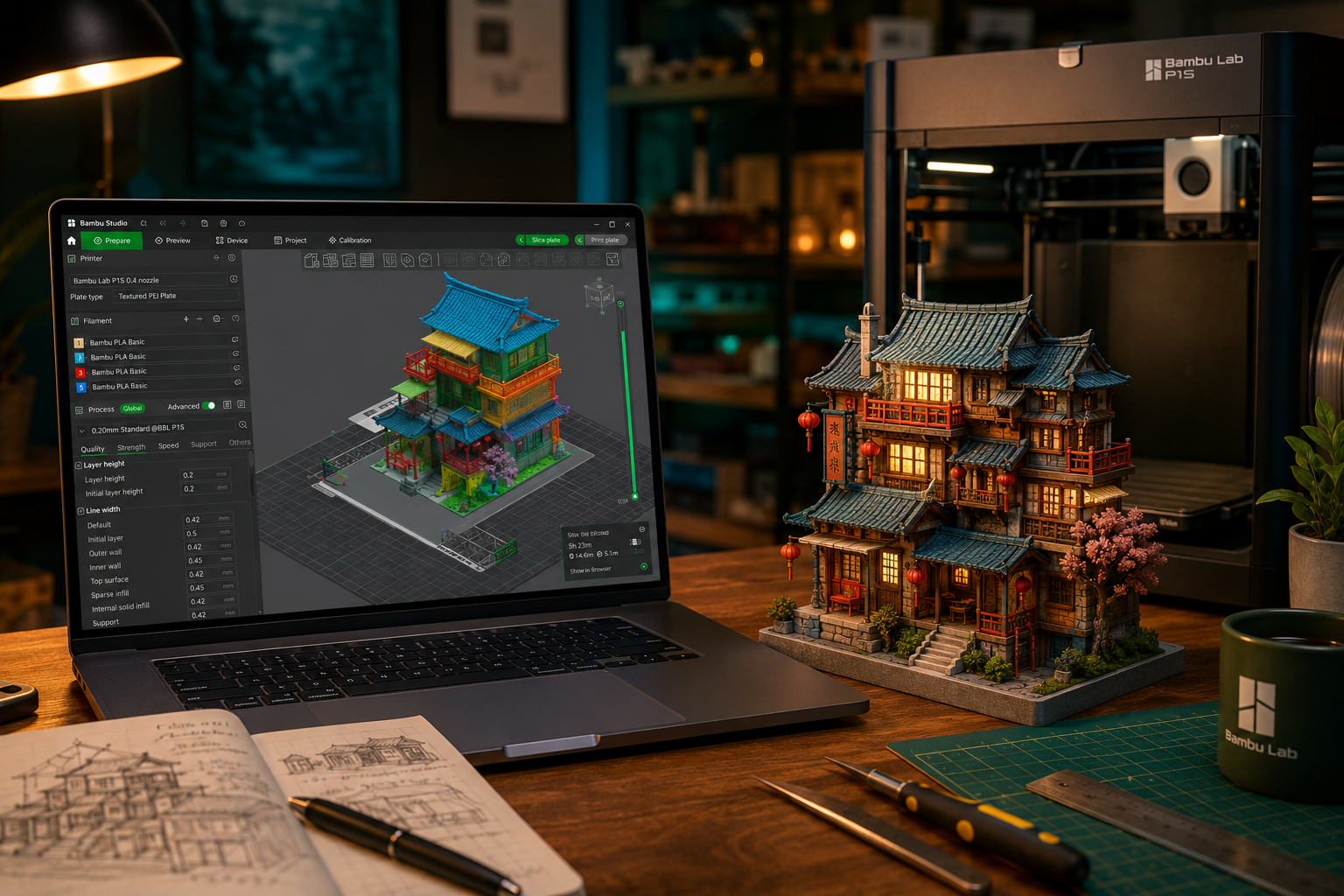
A great printer paired with poor software is a frustrating experience. Bambu Lab recognized this and built Bambu Studio, a slicer forked from PrusaSlicer, with a heavily customized interface optimized for Bambu hardware.
Key Software Features
- One-click print profiles for every Bambu filament type
- Multi-color paint tool for assigning colors to model surfaces
- Supports-on-demand with tree and grid support generation
- Cloud slicing for low-powered devices
- Orca Slicer compatibility — the popular open-source fork adds even more fine-tuning options
For beginners, the default profiles produce excellent results straight out of the box. For advanced users, every parameter from pressure advance to volumetric flow rate is accessible and adjustable.
Who Should Buy a Bambu 3D Printer? 🎯
Not every printer is right for every user. Here’s a practical breakdown:
✅ Buy a Bambu if you:
- Want fast, reliable prints with minimal tinkering
- Need multi-color capability
- Print engineering materials (choose P1S or X1 Carbon)
- Value a polished, integrated software-hardware experience
❌ Consider alternatives if you:
- Prefer open-source, fully hackable hardware (look at Voron or Prusa)
- Need a build volume larger than 256³ mm
- Are on a very tight budget under $200
Common Questions About the Bambu 3D Printer
Is the Bambu 3D printer good for beginners?
Yes — particularly the A1 Mini. The automated calibration, simple software, and reliable default profiles make it one of the most beginner-friendly machines on the market in 2026. Users can unbox, assemble (minimal assembly required), and print a successful first object within an hour.
How loud are Bambu printers?
Bambu printers are notably quieter than many competitors, typically operating between 35–45 dB in normal mode. A “silent mode” reduces noise further at the cost of some print speed.
Does Bambu use a proprietary ecosystem?
Bambu hardware works best with Bambu filament and Bambu Studio, but neither is mandatory. Third-party filaments and open-source slicers like Orca Slicer are fully supported. The AMS does have some proprietary elements, but the broader ecosystem is reasonably open.
What is the warranty on Bambu printers?
Bambu Lab offers a one-year limited warranty on hardware defects, with active customer support via their online community and official channels.
Conclusion: Is the Bambu 3D Printer Right for You?
The Bambu 3D printer lineup represents the most significant leap in consumer desktop fabrication in the past decade. By combining industrial-grade motion systems, intelligent automation, and genuinely user-friendly software, Bambu Lab has made high-quality 3D printing accessible to a far broader audience than ever before.
Actionable Next Steps ✅
- Define your use case — hobby prints, functional prototypes, or multi-color models each point to a different model.
- Start with the A1 Mini if budget is a concern; upgrade to the P1S or X1 Carbon if engineering materials or professional output are priorities.
- Download Bambu Studio (free) and explore the model library before purchasing to get a feel for the workflow.
- Join the Bambu Lab community on MakerWorld and the official forum — thousands of pre-configured print profiles and models are freely shared.
- Consider the AMS bundle from the start if multi-color printing is appealing — retrofitting it later costs more than buying it bundled.
Whether the goal is printing functional brackets, detailed miniatures, or full-color prototypes, the Bambu ecosystem in 2026 delivers a compelling, well-rounded solution that is hard to match at its price points.
Meta Title: Bambu 3D Printer: Full Guide to Models, Features & Speed
Meta Description: Explore the complete Bambu 3D printer guide for 2026 — covering all models, AMS multi-color system, materials, software, and who each printer is best for.
 Previous Page