May 25, 2026
things to 3d print
Share this article:



Manzeel is an award-winning Mortgage Broker and the Owner of the Toronto-based mortgage, Everything Mortgages.
With 16 years of experience in the Canadian mortgage industry and a formal background in mortgage underwriting, Manzeel’s lending expertise gives him unique insight into whether a deal is feasible which empowers his clients to make more informed lending decisions faster.
He has been recognized as one of Canada’s Top 10 Mortgage Brokers by the national Canadian Mortgage Professionals (CMP) Association. Him and his team of 18 mortgage agents are proud to offer a mortgage experience that's built on honesty, trust, and integrity. He prides himself on the brokerage’s dedication to deliver an excellent client experience throughout the entire home loan process from pre-approval to post-funding.
Since moving to Toronto in 1998, Manzeel has successfully launched and scaled several businesses from the ground up, ranging from a mortgage brokerage and a vast real estate investment portfolio to a private financing eCommerce platform. He continues to be a leader in the real estate industry as he uses his analytical expertise to seek new real estate investment opportunities.
As a tech junkie and avid sports enthusiast, when Manzeel’s not working with clients, you can find him reading technology blogs, playing squash or watching tennis with his two boys.
The global 3D printing market reached $18.3 billion in 2024 and continues to expand as desktop printers become more affordable and accessible. Whether you own a budget-friendly FDM printer or a high-resolution resin machine, discovering the right things to 3D print transforms your device from an expensive paperweight into an indispensable tool for solving everyday problems and unleashing creativity.
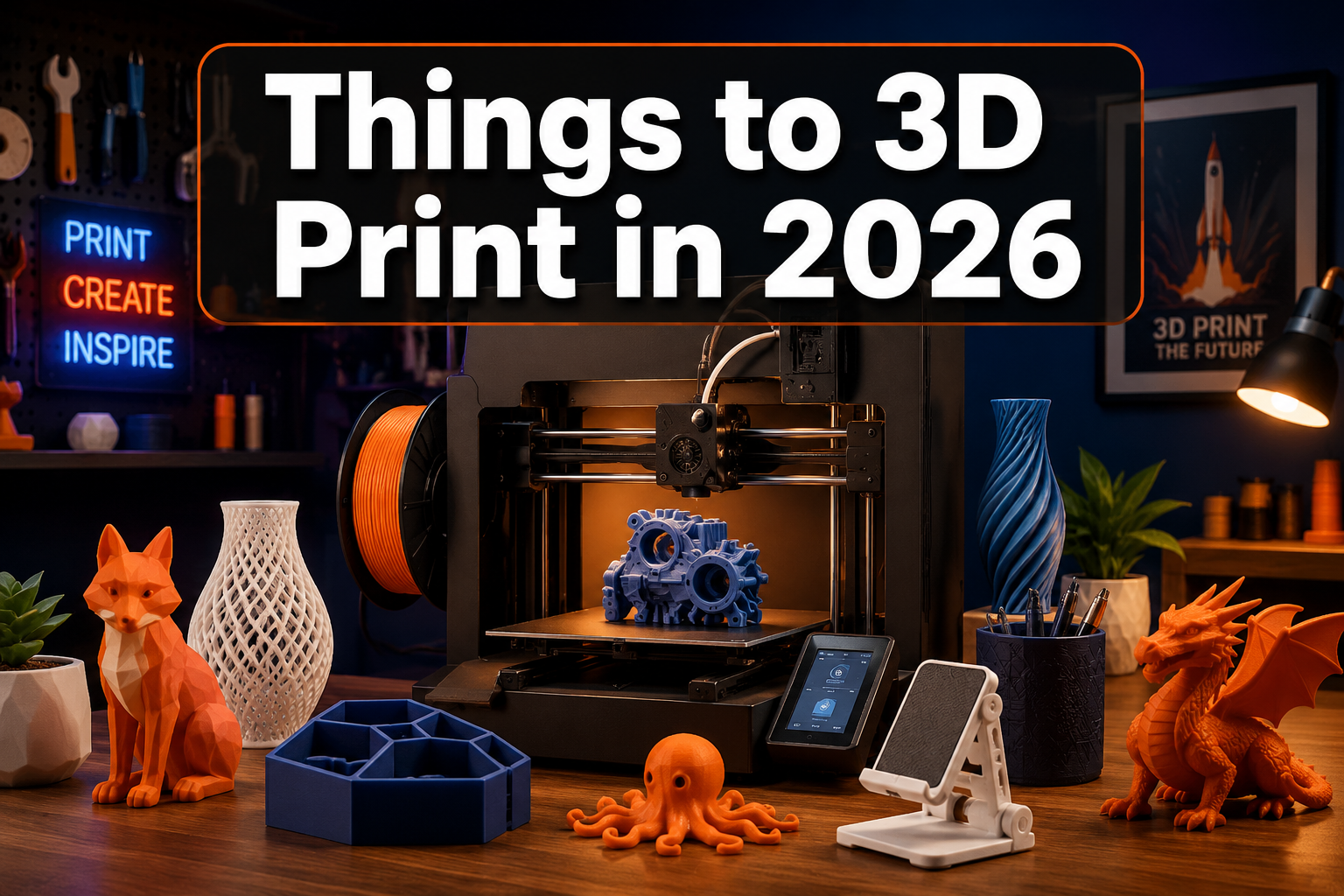
This comprehensive guide explores practical, creative, and functional things to 3D print that deliver real value. From household solutions to personalized gifts, these projects maximize your printer’s potential while building essential design and manufacturing skills.
Key Takeaways
- Practical household items like organizers, replacement parts, and kitchen tools offer immediate value and cost savings
- Creative projects including miniatures, decorative objects, and personalized gifts showcase 3D printing’s artistic potential
- Functional prototypes and mechanical parts demonstrate advanced applications for hobbyists and professionals
- Skill progression from simple prints to complex designs builds confidence and technical expertise
- Material selection significantly impacts print quality, durability, and application suitability
Practical Household Things to 3D Print
Organization and Storage Solutions
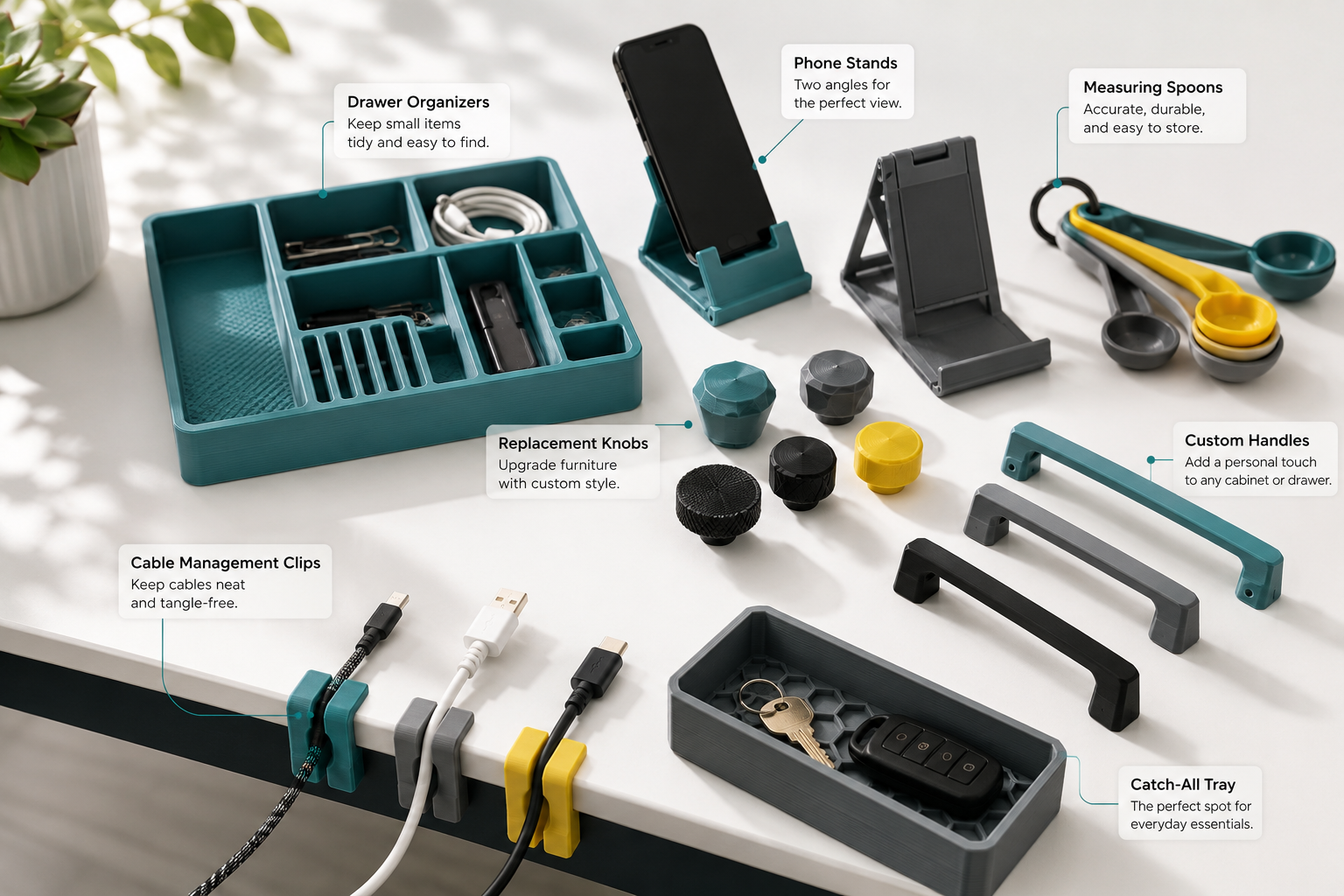
Custom drawer organizers rank among the most useful things to 3D print for immediate home improvement. Unlike generic store-bought options, printed organizers fit exact drawer dimensions and accommodate specific items. Design compartments for batteries, craft supplies, office accessories, or kitchen utensils with perfect sizing.
Cable management systems eliminate desk clutter through printed clips, holders, and routing channels. Create custom solutions that attach to desk edges, walls, or monitor stands. Popular designs include:
- Adhesive cable clips for routing wires along surfaces
- Under-desk cable trays with snap-together segments
- Charging station organizers with device-specific slots
- Headphone stands with integrated cable wrap
Shelf brackets and mounting hardware provide functional solutions when standard options don’t fit. Print custom brackets for floating shelves, curtain rod holders, or picture frame supports. These prints often require stronger materials like PETG or ABS for load-bearing applications.
Replacement Parts and Repairs
Broken household items often end up in landfills because replacement parts cost nearly as much as new products. 3D printing replacement components extends product lifespan while reducing waste. Common repair prints include:
- Appliance knobs and handles (dishwashers, ovens, washing machines)
- Vacuum cleaner attachments and clips
- Furniture hardware (drawer pulls, cabinet hinges, leg caps)
- Toy parts and game pieces
- Electronics enclosures and battery covers
Measuring the original part ensures proper fit. Use digital calipers for precision, or search online repositories where others may have already designed the exact component needed.
Kitchen and Dining Accessories
The kitchen offers numerous opportunities for practical things to 3D print that enhance daily routines. Cookie cutters in custom shapes create personalized baked goods for holidays, events, or themed parties. Use food-safe PLA or PETG, and ensure thorough cleaning between uses.
Measuring tools including custom scoops, portion guides, and leveling tools help with cooking precision. Print funnel sets in graduated sizes, jar openers with enhanced grip patterns, or bag clips that seal opened packages.
Sink organizers keep sponges, brushes, and soap accessible while promoting drainage. Design these with ventilation holes and angled surfaces that direct water back into the sink.
Creative and Decorative Things to 3D Print
Personalized Gifts and Keepsakes
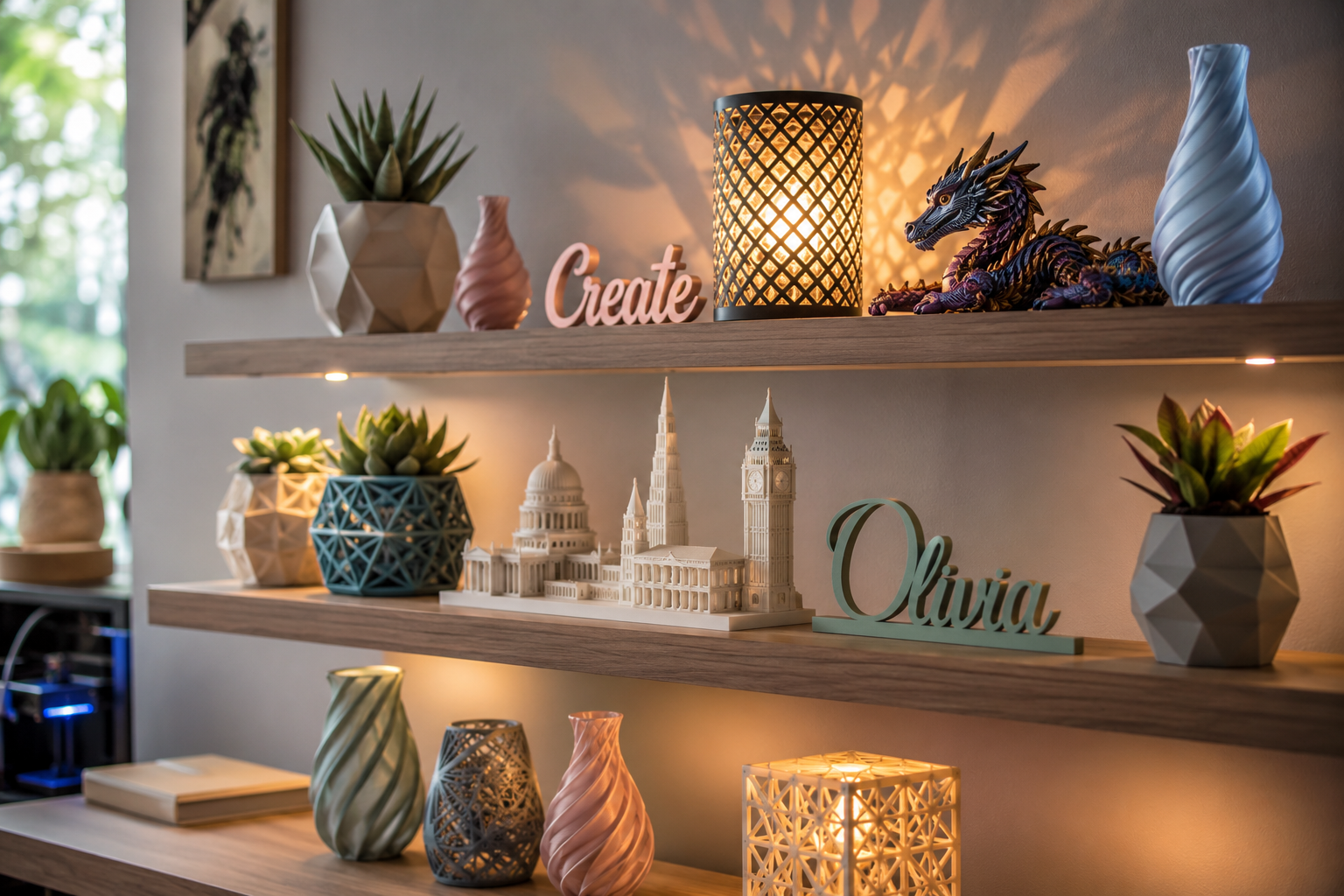
Custom name tags and labels transform ordinary items into personalized possessions. Print luggage tags with contact information, plant markers for gardens, or decorative name signs for children’s rooms. Variable font options and integrated designs make each piece unique.
Photo frames and display stands showcase memories with custom dimensions and styles. Create multi-photo arrangements, floating frame designs, or themed borders that complement specific images. Lithophane prints—where photo details emerge when backlit—produce stunning decorative pieces.
Jewelry and accessories demonstrate 3D printing’s artistic capabilities. Design earrings, pendants, bracelets, and rings with intricate geometric patterns impossible to create through traditional manufacturing. Resin printers excel at producing smooth, detailed jewelry pieces.
Home Décor and Art
Planters and vases combine functionality with aesthetic appeal. Print geometric planters with drainage systems, hanging pot holders, or self-watering designs with reservoir compartments. Experiment with spiral vases, lattice patterns, or gradient designs that showcase layer-by-layer construction.
Lighting fixtures create ambient atmosphere through custom lampshades, night lights, and accent lighting. Design patterns that cast interesting shadows, or create translucent prints using specific filament colors and wall thickness. LED integration transforms simple prints into functional lighting solutions.
Wall art and sculptures push creative boundaries with abstract designs, geometric patterns, or representational pieces. Multi-part prints enable large-scale installations, while articulated sculptures add interactive elements. Color-changing filaments or post-processing techniques like painting enhance visual impact.
Miniatures and Collectibles
Gaming miniatures represent one of the most popular categories of things to 3D print. Tabletop gamers create custom characters, terrain pieces, and accessories for role-playing games. Resin printers deliver the fine detail required for 28mm-32mm scale figures.
Model building spans architecture, vehicles, and historical replicas. Print scale models of famous buildings, custom car designs, or historical artifacts. Multi-part assemblies teach valuable skills in part orientation, support placement, and post-processing.
Action figures and toys with articulated joints demonstrate mechanical design principles. Ball-and-socket joints, hinges, and snap-fit connections enable poseable figures without additional hardware. These projects build understanding of tolerances and moving parts.
Functional and Technical Things to 3D Print
Tools and Workshop Accessories
Custom tool holders organize workshops efficiently. Print wall-mounted holders for screwdrivers, pliers, and wrenches with exact spacing for your collection. Drawer inserts keep smaller tools accessible, while pegboard accessories maximize vertical storage.
Jigs and fixtures improve accuracy for repetitive tasks. Create drill guides for consistent hole placement, angle guides for precise cuts, or assembly fixtures that hold components during gluing or fastening. These specialized tools often justify printer ownership through time savings alone.
Measurement and marking tools include custom gauges, depth finders, and angle indicators. Print radius gauges for woodworking, thread pitch identifiers for fasteners, or custom templates for marking patterns.
Electronics and Technology
Device stands and mounts position phones, tablets, and monitors at optimal angles. Design adjustable stands with multiple viewing positions, wall mounts for smart home devices, or dashboard holders for vehicle navigation. Cable routing channels integrate seamlessly with these designs.
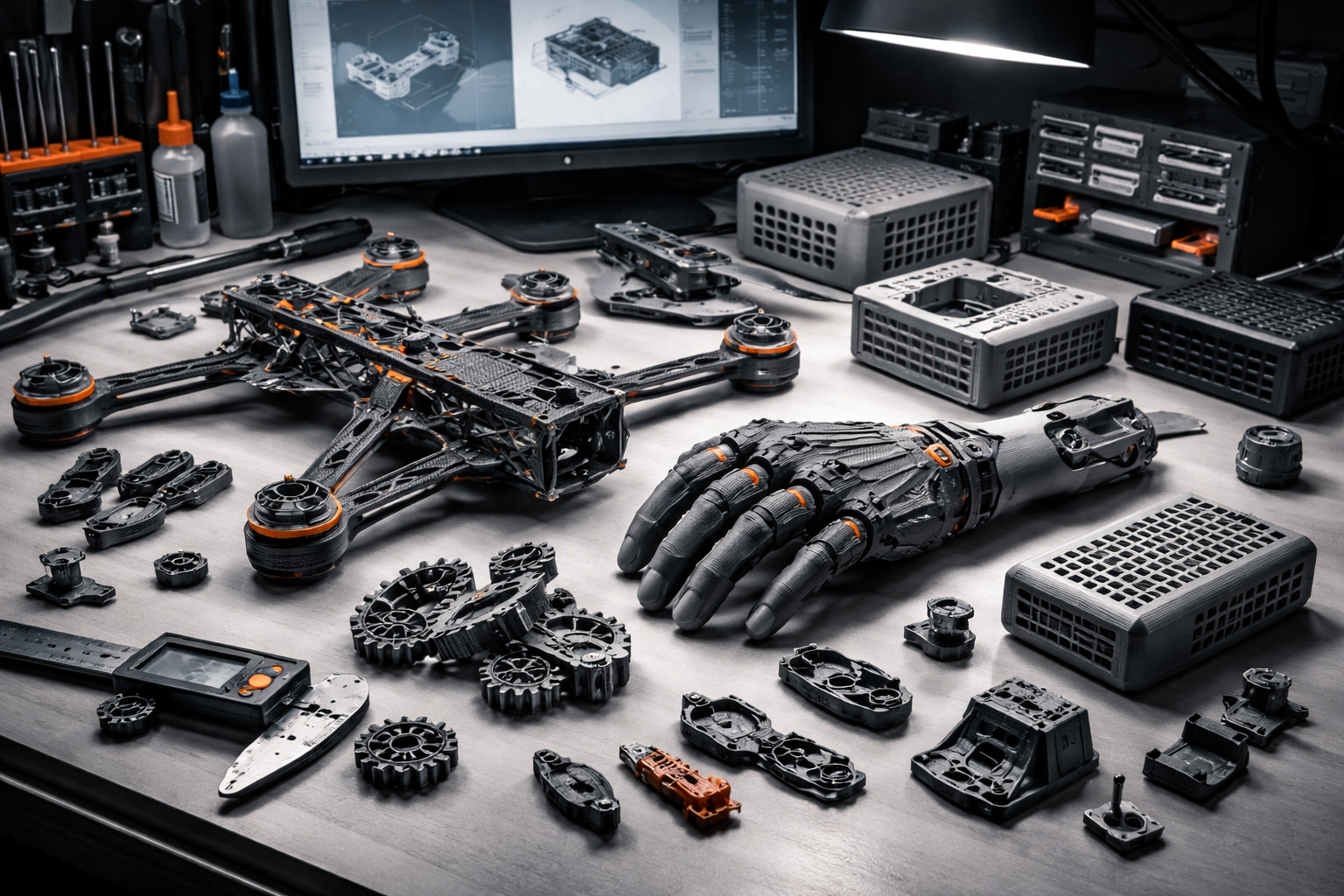
Raspberry Pi and Arduino enclosures protect electronics while providing access to ports and displays. Custom cases accommodate specific project requirements—sensor openings, cooling vents, or mounting points for additional components. Modular designs allow configuration changes without reprinting entire enclosures.
Keyboard accessories enhance typing comfort and functionality. Print wrist rests with ergonomic contours, custom keycaps with unique legends, or macro pad enclosures for programmable buttons. Mechanical keyboard enthusiasts create entire custom cases with specific mounting systems.
Mechanical Parts and Prototypes
Gears, pulleys, and linkages demonstrate mechanical engineering principles. Print functional gear trains to understand ratios, create belt-driven systems with custom pulley sizes, or design four-bar linkages for specific motion patterns. These projects build foundational knowledge for complex mechanisms.
Prototyping components accelerates product development. Test fit and function before committing to expensive manufacturing. Iterate designs quickly, making dimensional adjustments or feature modifications based on physical testing. This rapid prototyping capability proves invaluable for inventors and entrepreneurs.
Replacement mechanical parts keep equipment operational. Print gears for appliances, pulleys for exercise equipment, or custom adapters that connect incompatible components. Engineering-grade materials like nylon or polycarbonate provide strength for demanding applications.
Choosing the Right Things to 3D Print for Your Skill Level
Beginner-Friendly Projects
Start with simple geometric shapes that require minimal support structures. Coasters, basic organizers, and simple containers teach fundamental printing concepts without overwhelming complexity. These projects help calibrate printer settings and understand material behavior.
Pre-designed models from online repositories eliminate design challenges while building printing experience. Download tested designs with established print settings, then modify parameters to suit your specific printer and material. Success with proven designs builds confidence before tackling original creations.
Single-piece prints avoid assembly complications. Focus on mastering bed adhesion, layer bonding, and surface finish before attempting multi-part projects. Simple phone stands, cable organizers, or plant labels provide practical results with minimal frustration.
Intermediate Challenges
Multi-part assemblies introduce tolerance management and part orientation strategies. Design projects requiring precise fits between components—snap-together boxes, hinged containers, or modular storage systems. Learn how temperature, material, and print speed affect dimensional accuracy.
Support structure management becomes critical for complex geometries. Print overhanging features, bridging elements, or hollow structures that require internal supports. Develop skills in support placement, density adjustment, and post-processing removal techniques.
Material experimentation expands capability understanding. Test flexible TPU for phone cases, transparent PETG for protective covers, or wood-filled PLA for decorative items. Each material requires specific temperature, speed, and cooling settings for optimal results.
Advanced Applications
Functional mechanical assemblies combine multiple moving parts with precise tolerances. Design and print working mechanisms—drawer slides, hinges, or latching systems. Calculate clearances for smooth operation while maintaining structural integrity.
Multi-material prints leverage different filament properties within single projects. Use rigid materials for structural components and flexible materials for gaskets or grips. Printers with multiple extruders enable color combinations or soluble support materials.
Custom parametric designs using CAD software create fully customizable solutions. Learn to design objects with adjustable dimensions, configurable features, or scalable patterns. This skill transforms you from print consumer to design creator.
Material Selection for Different Things to 3D Print
Common Filament Types
PLA (Polylactic Acid) remains the most popular choice for general-purpose printing. This biodegradable material prints easily at lower temperatures, produces minimal warping, and works well for decorative items, prototypes, and low-stress applications. Available in countless colors and specialty variants including silk, metallic, and color-changing formulations.
PETG (Polyethylene Terephthalate Glycol) offers superior strength and chemical resistance compared to PLA. Use PETG for functional parts, outdoor applications, or items requiring flexibility without breaking. This material resists moisture and UV degradation better than PLA while maintaining reasonable printing ease.
ABS (Acrylonitrile Butadiene Styrene) provides excellent mechanical properties and heat resistance. Professional applications benefit from ABS’s durability and post-processing capabilities—acetone vapor smoothing creates glass-like surface finishes. Requires heated enclosure and proper ventilation due to printing fumes.
TPU (Thermoplastic Polyurethane) enables flexible prints for phone cases, gaskets, or wearable items. This rubber-like material requires slower print speeds and specific extruder configurations but produces parts with excellent impact resistance and compression recovery.
Specialty Materials
Wood-filled filaments combine PLA with wood fibers for aesthetic appeal. These materials print like standard PLA but produce parts with wood-like appearance and texture. Sand and stain printed objects for authentic wooden finishes.
Carbon fiber composites reinforce base materials with short carbon fibers for increased strength and stiffness. These engineering-grade filaments require hardened nozzles but produce parts suitable for structural applications and high-stress environments.
Conductive filaments enable printed circuits and touch-sensitive surfaces. Combine conductive traces with standard materials to create custom electronic interfaces, capacitive sensors, or simple circuits without traditional PCB manufacturing.
Optimizing Print Quality for Your Projects
Essential Print Settings
Layer height directly impacts print time and surface quality. Use 0.1-0.15mm layers for detailed miniatures or smooth surfaces, 0.2mm for general-purpose prints balancing quality and speed, or 0.3mm for large functional parts where appearance matters less than completion time.
Print speed affects both quality and reliability. Slower speeds (40-60mm/s) produce better detail and layer adhesion for complex geometries. Faster speeds (80-100mm/s) work well for simple shapes with large, flat surfaces. Adjust speed based on material, temperature, and geometric complexity.
Infill density determines internal structure and part strength. Use 10-20% infill for decorative items, 30-50% for functional parts requiring moderate strength, or 80-100% for maximum durability. Infill pattern selection (grid, honeycomb, gyroid) affects strength characteristics and material usage.
Post-Processing Techniques
Support removal requires patience and appropriate tools. Use flush cutters for FDM supports, carefully separating material at connection points. Resin prints benefit from warm water soaking before support removal. Sand connection points smooth after removal.
Surface finishing transforms rough prints into polished products. Progressive sanding with increasing grit (120→220→400→800) removes layer lines. Apply filler primer before painting for professional results. Vapor smoothing with acetone (ABS) or ethyl acetate (PLA) creates glass-smooth surfaces.
Assembly and bonding joins multi-part prints permanently or temporarily. Use cyanoacrylate (super glue) for permanent bonds, or design snap-fit connections for disassembly. Solvent welding with appropriate chemicals creates molecular bonds stronger than the base material.
Finding and Modifying Designs
Online Design Repositories
Thingiverse, Printables, and MyMiniFactory host millions of free designs across all categories. Search by keyword, browse curated collections, or explore trending designs. Download STL files directly and import into slicing software. Many designs include printing instructions and recommended settings.
Paid marketplaces like CGTrader or Cults3D offer premium designs with commercial licensing options. Professional designers create highly detailed models with guaranteed printability. Support creators while accessing exclusive content unavailable in free repositories.
Manufacturer-specific libraries provide designs optimized for particular printer models. These curated collections ensure compatibility and often include pre-configured print profiles for one-click printing.
Design Modification Basics
Scaling and resizing adapts existing designs to specific requirements. Most slicing software includes scaling tools for proportional or dimensional adjustments. Verify wall thickness remains adequate after scaling—extremely small prints may have walls too thin for reliable printing.
Combining multiple designs creates custom solutions from existing components. Import multiple STL files into CAD software, position elements as desired, then merge into single printable object. This technique enables personalization without advanced modeling skills.
Parametric customization through tools like Tinkercad or Fusion 360 allows dimensional modifications to designs created with adjustable parameters. Change text, dimensions, or feature counts through simple interface controls rather than complex modeling operations.
Conclusion
The versatility of things to 3D print extends far beyond novelty items and simple prototypes. From practical household solutions that solve everyday problems to creative projects that showcase artistic vision, 3D printing delivers tangible value across countless applications. The key to maximizing your printer’s potential lies in matching projects to your skill level while gradually expanding capabilities through increasingly complex designs.
Start with simple, practical prints that deliver immediate utility—organizers, replacement parts, or basic tools. Build confidence through successful completions, then progress to multi-part assemblies, custom designs, and advanced materials. The skills developed through hands-on printing experience translate directly to problem-solving abilities applicable across numerous domains.
Take action today by selecting three projects from this guide: one practical household item, one creative piece, and one skill-building challenge. Download designs from reputable repositories, configure your slicer settings appropriately, and begin printing. Document your results, learn from failures, and iterate toward improvement. The journey from beginner to advanced maker starts with a single print—make it count.
 Previous Page