February 9, 2026
2026 Self-Employed Mortgage Rates in Toronto: Lowest Fixed and Variable Options Revealed
Share this article:



Manzeel is an award-winning Mortgage Broker and the Owner of the Toronto-based mortgage, Everything Mortgages.
With 16 years of experience in the Canadian mortgage industry and a formal background in mortgage underwriting, Manzeel’s lending expertise gives him unique insight into whether a deal is feasible which empowers his clients to make more informed lending decisions faster.
He has been recognized as one of Canada’s Top 10 Mortgage Brokers by the national Canadian Mortgage Professionals (CMP) Association. Him and his team of 18 mortgage agents are proud to offer a mortgage experience that's built on honesty, trust, and integrity. He prides himself on the brokerage’s dedication to deliver an excellent client experience throughout the entire home loan process from pre-approval to post-funding.
Since moving to Toronto in 1998, Manzeel has successfully launched and scaled several businesses from the ground up, ranging from a mortgage brokerage and a vast real estate investment portfolio to a private financing eCommerce platform. He continues to be a leader in the real estate industry as he uses his analytical expertise to seek new real estate investment opportunities.
As a tech junkie and avid sports enthusiast, when Manzeel’s not working with clients, you can find him reading technology blogs, playing squash or watching tennis with his two boys.
Securing a mortgage as a self-employed professional in Toronto has traditionally felt like navigating a maze blindfolded. Without the comfort of a steady T4 slip, many entrepreneurs, freelancers, and small business owners face higher rates and stricter requirements. But here’s the good news: 2026 is shaping up to be one of the most competitive years for self-employed mortgage rates in Toronto, with fixed rates as low as 3.69% and variable options starting at 3.35%.
Understanding the 2026 Self-Employed Mortgage Rates in Toronto: Lowest Fixed and Variable Options Revealed can save self-employed borrowers thousands of dollars over the life of their mortgage. This comprehensive guide breaks down the current rate landscape, compares traditional banks against alternative lenders, and provides actionable steps to secure the best possible mortgage without conventional employment documentation.
Key Takeaways
✅ Self-employed borrowers in Toronto can access 5-year fixed rates as low as 3.69% and variable rates starting at 3.35% in 2026 through specialized lenders and proper documentation.
✅ Alternative lenders often offer better rates and more flexible approval criteria for self-employed applicants compared to traditional big banks, though requirements vary significantly.
✅ Two years of self-employment history with strong Notices of Assessment (NOAs) and tax returns remain the gold standard for qualifying at competitive rates.
✅ The Bank of Canada’s benchmark rate is holding steady at 2.25% through at least Q3 2026, creating a stable environment for both fixed and variable rate products[5][6].
✅ Proper income calculation and documentation strategies can mean the difference between approval at prime rates versus subprime alternatives or outright rejection.
Understanding the 2026 Self-Employed Mortgage Landscape in Toronto
The mortgage market for self-employed individuals in Toronto has evolved considerably. In 2026, lenders have become more sophisticated in assessing self-employed income, recognizing that traditional employment isn’t the only path to financial stability. However, this doesn’t mean the process is simple.
Current Rate Environment
The Bank of Canada has maintained its benchmark rate at 2.25%, with most economists predicting no meaningful movement through at least the third quarter of 2026[5][6]. This stability has created a favorable environment for mortgage seekers, particularly those who are self-employed.
According to current market data, the prime rate sits at 4.45%[1], though some institutions like TD Bank differentiate their prime rates (TD Prime at 4.95% for flexline products and TD Mortgage Prime at 5.10% for stand-alone variable mortgages)[3]. This variation highlights why shopping around is critical for self-employed borrowers.
Fixed vs. Variable: What Self-Employed Borrowers Need to Know
When exploring fixed or variable mortgage options, self-employed individuals face unique considerations. The decision isn’t just about rate—it’s about qualifying criteria, documentation requirements, and long-term financial planning.
Fixed-Rate Advantages for Self-Employed Borrowers:
- Predictable payments aid in business cash flow planning
- Protection against rate increases during economic uncertainty
- Easier to qualify with some lenders who prefer stability
- Simplified budgeting for variable business income
Variable-Rate Benefits:
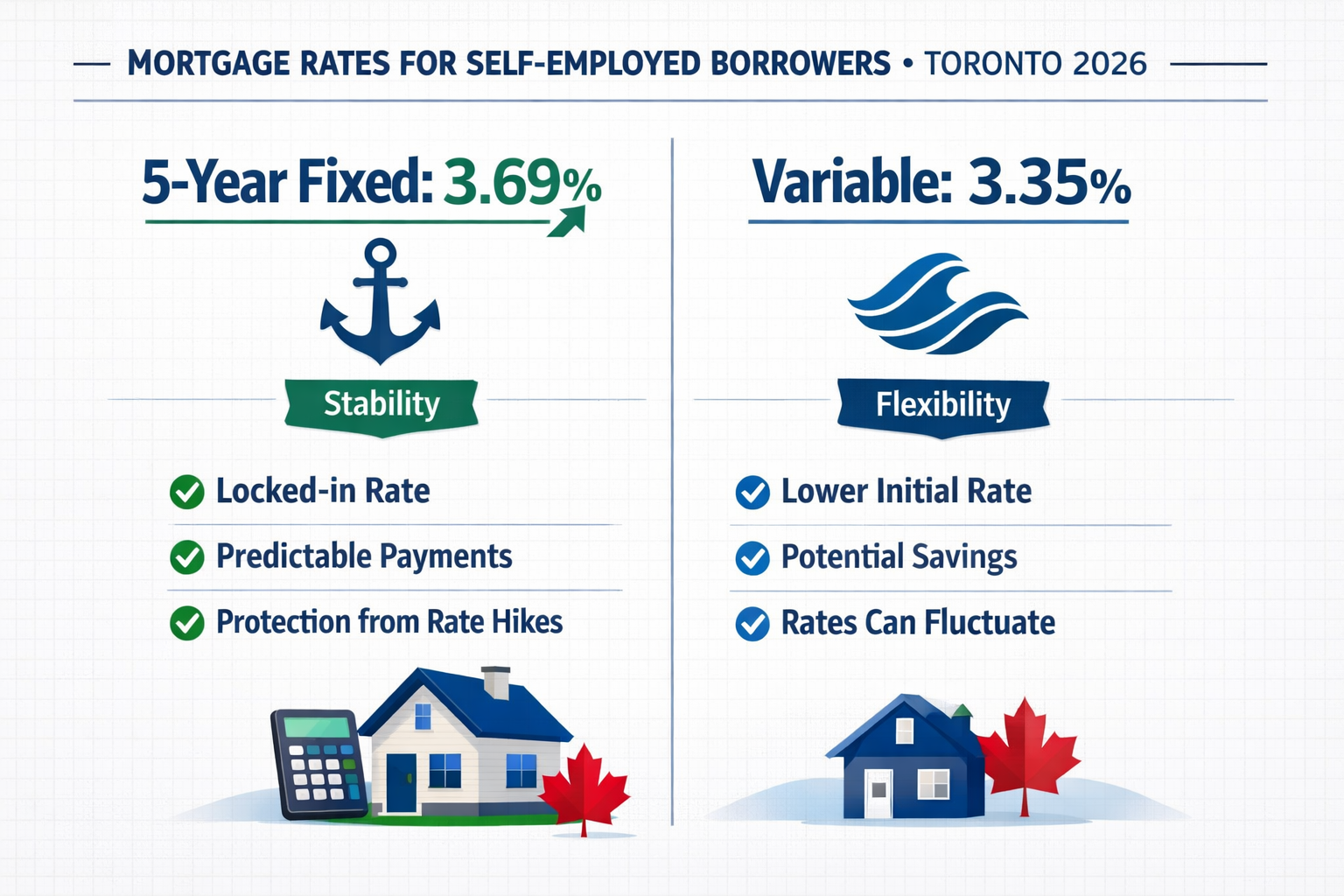
- Lower starting rates (currently 3.35% vs. 3.69% for fixed)
- Potential savings if rates remain stable or decrease
- Greater flexibility with penalty calculations
- Ability to lock in later if rates rise
For self-employed professionals in Toronto, the choice often depends on income consistency. Those with highly variable quarterly earnings may prefer the predictability of fixed rates, while established business owners with steady cash flow might capitalize on variable rate savings.
2026 Self-Employed Mortgage Rates in Toronto: Lowest Fixed and Variable Options Revealed – Current Rate Breakdown
Let’s examine the actual numbers available to self-employed borrowers in Toronto during 2026. These rates represent what qualified self-employed applicants can access with strong documentation and financial profiles.
Fixed-Rate Mortgages for Self-Employed Borrowers
| Term Length | Insured Rate | Conventional Rate | Posted Rate |
|---|---|---|---|
| 1-Year Fixed | 4.94% | 4.94% | 6.34% |
| 2-Year Fixed | 4.49% | 4.49% | 6.49% |
| 3-Year Fixed | 4.49% | 4.49% | 6.49% |
| 4-Year Fixed | 4.49% | 4.49% | 6.24% |
| 5-Year Fixed | 4.04%-4.24% | 4.19%-4.59% | 6.09% |
| 7-Year Fixed | 4.75% | 4.95% | 6.50% |
| 10-Year Fixed | 5.10% | 5.10% | 6.85% |
Data compiled from national benchmarks[3]
The 5-year fixed rate remains the most popular choice, with self-employed borrowers accessing rates between 4.04% and 4.59% depending on down payment size, documentation quality, and lender type. However, specialized lenders offering innovative mortgage solutions for self-employed Canadians can provide rates as competitive as 3.69% for well-qualified applicants.
Variable-Rate Mortgages for Self-Employed Borrowers
Variable-rate mortgages in 2026 are priced relative to the prime rate, currently at 4.45%[1]. Self-employed borrowers can access:
5-Year Adjustable Rate Mortgages:
- Prime minus 0.65% (best case): 3.80% effective rate
- Prime minus 0.50%: 3.95% effective rate
- Prime minus 0.26%: 4.19% effective rate
The most competitive self-employed borrowers with exceptional documentation can secure variable rates as low as 3.35% through select alternative lenders who specialize in self-employed mortgages. These rates typically require:
✔️ Minimum 20% down payment
✔️ Two consecutive years of increasing income
✔️ Strong credit score (720+)
✔️ Low debt-to-income ratio
✔️ Comprehensive business documentation
Open Mortgages and Short-Term Options
For self-employed individuals expecting significant income changes or planning to refinance quickly, 6-month open fixed mortgages are available at 9.70%[1]. While significantly higher than closed mortgages, these products offer maximum flexibility without prepayment penalties.
Big Banks vs. Alternative Lenders: Finding the Best Self-Employed Mortgage Rates in Toronto
One of the most critical decisions self-employed borrowers face is choosing between traditional banks and alternative lenders. The rate difference can be substantial, but so can the qualification requirements.
Traditional Big Bank Approach
Canada’s major banks—RBC, TD, Scotiabank, BMO, and CIBC—offer self-employed mortgages but typically maintain stricter documentation requirements. Their approach generally includes:
Big Bank Requirements:
- Minimum two years of self-employment with increasing income
- Full financial statements reviewed by their underwriting team
- Notice of Assessment (NOA) from CRA for past two years
- T1 General tax returns with all schedules
- Business license and registration documents
- Often require 20-25% down payment for best rates
- May average income over 2-3 years, reducing qualifying amount
Big Bank Rate Reality:
Self-employed borrowers at major banks typically access rates in the 4.19%-4.59% range for 5-year fixed products and prime minus 0.26% to prime minus 0.50% for variable mortgages[3]. While these rates are competitive, they’re rarely the absolute lowest available.
Alternative Lender Advantages
Alternative lenders—including credit unions, mortgage finance companies, and specialized B-lenders—have carved out a significant niche serving self-employed borrowers. These institutions understand that mortgages for self-employed borrowers require different assessment criteria.
Alternative Lender Benefits:
- More flexible income calculation methods
- Willingness to use stated income programs (with higher rates)
- Consideration of business assets and cash reserves
- Faster approval timelines (often 48-72 hours)
- Specialized underwriters trained in self-employment income
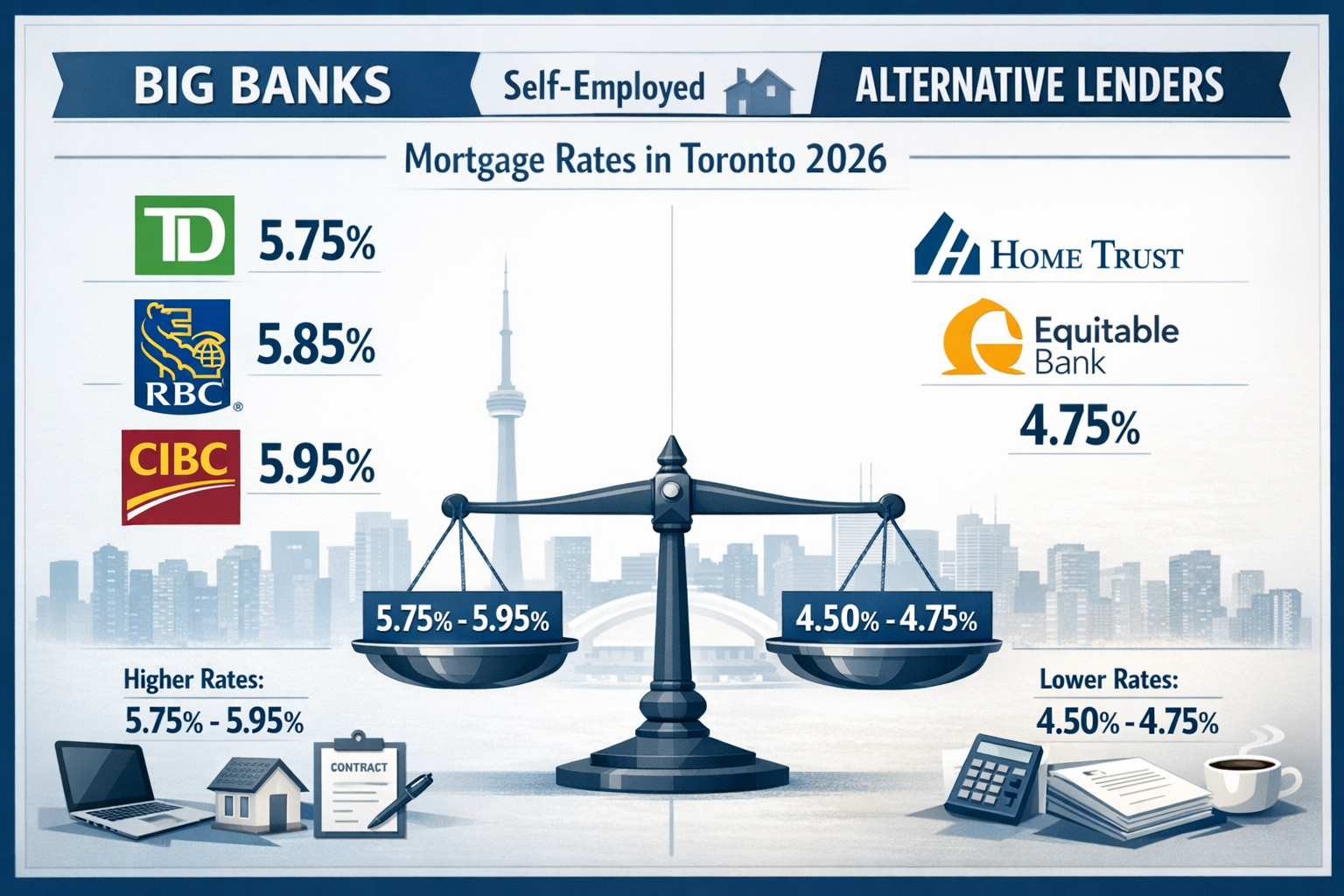
- Rates as low as 3.69% for 5-year fixed and 3.35% for variable
The Trade-Off:
Alternative lenders may charge slightly higher fees or require mortgage insurance in situations where banks wouldn’t. However, for many self-employed borrowers, the combination of better rates and higher approval odds makes these lenders the superior choice.
Credit Unions: The Middle Ground
Toronto-area credit unions like Meridian, DUCA, and Alterna often provide an excellent middle ground. They combine competitive rates (typically 3.89%-4.29% for 5-year fixed) with more personalized service and flexible underwriting for self-employed members.
Credit Union Advantages:
- Relationship-based lending decisions
- Local underwriting with decision-making authority
- Willingness to consider full financial picture
- Competitive rates for members with strong profiles
- Lower fees than many alternative lenders
Documentation Requirements: Securing the Lowest Rates Without T4 Slips

The key to accessing the best 2026 Self-Employed Mortgage Rates in Toronto: Lowest Fixed and Variable Options Revealed lies in proper documentation. Without traditional employment verification, self-employed borrowers must provide comprehensive evidence of income stability and business viability.
Essential Documentation Checklist
Tax Documentation (Most Important):
- Notices of Assessment (NOAs) – Past two years minimum
- T1 General tax returns – Complete with all schedules
- T2125 Statement of Business Activities – For sole proprietors
- T4 Summary and T5 slips – If incorporated and paying yourself
- Corporate tax returns (T2) – For incorporated businesses
Business Documentation:
- Business license and registration – Proof of legitimate operation
- Articles of incorporation – If applicable
- GST/HST returns – Demonstrates active business
- Business bank statements – 3-6 months showing consistent deposits
- Contracts or invoices – Evidence of ongoing work/revenue
Financial Statements:
- Personal bank statements – 90 days minimum
- Business financial statements – Prepared by accountant (ideal)
- Accounts receivable aging – Shows money owed to business
- Profit and loss statements – Year-to-date and previous year
- Balance sheet – Current business assets and liabilities
Income Calculation Methods
Lenders use different approaches to calculate self-employed income, significantly impacting how much you can borrow:
Method 1: Two-Year Average (Most Common)
Add your net income from the past two years and divide by two. This conservative approach is standard at big banks.
Example:
- Year 1: $85,000 net income
- Year 2: $95,000 net income
- Qualifying income: $90,000
Method 2: Most Recent Year (Alternative Lenders)
Some lenders use only your most recent year’s income if it shows an upward trend.
Example:
- Year 1: $85,000
- Year 2: $95,000
- Qualifying income: $95,000 (11% higher qualifying power)
Method 3: Add-Back Method (Sophisticated)
Certain expenses that reduce taxable income but don’t affect cash flow can be added back:
- Depreciation (CCA)
- Home office expenses
- Vehicle expenses (portion)
- Interest on business loans
Example:
- Reported net income: $85,000
- Add-backs: $15,000
- Qualifying income: $100,000
For IT consultants and self-employed professionals, understanding which calculation method your lender uses can dramatically impact approval amounts and available rates.
Strategies to Maximize Qualifying Income
💡 Work with an accountant before applying: Structure your business income to optimize mortgage qualification while remaining tax-efficient.
💡 Time your application strategically: Apply after filing taxes showing strong income, not during low-revenue quarters.
💡 Minimize write-offs in the year before applying: While tax deductions save money, they reduce qualifying income. Balance tax savings against mortgage needs.
💡 Maintain separate business and personal accounts: Clean financial separation demonstrates professionalism and makes income verification easier.
💡 Build cash reserves: Six months of mortgage payments in savings strengthens your application significantly.
Step-by-Step Guide to Securing the Best Self-Employed Mortgage Rates in Toronto
Ready to access those competitive 3.69% fixed or 3.35% variable rates? Follow this proven process to maximize your chances of approval at the lowest possible rate.
Step 1: Assess Your Financial Position (1-2 Weeks)
Before approaching any lender, conduct an honest assessment of your financial situation:
Credit Score Check:
- Obtain free credit reports from Equifax and TransUnion
- Target score: 680+ (good), 720+ (excellent rates)
- Dispute any errors immediately
- Pay down credit cards to below 30% utilization
Income Calculation:
- Review past two years of tax returns
- Calculate average income using different methods
- Identify potential add-backs with your accountant
- Determine realistic qualifying amount
Down Payment Verification:
- Confirm available funds (minimum 5%, ideally 20%+)
- Document 90-day source history
- Consider gifted down payments (require gift letters)
Debt Review:
- List all current debts and monthly payments
- Calculate total debt service ratio
- Plan to pay down high-interest debts if necessary
Step 2: Gather Complete Documentation (2-3 Weeks)
Using the checklist provided earlier, assemble all required documents. Create both physical and digital copies organized by category.
Pro Tip: Create a mortgage application folder with sections for:
- Tax documents (NOAs, T1s, business returns)
- Business documentation (license, registration, statements)
- Banking (personal and business statements)
- Credit (reports and explanations for any issues)
- Down payment (source documentation)
Step 3: Compare Lenders and Rate Options (1-2 Weeks)
Don’t settle for the first rate offered. Self-employed borrowers benefit enormously from shopping around.
Lender Comparison Strategy:
- Start with a mortgage broker specializing in self-employed mortgages
- Contact 2-3 alternative lenders directly for comparison
- Check your existing bank (relationship may help)
- Explore credit unions where you have membership
- Compare total costs, not just rates (fees, penalties, features)
When reviewing major banks that have adjusted their mortgage rates, remember that advertised rates often require traditional employment. Always ask specifically about self-employed rates.
Step 4: Submit Applications Strategically (1 Week)
Multiple Application Timing:
Submit all applications within a 14-day window. Credit bureaus count multiple mortgage inquiries in this timeframe as a single inquiry, protecting your credit score.
Application Best Practices:
- Be completely honest about income and employment
- Provide more documentation than requested
- Respond to lender questions within 24 hours
- Keep detailed notes of all conversations
- Get rate holds in writing (typically 90-120 days)
Step 5: Negotiate and Secure Your Rate (1-2 Weeks)
Once you receive offers, don’t immediately accept. Self-employed borrowers have negotiating power, especially with strong applications.
Negotiation Tactics:
- Share competing offers (without naming lenders initially)
- Ask about rate matching or beating competitors
- Negotiate fees, not just rates
- Request additional features (prepayment privileges, portability)
- Consider slightly higher rates for significantly better terms
Rate Hold Strategy:
Secure the longest rate hold possible. If rates drop during your hold period, many lenders will honor the lower rate. If rates rise, you’re protected.
Step 6: Complete Underwriting and Close (4-6 Weeks)
After accepting an offer, the lender’s underwriting team reviews everything in detail.
Underwriting Phase Expectations:
- Additional documentation requests (normal for self-employed)
- Possible business verification calls
- Property appraisal (lender-ordered)
- Title search and insurance
- Final approval conditions
Closing Preparation:
- Review all documents with your lawyer
- Confirm final mortgage amount and rate
- Arrange property insurance
- Prepare certified cheque for down payment and closing costs
- Schedule final walkthrough
Common Challenges and Solutions for Self-Employed Mortgage Applicants
Even with excellent income and credit, self-employed borrowers face unique obstacles. Understanding these challenges and their solutions increases approval odds.
Challenge 1: Income Appears Lower Than Actual Earnings
The Problem: Tax deductions that reduce taxable income also reduce qualifying income for mortgages.
The Solution:
- Use lenders that allow add-backs for legitimate business expenses
- Plan ahead—minimize deductions in years before applying
- Consider stated income programs (higher rates, but approval possible)
- Provide supplementary evidence of cash flow (bank statements showing deposits)
For freelancers and independent professionals, working with specialized lenders who understand variable income patterns is essential.
Challenge 2: Less Than Two Years Self-Employed
The Problem: Most lenders require minimum two years of self-employment history.
The Solution:
- Demonstrate industry experience before self-employment
- Provide contracts showing future income commitments
- Consider co-signers with traditional employment
- Explore alternative lenders with one-year programs
- Wait until you reach the two-year threshold (if possible)
Challenge 3: Declining or Inconsistent Income
The Problem: Income that varies significantly year-to-year raises lender concerns.
The Solution:
- Explain seasonal business fluctuations with documentation
- Provide forward-looking contracts or purchase orders
- Increase down payment to reduce lender risk
- Consider shorter mortgage terms with planned refinancing
- Build larger cash reserves (6-12 months expenses)
Challenge 4: Incorporated Business Complicates Income Verification
The Problem: Corporate structures separate personal and business income, making qualification complex.
The Solution:
- Work with accountants experienced in mortgage applications
- Combine salary, dividends, and retained earnings strategically
- Provide complete corporate financial statements
- Use lenders familiar with incorporated self-employed borrowers
- Consider personal tax planning adjustments before applying
Challenge 5: New Industry or Business Model
The Problem: Lenders prefer established, proven business models.
The Solution:
- Emphasize transferable skills and industry expertise
- Provide market research supporting business viability
- Show strong initial revenue and client base
- Consider larger down payments (25-30%)
- Explore alternative lenders with flexible criteria
The Impact of Economic Factors on 2026 Self-Employed Mortgage Rates

Understanding broader economic trends helps self-employed borrowers make informed decisions about rate types and timing.
Bank of Canada Policy and Rate Stability
The Bank of Canada’s decision to hold rates steady at 2.25% through at least Q3 2026 creates a unique environment[5][6]. This stability means:
📊 Fixed rates remain competitive without the premium typically charged during uncertain rate environments
📊 Variable rates offer genuine savings without immediate risk of significant increases
📊 Refinancing opportunities may be limited if rates stay flat
📊 Longer rate holds become more valuable as timing becomes less critical
For self-employed borrowers, this stability is particularly beneficial. Variable income streams are easier to manage when mortgage payments remain predictable, whether you choose fixed or variable products.
Toronto Real Estate Market Conditions
Toronto’s housing market directly impacts mortgage availability and rates for self-employed borrowers:
Current Market Factors:
- Moderate price appreciation (3-5% annually)
- Balanced inventory levels
- Strong employment across diverse sectors
- Continued immigration supporting demand
- New construction maintaining steady pace
These conditions mean lenders remain comfortable with Toronto real estate as collateral, maintaining competitive rates for qualified self-employed borrowers.
Alternative Lending Growth
The rise of alternative and B-lender mortgages has significantly benefited self-employed borrowers. Increased competition among these lenders has driven rates down while expanding approval criteria.
2026 Alternative Lending Trends:
- Technology-driven underwriting (faster decisions)
- Expanded income verification methods
- More competitive rates (narrowing gap with A-lenders)
- Greater willingness to work with complex income situations
- Enhanced mortgage products specifically for self-employed
Maximizing Your Mortgage: Beyond Just Getting Approved
Securing approval is just the beginning. Self-employed borrowers should optimize their mortgage for long-term financial success.
Prepayment Privileges and Flexibility
Self-employed income often includes irregular large payments (project completions, seasonal bonuses, contract renewals). Mortgage features that accommodate this income pattern are valuable:
Key Features to Negotiate:
- Annual prepayment allowance: Minimum 15%, ideally 20%+
- Lump sum frequency: Annual or more frequent
- Payment increase options: Ability to raise payments during high-income periods
- Double-up payments: Make additional payments matching regular amounts
- Skip-a-payment: Useful during low-income periods (though interest still accrues)
These features allow you to pay down your mortgage faster during profitable years while maintaining flexibility during slower periods.
Portability and Assumability
Self-employed professionals often relocate for business opportunities or market expansion. Mortgage portability becomes particularly valuable:
Portability Benefits:
- Transfer existing rate to new property
- Avoid penalties when moving
- Maintain favorable rates in rising-rate environments
- Combine with additional borrowing if needed
Assumability Considerations:
- Allow buyers to take over your mortgage
- Can make property more attractive to buyers
- Preserves favorable rates for purchasers
- May facilitate faster sales
Refinancing Strategy
Self-employed income typically grows over time as businesses mature. Plan your mortgage with future refinancing in mind:
Strategic Refinancing Timing:
- After significant income increases (access more equity)
- When rates drop substantially (1%+ savings)
- To consolidate high-interest business debt
- For business expansion capital needs
- At renewal to reassess rate type (fixed vs. variable)
Understanding how to get approved for a mortgage using your business income becomes easier with each successful mortgage cycle as you build lending relationships and financial history.
Real-World Rate Scenarios: What Self-Employed Borrowers Actually Pay
Let’s examine realistic scenarios showing what different self-employed profiles can expect in Toronto’s 2026 mortgage market.
Scenario 1: Established Consultant with Strong Income
Profile:
- Self-employed IT consultant, 5 years in business
- Average income: $120,000 (increasing trend)
- Credit score: 760
- Down payment: 25% ($150,000 on $600,000 property)
- Complete documentation with professional financial statements
Available Rates:
- 5-year fixed: 3.69% (alternative lender) to 4.19% (big bank)
- 5-year variable: 3.35% (prime minus 1.10%) to 3.95%
- Approval odds: Excellent across all lender types
Best Strategy: Shop aggressively among alternative lenders for the absolute lowest rates. Consider variable given stable Bank of Canada outlook and strong income to handle potential increases.
Scenario 2: Freelancer with Variable Income
Profile:
- Freelance graphic designer, 3 years self-employed
- Income: Year 1: $65,000, Year 2: $58,000, Year 3: $72,000
- Credit score: 690
- Down payment: 10% ($45,000 on $450,000 property)
- Basic documentation, some gaps in business records
Available Rates:
- 5-year fixed: 4.29% to 4.89% depending on lender
- 5-year variable: 4.15% to 4.65%
- Approval odds: Moderate with big banks, good with alternative lenders
Best Strategy: Focus on alternative lenders and credit unions. Fixed rate provides payment stability matching variable income. Emphasize upward income trend and provide detailed client contracts showing future work.
Scenario 3: New Business Owner with Previous Employment
Profile:
- Former corporate employee, now business owner (18 months)
- Current income: $95,000 (projected)
- Previous employment: $110,000 salary
- Credit score: 725
- Down payment: 20% ($100,000 on $500,000 property)
- Excellent credit history, complete documentation
Available Rates:
- 5-year fixed: 4.49% to 5.19%
- 5-year variable: 4.35% to 4.95%
- Approval odds: Challenging with big banks, moderate with alternatives
Best Strategy: Emphasize industry experience and previous stable employment. Consider waiting 6 months to reach two-year threshold for significantly better rates. If purchasing now is essential, alternative lenders with one-year programs offer best approval odds.
Scenario 4: Incorporated Professional with Complex Income
Profile:
- Incorporated dentist, 8 years in practice
- Corporate income: $300,000
- Personal salary: $80,000, Dividends: $40,000
- Credit score: 740
- Down payment: 30% ($300,000 on $1,000,000 property)
- Complete corporate and personal financial statements
Available Rates:
- 5-year fixed: 3.79% to 4.29%
- 5-year variable: 3.45% to 4.05%
- Approval odds: Good to excellent with proper documentation
Best Strategy: Work with lenders experienced in incorporated professionals who can maximize qualifying income by combining salary, dividends, and retained earnings. Large down payment provides negotiating leverage for premium rates.
Conclusion: Taking Action on Toronto’s Best Self-Employed Mortgage Rates in 2026
The landscape for 2026 Self-Employed Mortgage Rates in Toronto: Lowest Fixed and Variable Options Revealed presents genuine opportunities for entrepreneurs, freelancers, and business owners to secure competitive financing. With 5-year fixed rates available as low as 3.69% and variable options starting at 3.35%, self-employed borrowers can access rates that rival—and sometimes beat—those offered to traditionally employed applicants.
The key differentiators are preparation, documentation, and lender selection. Self-employed professionals who invest time in organizing comprehensive financial records, understanding income calculation methods, and comparing multiple lender options consistently secure the best rates and terms.
Your Next Steps
Immediate Actions (This Week):
- ✅ Check your credit score and review reports for errors
- ✅ Gather your last two years of tax returns and NOAs
- ✅ Calculate your qualifying income using different methods
- ✅ Determine your realistic down payment amount
- ✅ Research 3-5 potential lenders specializing in self-employed mortgages
Short-Term Actions (Next 2-4 Weeks):
- 📋 Consult with a mortgage broker experienced in self-employed applications
- 📋 Meet with your accountant to optimize income documentation
- 📋 Assemble complete documentation using the checklist provided
- 📋 Get pre-approved with multiple lenders to compare offers
- 📋 Secure rate holds on the best available options
Long-Term Strategy (Next 3-6 Months):
- 🎯 Build cash reserves to strengthen your application
- 🎯 Improve credit score if below 720
- 🎯 Increase down payment if possible (20%+ unlocks best rates)
- 🎯 Organize business finances for easier verification
- 🎯 Plan tax strategy balancing deductions with qualifying income
The Bottom Line
Being self-employed doesn’t mean settling for subpar mortgage rates or limited options. Toronto’s 2026 mortgage market offers competitive rates to self-employed borrowers who understand the process and prepare accordingly. Whether you choose the stability of a 3.69% fixed rate or the potential savings of a 3.35% variable rate, the key is matching your mortgage to your unique financial situation and business income patterns.
The self-employed mortgage journey requires more documentation and strategic planning than traditional applications, but the reward—homeownership with competitive financing—is absolutely achievable. With the Bank of Canada maintaining stable rates and lenders increasingly comfortable with diverse income sources, 2026 represents an excellent time for self-employed professionals in Toronto to enter or upgrade within the housing market.
Start your journey today by taking the first steps outlined above. The competitive rates available won’t last forever, and proper preparation now positions you to capitalize on Toronto’s best self-employed mortgage opportunities.
References
[1] Mortgage Rates – https://www.firstnational.ca/residential/mortgage-rates
[2] Rates – https://www.nbc.ca/personal/mortgages/rates.html
[3] Mortgage Report – https://rates.ca/mortgage-report
[4] Self Employed Mortgage Rates – https://www.nerdwallet.com/ca/p/best/mortgages/self-employed-mortgage-rates
[5] Bank Of Canada Likely On Hold In 2026 Why Gta Homeowners Are Turning To Lendworth For Mortgage Solutions 648 – https://www.lendworth.ca/blog/lendworth-blog-1/bank-of-canada-likely-on-hold-in-2026-why-gta-homeowners-are-turning-to-lendworth-for-mortgage-solutions-648
[6] Mortgage Rate Forecast – https://www.truenorthmortgage.ca/blog/mortgage-rate-forecast
 Previous Page