February 8, 2026
How Self-Employed Borrowers Can Secure Insurable Mortgage Rates in Toronto Under New 2026 Rules
Share this article:



Manzeel is an award-winning Mortgage Broker and the Owner of the Toronto-based mortgage, Everything Mortgages.
With 16 years of experience in the Canadian mortgage industry and a formal background in mortgage underwriting, Manzeel’s lending expertise gives him unique insight into whether a deal is feasible which empowers his clients to make more informed lending decisions faster.
He has been recognized as one of Canada’s Top 10 Mortgage Brokers by the national Canadian Mortgage Professionals (CMP) Association. Him and his team of 18 mortgage agents are proud to offer a mortgage experience that's built on honesty, trust, and integrity. He prides himself on the brokerage’s dedication to deliver an excellent client experience throughout the entire home loan process from pre-approval to post-funding.
Since moving to Toronto in 1998, Manzeel has successfully launched and scaled several businesses from the ground up, ranging from a mortgage brokerage and a vast real estate investment portfolio to a private financing eCommerce platform. He continues to be a leader in the real estate industry as he uses his analytical expertise to seek new real estate investment opportunities.
As a tech junkie and avid sports enthusiast, when Manzeel’s not working with clients, you can find him reading technology blogs, playing squash or watching tennis with his two boys.
Navigating the Toronto mortgage market as a self-employed borrower has never been more challenging—or more critical to understand. With major banks rejecting 73% of self-employed applications in 2026 that would have been approved just two years ago[1], the landscape has fundamentally shifted. Yet despite these stricter standards, self-employed Torontonians can still access competitive insurable mortgage rates starting at 3.69%[1][5]—if they know exactly what lenders are looking for.
The key lies in understanding the new 2026 rules and preparing your financial profile accordingly. From extended documentation requirements to tightened debt ratios, the path to mortgage approval now demands meticulous preparation. This comprehensive guide breaks down exactly how self-employed borrowers can secure insurable mortgage rates in Toronto under new 2026 rules, providing actionable strategies that work in today’s stringent lending environment.
Key Takeaways
✅ Documentation requirements have doubled: Lenders now require 24-month business bank statements (up from 12 months), complete T1 Generals for 2-3 years, and CPA-prepared financial statements[1].
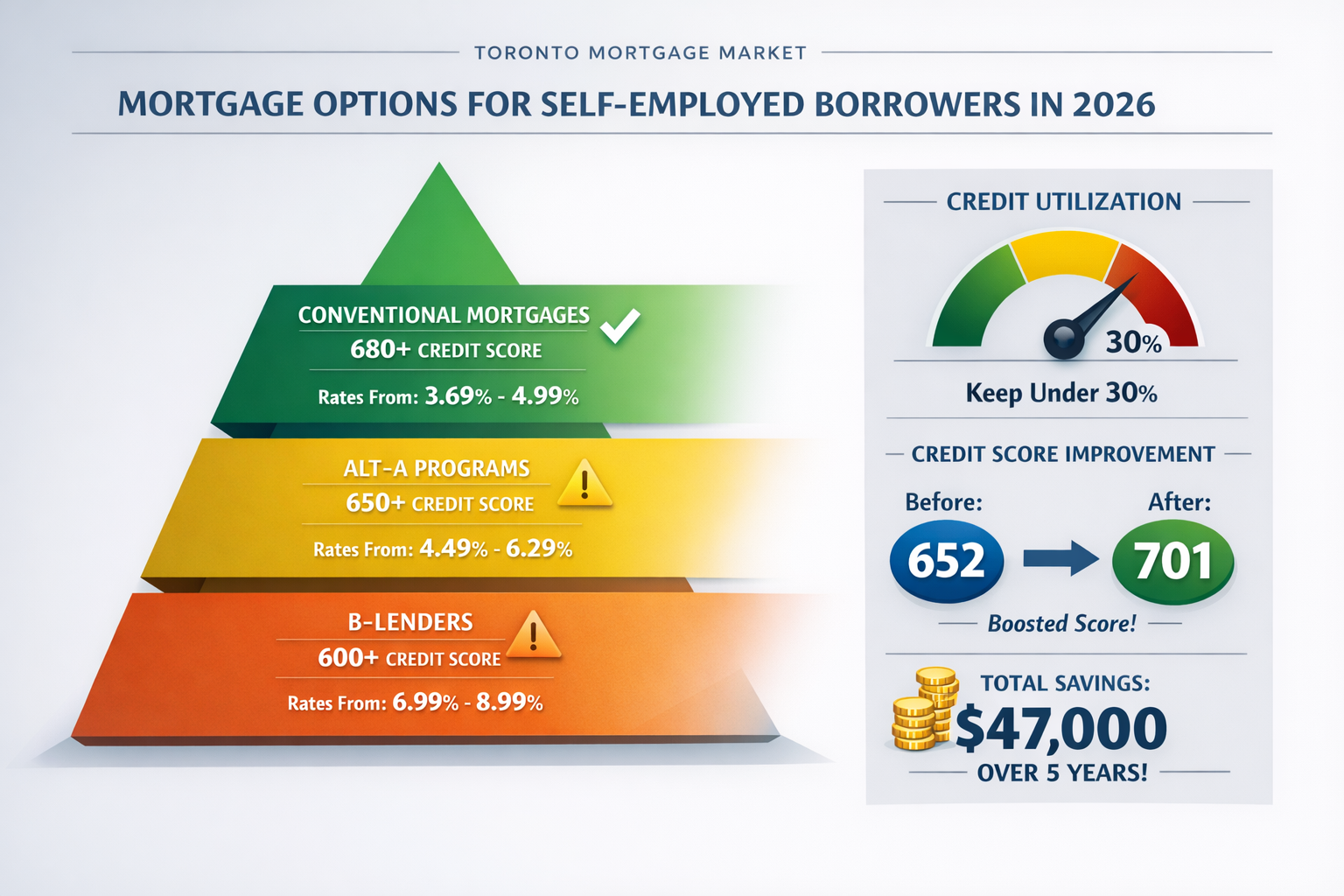
✅ Credit score thresholds have increased: Conventional mortgages now require 680+ credit scores (up from 650), while Alt-A programs require 650+ and B-lenders accept 600+[1].
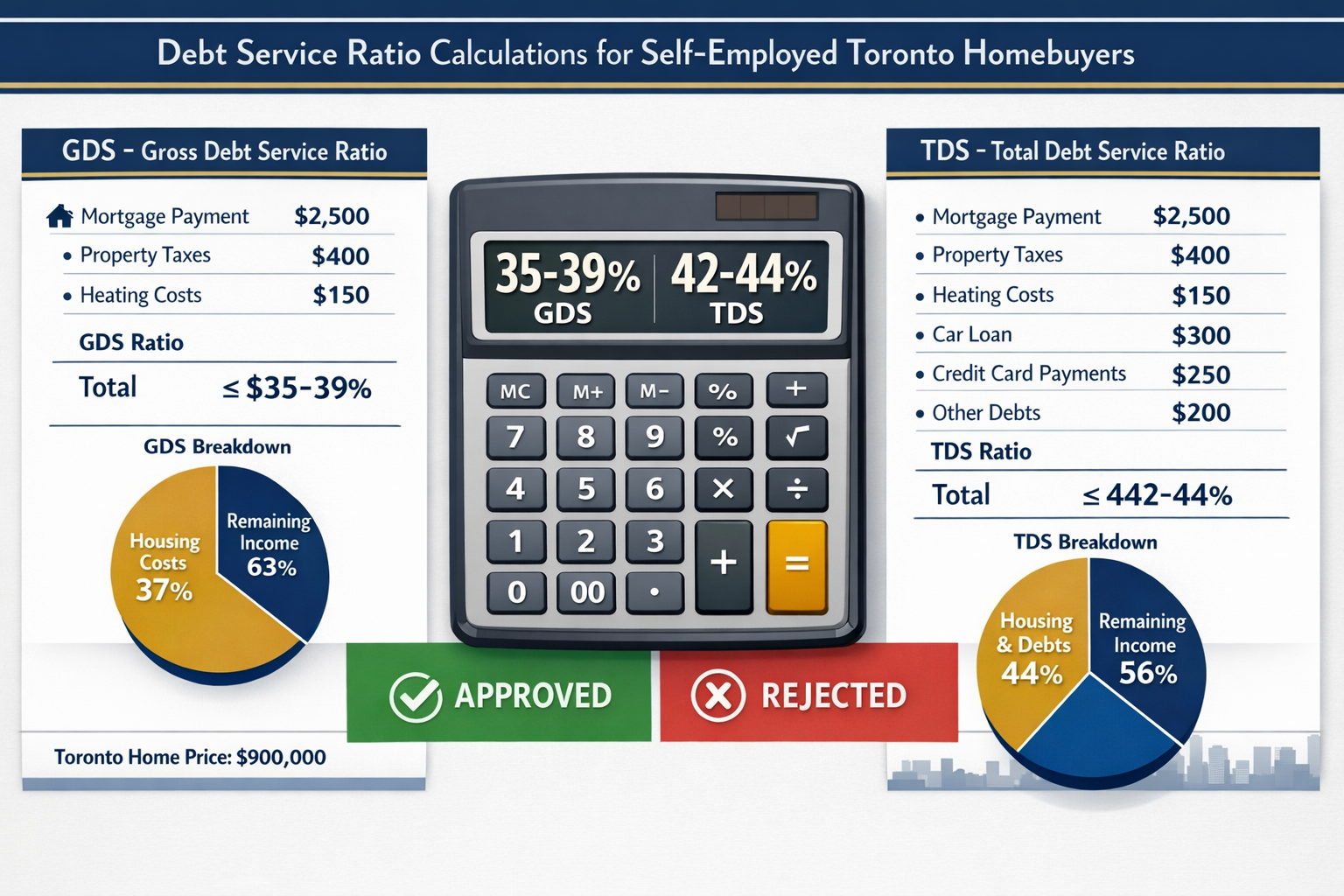
✅ Debt-to-income ratios have tightened: The maximum debt-to-income ratio for self-employed borrowers has decreased to 42% (down from 45%), with GDS ratios capped at 35-39%[1][3].
✅ Strategic preparation pays off: Paying down credit cards to under 30% utilization 90 days before applying can improve credit scores by 50+ points, potentially saving $47,000 in interest over 5 years[1].
✅ Alternative pathways exist: When traditional lenders say no, specialized self-employed mortgage solutions and alternative lenders provide viable options for qualified borrowers.
Understanding the New 2026 Mortgage Documentation Requirements for Self-Employed Borrowers
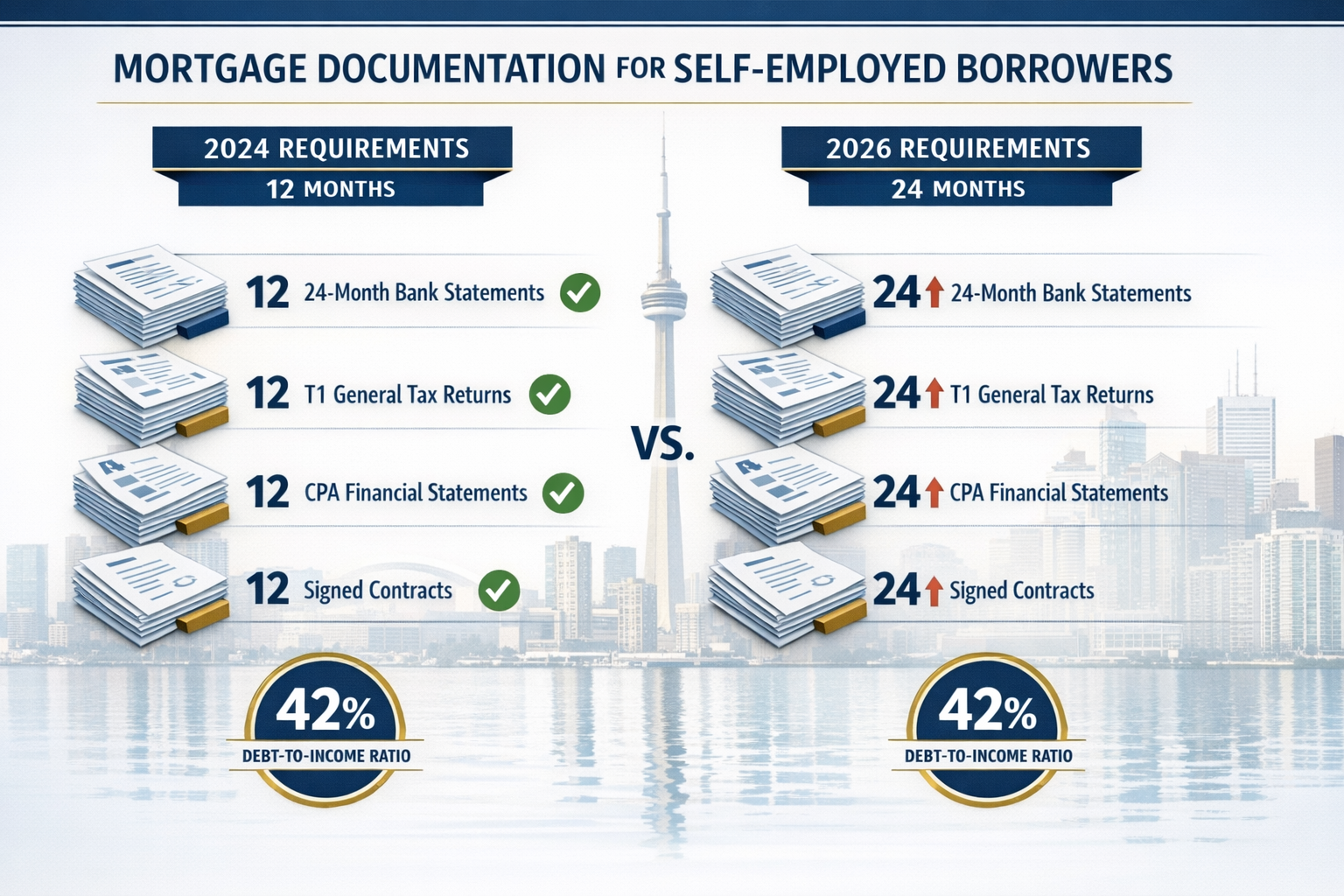
The most significant change affecting how self-employed borrowers can secure insurable mortgage rates in Toronto under new 2026 rules involves documentation standards. Lenders have fundamentally restructured their verification processes, creating more rigorous—but ultimately more transparent—qualification criteria.
Extended Bank Statement Requirements 📊
The shift from 12-month to 24-month business bank statements represents the single biggest documentation change[1]. This extended timeline allows lenders to:
- Identify seasonal income fluctuations more accurately
- Verify consistent business performance over multiple fiscal periods
- Detect potential income irregularities or one-time windfalls
- Assess business stability through economic cycles
For Toronto-based entrepreneurs, this means maintaining clean, organized banking records for at least two full years before applying. Lenders scrutinize these statements for regular deposits, business expense patterns, and overall cash flow health.
Complete Tax Documentation Package
Beyond bank statements, the 2026 requirements demand comprehensive tax documentation:
| Document Type | Requirement | Purpose |
|---|---|---|
| T1 General Tax Returns | 2-3 complete years | Verify reported income to CRA |
| Notice of Assessments (NOA) | Matching tax years | Confirm CRA acceptance |
| Business Financial Statements | CPA-prepared, 2 years | Validate business profitability |
| Accounts Receivable Aging | Current snapshot | Assess income collectability |
| Signed Contracts | Future income documentation | Project forward earnings |
The requirement for CPA-prepared financial statements[1] has become non-negotiable for most A-lenders. Self-employed borrowers who previously filed their own taxes or used basic bookkeeping software now need professional accounting support to meet lender standards.
Income Verification Methodology
Lenders calculate qualifying income using increasingly conservative formulas. For incorporated business owners, the typical calculation includes:
- Line 150 income (personal income)
- Plus: Declared dividends
- Plus: A percentage of retained corporate earnings (typically 50-100% depending on lender)
- Minus: Personal tax obligations
For unincorporated sole proprietors, lenders examine:
- Gross business income
- Minus: Allowable business expenses
- Plus back: Certain non-cash deductions (depreciation, amortization)
Understanding these calculations helps self-employed borrowers structure their income reporting strategically—balancing tax efficiency with mortgage qualification needs. For more detailed guidance on mortgages for self-employed borrowers, specialized mortgage professionals can provide personalized income optimization strategies.
The Two-Year Self-Employment History Requirement
Most lenders now require a minimum two years of self-employment history[3], with some preferring three years for optimal rates. This creates challenges for:
- Recently transitioned employees who started businesses in 2024-2025
- Entrepreneurs who changed business structures (incorporation, partnership changes)
- Professionals who switched industries or service offerings
“Even small changes to your business structure—like incorporating or adding a partner—can reset the clock on your self-employment history from a lender’s perspective.”[4]
For those with less than two years of self-employment, alternative income verification options may provide pathways to approval, though typically at higher rates.
Credit Score Requirements and Optimization Strategies for Self-Employed Toronto Homebuyers
Credit requirements have become significantly more stringent in 2026, directly impacting how self-employed borrowers can secure insurable mortgage rates in Toronto under new 2026 rules. Understanding these thresholds—and how to optimize your score—can mean the difference between approval and rejection.
2026 Credit Score Thresholds by Lender Type
The credit landscape has stratified into clear tiers:
Conventional A-Lenders (Major Banks and Credit Unions)
- Minimum score: 680+ (increased from 650 in 2024)[1]
- Optimal score: 720+ for best rates
- Insurable mortgage rates: Starting at 3.69% for well-qualified borrowers[1][5]
Alt-A Lenders (Near-Prime Institutions)
- Minimum score: 650+[1]
- Rate premium: Typically 0.25-0.75% above A-lender rates
- Flexibility: More lenient on income documentation with strong credit
B-Lenders (Alternative Mortgage Providers)
- Minimum score: 600+ (some accept 580 with strong income documentation)[1]
- Rate premium: 1.5-3.5% above prime rates
- Trade-off: Higher rates but greater approval flexibility
For Toronto borrowers exploring stricter lending standards and higher scrutiny, understanding these tiers helps set realistic expectations.
The 30% Credit Utilization Rule 💳
One of the most powerful credit optimization strategies involves credit card utilization. The documented case of a borrower improving their score from 652 to 701—saving $47,000 in interest over 5 years—demonstrates the financial impact[1].
Strategic Credit Optimization Timeline:
- 90 Days Before Application: Pay down credit cards to under 30% utilization
- 60 Days Before Application: Review credit reports for errors, dispute inaccuracies
- 30 Days Before Application: Avoid new credit applications or major purchases
- Application Time: Credit score reflects 2-3 months of improved behavior
The math is compelling: A borrower with a 650 credit score might qualify for a 4.89% rate, while a 700+ score could secure 3.99%—a difference of $234 per month on a $600,000 mortgage, or $84,240 over a 30-year amortization.
Credit Report Red Flags That Block Approval
Beyond the numerical score, lenders scrutinize credit reports for specific warning signs:
- ❌ Collections or judgments (even if paid, may require 2+ years seasoning)
- ❌ Consumer proposals or bankruptcies (typically 2-7 year waiting periods)
- ❌ Late payments in past 12 months (especially mortgage or rent payments)
- ❌ Multiple recent credit inquiries (suggests credit shopping or financial stress)
- ❌ High credit utilization (above 50% is particularly damaging)
For borrowers with credit challenges, understanding credit scores in the mortgage approval process provides context for rehabilitation strategies.
Building Credit History for New Entrepreneurs
Self-employed borrowers who recently started their businesses often face dual challenges: limited business history and thin credit files. Strategies to build credit include:
- Secured credit cards with monthly usage and full payment
- Credit builder loans from credit unions
- Becoming an authorized user on established accounts (with permission)
- Business credit cards used responsibly (though personal credit remains primary for mortgage qualification)
The goal is demonstrating consistent, responsible credit behavior over time—ideally 24+ months of perfect payment history before applying for a mortgage.
Debt-to-Income Ratios: Meeting the Tightened 2026 Standards
Understanding and optimizing debt-to-income ratios has become critical for how self-employed borrowers can secure insurable mortgage rates in Toronto under new 2026 rules. The tightening from 45% to 42% maximum debt-to-income ratio[1] eliminates thousands of previously qualified borrowers—unless they strategically reduce debt before applying.
Understanding GDS and TDS Ratios
Canadian mortgage qualification relies on two key metrics:
Gross Debt Service (GDS) Ratio
This measures housing costs as a percentage of gross income:
<code>GDS = (Mortgage Payment + Property Taxes + Heating + 50% Condo Fees) ÷ Gross Income
</code>
Maximum GDS for insurable mortgages: 35-39%[3]
Total Debt Service (TDS) Ratio
This includes all debt obligations:
<code>TDS = (GDS + Car Loans + Credit Cards + Personal Loans + Other Debt) ÷ Gross Income
</code>
Maximum TDS for self-employed borrowers in 2026: 42% (down from 45%)[1]
Maximum TDS through mortgage default insurers: 44%[3]
Real-World Toronto Example
Consider a self-employed graphic designer in Toronto with:
- Gross annual income: $95,000 (verified through 24-month bank statements)
- Desired home price: $750,000
- Down payment: $75,000 (10%)
- Monthly mortgage payment (principal + interest at 4.5%): $3,422
- Property taxes: $400/month
- Heating: $150/month
- Condo fees: $350/month (50% = $175 counted)
- Car loan: $450/month
- Credit card minimum payments: $200/month
GDS Calculation: ($3,422 + $400 + $150 + $175) ÷ ($95,000 ÷ 12) = $4,147 ÷ $7,917 = 52.4% ❌
This exceeds the 39% maximum GDS, making the borrower ineligible despite strong income.
Solution: Reduce the home price to $625,000, creating a monthly mortgage payment of $2,852:
($2,852 + $400 + $150 + $175) ÷ $7,917 = 45.2% GDS (still too high)
The borrower needs to target homes around $575,000 to achieve a 39% GDS ratio—or increase their down payment significantly.
Strategic Debt Reduction Before Application 📉
The most effective strategy for meeting 2026 debt ratio requirements involves strategic debt elimination:
Priority 1: High-Interest Revolving Debt
- Pay off credit cards completely (or reduce to under 30% utilization)
- Eliminate personal lines of credit
- Impact: Reduces monthly obligations AND improves credit score
Priority 2: Short-Term Installment Loans
- Pay off car loans with less than 12 months remaining
- Eliminate furniture financing or buy-now-pay-later balances
- Impact: Removes monthly payment obligations from TDS calculation
Priority 3: Consolidation Strategies
- Consider debt consolidation mortgages if you currently own property
- Refinance high-interest debt into lower-payment structures
- Caution: Only effective if it genuinely reduces monthly payments
Income Averaging for Variable Self-Employment Income
For self-employed borrowers with fluctuating income, lenders typically use conservative averaging methods:
- Two-year average of net business income (most common)
- Most recent year only if income is declining (penalizes growth trajectories)
- Three-year average for maximum stability demonstration
A Toronto-based contractor with income of $78,000 (2024), $92,000 (2025), and $105,000 (2026) would likely qualify based on:
Two-year average: ($92,000 + $105,000) ÷ 2 = $98,500 qualifying income
This conservative approach protects lenders but can undervalue rapidly growing businesses. Providing signed contracts for future work[1] can help justify using more recent (higher) income figures.
Alternative Pathways When Traditional Lenders Say No
Even with perfect preparation, some self-employed borrowers find that how self-employed borrowers can secure insurable mortgage rates in Toronto under new 2026 rules through traditional channels remains out of reach. Fortunately, alternative lending solutions have evolved to fill this gap.
The Rise of Alternative Lenders in 2026
The dramatic increase in traditional lender rejections—73% of previously qualified self-employed applications[1]—has created robust demand for alternative mortgage products. These lenders offer:
Alt-A Lenders
- Credit scores: 650+[1]
- Income verification: More flexible documentation accepted
- Rates: Typically 0.25-1.0% above prime lender rates
- Best for: Borrowers with good credit but complex income structures
B-Lenders
- Credit scores: 600+[1]
- Income verification: Stated income programs available
- Rates: 1.5-3.5% above prime rates
- Best for: Borrowers with credit challenges or minimal documentation
Private Lenders
- Credit scores: Flexible (case-by-case)
- Income verification: Minimal or none (equity-based lending)
- Rates: 7-12%+ typically
- Best for: Short-term solutions, unique situations, or bridge financing
For Toronto borrowers exploring these options, understanding what private mortgage options are available in Ontario provides valuable context.
Stated Income and Self-Declared Programs
Stated income mortgages—where borrowers declare their income without full traditional verification—have made a comeback in 2026, though with important safeguards:
Requirements typically include:
- ✅ Minimum 20% down payment (no insurance available)
- ✅ Credit score 650+ for most programs
- ✅ Reasonable income claims (verified against industry standards)
- ✅ Proof of self-employment (business license, GST/HST registration)
- ✅ Recent bank statements showing business activity
These programs work well for:
- Cash-heavy businesses (restaurants, retail, personal services)
- New businesses with strong initial traction but limited history
- Borrowers transitioning between employment and self-employment
Learn more about alternative income verification and self-declared income mortgages for detailed program comparisons.
Mortgage Renewal Advantages for Existing Homeowners
Self-employed borrowers who already own homes face different dynamics at renewal. The shift in lending standards creates both challenges and opportunities:
Challenge: Your current lender may require full re-qualification under 2026 rules, potentially denying renewal if your documentation doesn’t meet new standards[4].
Opportunity: Mortgage refinancing and switching lenders at renewal can unlock better rates or access equity without full income verification.
“Existing mortgage holders have leverage at renewal. Even with tightened standards, lenders prefer retaining clients over losing them to competitors—creating negotiation opportunities.”
Building a Lender-Ready Application Package 📋
When pursuing alternative pathways, presentation matters enormously. A professional application package should include:
Financial Documentation:
- 24-month business bank statements (highlighted for consistent deposits)
- 2-3 years T1 General tax returns with NOAs
- CPA-prepared financial statements
- Accounts receivable aging report
- Contracts or letters of intent for future work
Business Credibility:
- Business registration documents
- Professional licenses or certifications
- Client testimonials or references
- Business website and marketing materials
- Industry association memberships
Personal Financial Strength:
- Credit report (pulled yourself first to check for errors)
- Explanation letters for any credit issues
- Proof of down payment source (90-day paper trail)
- List of assets and net worth statement
Cover Letter: A one-page professional summary explaining:
- Your business model and value proposition
- Income stability and growth trajectory
- Why you’re an excellent lending risk
- Your long-term financial plans
This comprehensive approach demonstrates professionalism and reduces lender risk perception—often making the difference between approval and rejection.
Geographic Advantages: Why Toronto Matters
Toronto’s robust real estate market provides self-employed borrowers with unique advantages:
- Property appreciation creates equity cushions that reduce lender risk
- Diverse employment opportunities provide income stability evidence
- Competitive lender landscape offers more product choices
- Strong rental markets support income property strategies
These factors often make Toronto-based self-employed borrowers more attractive to lenders than similar applicants in smaller markets—though they must still meet the fundamental 2026 qualification criteria.
Actionable Steps to Secure Insurable Mortgage Rates as a Self-Employed Toronto Borrower
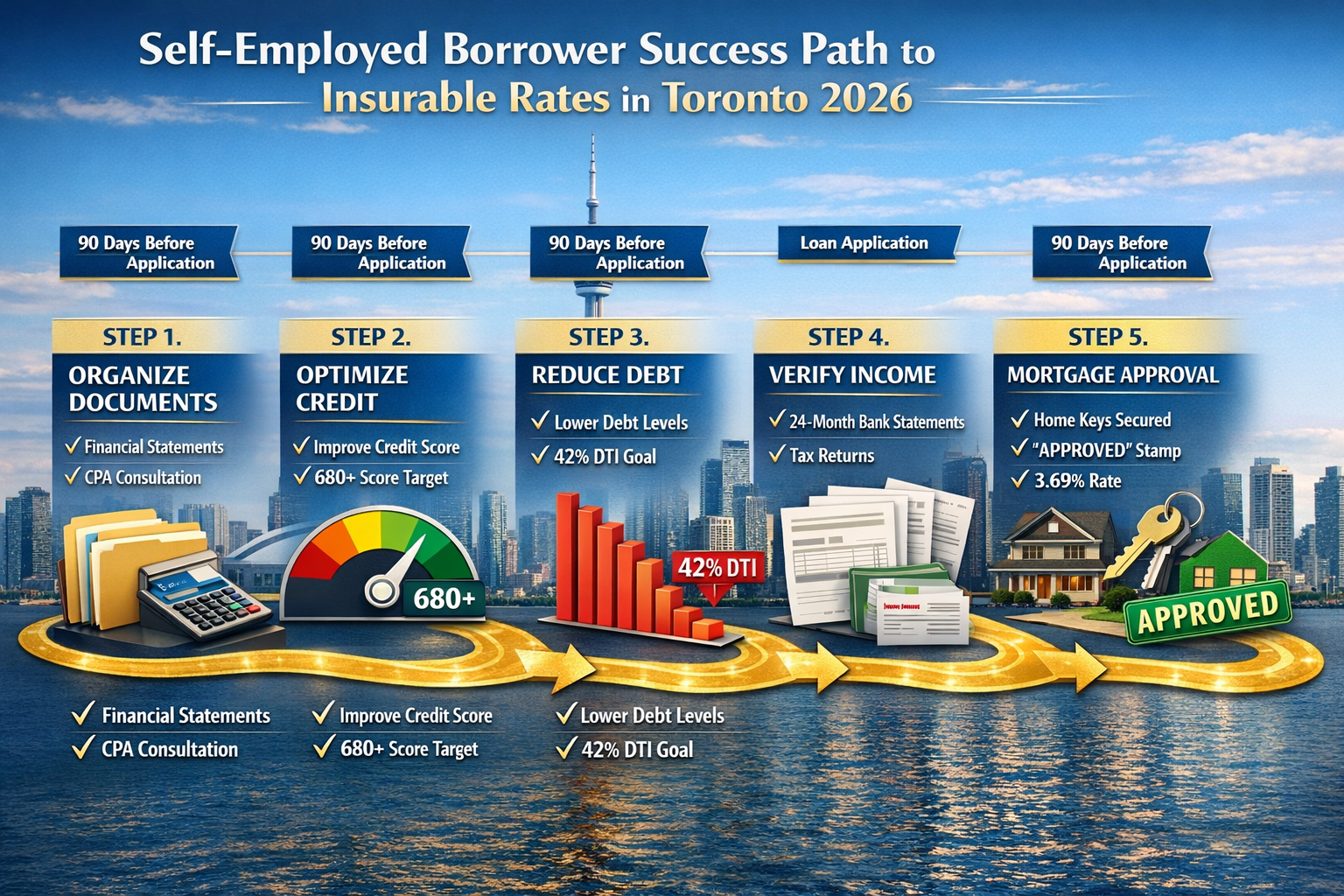
Understanding how self-employed borrowers can secure insurable mortgage rates in Toronto under new 2026 rules is only valuable when translated into concrete action. This section provides a step-by-step roadmap for successful mortgage qualification.
Step 1: Financial Documentation Audit (Timeline: 6-12 Months Before Application)
Begin with a comprehensive review of your financial documentation:
Month 1-2: Document Collection
- ✅ Gather 24 months of business bank statements
- ✅ Collect 2-3 years of complete T1 General returns with NOAs
- ✅ Request CPA-prepared financial statements (if not already prepared)
- ✅ Compile contracts showing future income commitments
- ✅ Organize accounts receivable aging reports
Month 3-4: Gap Analysis
- ❓ Identify missing documentation
- ❓ Assess whether income averaging will support your target mortgage
- ❓ Calculate current GDS and TDS ratios
- ❓ Determine if you meet minimum self-employment history requirements
Month 5-6: Professional Consultation
- 📞 Meet with a specialized mortgage professional for pre-qualification assessment
- 📞 Consult with your CPA about income optimization strategies
- 📞 Discuss business structure changes if beneficial for qualification
Step 2: Credit Score Optimization (Timeline: 90-180 Days Before Application)
Credit improvement requires time—start early:
Immediate Actions:
- Pay down credit cards to under 30% utilization (ideally under 10%)
- Pull your credit reports from Equifax and TransUnion
- Dispute any errors or inaccuracies immediately
- Set up automatic payments to prevent any future late payments
60-90 Day Actions:
- Monitor credit score improvements monthly
- Avoid applying for any new credit
- Don’t close old credit accounts (reduces available credit)
- Keep credit card balances low even if paying in full monthly
Target Outcomes:
- 680+ credit score for conventional insurable rates[1]
- Zero late payments in past 24 months
- Credit utilization under 30% across all accounts
- Clean credit report with no collections or judgments
Step 3: Debt Reduction Strategy (Timeline: 6-12 Months Before Application)
Strategic debt elimination maximizes your qualifying power:
High-Priority Debt Elimination:
| Debt Type | Monthly Payment | Interest Rate | Payoff Priority | Rationale |
|---|---|---|---|---|
| Credit Card A | $350 | 19.99% | 1st | High rate, improves credit utilization |
| Personal Loan | $280 | 12.5% | 2nd | Removes TDS obligation |
| Credit Card B | $150 | 21.99% | 3rd | High rate, credit score boost |
| Car Loan | $450 | 4.9% | 4th | Low rate, but reduces TDS if paid |
Calculation Example:
Eliminating $780/month in credit card and personal loan payments improves TDS by approximately 10 percentage points for a borrower earning $95,000 annually:
- Before: $780 ÷ $7,917/month = 9.85% of income
- After: 0% of income allocated to these debts
- Result: Can qualify for $780 × 12 = $9,360 more annual housing costs
Step 4: Income Documentation Strategy (Timeline: Ongoing)
Structure your business finances with mortgage qualification in mind:
For Incorporated Business Owners:
- Balance salary vs. dividend strategies with your CPA
- Consider taking higher salary in the 12-24 months before applying
- Retain earnings strategically (lenders may count 50-100% toward income)
- Document all income sources comprehensively
For Sole Proprietors:
- Minimize aggressive tax deductions in qualification years
- Add back non-cash expenses (depreciation, CCA) for income calculation
- Maintain consistent monthly deposits to business accounts
- Avoid large irregular deposits without clear documentation
For All Self-Employed Borrowers:
- Keep personal and business finances clearly separated
- Maintain detailed records of all business expenses
- Secure written contracts for ongoing or future work
- Build relationships with clients who can provide references
Step 5: Pre-Approval and Application Process
With documentation prepared and finances optimized:
Pre-Approval Stage:
- Submit complete application package to multiple lenders
- Compare pre-approval offers (rates, terms, conditions)
- Understand any conditions or requirements
- Lock in rate holds (typically 90-120 days)
Home Shopping Stage:
- Stay within pre-approved budget
- Factor in property taxes and heating costs for GDS calculation
- Consider future income stability when choosing mortgage size
- Avoid major financial changes during this period
Final Approval Stage:
- Provide updated bank statements and income documentation
- Complete property appraisal and title search
- Finalize insurance arrangements
- Review all mortgage documents carefully before signing
For borrowers interested in business owner mortgage strategies, specialized guidance can optimize the application approach.
Step 6: Ongoing Financial Management Post-Approval
Securing the mortgage is just the beginning:
First Year Strategies:
- Maintain emergency fund (6+ months expenses)
- Continue building credit score
- Document business growth and stability
- Prepare for potential rate increases at renewal
Long-Term Planning:
- Consider mortgage refinancing options as business grows
- Build equity through accelerated payments when possible
- Monitor market conditions for renewal opportunities
- Maintain relationships with mortgage professionals for future needs
Understanding financial strategies for managing mortgages helps ensure long-term success beyond initial approval.
Understanding Market Context: Why 2026 Rules Changed
The dramatic tightening of self-employed lending standards didn’t happen in isolation. Understanding the broader economic context helps self-employed borrowers navigate how self-employed borrowers can secure insurable mortgage rates in Toronto under new 2026 rules more strategically.
Economic Factors Driving Stricter Standards
Several converging factors prompted lenders to tighten requirements:
Rising Delinquency Rates Mortgage delinquencies increased in 2025[5], particularly among self-employed borrowers who faced business disruptions. Lenders responded by requiring more extensive documentation to verify income stability.
Regulatory Pressure Federal regulators increased scrutiny of mortgage underwriting practices, particularly for non-traditional income verification. The emphasis shifted toward sustainable lending that protects both borrowers and the financial system.
Default Insurance Changes CMHC and other mortgage insurers tightened their own requirements, forcing lenders to adopt stricter qualification criteria for insurable mortgages—those with less than 20% down payment.
Interest Rate Volatility Despite Bank of Canada rate adjustments, fixed mortgage rates haven’t always followed predictable patterns, creating uncertainty that makes lenders more conservative.
The Self-Employed Lending Gap
The rejection of 73% of previously qualified self-employed applications[1] created what industry experts call the “self-employed lending gap”—qualified borrowers who can afford mortgages but can’t access traditional financing.
This gap has driven growth in:
- Alternative lender market share
- Private mortgage volumes
- Stated income program offerings
- Mortgage broker specialization in self-employed clients
For Toronto borrowers, this actually creates opportunity: specialized lenders competing for self-employed business often offer more flexible terms than they would have in previous years.
Future Outlook: Will Requirements Ease?
Industry experts suggest 2026 represents the “new normal” rather than a temporary tightening[2][6]. Self-employed borrowers should plan for:
- Persistent documentation requirements (24-month statements likely permanent)
- Continued credit score importance (680+ threshold stable)
- Stable debt ratio limits (42% TDS likely maintained)
- Growing alternative lender options (market filling the gap)
Rather than waiting for easier qualification standards, successful self-employed borrowers are adapting their financial strategies to meet current requirements—positioning themselves for approval regardless of future regulatory changes.
Conclusion: Your Path to Mortgage Approval as a Self-Employed Toronto Borrower
Understanding how self-employed borrowers can secure insurable mortgage rates in Toronto under new 2026 rules requires acknowledging a fundamental truth: the qualification process has become more demanding, but approval remains entirely achievable for borrowers who prepare strategically.
The key differentiators between approved and rejected applications in 2026 are:
✅ Comprehensive documentation (24-month bank statements, CPA-prepared financials, complete tax history)
✅ Optimized credit profiles (680+ scores, under 30% utilization, clean payment history)
✅ Strategic debt management (TDS ratios under 42%, GDS under 39%)
✅ Professional presentation (organized applications, clear income narratives, business credibility)
✅ Realistic expectations (understanding alternative pathways when traditional lending doesn’t fit)
Your Next Steps 🎯
If you’re 12+ months from purchasing:
- Begin organizing financial documentation now
- Consult with a CPA about income optimization strategies
- Start credit score improvement initiatives
- Build 24 months of consistent business banking history
If you’re 3-6 months from purchasing:
- Complete pre-qualification with specialized mortgage professionals
- Finalize debt reduction strategies
- Ensure credit utilization is under 30%
- Gather all required documentation for lender submission
If you’re ready to purchase now:
- Connect with mortgage specialists experienced in self-employed applications
- Explore both traditional and alternative lending options
- Get pre-approved before house hunting
- Maintain financial stability throughout the process
If you’re facing challenges with traditional approval:
- Investigate alternative income verification programs
- Consider increasing your down payment to 20%+ for more options
- Explore B-lender or private mortgage solutions as bridges
- Work with professionals who specialize in complex applications
The Toronto Advantage
Toronto’s robust real estate market, diverse economy, and competitive lending landscape provide self-employed borrowers with advantages unavailable in many other Canadian markets. The city’s strong property values, rental demand, and economic opportunities create conditions where lenders—even under strict 2026 rules—remain eager to finance qualified self-employed borrowers.
The challenge isn’t whether self-employed Torontonians can secure mortgages in 2026—they absolutely can. The question is whether individual borrowers will invest the time and effort to meet the new standards. Those who do will find that insurable mortgage rates starting at 3.69%[1][5] remain accessible, offering the same homeownership opportunities available to traditionally employed borrowers.
Take Action Today
Don’t let the complexity of 2026 mortgage rules delay your homeownership goals. Schedule a free mortgage consultation with specialists who understand the unique challenges self-employed borrowers face—and the proven strategies that lead to approval.
Your path to homeownership in Toronto starts with understanding the rules, preparing your finances, and working with professionals who know how to navigate the 2026 lending landscape. The door to insurable mortgage rates remains open for self-employed borrowers who approach it with the right preparation and guidance.
References
[1] 5 Steps To Navigating 2026s Tightened Self Employed Lending Rules – https://www.kraftmortgages.ca/blog/5-steps-to-navigating-2026s-tightened-self-employed-lending-rules
[2] Self Employed Canadians In 2026 – https://rateshop.ca/post/self-employed-canadians-in-2026
[3] Self Employed Mortgage Requirements – https://www.frankmortgage.com/blog/self-employed-mortgage-requirements
[4] Self Employed At Renewal Why Small Changes Can Complicate Your Mortgage – https://www.canadianmortgagetrends.com/2025/12/self-employed-at-renewal-why-small-changes-can-complicate-your-mortgage/
[6] Ask Mortgage Expert How To Buy Home 2026 – https://rates.ca/resources/ask-mortgage-expert-how-to-buy-home-2026
 Previous Page