February 24, 2026
Native-AI SaaS vs AI-Enabled: Choosing the Best CRM and Marketing Tools for 2026
Share this article:



Manzeel is an award-winning Mortgage Broker and the Owner of the Toronto-based mortgage, Everything Mortgages.
With 16 years of experience in the Canadian mortgage industry and a formal background in mortgage underwriting, Manzeel’s lending expertise gives him unique insight into whether a deal is feasible which empowers his clients to make more informed lending decisions faster.
He has been recognized as one of Canada’s Top 10 Mortgage Brokers by the national Canadian Mortgage Professionals (CMP) Association. Him and his team of 18 mortgage agents are proud to offer a mortgage experience that's built on honesty, trust, and integrity. He prides himself on the brokerage’s dedication to deliver an excellent client experience throughout the entire home loan process from pre-approval to post-funding.
Since moving to Toronto in 1998, Manzeel has successfully launched and scaled several businesses from the ground up, ranging from a mortgage brokerage and a vast real estate investment portfolio to a private financing eCommerce platform. He continues to be a leader in the real estate industry as he uses his analytical expertise to seek new real estate investment opportunities.
As a tech junkie and avid sports enthusiast, when Manzeel’s not working with clients, you can find him reading technology blogs, playing squash or watching tennis with his two boys.
The artificial intelligence revolution has fundamentally transformed how businesses approach customer relationship management and marketing automation. As we navigate 2026, organizations face a critical decision: should they invest in native-AI SaaS platforms built from the ground up with artificial intelligence at their core, or opt for traditional AI-enabled solutions that layer AI capabilities onto existing infrastructure? Understanding the distinction between Native-AI SaaS vs AI-Enabled: Choosing the Best CRM and Marketing Tools for 2026 isn’t just a technical consideration—it’s a strategic imperative that impacts integration costs, data security, operational efficiency, and long-term scalability.
The landscape has evolved dramatically. What began as simple chatbots and basic automation has matured into sophisticated AI agents capable of managing entire sales processes, predicting customer behavior with remarkable accuracy, and automatically enriching databases without human intervention. Yet not all AI implementations are created equal, and the architectural differences between native and enabled solutions create vastly different experiences for end users and IT teams alike.
Key Takeaways
- Native-AI platforms like Salesforce Einstein and Zoho Zia embed AI throughout their architecture, offering seamless integration and unified data flows, while AI-enabled solutions bolt AI capabilities onto existing systems, often requiring additional configuration and integration work
- Integration costs and complexity vary significantly: native solutions typically provide out-of-the-box functionality with lower technical overhead, whereas AI-enabled platforms may require developer support and ongoing maintenance
- Pricing structures reflect AI sophistication levels, with entry-level plans starting as low as $9/user/month for basic AI features, while advanced predictive analytics and custom AI agents command $50-$199/user/month
- Data security and governance differ between architectures, with native-AI systems offering centralized control and AI-enabled solutions potentially creating additional security touchpoints through third-party integrations
- Enterprise scalability depends on your growth trajectory: native platforms excel at scaling AI capabilities across departments, while AI-enabled solutions offer flexibility for organizations with specific, targeted AI needs
Understanding the Fundamental Difference: Native-AI vs AI-Enabled Architecture
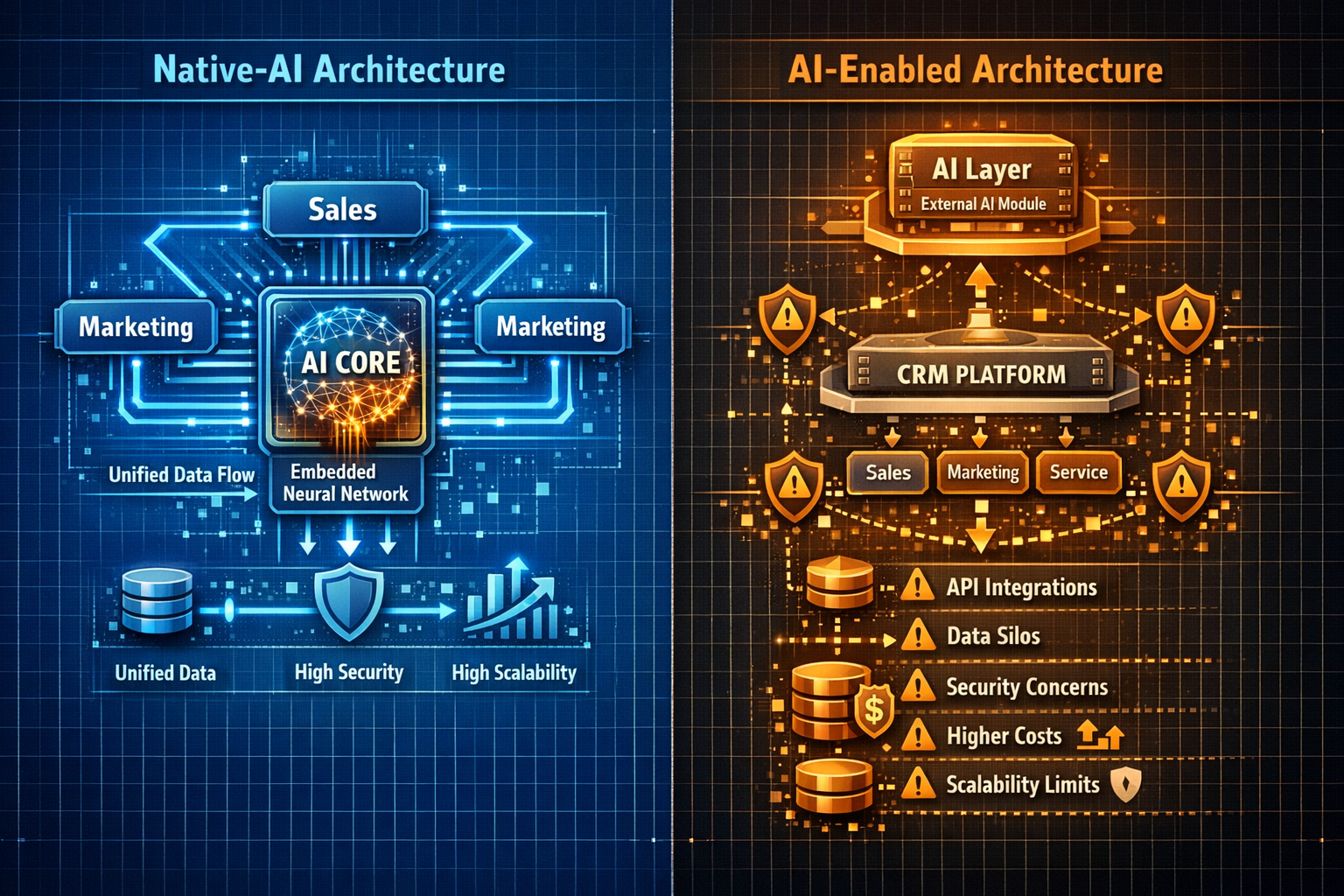
The distinction between native-AI and AI-enabled platforms goes far deeper than marketing terminology. It represents fundamentally different approaches to how artificial intelligence integrates with core business systems.
What Makes a Platform “Native-AI”?
Native-AI platforms are designed from inception with artificial intelligence as a foundational component rather than an afterthought. These systems feature AI woven throughout their architecture, creating a unified ecosystem where machine learning models, predictive analytics, and automation capabilities share a common data foundation[6].
Consider Salesforce’s approach: the platform now offers over 200 customizable AI agents that operate across sales, service, marketing, and commerce functions[2]. These agents don’t exist as separate add-ons but rather as integral components of the platform’s DNA. When a sales representative logs into Salesforce Einstein, the AI has immediate access to the complete customer journey—from marketing touchpoints to service interactions—without requiring complex integrations or data synchronization.
Similarly, Zoho CRM’s Zia intelligence features 14 AI tools embedded across all sales processes[2]. The AI doesn’t sit on top of the CRM; it operates within it, analyzing patterns in real-time and surfacing insights at precisely the moment users need them.
The AI-Enabled Approach: Layered Intelligence
In contrast, AI-enabled platforms take existing CRM or marketing automation systems and add AI capabilities through integrations, plugins, or bolt-on modules. While this approach can be effective, it introduces architectural complexity that impacts performance, data flow, and user experience.
AI-enabled solutions typically require:
- Additional API connections between the core platform and AI services
- Data synchronization to ensure AI models have access to current information
- Manual configuration to define how AI insights flow back into user workflows
- Separate security protocols for AI components versus core platform data
The practical implications become clear when examining implementation timelines and technical requirements. Salesforce Einstein, despite being native to the platform, still requires technical configuration and developer support for full implementation[2]—a testament to the sophistication involved even in native solutions. AI-enabled platforms often demand even more extensive technical resources to achieve comparable functionality.
Real-World Performance Differences
The architectural distinction manifests in several critical areas:
Data Flow and Latency: Native-AI systems process information within a unified database, eliminating the lag time associated with API calls and data transfers. When Zoho’s Zia predicts which leads are most likely to convert, it’s analyzing data already resident in the system, not pulling information from external sources[3].
Feature Coherence: Native platforms deliver consistent AI experiences across modules. HubSpot’s Breeze, for example, provides the same intelligent automation capabilities whether users are managing email campaigns, sales sequences, or customer service tickets[1].
Update Synchronization: When native-AI platforms release new capabilities, they deploy across the entire ecosystem simultaneously. AI-enabled solutions may experience version conflicts or feature gaps as different components update on independent schedules.
Evaluating Integration Costs, Data Security, and Technical Complexity
The decision between native-AI and AI-enabled solutions carries significant financial and operational implications that extend far beyond initial licensing fees. Organizations must account for the total cost of ownership, including integration expenses, security infrastructure, and ongoing maintenance requirements.
The True Cost of Integration
Initial Implementation Expenses
Native-AI platforms typically offer more straightforward implementation paths, though “straightforward” remains relative in enterprise software. Platforms like Freshsales with Freddy AI start at just $9/user/month[2], providing SMBs with accessible entry points that include basic AI functionality out of the box. However, enterprise implementations tell a different story.
Even native solutions like Salesforce Einstein require substantial upfront investment in:
- 🔧 Configuration and customization to align AI agents with specific business processes
- 👨💻 Developer resources for advanced workflow automation and custom AI model training
- 📊 Data cleansing and preparation to ensure AI models receive quality training data
- 🎓 User training and change management to drive adoption across teams
AI-enabled platforms compound these costs with additional integration work. Organizations must budget for:
- Middleware or integration platform as a service (iPaaS) solutions to connect AI capabilities
- Custom API development when pre-built connectors don’t exist
- Ongoing synchronization monitoring to prevent data inconsistencies
- Troubleshooting resources when AI components and core platforms conflict
Tiered Pricing Reveals AI Value Stratification
The market has developed sophisticated pricing models that monetize AI capabilities at different levels of sophistication. Vtiger One exemplifies this approach: the base plan at $12/user/month includes standard AI features, but organizations requiring advanced predictive AI and chatbot training must upgrade to $50/user/month[3].
This tiering pattern appears across the market:
| Platform | Entry-Level AI | Advanced AI | Enterprise AI |
|---|---|---|---|
| Freshsales | $9/user/month | $39/user/month | $69/user/month |
| Zoho CRM | $14/user/month | $23/user/month | $40/user/month |
| Salesmate | $39/month team | $99/month team | $199/month team |
| HubSpot | Free (limited) | $800/month | Custom pricing |
The mid-market sweet spot appears in the $39-$99 range, where platforms like Salesmate deliver AI sequences, lead insights, and multichannel campaigns[4] without requiring enterprise-level investment.
Data Security Considerations in AI Architectures
Security implications differ substantially between native and enabled approaches, particularly as data privacy regulations tighten globally and businesses handle increasingly sensitive customer information.
Native-AI Security Advantages
When AI operates within the platform’s core architecture, organizations benefit from:
✅ Unified security protocols that apply consistently across all AI and non-AI functions
✅ Centralized access control with single sign-on and role-based permissions governing both data and AI capabilities
✅ Simplified compliance auditing since all processing occurs within one security perimeter
✅ Reduced attack surface by eliminating additional integration points that could serve as vulnerabilities
AI-Enabled Security Challenges
Layered AI solutions introduce complexity that security teams must address:
⚠️ Multiple security perimeters requiring separate authentication and authorization protocols
⚠️ Data transfer vulnerabilities when information moves between core platform and AI services
⚠️ Third-party risk management when AI capabilities come from external vendors
⚠️ Compliance fragmentation if AI processors reside in different jurisdictions than core data
Organizations in regulated industries—financial services, healthcare, and professional services like those working with mortgage brokers who handle sensitive financial documentation—must carefully evaluate how AI architectures impact their compliance posture.
Technical Complexity and Resource Requirements
The ongoing operational burden represents a hidden cost that many organizations underestimate during platform selection.
Developer Dependency
Native-AI platforms reduce but don’t eliminate technical complexity. Salesforce Einstein’s cross-platform AI integration extending beyond sales to service, marketing, and commerce[2] delivers tremendous value but requires skilled administrators who understand both the platform and AI concepts.
AI-enabled solutions amplify this dependency. Organizations must maintain expertise in:
- The core CRM or marketing platform
- The AI service or plugin architecture
- Integration technologies connecting the two
- Troubleshooting across multiple systems when issues arise
Automation and Self-Service
Modern platforms increasingly emphasize automated activity capture, with systems like Salesforce and HubSpot automatically logging emails, calls, and calendar events[2]. This reduces manual CRM data entry and improves data quality for AI models.
Native-AI platforms extend this automation further with AI agents for database management that enrich records automatically, fill missing details, and summarize interactions without manual configuration[2]. These capabilities represent significant time savings, particularly for small teams managing large contact databases.
Enterprise Scalability: HubSpot, Salesforce, and Emerging Native Platforms
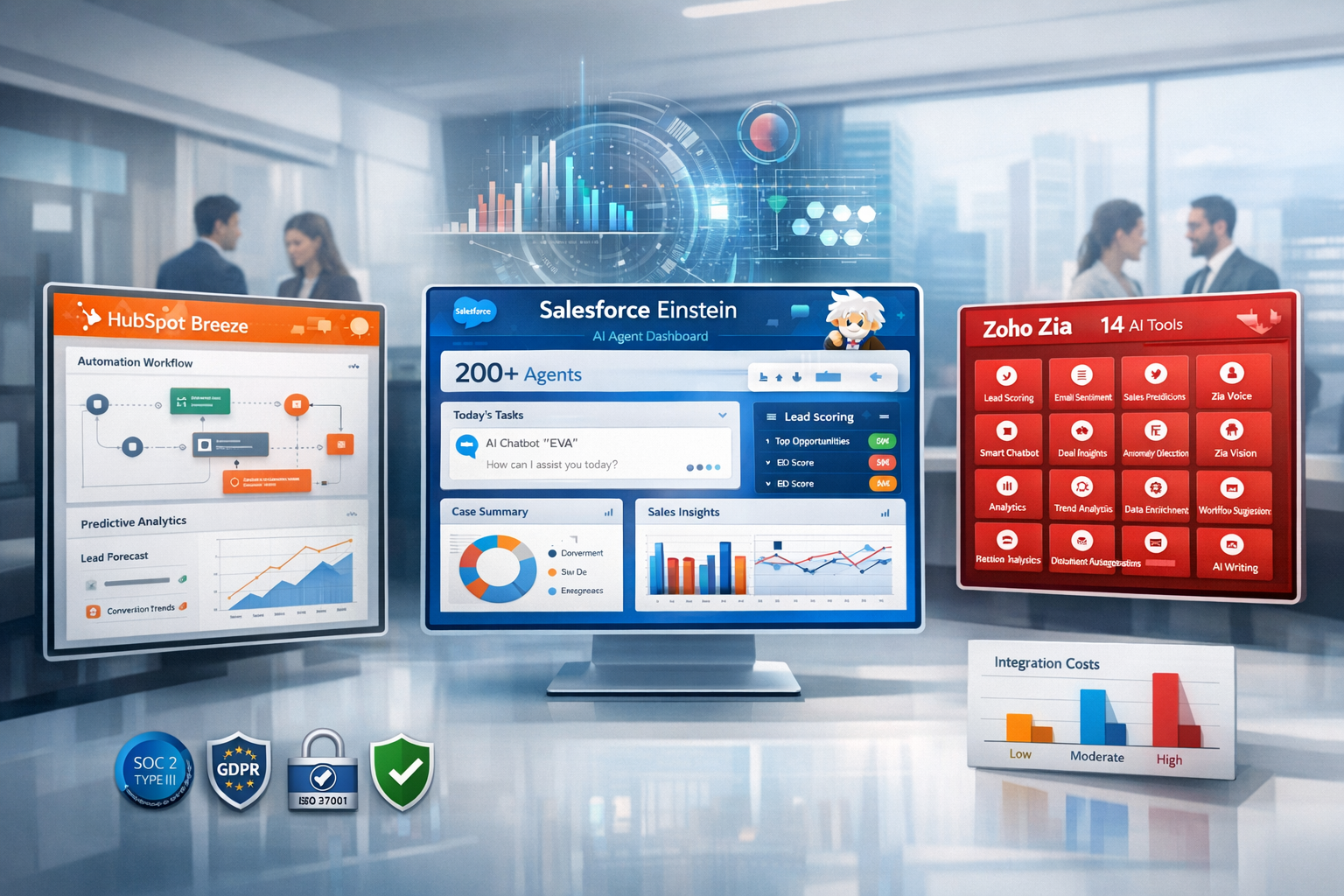
As businesses grow from startups to mid-market companies to enterprise organizations, their CRM and marketing automation needs evolve dramatically. The scalability question in Native-AI SaaS vs AI-Enabled: Choosing the Best CRM and Marketing Tools for 2026 becomes critical when considering multi-year platform investments.
The Enterprise Leaders: Salesforce Einstein and HubSpot Breeze
Salesforce Einstein: The Enterprise Standard
Salesforce has positioned Einstein as the comprehensive AI solution for large, complex organizations requiring AI capabilities across multiple business functions. The platform’s strength lies in its breadth:
🏢 Cross-Departmental Integration: Einstein doesn’t just serve sales teams. The AI extends to Service Cloud for customer support, Marketing Cloud for campaign optimization, and Commerce Cloud for personalized shopping experiences[2].
📈 Advanced Predictive Capabilities: Enterprise users gain access to sophisticated forecasting models that analyze historical patterns, market conditions, and pipeline health to predict revenue with increasing accuracy.
🤖 Customizable Agent Framework: The 200+ customizable agents available in Salesforce represent pre-built AI capabilities that organizations can deploy and tailor to specific processes[2]. An enterprise might configure one agent to handle lead routing, another to identify upsell opportunities, and a third to predict customer churn.
However, Salesforce’s enterprise focus comes with corresponding complexity and cost. Organizations should anticipate:
- Significant implementation timelines (often 6-12 months for full deployment)
- Dedicated Salesforce administrators or consultants
- Premium pricing that reflects enterprise positioning
- Steep learning curves for users unfamiliar with the platform
HubSpot Breeze: Growth-Stage Flexibility
HubSpot has evolved from its inbound marketing roots into a comprehensive CRM platform with native AI capabilities that appeal particularly to growth-stage companies. Breeze represents HubSpot’s AI layer, offering:
✨ User-Friendly Interface: HubSpot maintains its reputation for intuitive design, making AI capabilities accessible to non-technical users
🔄 Unified Hub Architecture: AI operates consistently across Marketing Hub, Sales Hub, Service Hub, and CMS Hub
💰 Flexible Pricing: Starting with a robust free tier and scaling to enterprise plans, HubSpot accommodates businesses at various growth stages
📊 Marketing-First Heritage: While now comprehensive, HubSpot’s AI particularly excels at marketing automation, content optimization, and campaign performance prediction
The platform suits organizations that prioritize ease of use and marketing sophistication, though it may lack some of the deep customization capabilities that Salesforce offers for complex enterprise scenarios.
Mid-Market Contenders: Zoho, Freshsales, and Specialized Solutions
The mid-market segment has seen explosive growth in native-AI offerings, providing alternatives to enterprise platforms at more accessible price points.
Zoho CRM with Zia: The Ecosystem Play
Zoho’s strategy differs from competitors by embedding AI across an extensive suite of business applications. Organizations already using Zoho’s productivity tools, finance software, or project management platforms find particular value in Zia because:
🔗 Cross-Application Intelligence: Zia can surface insights from Zoho Books (accounting), Zoho Projects, and Zoho Desk, creating a more complete business intelligence picture
🎯 Customizable Deployment: Businesses can deploy AI agents where they deliver the most value rather than implementing across all functions simultaneously
📉 Competitive Pricing: Starting at $14/user/month for paid plans[4], Zoho delivers enterprise-class AI at mid-market prices
⚠️ Learning Curve Consideration: Despite its power, Zoho is noted for a steep learning curve[3], particularly when leveraging advanced predictive analytics and forecasting capabilities
Freshsales with Freddy AI: SMB Accessibility
Freshworks has positioned Freshsales as the AI-powered CRM for small and medium businesses that need sophisticated capabilities without enterprise complexity:
💵 Aggressive Pricing: Starting at $9/user/month[2], Freshsales removes financial barriers to AI adoption
🎁 All-in-One Approach: The platform bundles CRM, email, phone, and AI capabilities in a single package
🤖 Freddy AI Capabilities: Predictive contact scoring, deal insights, and intelligent workflow automation come standard
📱 Mobile-First Design: Particularly valuable for field sales teams who need AI insights on the go
The platform serves businesses that need AI capabilities quickly without extensive customization or technical resources.
Emerging Native-AI Platforms: The Innovation Frontier
Beyond established players, a new generation of AI-native CRM platforms is emerging, built entirely around artificial intelligence from their first line of code[6].
Folk: The Relationship-First AI CRM
Folk represents the new wave of AI-native platforms that reimagine CRM around relationship intelligence rather than transaction tracking. The platform emphasizes:
- Natural language interaction with the CRM
- Automatic relationship mapping and network analysis
- Context-aware suggestions based on communication patterns
- Simplified data entry through AI-powered enrichment
EngageBay: Integrated AI for Startups
EngageBay targets startups and small businesses with affordable all-in-one solutions that include OpenAI integration[2], providing:
- Marketing automation with AI-powered segmentation
- Sales CRM with predictive lead scoring
- Customer service tools with AI chatbots
- Unified pricing that bundles all capabilities
These emerging platforms often sacrifice the breadth of established solutions but deliver focused AI capabilities with modern user experiences that appeal to digital-native teams.
Scalability Patterns: Matching Platform to Growth Trajectory
Organizations should align platform selection with realistic growth projections:
Startup to 50 Employees: Platforms like Freshsales, EngageBay, or HubSpot’s free tier provide sufficient AI capabilities without overwhelming small teams. The focus should be on ease of use and quick time-to-value.
50 to 250 Employees: Mid-market solutions like Zoho CRM, Salesmate (with its $39-$199/month AI sequences and multichannel campaigns)[4], or HubSpot’s Professional tier offer the sophistication growing companies need while maintaining manageability.
250+ Employees: Enterprise platforms like Salesforce Einstein or HubSpot Enterprise become necessary when organizations require:
- Complex multi-team workflows
- Advanced customization and integration
- Dedicated support and SLAs
- Comprehensive security and compliance features
Similar to how self-employed borrowers need specialized mortgage solutions that traditional banks can’t provide, growing businesses often need CRM capabilities that entry-level platforms can’t deliver at scale.
Critical Features to Evaluate in 2026: Predictive Analytics, Generative AI, and Automation
The AI capabilities that defined cutting-edge CRM platforms in 2023 have become table stakes by 2026. Organizations evaluating Native-AI SaaS vs AI-Enabled: Choosing the Best CRM and Marketing Tools for 2026 should focus on how platforms implement three critical feature categories: predictive analytics, generative AI, and intelligent automation.
Predictive Analytics: From Reactive to Proactive Sales
Lead Scoring and Prioritization
Modern AI-powered CRMs analyze dozens of signals to predict which prospects are most likely to convert, allowing sales teams to focus energy where it matters most. Predictive analytics capabilities now extend across platforms including Salesforce, Zoho, Freshsales, Zendesk Sell, and Vtiger[2][3].
Sophisticated lead scoring considers:
📧 Engagement patterns: Email open rates, website visits, content downloads, and webinar attendance
👤 Demographic fit: Company size, industry, role, and geographic location
⏱️ Behavioral timing: Frequency and recency of interactions
🔍 Intent signals: Search behavior, competitor research, and buying stage indicators
The difference between native and enabled AI becomes apparent in scoring accuracy. Native platforms continuously refine models based on actual conversion outcomes within the same database, creating a feedback loop that improves predictions over time. AI-enabled solutions may struggle with this continuous learning if data doesn’t flow seamlessly between the AI engine and the core CRM.
Deal Forecasting and Pipeline Intelligence
Beyond individual lead scoring, enterprise platforms now predict deal closure probability and forecast revenue with remarkable precision. Salesforce Einstein analyzes:
- Historical win rates by deal characteristics
- Sales cycle length patterns
- Competitive dynamics in similar opportunities
- Sales representative performance trends
- Seasonal and market condition impacts
This intelligence helps sales leaders make informed decisions about resource allocation, quota setting, and strategic planning—capabilities that were previously the domain of business intelligence specialists with advanced analytics tools.
Churn Prediction and Customer Health Scoring
For subscription businesses and service providers, churn prediction has become as critical as new customer acquisition. AI models identify at-risk customers by analyzing:
⚠️ Usage decline: Decreasing login frequency, feature adoption, or engagement metrics
💬 Support patterns: Increasing ticket volume or negative sentiment in communications
💰 Payment behavior: Late payments, downgrade requests, or pricing inquiries
🔄 Renewal timing: Historical patterns around contract expiration dates
Platforms like Zoho Zia excel at these advanced predictive analytics and forecasting capabilities[3], giving customer success teams early warning to intervene before customers leave.
Generative AI: Content Creation and Communication Enhancement
The explosion of large language models has transformed how sales and marketing teams create content, communicate with prospects, and document interactions.
Email Drafting and Personalization
Generative AI for sales now includes email drafting, call summaries, follow-up suggestions, and close-plan recommendations across mid-market and enterprise platforms[2]. Rather than starting from blank screens, sales representatives receive AI-generated first drafts that:
✍️ Incorporate context: The AI references previous conversations, customer pain points, and relevant product features
🎯 Match tone: Generative models adapt writing style to recipient preferences and relationship stage
⏰ Optimize timing: Suggestions include best send times based on recipient engagement patterns
📎 Attach relevant content: AI recommends case studies, whitepapers, or product sheets that align with prospect interests
Platforms like HubSpot Breeze and Salesforce Einstein have integrated these capabilities natively, while AI-enabled solutions often rely on third-party integrations with tools like ChatGPT or Jasper.
Call Summaries and Meeting Intelligence
Post-call documentation has historically consumed significant sales time. Modern AI platforms automatically:
🎙️ Transcribe conversations: Converting voice to text with speaker identification
📝 Extract action items: Identifying commitments, next steps, and deadlines
💡 Surface key insights: Highlighting objections, competitor mentions, and buying signals
🔄 Update CRM records: Automatically logging activities and updating deal stages
This automation not only saves time but improves CRM data quality—a persistent challenge when manual entry depends on busy sales representatives remembering to log activities.
Content Optimization for Marketing
Marketing teams leverage generative AI to:
- Create ad copy variations for A/B testing
- Generate social media posts aligned with brand voice
- Draft blog outlines and content briefs
- Personalize email campaigns at scale
- Optimize landing page headlines and calls-to-action
The best AI marketing tools for 2026 combine generation capabilities with performance analytics, creating feedback loops where AI learns which content variations drive the best results[4][5].
Intelligent Automation: Reducing Manual CRM Work
Perhaps the most immediately valuable AI capability is the reduction of tedious manual work that has plagued CRM adoption for decades.
Automated Activity Capture
Platforms like Salesforce and HubSpot now automatically log emails, calls, and calendar events[2], eliminating the need for sales representatives to manually record every customer interaction. The AI:
📧 Monitors email: Capturing correspondence with contacts in the CRM
📞 Tracks calls: Logging phone conversations with duration and participants
📅 Syncs calendars: Recording meetings and associating them with relevant deals
🔗 Identifies relationships: Mapping new contacts discovered through email threads
This passive data collection ensures CRM accuracy even when users don’t actively maintain records—a game-changer for organizations that have struggled with CRM adoption.
AI Agents for Database Management
The newest frontier in CRM automation involves AI agents that enrich records automatically, fill missing details, summarize interactions, and provide predictive insights without manual configuration[2]. These agents:
🔍 Enrich contact data: Automatically adding job titles, company information, social profiles, and contact details
🧹 Clean duplicates: Identifying and merging redundant records
📊 Standardize formatting: Ensuring consistency in phone numbers, addresses, and company names
🏷️ Auto-tag records: Applying categories and labels based on characteristics and behavior
Zoho’s 14 AI tools embedded across all sales processes[2] exemplify this comprehensive automation approach, where AI touches virtually every aspect of CRM data management.
Workflow Automation and Intelligent Routing
Beyond data management, AI optimizes business processes through:
- Lead routing: Automatically assigning leads to the best-fit sales representative based on territory, expertise, workload, and past performance
- Task creation: Generating follow-up reminders and action items based on deal stage and time elapsed
- Escalation triggers: Alerting managers when deals stall or high-value opportunities need attention
- Approval workflows: Routing discount requests, contract terms, or custom pricing through appropriate approval chains
These automations reduce response times and ensure consistent process execution—particularly valuable for businesses managing complex sales cycles or multiple product lines, much like how mortgage brokers streamline the approval process for borrowers navigating complicated lending scenarios.
Making the Decision: Framework for Choosing Between Native-AI and AI-Enabled Solutions
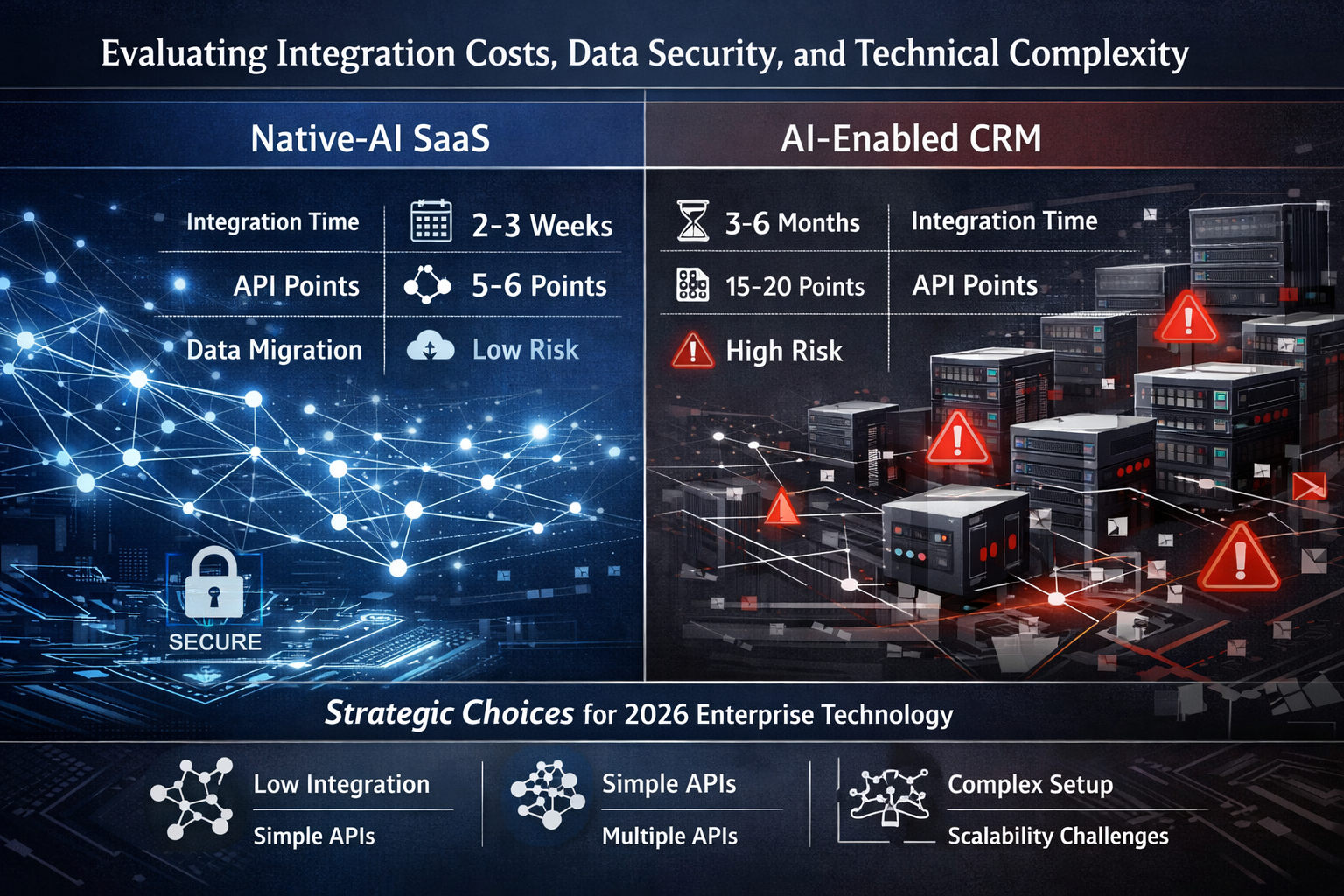
With a clear understanding of architectural differences, cost implications, and feature capabilities, organizations need a structured framework to evaluate Native-AI SaaS vs AI-Enabled: Choosing the Best CRM and Marketing Tools for 2026 for their specific circumstances.
Assessment Framework: Five Critical Dimensions
1. Current Technical Capabilities and Resources
Begin by honestly assessing internal technical capacity:
❓ Do you have dedicated IT or development resources?
- Yes: AI-enabled solutions become more viable since you can manage integration complexity
- No: Native-AI platforms with out-of-the-box functionality reduce dependency on technical expertise
❓ What is your team’s comfort level with technology adoption?
- High: Platforms with advanced customization (Salesforce, Zoho) can be fully leveraged
- Low: User-friendly solutions (HubSpot, Freshsales) accelerate adoption and reduce training burden
❓ Do you already have established systems that must integrate with your CRM?
- Yes: Evaluate integration capabilities carefully; some AI-enabled solutions may connect more easily to legacy systems
- No: Native-AI platforms offer cleaner implementations without legacy constraints
2. Budget Realities and Total Cost of Ownership
Move beyond sticker price to understand comprehensive costs:
💰 Initial Investment:
- Entry-level AI: $9-$14/user/month (Freshsales, Zoho)
- Mid-market AI: $39-$99/user/month (Salesmate, HubSpot Professional)
- Enterprise AI: $150+/user/month (Salesforce, HubSpot Enterprise)
💰 Implementation Costs:
- DIY setup: Minimal (suitable for platforms with free trials like Pipedrive’s 14-day or Salesforce’s 30-day options[3])
- Guided implementation: $5,000-$25,000 for mid-market deployments
- Enterprise implementation: $50,000-$500,000+ for complex Salesforce deployments
💰 Ongoing Expenses:
- User licenses (calculate based on projected headcount growth)
- Additional AI feature tiers (remember Vtiger’s jump from $12 to $50/user/month for advanced AI[3])
- Integration and middleware costs
- Training and change management
- Support and maintenance
3. Scalability Requirements and Growth Trajectory
Project your needs 3-5 years forward:
📈 User Growth: How many employees will need CRM access?
📈 Data Volume: How quickly will your contact and interaction database grow?
📈 Feature Expansion: Will you need to add marketing automation, customer service, or e-commerce capabilities?
📈 Geographic Expansion: Will international growth require multi-currency, multi-language, or regional compliance features?
Native-AI platforms generally scale more smoothly across departments and use cases since AI capabilities extend uniformly across the platform. AI-enabled solutions may require additional integrations as you expand into new functional areas.
4. Industry-Specific Requirements
Certain industries demand specialized capabilities:
🏥 Healthcare: HIPAA compliance, patient data security, and specialized workflows
💰 Financial Services: Regulatory compliance, audit trails, and sophisticated security (similar to requirements for mortgage brokers handling sensitive financial data)
🏭 Manufacturing: Complex product configurations, distributor management, and supply chain integration
🛍️ E-commerce: Shopping cart integration, inventory management, and omnichannel customer tracking
Evaluate whether platforms offer industry-specific solutions or if you’ll need extensive customization to meet sector requirements.
5. AI Maturity and Strategic Importance
Consider where AI fits in your competitive strategy:
🎯 AI as Differentiator: If AI-powered customer experiences or sales processes provide competitive advantage, invest in sophisticated native-AI platforms with advanced capabilities
🎯 AI as Efficiency Tool: If AI primarily reduces manual work and improves productivity, mid-market solutions with solid automation may suffice
🎯 AI as Future-Proofing: If you’re building AI capabilities for anticipated future needs, prioritize platforms with strong development roadmaps and regular feature releases
Platform Selection Decision Tree
Use this simplified decision tree to narrow options:
Start Here: What is your organization size?
→ Under 25 employees: Consider Freshsales ($9/user/month), EngageBay, or HubSpot free tier
→ 25-250 employees: Evaluate Zoho CRM ($14-$40/user/month), Salesmate ($39-$199/month), or HubSpot Professional
→ 250+ employees: Focus on Salesforce Einstein, HubSpot Enterprise, or Microsoft Dynamics 365
Next: What is your primary use case?
→ Sales-focused: Salesforce, Zoho, Freshsales, or Pipedrive
→ Marketing-focused: HubSpot, Salesforce Marketing Cloud, or specialized marketing platforms
→ All-in-one: HubSpot, Zoho ecosystem, or Salesforce with multiple clouds
→ Customer service: Zendesk Sell, Freshdesk, or Salesforce Service Cloud
Finally: What is your technical capacity?
→ Limited technical resources: HubSpot, Freshsales, or EngageBay (user-friendly, minimal configuration)
→ Moderate technical resources: Zoho, Salesmate, or Pipedrive (some customization capability)
→ Strong technical resources: Salesforce, custom AI-enabled solutions (maximum flexibility and customization)
Testing and Validation Approach
Before committing to multi-year contracts, leverage free plans and trials that are now standard across platforms[3]:
✅ HubSpot: Robust free tier with limited AI features
✅ Pipedrive: 14-day trial
✅ Salesforce: 30-day trial
✅ Zoho: Free plan for up to 3 users
✅ Freshsales: 21-day free trial
During trial periods, focus on:
- User adoption: Do team members actually use the platform, or does it feel cumbersome?
- AI accuracy: Do predictive scores and recommendations align with your team’s intuition and outcomes?
- Integration success: Can you connect existing tools (email, calendar, marketing automation) smoothly?
- Support responsiveness: How quickly and effectively does the vendor address questions and issues?
- Data migration: How difficult will it be to move existing CRM data to the new platform?
Common Pitfalls to Avoid
⚠️ Over-buying on features: Don’t pay for enterprise capabilities you won’t use for years. Start with platforms that meet current needs and offer clear upgrade paths.
⚠️ Under-estimating change management: The best AI platform fails if users don’t adopt it. Budget time and resources for training and adoption programs.
⚠️ Ignoring integration ecosystem: Ensure the CRM connects to tools you already use (email platforms, marketing automation, customer support, accounting software).
⚠️ Focusing solely on AI: While AI capabilities matter, foundational CRM functionality—contact management, pipeline tracking, reporting—remains critical. Don’t sacrifice core features for flashy AI.
⚠️ Neglecting data quality: AI models are only as good as the data they analyze. Platforms with strong data enrichment and cleaning capabilities deliver better AI outcomes.
Conclusion: Strategic Recommendations for 2026 CRM Selection
The question of Native-AI SaaS vs AI-Enabled: Choosing the Best CRM and Marketing Tools for 2026 doesn’t have a universal answer—but it has a right answer for your specific organization based on size, technical capacity, budget, and strategic priorities.
For small businesses and startups (under 50 employees), native-AI platforms with user-friendly interfaces and affordable pricing represent the optimal choice. Freshsales at $9/user/month or HubSpot’s free tier provide sophisticated AI capabilities without overwhelming small teams or budgets. The focus should be on quick implementation, ease of use, and immediate productivity gains rather than extensive customization.
For mid-market companies (50-250 employees), the decision becomes more nuanced. Organizations with technical resources and complex requirements may benefit from platforms like Zoho CRM, which offers extensive customization and AI sophistication at competitive prices ($14-$40/user/month). Those prioritizing ease of use and marketing sophistication should evaluate HubSpot’s Professional tier, which balances capability with accessibility.
For enterprise organizations (250+ employees), Salesforce Einstein remains the gold standard for companies requiring comprehensive AI across sales, service, marketing, and commerce functions. The platform’s 200+ customizable agents, cross-departmental integration, and extensive ecosystem justify premium pricing for organizations that can leverage its full capabilities. However, enterprises should budget appropriately for implementation costs, dedicated administrators, and ongoing customization.
Actionable Next Steps
Immediate Actions (This Week):
- ✅ Assemble your evaluation team: Include representatives from sales, marketing, IT, and finance to ensure all perspectives inform the decision
- ✅ Document current pain points: Identify specific CRM challenges AI should address (manual data entry, poor lead prioritization, forecasting inaccuracy, etc.)
- ✅ Calculate user count projections: Estimate CRM users for the next 3 years to understand scaling costs
- ✅ List must-have integrations: Identify critical tools (email, calendar, marketing automation, customer support) that must connect to your CRM
Short-Term Actions (Next 30 Days):
- 📋 Request demos from 3-5 platforms that align with your size and budget parameters
- 📋 Start free trials with your top 2-3 choices, assigning real users to test with actual workflows
- 📋 Evaluate data migration complexity by requesting migration assessments from vendors
- 📋 Calculate total cost of ownership including licenses, implementation, training, and ongoing support for each platform
- 📋 Check references by speaking with current customers in similar industries and company sizes
Long-Term Actions (Next 90 Days):
- 🎯 Conduct pilot implementations with a small team using real data before company-wide rollout
- 🎯 Develop adoption and training plan including role-specific training, documentation, and ongoing support
- 🎯 Establish success metrics to measure CRM impact on sales productivity, forecast accuracy, and customer engagement
- 🎯 Plan phased rollout starting with early adopters and expanding based on lessons learned
- 🎯 Schedule quarterly reviews to assess platform performance and identify optimization opportunities
The Future of AI in CRM
As we progress through 2026, the distinction between native-AI and AI-enabled platforms will likely blur as legacy systems rebuild architectures and new platforms emerge with AI-first designs. The competitive pressure to deliver sophisticated AI capabilities at accessible price points will continue driving innovation.
Organizations that choose platforms aligned with their current needs while maintaining flexibility for future growth will position themselves to leverage AI’s transformative potential. Whether you select a native-AI powerhouse like Salesforce Einstein, a user-friendly solution like HubSpot Breeze, or a mid-market specialist like Zoho Zia, the key is matching platform capabilities to organizational realities—technical capacity, budget constraints, and strategic priorities.
The AI revolution in CRM and marketing automation has moved beyond hype into practical tools that demonstrably improve sales productivity, forecast accuracy, and customer engagement. By carefully evaluating Native-AI SaaS vs AI-Enabled: Choosing the Best CRM and Marketing Tools for 2026 through the framework outlined in this guide, organizations can make informed decisions that drive competitive advantage in an increasingly AI-powered business landscape.
References
[1] Crm Native Ai Tools Breeze Agentforce Einstein Compared – https://www.octavehq.com/post/crm-native-ai-tools-breeze-agentforce-einstein-compared
[2] Best Ai Crm Tools – https://www.softr.io/blog/best-ai-crm-tools
[3] Best Ai Crm – https://www.emailvendorselection.com/best-ai-crm/
[4] Best Ai Tools Marketing 2026 – https://thesmarketers.com/blogs/best-ai-tools-marketing-2026/
[5] Best Ai Marketing Tools – https://www.campaignmonitor.com/blog/comparison/best-ai-marketing-tools/
[6] Ai Native Crm – https://www.folk.app/articles/ai-native-crm
[7] Best Tools To Automate Crm Updates – https://www.askelephant.ai/blog/best-tools-to-automate-crm-updates
[8] 10 Ai Marketing Tools Every Startup Should Be Using In 2026 (and 5 That Are Overhyped) – https://www.averi.ai/how-to/10-ai-marketing-tools-every-startup-should-be-using-in-2026-(and-5-that-are-overhyped)
[9] Best Ai Sales Tools In 2026 – https://www.zeliq.com/blog/best-ai-sales-tools-in-2026
[10] Best Ai Agents For Marketing – https://pinggy.io/blog/best_ai_agents_for_marketing/
 Previous Page