March 13, 2026
Navigating 26% Renewal Shocks for Self-Employed in Toronto: Variable vs Fixed Rate Strategies at 2.25% BoC Hold
Share this article:



Manzeel is an award-winning Mortgage Broker and the Owner of the Toronto-based mortgage, Everything Mortgages.
With 16 years of experience in the Canadian mortgage industry and a formal background in mortgage underwriting, Manzeel’s lending expertise gives him unique insight into whether a deal is feasible which empowers his clients to make more informed lending decisions faster.
He has been recognized as one of Canada’s Top 10 Mortgage Brokers by the national Canadian Mortgage Professionals (CMP) Association. Him and his team of 18 mortgage agents are proud to offer a mortgage experience that's built on honesty, trust, and integrity. He prides himself on the brokerage’s dedication to deliver an excellent client experience throughout the entire home loan process from pre-approval to post-funding.
Since moving to Toronto in 1998, Manzeel has successfully launched and scaled several businesses from the ground up, ranging from a mortgage brokerage and a vast real estate investment portfolio to a private financing eCommerce platform. He continues to be a leader in the real estate industry as he uses his analytical expertise to seek new real estate investment opportunities.
As a tech junkie and avid sports enthusiast, when Manzeel’s not working with clients, you can find him reading technology blogs, playing squash or watching tennis with his two boys.
The mortgage renewal landscape in 2026 presents an unprecedented challenge for Toronto’s self-employed community. With approximately 1.15 million Canadian borrowers facing renewal this year, those who secured ultra-low pandemic-era rates are confronting payment increases averaging 26% for fixed-rate mortgages. For self-employed professionals already managing income volatility, navigating 26% renewal shocks for self-employed in Toronto: variable vs fixed rate strategies at 2.25% BoC hold requires careful planning and strategic decision-making.
The Bank of Canada’s decision to hold its policy rate at 2.25% provides a stable foundation, but renewal rates remain significantly higher than the sub-2% mortgages many locked in during 2020-2021. This creates a perfect storm for self-employed borrowers who must balance payment affordability with income documentation challenges.
Key Takeaways
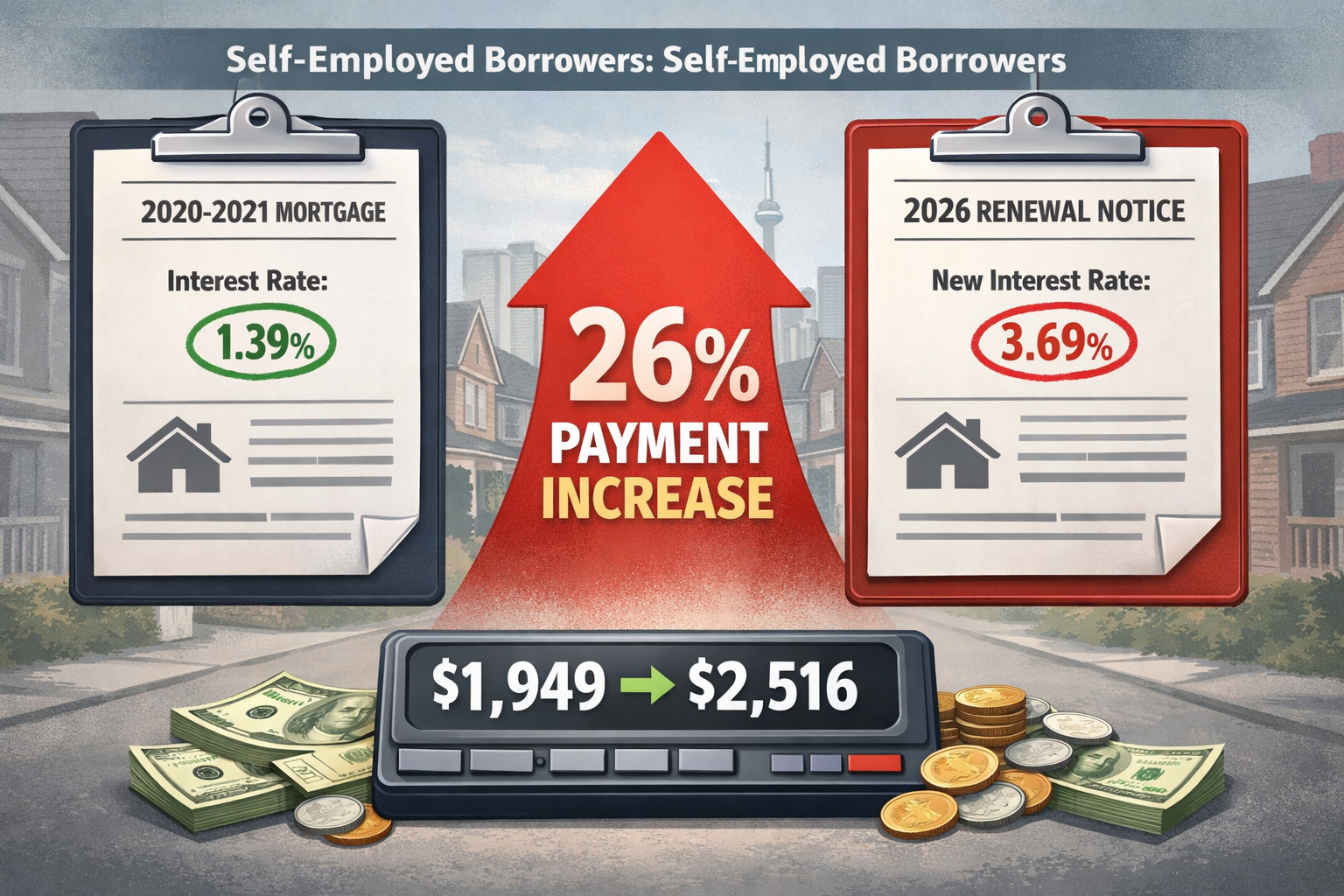
✅ Fixed-rate borrowers renewing in 2026 face average payment increases of 26%, with a $500,000 mortgage jumping from $1,949 to $2,516 monthly
✅ Variable-rate mortgage holders experience more modest 4% increases, having already absorbed rate hikes through floating payments
✅ Self-employed borrowers can secure sub-4% rates through strategic lender selection, enhanced documentation, and timing their renewals effectively
✅ The Bank of Canada’s 2.25% hold creates stability but limited room for further rate decreases, making current rates potentially the new normal
✅ Alternative lending options and bank statement programs offer pathways for self-employed professionals facing traditional income verification challenges
Understanding the 26% Payment Shock Reality for Toronto’s Self-Employed
The mathematics behind the renewal crisis are stark. Borrowers who secured five-year fixed mortgages at 1.39% in early 2021 now face renewal rates around 3.69%—a 230-basis-point increase that translates directly into significantly higher monthly obligations.
Payment Increase Scenarios by Mortgage Amount
| Original Mortgage | 2021 Rate | 2021 Payment | 2026 Rate | 2026 Payment | Monthly Increase | % Increase |
|---|---|---|---|---|---|---|
| $400,000 | 1.39% | $1,559 | 3.69% | $2,013 | $454 | 29.1% |
| $500,000 | 1.39% | $1,949 | 3.69% | $2,516 | $567 | 29.1% |
| $750,000 | 1.39% | $2,923 | 3.69% | $3,774 | $851 | 29.1% |
| $1,000,000 | 1.39% | $3,897 | 3.69% | $5,032 | $1,135 | 29.1% |
For self-employed professionals in Toronto—whether IT consultants, contractors, real estate agents, or small business owners—these increases hit particularly hard. Unlike salaried employees with predictable income streams, self-employed borrowers face unique challenges when demonstrating their ability to afford higher payments.
Why Self-Employed Borrowers Face Compounded Challenges
The renewal shock compounds existing obstacles for Toronto’s self-employed community:
💼 Income volatility makes stress-testing at higher rates more difficult
📊 Tax write-offs that reduce reported income can lower qualification amounts
🏢 Business cycle timing may show reduced income during application periods
📋 Documentation requirements become more stringent at renewal with payment increases
🏦 Lender risk perception increases when combining self-employment with higher debt ratios
Understanding these compounded factors is essential when navigating 26% renewal shocks for self-employed in Toronto: variable vs fixed rate strategies at 2.25% BoC hold become critical decisions that impact both short-term affordability and long-term financial stability.
Variable vs Fixed Rate Strategies: Which Path Makes Sense in 2026?

The choice between variable and fixed rates takes on new significance when renewal rates have climbed substantially from original terms. Current market conditions show:
- Five-year variable rates: Approximately 3.35% (Prime minus discount)
- Five-year fixed rates: Approximately 3.69%
- Spread: Only 34 basis points separating the two options
The Variable Rate Advantage for Self-Employed Renewals
Variable-rate mortgages offer several strategic advantages for self-employed borrowers navigating renewal shocks:
Lower Initial Payments 💰
The 34-basis-point difference translates to meaningful monthly savings. On a $500,000 mortgage, choosing variable at 3.35% versus fixed at 3.69% saves approximately $89 monthly or $1,068 annually.
Flexibility for Income Fluctuations 📈
Self-employed professionals with seasonal or project-based income benefit from the ability to make lump-sum payments when cash flow is strong, taking advantage of variable mortgage prepayment privileges.
Smaller Renewal Shock 🎯
Variable-rate borrowers renewing in 2026 face only 4% average payment increases compared to 26% for fixed-rate holders, as they’ve already absorbed most rate increases through their floating rates.
Lower Penalties for Early Exit 🚪
If business circumstances change or refinancing becomes necessary, variable mortgages typically carry three-months-interest penalties versus the potentially massive Interest Rate Differential (IRD) penalties on fixed mortgages.
The Fixed Rate Case for Stability-Seeking Self-Employed
Despite higher initial rates, fixed mortgages offer compelling benefits for certain self-employed scenarios:
Predictable Budgeting 📊
Business owners managing multiple financial obligations benefit from knowing exactly what their mortgage payment will be for the next five years, enabling more accurate cash flow projections.
Protection from Further Increases 🛡️
While the Bank of Canada holds at 2.25%, economic uncertainty—including potential inflation resurgence or external shocks—could push rates higher. Fixed rates provide insurance against this risk.
Qualification Certainty ✅
Some self-employed borrowers with borderline qualification may only qualify at fixed rates, as lenders stress-test variable mortgages at higher rates.
Peace of Mind Value 🧘
For self-employed professionals already managing business uncertainty, eliminating mortgage rate risk can provide psychological benefits worth the modest rate premium.
Hybrid Strategies: Splitting the Difference
Many self-employed borrowers benefit from split mortgages—dividing their total mortgage between variable and fixed portions. For example:
- 50% variable at 3.35% for flexibility and lower payments
- 50% fixed at 3.69% for stability and rate protection
- Blended effective rate: 3.52%
This approach allows self-employed professionals to benefit from both strategies while managing risk. As outlined in resources on mortgage refinancing and switching lenders at renewal, renewal time presents the perfect opportunity to restructure mortgage terms.
Securing Sub-4% Rates: Strategies for Self-Employed Borrowers in Toronto

Despite the challenges, self-employed borrowers in Toronto can secure competitive rates below 4% through strategic preparation and lender selection. The key lies in understanding how to present your financial profile most effectively.
Documentation Strategies That Work in 2026
Bank Statement Programs 📋
Alternative lenders now offer bank statement loan programs that assess income based on deposits rather than tax returns. This approach benefits self-employed professionals who write off significant business expenses.
Stated Income with Asset Verification 💼
Some lenders accept stated income when supported by substantial assets, strong credit (720+ scores), and significant equity positions (35%+ down payment or equity).
Two-Year Average Income 📊
Traditional lenders typically average two years of tax returns. Strategic timing of your renewal to coincide with strong income years can improve qualification amounts.
Business Financial Statements 🏢
Incorporated professionals can strengthen applications by providing audited or reviewed financial statements showing business profitability and sustainability.
Lender Selection: Where to Find Competitive Rates
Not all lenders treat self-employed borrowers equally. Rate shopping across multiple channels is essential:
Big Banks 🏦
- Offer lowest advertised rates (3.35%-3.69%)
- Strictest income documentation requirements
- Best for self-employed with clean two-year tax returns showing strong income
Credit Unions 🤝
- Competitive rates (3.45%-3.79%)
- More flexible income assessment
- Relationship-based underwriting benefits established members
Monoline Lenders 🎯
- Highly competitive rates (3.39%-3.69%)
- Specialized self-employed programs
- More accommodating of complex income situations
Alternative Lenders 💡
- Rates typically 3.99%-5.99%
- Minimal income documentation required
- Bridge solution for challenging situations
For IT consultants and contractors specifically, our guide on getting mortgage approval as an IT consultant in Toronto provides industry-specific strategies.
Negotiation Tactics That Lower Your Rate
Leverage Multiple Pre-Approvals 🎯
Obtain pre-approvals from 3-4 lenders and use them as negotiating leverage. Lenders will often match or beat competitor rates to secure your business.
Highlight Strong Compensating Factors ⭐
Emphasize elements that reduce lender risk:
- Credit scores above 750
- Equity positions exceeding 30%
- Multiple years in business (5+ years ideal)
- Diversified client base
- Professional designations or certifications
Consider Insured Mortgage Options 🛡️
If you qualify for mortgage default insurance (less than 20% down or refinancing under 80% LTV), insured mortgage rates for self-employed borrowers can be 20-40 basis points lower than conventional rates.
Time Your Application Strategically ⏰
Apply during strong income months when recent bank statements show healthy deposits. Many lenders review the most recent 3-6 months of statements, giving more weight to recent performance.
Use Professional Mortgage Brokers 🤝
Brokers access wholesale rates unavailable to consumers and understand which lenders offer the best programs for self-employed scenarios. They can package your application to highlight strengths and minimize weaknesses.
Current Rate Benchmarks for Self-Employed in Toronto (2026)
Based on current self-employed mortgage rates in Toronto, here’s what self-employed borrowers should target:
| Credit Profile | Variable Rate Target | Fixed Rate Target | Lender Type |
|---|---|---|---|
| Excellent (750+, 2 years clean returns) | 3.35%-3.45% | 3.69%-3.79% | Big Banks, Monolines |
| Good (680-749, some complexity) | 3.55%-3.75% | 3.89%-4.09% | Credit Unions, Alt-A |
| Fair (620-679, limited documentation) | 3.99%-4.49% | 4.29%-4.79% | Alternative Lenders |
| Challenged (below 620, stated income) | 4.99%-6.99% | 5.29%-7.49% | Private Lenders |
Preparing for Renewal: Action Steps for Self-Employed Borrowers

Strategic preparation can mean the difference between securing competitive sub-4% rates and settling for higher-cost alternative financing. Self-employed borrowers should begin the renewal process 120-180 days before their maturity date.
180 Days Before Renewal: Foundation Building
Review Your Financial Documentation 📑
Gather and organize:
- Last two years of complete tax returns (T1 Generals, Notices of Assessment)
- Business financial statements (if incorporated)
- Recent bank statements (3-6 months for all business and personal accounts)
- Current mortgage statement showing balance and payment history
- Credit reports from both Equifax and TransUnion
Assess Your Income Presentation 💰
Calculate your qualifying income using lender formulas:
- Sole proprietors: Line 13500 (Net Income) + Line 22900 (Other Employment Expenses) + CCA (Capital Cost Allowance)
- Incorporated: Salary + Dividends + Retained Earnings (percentage varies by lender)
Understanding how lenders calculate your income helps identify whether you need to adjust business compensation strategies before renewal.
Check Your Credit Profile 📊
Obtain free credit reports and ensure:
- No errors or inaccuracies exist
- All accounts show current status
- Credit utilization remains below 30% on revolving accounts
- No recent collections or judgments appear
120 Days Before Renewal: Rate Shopping Begins
Start the Pre-Approval Process 🎯
Begin obtaining pre-approvals from multiple sources:
- Your current lender (often provides renewal offers 120 days out)
- 2-3 competing banks or credit unions
- A mortgage broker who can access multiple lenders
This timeline allows for document gathering, application processing, and negotiation without rushing.
Consider Strategic Financial Moves 💡
Depending on your situation:
- Pay down high-interest debt to improve debt ratios
- Increase business income draws if recent months show lower deposits
- Consolidate business accounts to show clearer income patterns
- Avoid major purchases that could impact credit or debt ratios
Evaluate Refinancing vs. Straight Renewal 🔄
Renewal time presents an opportunity to access equity for:
- Debt consolidation at lower rates
- Business investment or expansion
- Property improvements or renovations
- Investment property down payments
Refinancing allows borrowing up to 80% of home value but requires full qualification and appraisal. For guidance on when refinancing makes sense, consider both rate environment and personal financial goals.
90 Days Before Renewal: Decision Time
Compare All Offers Holistically 📋
Don’t focus solely on rate. Evaluate:
- Interest rate (obviously important)
- Prepayment privileges (10/10, 15/15, 20/20 options)
- Portability features (if you might move)
- Penalty calculations (three-months interest vs. IRD)
- Payment flexibility (ability to skip payments, adjust frequency)
Negotiate Aggressively 💪
Use competing offers as leverage. Phrases that work:
- “Lender X offered me 3.45% variable—can you match or beat that?”
- “I’ve been a client for [X] years with perfect payment history. What’s your best rate for loyalty?”
- “I’m willing to move my banking relationship for a better rate. What can you offer?”
Lock in Your Rate 🔒
Once you’ve negotiated your best rate, secure a rate hold. Most lenders offer 90-120 day rate holds, protecting you if rates increase before your renewal date.
30 Days Before Renewal: Finalization
Review Final Documents Carefully 🔍
Ensure:
- Rate matches what was promised
- Term length is correct
- Payment amount is accurate
- All features and privileges are included
Set Up Payment Arrangements 💳
Confirm:
- Payment frequency (monthly, bi-weekly, weekly)
- Payment method (pre-authorized debit account)
- First payment date
Plan for Payment Increase 📊
If facing a 26% payment shock, strategize how to manage:
- Adjust business draws to accommodate higher payments
- Reduce discretionary spending temporarily
- Consider accelerated payment strategies to reduce principal faster
- Build emergency fund to cover 3-6 months of new payment amount
Alternative Strategies for Challenging Situations
If traditional renewal isn’t feasible due to income documentation challenges or qualification issues, consider:
Private Mortgage Bridge Financing 🌉
Short-term (6-12 month) private mortgages at higher rates (7-12%) can bridge gaps while you:
- Complete a strong income year
- Resolve credit issues
- Build additional equity
Extending Amortization ⏳
If your current lender allows, extending amortization from 20 to 25 years can reduce payment shock while you adjust to new rates.
Co-Signer or Guarantor 🤝
Adding a creditworthy co-signer with traditional employment can help qualify for better rates, though this requires careful legal and financial consideration.
DSCR Loans for Investment Properties 🏘️
If renewing on a rental property, DSCR loans for self-employed real estate investors qualify based on property cash flow rather than personal income.
Conclusion: Taking Control of Your Mortgage Renewal in 2026
Navigating 26% renewal shocks for self-employed in Toronto: variable vs fixed rate strategies at 2.25% BoC hold requires proactive planning, strategic documentation, and informed decision-making. While the payment increases facing 1.15 million Canadian borrowers in 2026 present real challenges, self-employed professionals have multiple pathways to secure competitive sub-4% rates.
The key insights for self-employed borrowers facing renewal:
Start early ⏰ – Begin preparation 180 days before renewal to maximize options and negotiating power
Choose strategically 🎯 – Variable rates offer flexibility and lower initial payments ideal for income volatility, while fixed rates provide budgeting certainty worth considering for stability-focused borrowers
Document thoroughly 📋 – Leverage bank statement programs, business financial statements, and strategic income presentation to overcome traditional documentation challenges
Shop competitively 🏪 – Compare offers from big banks, credit unions, monoline lenders, and alternative sources to find the best combination of rate and features
Negotiate confidently 💪 – Use competing offers, emphasize compensating factors, and leverage professional mortgage brokers to secure optimal terms
The Bank of Canada’s hold at 2.25% provides a stable foundation, but current renewal rates represent the new normal rather than a temporary spike. Self-employed borrowers who approach renewal strategically—understanding their options, preparing documentation thoroughly, and negotiating effectively—can successfully navigate payment shocks while positioning themselves for long-term financial success.
For personalized guidance on your specific renewal situation, consider consulting with mortgage professionals who specialize in self-employed mortgage solutions and understand the unique challenges facing Toronto’s entrepreneurial community in 2026.
 Previous Page