February 6, 2026
Self-Employed Mortgage Rates in Toronto 2026: Current Fixed and Variable Options Under 4%
Share this article:



Manzeel is an award-winning Mortgage Broker and the Owner of the Toronto-based mortgage, Everything Mortgages.
With 16 years of experience in the Canadian mortgage industry and a formal background in mortgage underwriting, Manzeel’s lending expertise gives him unique insight into whether a deal is feasible which empowers his clients to make more informed lending decisions faster.
He has been recognized as one of Canada’s Top 10 Mortgage Brokers by the national Canadian Mortgage Professionals (CMP) Association. Him and his team of 18 mortgage agents are proud to offer a mortgage experience that's built on honesty, trust, and integrity. He prides himself on the brokerage’s dedication to deliver an excellent client experience throughout the entire home loan process from pre-approval to post-funding.
Since moving to Toronto in 1998, Manzeel has successfully launched and scaled several businesses from the ground up, ranging from a mortgage brokerage and a vast real estate investment portfolio to a private financing eCommerce platform. He continues to be a leader in the real estate industry as he uses his analytical expertise to seek new real estate investment opportunities.
As a tech junkie and avid sports enthusiast, when Manzeel’s not working with clients, you can find him reading technology blogs, playing squash or watching tennis with his two boys.
For self-employed professionals in Toronto, securing a mortgage has traditionally meant navigating higher rates and stricter qualification requirements. However, 2026 brings unprecedented opportunities, with Self-Employed Mortgage Rates in Toronto 2026: Current Fixed and Variable Options Under 4% now available for the first time in three years. With the Bank of Canada rate standing at 2.25% and prime rates at 4.45%[1][6], self-employed borrowers can access competitive five-year fixed rates starting at 3.69% and variable rates as low as 3.35% from major lenders including CIBC and RBC.
This comprehensive guide explores how self-employed individuals can capitalize on these historically favorable rates, overcome traditional qualification barriers, and secure the most competitive mortgage products available in Toronto’s dynamic 2026 market.
Key Takeaways
✅ Record-low rates for self-employed borrowers: Five-year fixed rates starting at 3.69% and variable rates at 3.35% represent the lowest options available since 2023[1][3]
✅ Documentation is critical: Self-employed applicants need at least two years of Notices of Assessment (NOAs), T1 tax returns, business financial statements, and comprehensive bank statements[4]
✅ Lender selection matters significantly: Major banks like CIBC, RBC, TD, and Scotiabank now offer competitive programs specifically designed for self-employed borrowers, while alternative lenders provide additional flexibility[4]
✅ Broker expertise provides advantages: Working with a specialized self-employed mortgage broker can unlock better rates and approval odds through lender relationships and documentation strategies
✅ Strategic timing creates opportunities: Current market conditions in 2026 favor self-employed borrowers more than any period in recent history, making this an optimal time to secure financing
Understanding Self-Employed Mortgage Rates in Toronto 2026
The Current Rate Environment
The mortgage landscape in Toronto has transformed dramatically in 2026. The Bank of Canada’s policy rate of 2.25% has created a ripple effect throughout the lending market, bringing prime rates down to 4.45%[1][6]. This represents a significant departure from the high-rate environment of 2023-2024, when rates peaked above 7% for many borrowers.
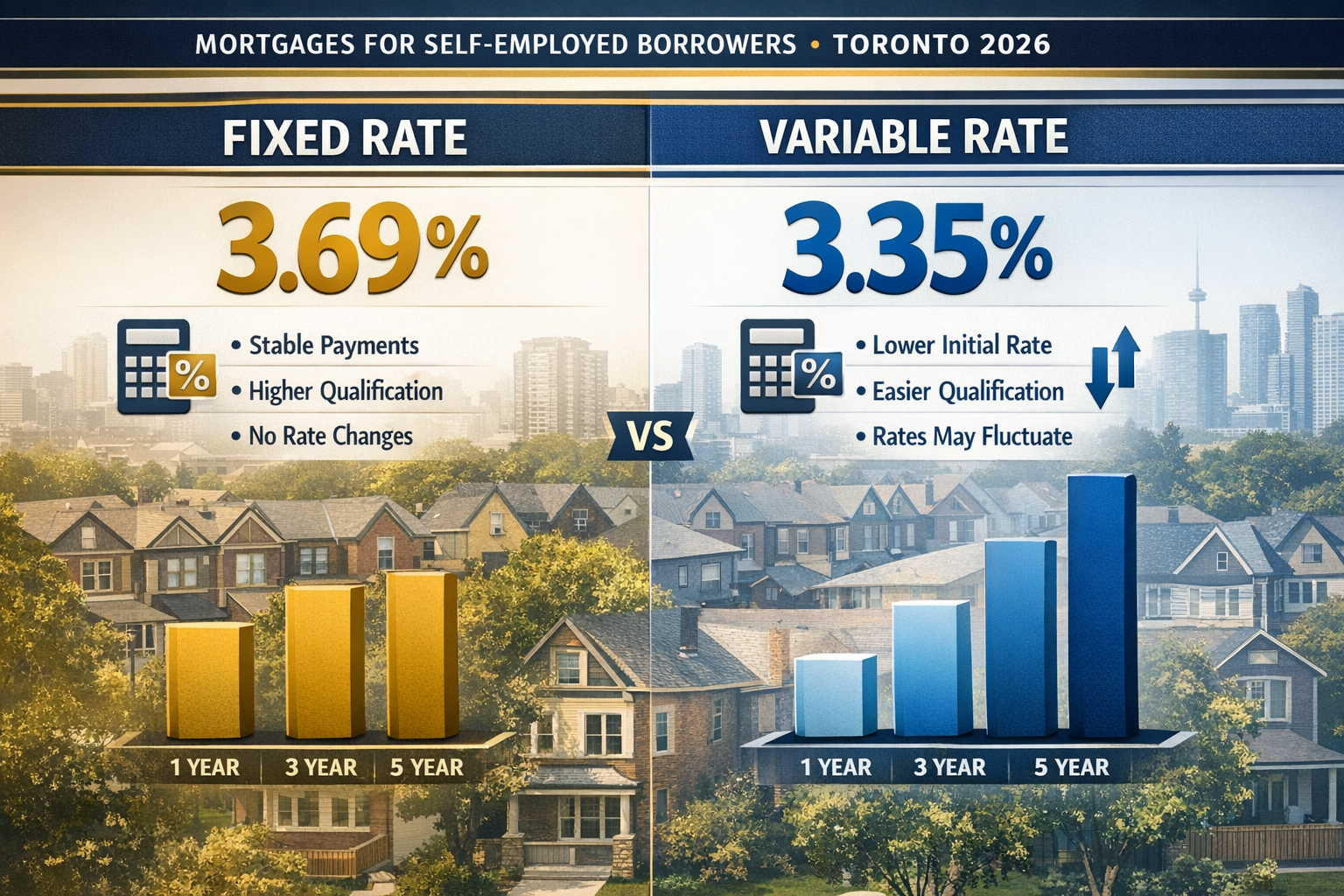
For self-employed individuals specifically, this rate environment translates into tangible savings. Best variable mortgage rates in Canada are now below 4% for the first time in three years[1], with competitive options available to those who meet qualification criteria. The discounted five-year fixed rates range from 4.04% to 4.24% for insured mortgages, compared to posted conventional rates averaging 6.09%[3][5].
Fixed vs. Variable: What Self-Employed Borrowers Need to Know
When evaluating Self-Employed Mortgage Rates in Toronto 2026: Current Fixed and Variable Options Under 4%, understanding the fundamental differences between fixed and variable products becomes essential.
Fixed-Rate Mortgages provide stability and predictability—critical advantages for self-employed professionals whose income may fluctuate seasonally or project-to-project. Current five-year fixed rates starting at 3.69% offer:
- Payment certainty for the entire term
- Protection against potential rate increases
- Easier budgeting for variable income earners
- Peace of mind during economic uncertainty
Variable-Rate Mortgages currently offer the lowest entry points at 3.35%, providing:
- Lower initial rates compared to fixed options
- Potential savings if rates continue declining
- Flexibility with typically lower penalties for breaking the mortgage
- Rate adjustment risk that requires financial cushioning
It’s important to note that TD Bank offers two distinct prime rates: TD Prime at 4.95% for Flexline mortgages with HELOCs, and TD Mortgage Prime at 5.10% for standalone variable mortgages[3]. This dual-rate structure means self-employed borrowers must carefully evaluate which product type aligns with their financial strategy.
For insights into how fixed rates behave independently of central bank decisions, review our analysis on why fixed mortgage rates may not follow Bank of Canada cuts.
Rate Premiums for Self-Employed Borrowers
Historically, self-employed borrowers faced rate premiums of 0.25% to 1.00% above rates offered to salaried employees. In 2026, this gap has narrowed considerably, though it hasn’t disappeared entirely. Self-employed borrowers may pay higher rates than salaried applicants, depending on several factors[4]:
- Lender type (A-lenders vs. B-lenders vs. alternative lenders)
- Documentation quality and completeness
- Overall financial profile including credit score and down payment
- Income stability demonstrated through tax returns
- Business type and industry sector
The good news? With proper preparation and the right lender match, many self-employed professionals in Toronto are now accessing the same sub-4% rates as traditionally employed borrowers.
Qualification Requirements for Self-Employed Mortgage Applicants
Minimum Documentation Standards
Most Canadian lenders require at least two years of self-employment history to assess income stability[4]. This two-year threshold represents the minimum standard, though some lenders may consider applicants with 18 months of self-employment if other compensating factors exist.
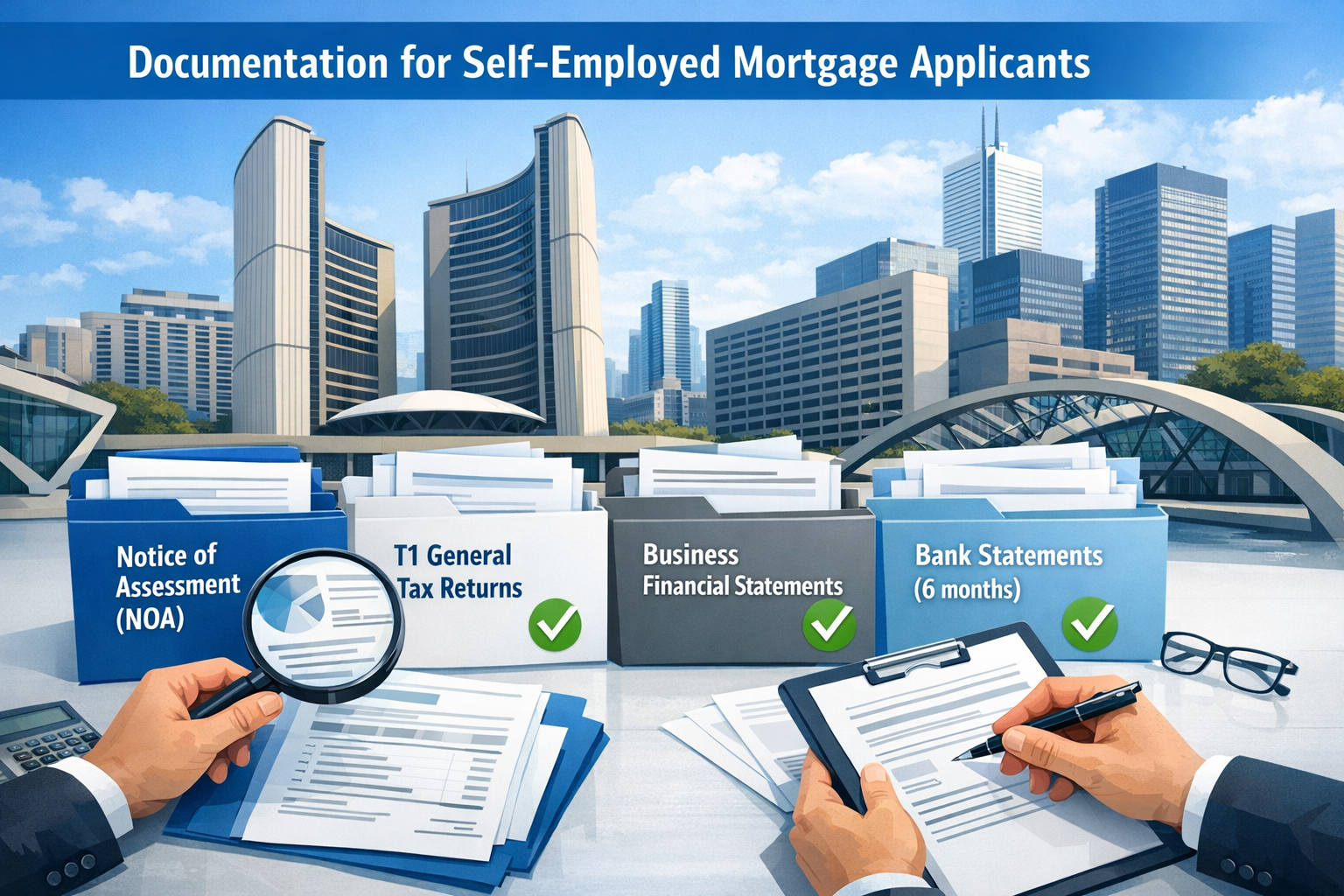
The core documentation package for self-employed mortgage applications includes:
📄 Notices of Assessment (NOAs) – Two years minimum, directly from the Canada Revenue Agency (CRA)
📄 T1 General Tax Returns – Complete returns for the past two years, including all schedules
📄 Business Financial Statements – Profit and loss statements, balance sheets, and business tax returns (T2 for corporations, T2125 for sole proprietors)
📄 Bank Statements – Typically 3-6 months of business and personal account statements
📄 Proof of Business Registration – Business license, articles of incorporation, or partnership agreements
📄 Credit Bureau Authorization – Permission for lenders to assess personal credit history
For professionals in specific fields, additional documentation may strengthen applications. Our guide on self-employed mortgages for doctors and IT consultant self-employed mortgages provides industry-specific insights.
Income Calculation Methods
Lenders use different methodologies to calculate qualifying income for self-employed borrowers:
Traditional Income Calculation (A-Lenders) Most major banks average the net income from your past two years of tax returns. If your income is trending upward, some lenders will weight the most recent year more heavily. Conversely, declining income patterns may result in conservative calculations.
Stated Income Programs (Alternative Lenders) Some alternative lenders offer stated income programs where borrowers declare their income with reduced documentation requirements. These programs typically require:
- Larger down payments (35% or more)
- Higher interest rates (often 0.50%-1.50% above standard rates)
- Strong credit scores (680+)
- Proof of business existence and viability
Add-Back Method Sophisticated lenders may add back certain business expenses that reduce taxable income but don’t represent actual cash outflows:
- Depreciation and amortization
- Home office expenses
- Vehicle expenses (portion)
- Business-use-of-home claims
This add-back method can significantly increase qualifying income for self-employed borrowers who legitimately minimize their tax burden through business deductions.
Credit Score and Down Payment Requirements
While self-employed status affects income verification, credit score and down payment requirements remain consistent with traditionally employed borrowers:
| Down Payment | Minimum Credit Score | Mortgage Insurance |
|---|---|---|
| 5-9.99% | 680+ (most lenders) | Required (CMHC/Sagen/Canada Guaranty) |
| 10-19.99% | 660+ | Required |
| 20%+ | 620+ (A-lenders), 600+ (B-lenders) | Not required |
| 35%+ | 550+ (alternative lenders) | Not required |
Higher credit scores unlock better rates and more lender options. Self-employed borrowers with scores above 720 typically access the most competitive rates in the Self-Employed Mortgage Rates in Toronto 2026: Current Fixed and Variable Options Under 4% category.
Top Lenders Offering Competitive Rates for Self-Employed Borrowers
Major Banks and Their Self-Employed Programs
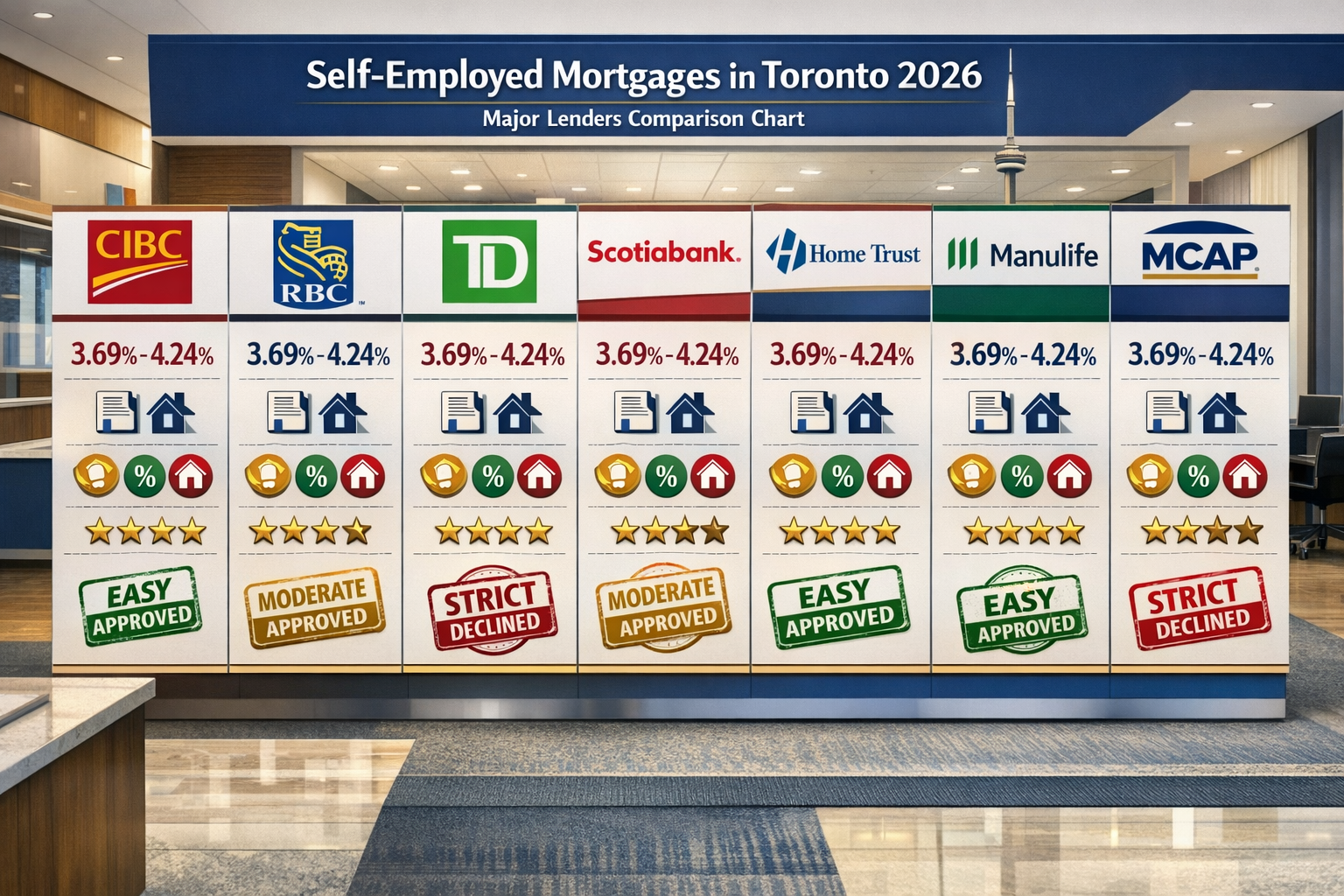
CIBC has emerged as a leader in the self-employed mortgage space in 2026, offering five-year fixed rates starting at 3.69% for well-qualified borrowers. CIBC’s self-employed program features:
- Flexible income verification options
- Competitive rates matching salaried employee offerings
- Relationship pricing for existing banking clients
- Streamlined application process for established businesses
RBC provides comprehensive self-employed mortgage solutions with variable rates as low as 3.35%. RBC’s advantages include:
- Dedicated self-employed underwriting team
- Business banking integration benefits
- Professional practice programs for doctors, lawyers, and accountants
- Portfolio lending for complex income situations
TD Bank offers both fixed and variable options, though borrowers should note the dual prime rate structure mentioned earlier. TD’s self-employed benefits include:
- Flexline products combining mortgage and HELOC
- Business account relationship discounts
- Specialized programs for franchise owners
- Accelerated approval timelines for complete applications
Scotiabank rounds out the major bank options with competitive rates and the Scotia Total Equity Plan (STEP), which provides:
- Combined mortgage and line of credit solutions
- Flexible readvanceable features
- Professional practice programs
- International banking integration for global entrepreneurs
Alternative and B-Lenders
When major bank qualification proves challenging, alternative lenders provide valuable options. Lenders working with self-employed borrowers include Hometrust, Manulife, Marathon, MCAN, MCAP, and Strive[4].
Hometrust specializes in self-employed mortgages with:
- Reduced documentation programs
- Competitive rates (typically 0.25%-0.75% above A-lender rates)
- Flexible income verification
- Strong approval rates for complex situations
Manulife Bank offers the Manulife One account, which combines:
- Mortgage and banking in a single account
- Interest savings through daily balance calculations
- Flexibility for irregular income patterns
- No separate HELOC required
For borrowers who don’t qualify with traditional lenders, our resource on B-lender mortgage rates in Toronto provides comprehensive information on alternative lending options.
The Broker Advantage
Mortgage brokers can be especially helpful for self-employed borrowers, as they often know which lenders are more flexible with non-traditional income recognition[4]. A specialized broker provides:
🎯 Lender matching – Identifying which lenders best suit your specific income documentation and business structure
🎯 Rate negotiation – Leveraging volume relationships to secure better rates than retail offerings
🎯 Application optimization – Structuring your application to highlight strengths and address potential concerns
🎯 Documentation guidance – Ensuring you provide the right information in the right format to maximize approval odds
Working with a best self-employed mortgage broker in Toronto can mean the difference between approval and rejection, or between a 4.5% rate and a 3.8% rate—savings that compound to tens of thousands of dollars over a mortgage term.
Strategies to Secure the Best Self-Employed Mortgage Rates in Toronto 2026
Optimizing Your Financial Profile
Before applying for a mortgage, self-employed borrowers should take strategic steps to strengthen their applications:
1. Maximize Your Reported Income While tax minimization is smart business practice, mortgage qualification requires demonstrating strong income. Consider:
- Timing major business deductions strategically
- Balancing tax savings against mortgage qualification needs
- Working with an accountant who understands mortgage lending
- Planning 12-24 months ahead of your intended purchase
2. Maintain Impeccable Credit Your credit score directly impacts rate offerings and approval odds:
- Pay all bills on time, every time
- Keep credit utilization below 30% of available limits
- Avoid new credit applications in the 6 months before mortgage shopping
- Dispute any errors on your credit report immediately
- Maintain a mix of credit types (credit cards, loans, etc.)
3. Increase Your Down Payment Larger down payments unlock multiple benefits:
- Access to better rates (20%+ down eliminates insurance premiums)
- Wider lender selection
- Lower monthly payments
- Reduced qualification stress
- Stronger negotiating position
4. Strengthen Business Documentation Professional, organized documentation signals credibility:
- Use accounting software (QuickBooks, FreshBooks, Xero)
- Maintain clear separation between business and personal finances
- Keep detailed records of contracts and invoices
- Prepare professional financial statements
- Document business stability and growth trajectory
Avoiding Common Self-Employed Mortgage Mistakes
Self-employed borrowers frequently encounter preventable obstacles. Our guide on the top 5 mistakes self-employed homebuyers make highlights critical errors, including:
❌ Insufficient income documentation – Waiting until application time to gather documents often reveals gaps or inconsistencies
❌ Aggressive tax write-offs immediately before applying – Reducing your taxable income to $40,000 when you need to qualify for a $600,000 mortgage creates obvious problems
❌ Applying to the wrong lenders – Not all lenders understand or accommodate self-employed income structures
❌ Inadequate down payment – Attempting to qualify with minimum down payment when income documentation is borderline
❌ Poor timing – Applying during slow business periods or immediately after incorporating
Leveraging Current Market Conditions
The 2026 mortgage market offers unique opportunities for strategic borrowers:
Rate Shopping Timing With rates at multi-year lows, timing your application strategically matters:
- Monitor Canadian mortgage rate trends to identify optimal application windows
- Consider rate holds (typically 90-120 days) to lock in favorable rates
- Understand that fixed rates respond to bond markets, not just Bank of Canada announcements
- Stay informed about how U.S. tariffs could impact Canadian mortgage rates
Pre-Approval Strategy Securing pre-approval provides multiple advantages:
- Rate guarantee during your house-hunting period
- Clear budget parameters
- Competitive advantage in multiple-offer situations
- Identification of documentation gaps before time-sensitive situations
- Opportunity to address issues before formal application
Negotiation Leverage Current market competition among lenders creates negotiation opportunities:
- Obtain multiple quotes to create competitive pressure
- Leverage existing banking relationships for preferential pricing
- Consider bundling products (mortgage + business banking + investments)
- Ask about rate-matching policies
- Negotiate terms beyond just rate (prepayment privileges, portability, etc.)
Alternative Qualification Pathways
For self-employed borrowers who face challenges with traditional qualification, several alternative pathways exist:
Stated Income Programs As mentioned earlier, these programs require larger down payments but reduce documentation requirements. Best suited for:
- Borrowers with strong credit and substantial assets
- Cash-based businesses with legitimate but difficult-to-document income
- Recent business owners with less than two years of history
- Situations where income is trending strongly upward
Co-Applicant or Co-Signer Strategies Adding a traditionally employed co-applicant can:
- Supplement qualifying income
- Improve debt-to-income ratios
- Access better rates
- Increase approval probability
Portfolio or Relationship Lending Some lenders offer preferential treatment to clients with:
- Substantial deposits or investments
- Multiple accounts and products
- Long-standing banking relationships
- Business banking connections
For comprehensive information on self-employed mortgage solutions, explore specialized programs designed specifically for non-traditional income earners.
Rate Comparison and Product Selection
Current Rate Landscape for Self-Employed Borrowers
The following table represents typical rate ranges available to well-qualified self-employed borrowers in Toronto as of 2026:
| Mortgage Type | Term | Rate Range | Lender Type |
|---|---|---|---|
| Fixed | 1-year | 4.89% – 5.49% | A-lenders |
| Fixed | 2-year | 4.29% – 4.89% | A-lenders |
| Fixed | 3-year | 3.89% – 4.49% | A-lenders |
| Fixed | 5-year | 3.69% – 4.24% | A-lenders |
| Fixed | 5-year | 4.24% – 5.50% | B-lenders |
| Variable | 3-year | 3.55% – 4.15% | A-lenders |
| Variable | 5-year | 3.35% – 3.95% | A-lenders |
| Variable | 5-year | 4.00% – 5.25% | B-lenders |
Note: Rates vary based on credit score, down payment, property type, and individual lender policies. These ranges represent qualified borrowers with 20%+ down payment and credit scores above 700.
Calculating Your Potential Savings
Understanding the financial impact of rate differences helps prioritize your optimization efforts. Consider a $600,000 mortgage with a 25-year amortization:
At 3.69% (5-year fixed):
- Monthly payment: $3,063
- Total interest over 5 years: $106,344
At 4.24% (higher 5-year fixed):
- Monthly payment: $3,228
- Total interest over 5 years: $122,636
Difference: $165/month or $9,900 over the five-year term
At 3.35% (5-year variable):
- Monthly payment: $2,964
- Total interest over 5 years (assuming rate remains constant): $97,356
The potential savings of securing the best available rate versus an average rate can exceed $10,000-$25,000 over a single mortgage term—money that self-employed professionals can reinvest in their businesses or savings.
Features Beyond Rate
While securing the lowest rate matters, other mortgage features significantly impact long-term value:
Prepayment Privileges Look for mortgages offering:
- Annual lump-sum payments (15-20% of original principal)
- Payment increase options (15-20% annually)
- Penalty-free payment flexibility for irregular income patterns
Portability Essential for self-employed professionals who may relocate:
- Ability to transfer mortgage to new property
- Preservation of favorable rates during moves
- Blending options if purchasing higher-priced property
Assumability Valuable in rising rate environments:
- Allows qualified buyers to assume your mortgage
- Potential selling advantage
- Rate preservation for purchasers
Penalty Calculations Understanding break penalties protects against unexpected costs:
- Fixed-rate penalties: Greater of three months’ interest or Interest Rate Differential (IRD)
- Variable-rate penalties: Typically three months’ interest only
- IRD calculations can be substantial on fixed mortgages
Looking Ahead: Self-Employed Mortgage Outlook for 2026 and Beyond
Economic Factors Influencing Rates
Several macroeconomic factors will influence Self-Employed Mortgage Rates in Toronto 2026: Current Fixed and Variable Options Under 4% throughout the year:
Bank of Canada Policy The Bank of Canada rate is expected to hold at 2.25% through Q3 2026[1][6], providing stability to variable-rate products. However, unexpected inflation pressures or economic shocks could alter this trajectory. Stay informed through regular updates on mortgage news in Toronto.
Bond Market Dynamics Fixed mortgage rates follow government bond yields more closely than Bank of Canada announcements. Recent analysis shows fixed mortgage rate increases amid declining bond yields, demonstrating the complex relationship between these factors.
Housing Market Conditions Toronto’s housing market dynamics influence lender competition and rate offerings:
- Increased competition during spring/summer typically brings rate specials
- Slower winter markets may see fewer promotional rates
- Inventory levels affect lender appetite for new business
Global Economic Factors International developments impact Canadian mortgage rates:
- U.S. Federal Reserve policy decisions
- Trade relationships and tariff policies
- Global inflation trends
- Currency exchange rates
Regulatory Changes Affecting Self-Employed Borrowers
Recent regulatory developments have created both opportunities and challenges:
Easier Qualification for Self-Employed Borrowers Some lenders have introduced easier qualification pathways for self-employed borrowers, recognizing the growing gig economy and entrepreneurial workforce. These changes include:
- Reduced documentation requirements for established businesses
- Alternative income verification methods
- Recognition of non-traditional income sources
- Streamlined processes for professional practices
Stress Test Considerations Self-employed borrowers must still qualify at the higher of:
- The contract rate plus 2%
- 5.25% (current benchmark rate)
This stress test ensures borrowers can withstand rate increases, though it reduces purchasing power for all borrowers, employed or self-employed.
Strategic Positioning for Future Success
Self-employed professionals planning for long-term homeownership success should:
Build Long-Term Lender Relationships Establishing relationships with lenders who understand your business creates advantages:
- Easier renewals and refinancing
- Preferential rate offerings
- Streamlined documentation for subsequent mortgages
- Access to additional products (HELOCs, business lines of credit)
Maintain Financial Documentation Discipline Ongoing documentation practices pay dividends:
- Annual financial statement preparation
- Consistent accounting practices
- Clear business/personal finance separation
- Professional tax preparation and planning
Plan Major Purchases Strategically Coordinate major financial decisions:
- Time business expansions around mortgage needs
- Plan vehicle or equipment purchases to minimize debt-to-income impact
- Structure business draws to support mortgage qualification
- Coordinate with accountants and mortgage professionals
Stay Informed About Market Conditions Knowledge creates opportunity:
- Monitor rate trends and economic indicators
- Understand renewal options well before maturity
- Stay aware of new products and lender programs
- Maintain relationships with mortgage professionals
Conclusion: Capitalizing on Historic Opportunities
Self-Employed Mortgage Rates in Toronto 2026: Current Fixed and Variable Options Under 4% represent a remarkable opportunity for entrepreneurs, freelancers, contractors, and business owners to achieve homeownership goals at historically favorable terms. With five-year fixed rates starting at 3.69% and variable rates as low as 3.35%, the current market offers rates not seen since before the pandemic.
However, accessing these exceptional rates requires strategic preparation, comprehensive documentation, and often, professional guidance. The difference between a well-prepared application and a hastily assembled one can mean thousands of dollars in rate differences or even the difference between approval and rejection.
Your Action Plan
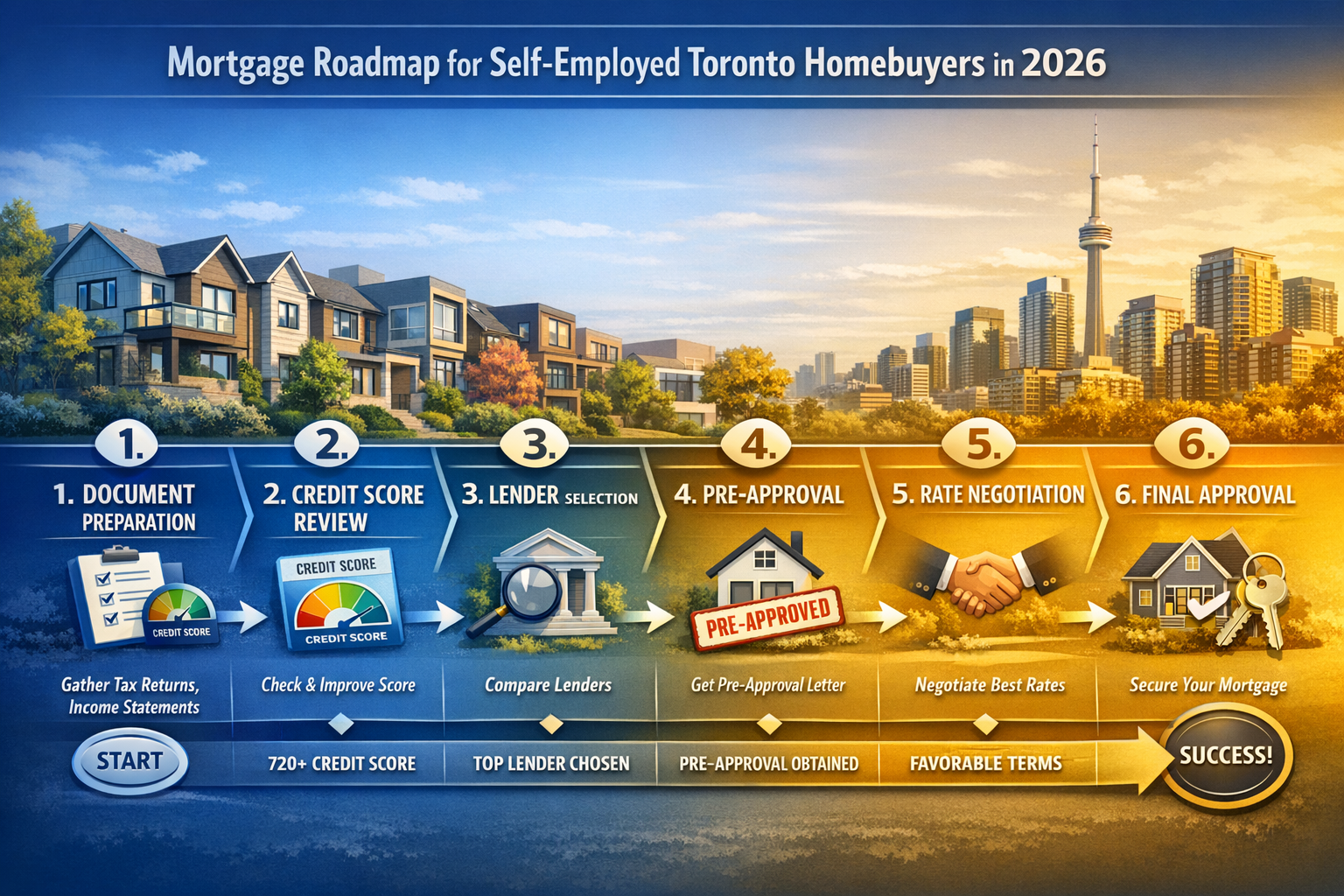
Immediate Steps (Next 30 Days):
- Gather your financial documentation – Collect two years of NOAs, tax returns, business financial statements, and bank statements
- Check your credit score – Obtain free credit reports and address any errors or issues
- Calculate your budget – Determine realistic purchase price based on income documentation
- Connect with a specialized broker – Consult with a self-employed mortgage specialist to assess your qualification potential
Medium-Term Preparation (30-90 Days):
- Optimize your financial profile – Work with your accountant to balance tax planning with mortgage qualification needs
- Increase your down payment – Accelerate savings to reach 20%+ if possible
- Secure pre-approval – Lock in current rates and identify any documentation gaps
- Research lenders and products – Compare offerings from multiple sources
Long-Term Success (90+ Days):
- Execute your home search – Work with real estate professionals who understand self-employed buyer needs
- Finalize your mortgage – Complete application with your chosen lender
- Plan for renewal – Begin preparing for renewal 6-12 months before maturity
- Build ongoing lender relationships – Maintain connections for future needs
The self-employed mortgage landscape in Toronto has never been more accessible or affordable than in 2026. By understanding the qualification requirements, preparing comprehensive documentation, leveraging professional expertise, and acting strategically, self-employed professionals can secure exceptional mortgage rates that support their homeownership dreams and financial goals.
Don’t let self-employment status become a barrier to homeownership—let it become your pathway to building wealth through Toronto real estate. The rates are favorable, the lenders are competitive, and the opportunities are abundant. The question isn’t whether you can qualify for a great mortgage rate as a self-employed borrower in Toronto—it’s how quickly you’ll take action to make it happen.
References
[1] What Can Mortgage Borrowers Expect In 2026 – https://www.ratehub.ca/blog/what-can-mortgage-borrowers-expect-in-2026/
[2] Rates – https://www.nbc.ca/personal/mortgages/rates.html
[3] Mortgage Report – https://rates.ca/mortgage-report
[4] Self Employed Mortgage Rates – https://www.nerdwallet.com/ca/p/best/mortgages/self-employed-mortgage-rates
[5] Posted Interest Rates Offered By Chartered Banks – https://www.bankofcanada.ca/rates/banking-and-financial-statistics/posted-interest-rates-offered-by-chartered-banks/
[6] Mortgage Rate Forecast – https://www.truenorthmortgage.ca/blog/mortgage-rate-forecast
[7] Bank Of Canada Rate Announcement Jan 28th 2026 – https://www.independentmortgages.ca/bank-of-canada-rate-announcement-jan-28th-2026
 Previous Page