February 6, 2026
How Self-Employed Borrowers in Toronto Can Secure Insurable Mortgage Rates in 2026
Share this article:



Manzeel is an award-winning Mortgage Broker and the Owner of the Toronto-based mortgage, Everything Mortgages.
With 16 years of experience in the Canadian mortgage industry and a formal background in mortgage underwriting, Manzeel’s lending expertise gives him unique insight into whether a deal is feasible which empowers his clients to make more informed lending decisions faster.
He has been recognized as one of Canada’s Top 10 Mortgage Brokers by the national Canadian Mortgage Professionals (CMP) Association. Him and his team of 18 mortgage agents are proud to offer a mortgage experience that's built on honesty, trust, and integrity. He prides himself on the brokerage’s dedication to deliver an excellent client experience throughout the entire home loan process from pre-approval to post-funding.
Since moving to Toronto in 1998, Manzeel has successfully launched and scaled several businesses from the ground up, ranging from a mortgage brokerage and a vast real estate investment portfolio to a private financing eCommerce platform. He continues to be a leader in the real estate industry as he uses his analytical expertise to seek new real estate investment opportunities.
As a tech junkie and avid sports enthusiast, when Manzeel’s not working with clients, you can find him reading technology blogs, playing squash or watching tennis with his two boys.
nn
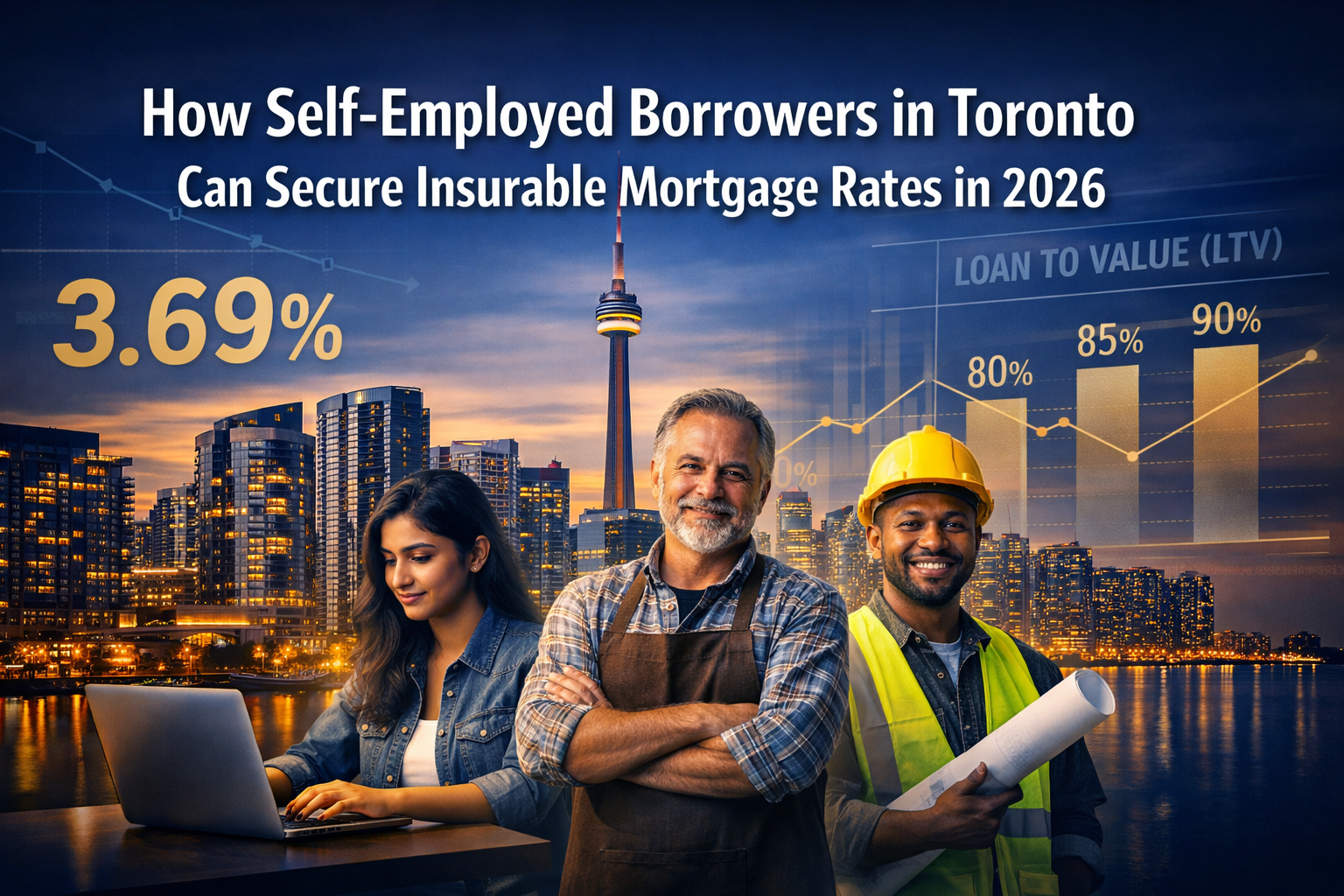
For self-employed professionals in Toronto’s competitive housing market, securing a mortgage can feel like navigating a maze blindfolded. While salaried employees breeze through applications with their T4 slips and pay stubs, entrepreneurs, freelancers, and small business owners face a fundamentally different challenge. The stakes are particularly high when it comes to insurable mortgage rates—the lowest rates available in the Canadian market—which can save borrowers tens of thousands of dollars over the life of their loan.
Understanding how self-employed borrowers in Toronto can secure insurable mortgage rates in 2026 is critical for anyone running their own business who dreams of homeownership. With insurable 5-year fixed rates currently sitting at an attractive 3.69% in Ontario[1], and the Bank of Canada holding its overnight rate steady at 2.25%[1], the opportunity to lock in favorable financing has never been more compelling. However, self-employed applicants often find themselves shut out from these premium rates due to documentation challenges, income verification complexities, and lender risk perceptions.
This comprehensive guide breaks down exactly what self-employed borrowers need to know about qualifying for insurable mortgage rates in Toronto’s 2026 market, including eligibility requirements, documentation strategies, and lender-specific insights that can make the difference between approval and rejection.
Key Takeaways
✅ Insurable mortgage rates require meeting strict criteria: Loan-to-value ratio under 80%, credit score above 620, and verifiable stable income—barriers that disproportionately affect self-employed borrowers.
✅ Current rates favor well-prepared applicants: As of February 2026, the best high-ratio 5-year fixed insurable rate in Ontario is 3.69%, with variable rates around 3.35%—the lowest since summer 2022[1].
✅ Documentation is the deciding factor: Self-employed borrowers need two years of Notice of Assessments, comprehensive business financial statements, and proof of consistent income to compete with traditional employees.
✅ Toronto lenders vary significantly in self-employed flexibility: Working with a knowledgeable mortgage broker who understands which lenders accept alternative income verification can dramatically improve approval odds.
✅ Strategic preparation can bridge the gap: Improving credit scores above 680, increasing down payments beyond 20%, and optimizing debt service ratios can help self-employed borrowers access insurable rates despite non-traditional income.
Understanding Insurable Mortgage Rates and Why They Matter
What Makes a Mortgage “Insurable”?
Insurable mortgages represent the gold standard of Canadian home financing. These mortgages qualify for insurance through the Canada Mortgage and Housing Corporation (CMHC), Saginaw, or Canada Guaranty, which protects lenders against borrower default. Because of this government-backed insurance, lenders can offer significantly lower interest rates—often 0.5% to 1.5% lower than uninsurable mortgages.
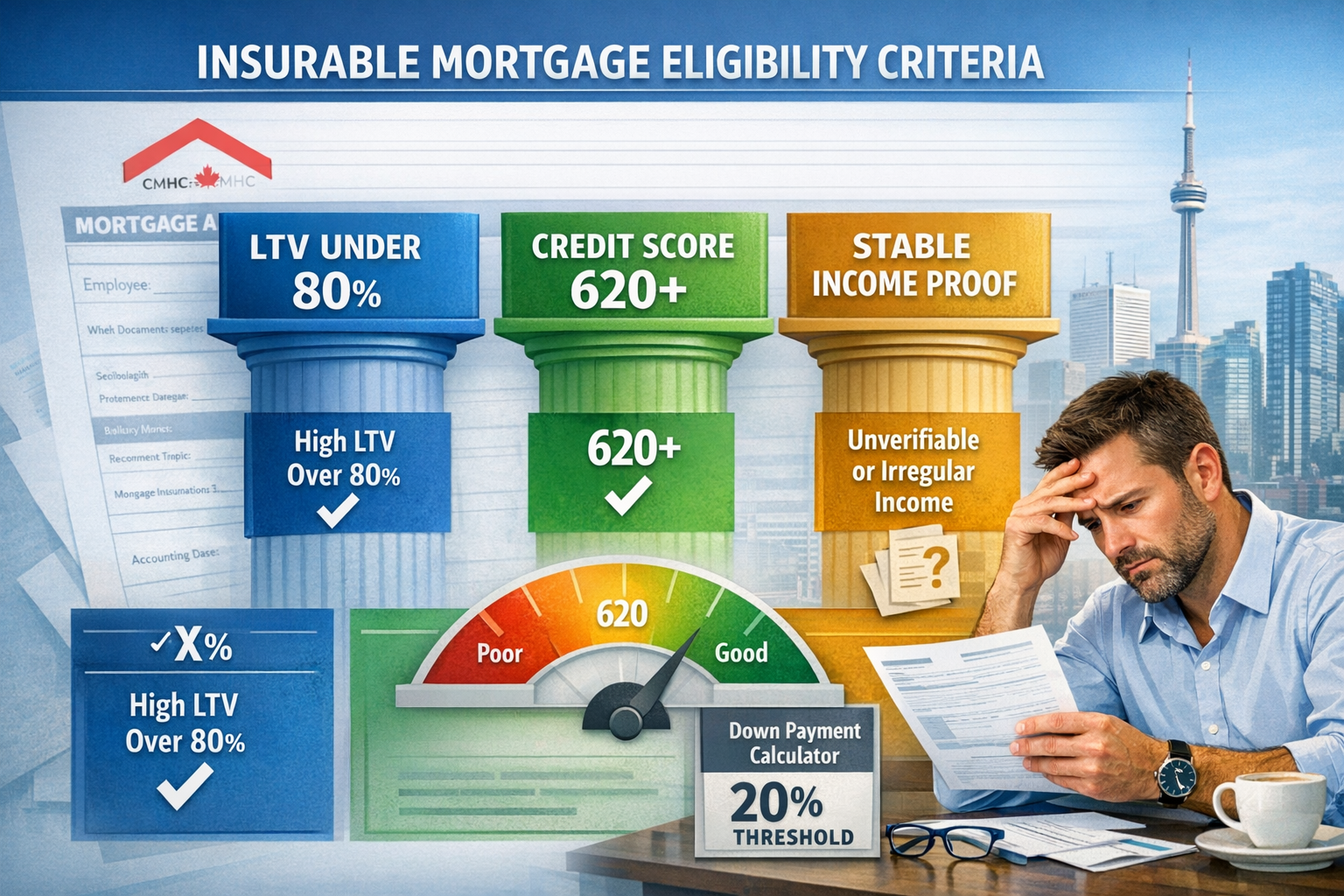
For a mortgage to qualify as insurable in 2026, it must meet three fundamental criteria:
- Loan-to-Value Ratio (LTV) under 80%: The mortgage amount cannot exceed 80% of the property’s purchase price or appraised value, requiring a minimum down payment of 20%
- Property purchase price under $1 million: The home must fall below the $1 million threshold
- Owner-occupied property: The home must be your primary residence, not an investment property
- Amortization period of 25 years or less: Longer amortization periods disqualify the mortgage from insurance
Additionally, borrowers must meet credit score requirements (typically 620 minimum, though 680+ is preferred), demonstrate stable income, and satisfy debt service ratio calculations.
Current Insurable Rate Landscape in Toronto (2026)
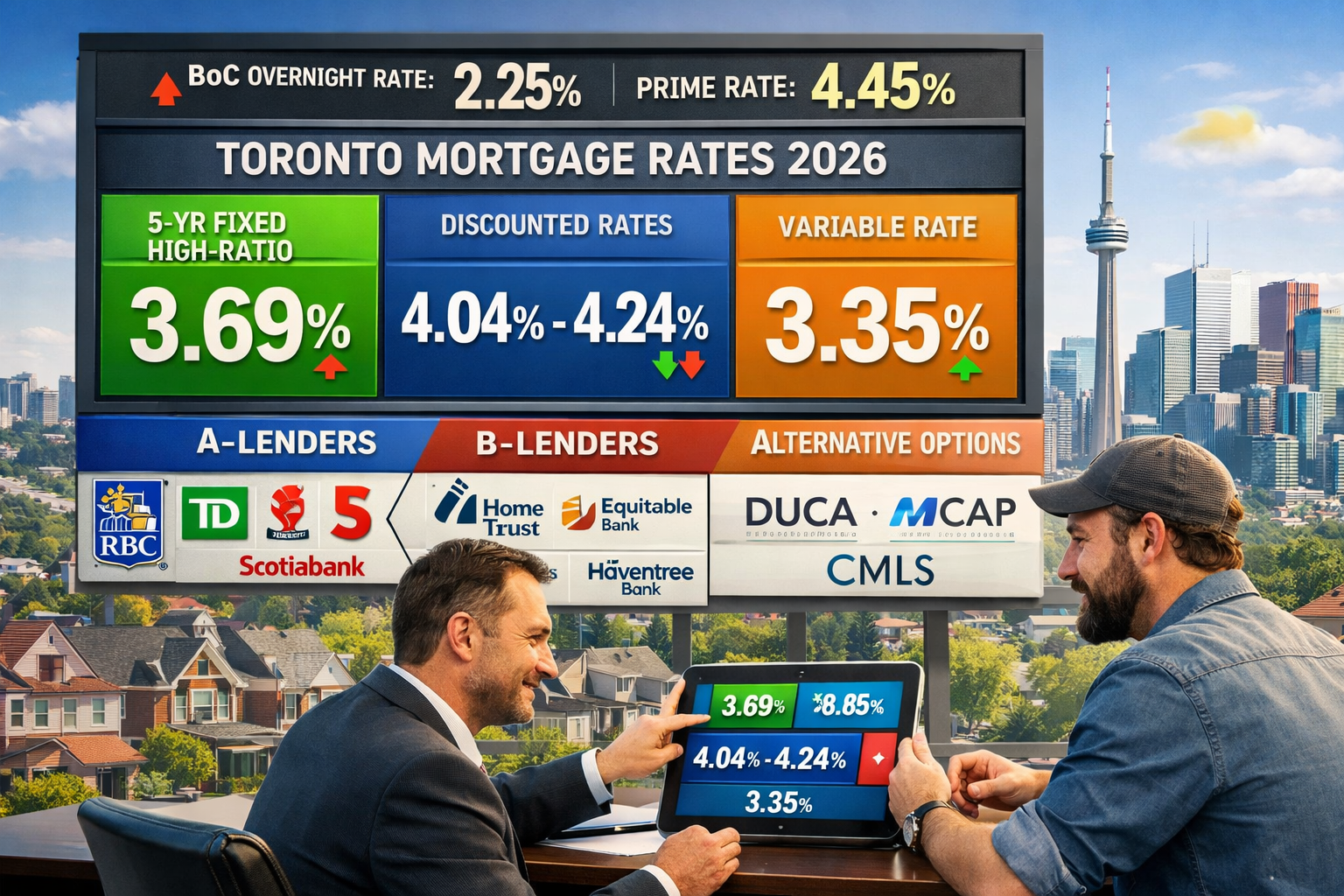
The mortgage rate environment in early 2026 presents a favorable opportunity for qualified borrowers. According to current market data, insurable mortgage rates in Ontario include[1]:
- Best high-ratio 5-year fixed rate: 3.69%
- Discounted 5-year insured mortgages: 4.04%–4.24%[3]
- 5-year variable rates: Approximately 3.35%, the lowest since summer 2022[1]
- Posted conventional rates: Averaging 6.09%[5]
The Bank of Canada maintained its overnight rate at 2.25% at its January 28, 2026 announcement, keeping Canada’s prime rate stable at 4.45%[1]. This policy hold signals that the BoC considers the current setting “about right,” making additional rate cuts less likely in the near term[1].
For self-employed borrowers, these rates represent substantial savings potential—but only if they can successfully navigate the qualification process.
The Self-Employed Disadvantage in Accessing Insurable Rates
Self-employed individuals face systematic barriers when pursuing insurable mortgage rates. Traditional lenders design their underwriting processes around salaried employees with predictable, easily verifiable income. The challenges include:
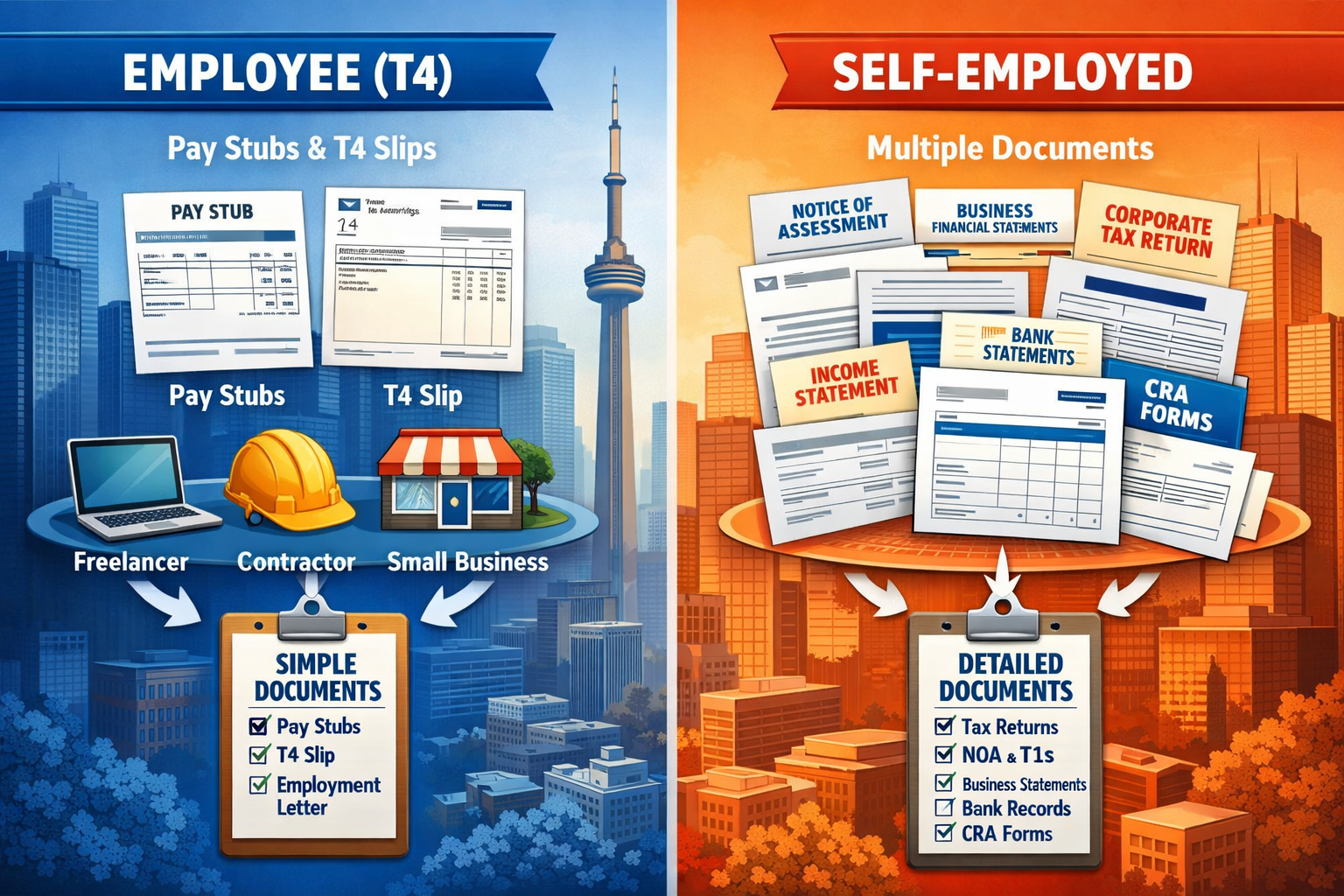
Income Verification Complexity: While employed borrowers provide simple T4 slips and recent pay stubs, self-employed applicants must submit two years of Notice of Assessments (NOAs), complete tax returns, business financial statements, and often additional documentation proving income stability.
Tax Optimization Conflicts: Many self-employed professionals legitimately reduce their taxable income through business deductions, write-offs, and corporate structures. However, this tax efficiency directly undermines mortgage applications, as lenders assess borrowing capacity based on reported income—creating a frustrating catch-22.
Income Volatility Perception: Even when self-employed income averages higher than comparable salaried positions, lenders view fluctuating income as higher risk, often applying more conservative debt service ratio calculations.
Limited Lender Options: Not all lenders actively pursue self-employed clients, and those that do may reserve their best insurable rates for traditional employees, pushing entrepreneurs toward higher-rate products.
Understanding these challenges is the first step toward overcoming them. For more context on the broader landscape, explore our ultimate guide to securing a mortgage for self-employed Canadians.
How Self-Employed Borrowers in Toronto Can Meet Insurable Mortgage Eligibility Requirements
Credit Score Requirements: The 620 Minimum and the 680 Reality
While CMHC technically accepts credit scores as low as 620 for insured mortgages, self-employed borrowers face a higher practical threshold. Most lenders offering competitive insurable rates to self-employed applicants prefer credit scores of 680 or higher.
Why the higher standard? Lenders view self-employed income as inherently less predictable than salaried employment. A stronger credit score compensates for this perceived risk, demonstrating financial responsibility and reducing the lender’s overall risk profile.
Strategies to Optimize Credit Scores:
- Pay all bills on time: Payment history accounts for 35% of your credit score
- Reduce credit utilization: Keep balances below 30% of available credit limits
- Maintain older credit accounts: Length of credit history matters significantly
- Avoid new credit applications: Multiple inquiries can temporarily lower scores
- Dispute errors: Review credit reports from Equifax and TransUnion for inaccuracies
Self-employed borrowers should begin credit optimization at least 6-12 months before applying for a mortgage to achieve meaningful improvements.
Loan-to-Value Ratio: Why 20% Down Payment Matters More for Self-Employed
The 80% LTV threshold represents a critical dividing line in mortgage qualification. For insurable mortgages, this means providing a minimum 20% down payment. While this requirement applies equally to all borrowers, self-employed applicants benefit from exceeding this minimum.
Strategic advantages of larger down payments for self-employed borrowers:
| Down Payment | LTV Ratio | Strategic Benefit |
|---|---|---|
| 20% | 80% | Meets minimum insurable threshold |
| 25% | 75% | Demonstrates stronger financial position, may offset income concerns |
| 30% | 70% | Significantly reduces lender risk perception |
| 35%+ | 65% or lower | Opens doors to premium rate negotiations |
A larger down payment accomplishes several objectives simultaneously: it reduces the loan amount (lowering debt service ratios), demonstrates savings discipline, and provides a larger equity cushion that protects lenders against market fluctuations.
For self-employed borrowers struggling with down payment accumulation, our guide on down payment challenges in Canada offers practical solutions.
Income Verification: The Two-Year Track Record
The two-year income verification requirement represents the most significant hurdle for self-employed mortgage applicants. Lenders typically require:
📋 Essential Documentation:
- Two consecutive years of personal tax returns (T1 Generals)
- Two years of Notice of Assessments from CRA
- Business financial statements (for incorporated businesses)
- Corporate tax returns (T2s for incorporated businesses)
- Year-to-date profit and loss statements
- Business bank statements (typically 3-6 months)
- Accounts receivable aging reports (for some lenders)
Income Calculation Methods:
Lenders use different approaches to calculate qualifying income for self-employed borrowers:
- Two-Year Average: Adding both years of income and dividing by two
- Most Recent Year: Using only the most recent year if income is declining
- Line 150 Method: Using Line 150 (total income) from tax returns
- Add-Back Method: Adding certain business expenses back to income (depreciation, interest, etc.)
The specific calculation method varies by lender and can dramatically impact qualifying amounts. This is where working with an experienced mortgage broker becomes invaluable—they understand which lenders use the most favorable calculation methods for your specific income structure.
For professionals in specific fields, specialized guidance is available through resources like our mortgage solutions for self-employed doctors or IT consultant mortgage guide.
Debt Service Ratios: The Hidden Qualification Barrier
Even with excellent credit and sufficient down payment, self-employed borrowers must satisfy debt service ratio requirements. Canadian lenders evaluate two key ratios:
Gross Debt Service (GDS) Ratio: Total housing costs (mortgage principal and interest, property taxes, heating, and 50% of condo fees if applicable) divided by gross income. Maximum threshold is typically 32-39% for insured mortgages.
Total Debt Service (TDS) Ratio: Total housing costs plus all other debt obligations (car loans, credit cards, lines of credit, student loans) divided by gross income. Maximum threshold is typically 42-44% for insured mortgages.
Self-employed borrowers often struggle with these ratios because:
- Their qualifying income may be lower than actual earnings due to tax optimization
- Business debt may be considered in calculations
- Income volatility may trigger more conservative assessments
Optimization Strategies:
- Pay down high-interest consumer debt before applying
- Consider consolidating debts to lower monthly payments
- Delay major purchases (vehicles, equipment) until after mortgage approval
- Increase reported income in the year before application (if possible)
- Choose properties with lower carrying costs
Toronto-Specific Lender Landscape for Self-Employed Borrowers in 2026
Major Banks vs. Alternative Lenders: Understanding Your Options
Toronto’s mortgage market offers diverse lending options, each with different appetites for self-employed borrowers. Understanding how self-employed borrowers in Toronto can secure insurable mortgage rates in 2026 requires knowing which institutions offer the best opportunities.
A-Lenders (Major Banks and Credit Unions)
Canada’s major banks—RBC, TD, Scotiabank, BMO, and CIBC—offer the lowest insurable mortgage rates but maintain the strictest qualification criteria for self-employed applicants. These institutions:
✅ Advantages:
- Lowest available rates (currently 3.69% for best high-ratio 5-year fixed)[1]
- Full-service banking relationships
- Potential for preferential rates with existing accounts
- Established reputation and stability
❌ Disadvantages:
- Rigid income verification requirements
- Limited flexibility in documentation
- Conservative debt service ratio calculations
- May decline applications that alternative lenders would approve
Note: TD Bank operates two separate prime rates—TD Prime at 4.95% for Flexline mortgages/HELOCs and TD Mortgage Prime (TDMP) at 5.10% for stand-alone variable-rate mortgages[3], which can affect rate calculations.
Credit unions often provide more personalized service and may show greater flexibility with self-employed borrowers while still offering competitive insurable rates. Our comparison of credit unions vs. banks for mortgages explores these differences in detail.
B-Lenders and Alternative Lenders
When A-lenders decline applications, B-lenders and alternative lenders provide viable pathways to homeownership, though typically at higher rates:
✅ Advantages:
- More flexible income verification
- Accept alternative documentation
- Consider overall financial picture beyond ratios
- Specialize in non-traditional borrowers
❌ Disadvantages:
- Higher interest rates (typically 0.5-2% above A-lender rates)
- May charge lender fees
- Less favorable terms and conditions
- May not offer insurable rate products
For self-employed borrowers who don’t qualify for insurable rates through traditional channels, exploring innovative mortgage solutions for self-employed Canadians can reveal alternative pathways.
The Mortgage Broker Advantage in Toronto’s Market
Working with a knowledgeable mortgage broker provides substantial advantages for self-employed borrowers pursuing insurable rates. Brokers offer:
🎯 Lender Matching: Brokers maintain relationships with dozens of lenders and understand which institutions are currently most receptive to self-employed applications and offer the best rates for specific income profiles.
🎯 Application Optimization: Experienced brokers know how to present self-employed income in the most favorable light, choosing documentation strategies that maximize qualifying income.
🎯 Rate Negotiation: Brokers can leverage competition between lenders to secure better rates and terms than individual applicants might obtain directly.
🎯 Efficiency: Rather than applying to multiple lenders sequentially (each triggering credit inquiries), brokers can submit applications strategically to maximize approval odds.
According to industry data, self-employed borrowers may face higher rates than salaried applicants, though rate differences typically depend on the type of lender, documentation quality, and overall financial profile[4]. A skilled broker can minimize these differentials.
For personalized guidance on your specific situation, consider booking a free mortgage consultation to explore your options.
Toronto Real Estate Market Considerations
Toronto’s unique real estate landscape adds another layer of complexity to mortgage qualification. As of 2026, Toronto homebuyers face:
- High property values: Average home prices in Toronto remain significantly above the national average, requiring larger down payments to meet the 20% threshold
- Competitive market conditions: Multiple offers and bidding wars may pressure buyers to waive financing conditions, requiring solid pre-approval
- Condo vs. house dynamics: Condo fees impact debt service ratios differently than house maintenance costs
- Neighborhood price variations: Strategic property selection can help self-employed buyers stay within comfortable qualification parameters
Self-employed borrowers should consider properties slightly below their maximum qualification to maintain financial flexibility and improve approval odds. For insights into Toronto’s real estate trends, explore our Toronto real estate resources.
Overcoming Common Barriers: Strategies for Self-Employed Success
Addressing Income Documentation Challenges
The income verification process presents the most significant obstacle for self-employed borrowers seeking insurable rates. Several strategic approaches can strengthen applications:
Strategy 1: Strategic Tax Planning
While minimizing taxable income makes sense from a tax perspective, it directly undermines mortgage qualification. Self-employed borrowers planning to purchase within 1-2 years should:
- Consult with accountants early: Discuss mortgage plans to balance tax optimization with income reporting
- Claim fewer discretionary deductions: Consider reporting higher income in the 1-2 years before application
- Document add-backs: Identify legitimate business expenses that lenders may add back to income (depreciation, capital cost allowance, interest expenses)
- Maintain detailed records: Comprehensive documentation supports income claims
Strategy 2: Alternative Income Verification Programs
Some lenders offer stated income or alternative documentation programs specifically designed for self-employed borrowers. These programs may accept:
- Bank statement analysis (reviewing deposits over 6-12 months)
- Business financial statements prepared by accountants
- Contracts and invoices demonstrating ongoing income
- Industry-specific income verification
However, these programs typically don’t qualify for insurable rates, instead offering higher-rate products. For more information, see our guide on alternative income verification and self-declared income mortgages.
Strategy 3: Co-Applicant or Guarantor
Adding a salaried co-applicant (spouse, partner, or family member) can:
- Provide stable, easily verified income to supplement self-employed earnings
- Improve debt service ratios
- Strengthen overall application risk profile
- Potentially qualify for better rates
This strategy works best when the co-applicant has strong credit, stable employment, and low personal debt.
Building a Stronger Financial Profile
Beyond income documentation, self-employed borrowers can strengthen their applications through comprehensive financial preparation:
12-Month Preparation Timeline:
Months 12-9 Before Application:
- Review credit reports and dispute errors
- Begin debt reduction strategy
- Consult with accountant about income reporting
- Research Toronto neighborhoods and property prices
- Start saving for larger down payment
Months 8-6 Before Application:
- Continue debt paydown
- Avoid new credit applications
- Maintain low credit utilization
- Document business stability and growth
- Research lender options and requirements
Months 5-3 Before Application:
- Finalize down payment savings
- Gather all required documentation
- Consult with mortgage broker
- Obtain mortgage pre-approval
- Refine property search criteria
Months 2-0 Before Application:
- Maintain financial stability (avoid major changes)
- Keep credit utilization low
- Ensure all documentation is current
- Begin serious property search
- Submit formal applications
This structured approach demonstrates to lenders that you’re a serious, prepared borrower who understands the mortgage process.
Avoiding Common Self-Employed Mortgage Mistakes
Self-employed borrowers frequently make preventable errors that jeopardize their applications. Our comprehensive guide on top 5 mistakes self-employed homebuyers make details these pitfalls, but key mistakes include:
❌ Mistake 1: Applying too soon after starting a business (most lenders require 2+ years of operation)
❌ Mistake 2: Maximizing tax deductions immediately before mortgage application
❌ Mistake 3: Failing to maintain separation between personal and business finances
❌ Mistake 4: Not shopping around for lender-specific policies on self-employed income
❌ Mistake 5: Underestimating the documentation requirements and timeline
Awareness of these common errors helps self-employed borrowers navigate the process more successfully.
Rate Outlook and Timing Considerations for 2026
Bank of Canada Policy and Rate Forecasts
Understanding the broader interest rate environment helps self-employed borrowers make informed timing decisions. As of early 2026, the rate landscape shows:
Current Policy Environment:
- Bank of Canada overnight rate: 2.25% (held at January 28, 2026 meeting)[1]
- Canada prime rate: 4.45%[1]
- Policy stance: “About right,” suggesting limited near-term changes[1]
The BoC implemented nine cumulative rate cuts between June 2024 and October 2025, bringing rates down from pandemic-era highs[1]. However, further declines in 2026 appear limited unless economic conditions weaken significantly or bond yields decline further[1].
Rate Hold Expectations: The BoC rate of 2.25% (prime at 4.45%) is expected to hold for several months, potentially through Q3 2026[6]. This stability provides a predictable environment for mortgage planning.
Fixed vs. Variable Rate Considerations for Self-Employed Borrowers
The choice between fixed and variable rates carries particular significance for self-employed borrowers:
5-Year Fixed Rates (Current: 3.69% best insurable)[1]:
✅ Advantages:
- Payment predictability supports business cash flow planning
- Protection against potential rate increases
- Simplifies budgeting for variable business income
- Currently near historical lows
❌ Disadvantages:
- Higher initial rate than variable options
- Penalties for early termination can be substantial
- Less flexibility if income circumstances change
5-Year Variable Rates (Current: ~3.35%)[1]:
✅ Advantages:
- Lowest available rates (lowest since summer 2022)
- Benefit from potential future rate cuts
- Lower penalties for early termination
- Potential for significant savings over term
❌ Disadvantages:
- Payment uncertainty complicates budgeting
- Risk of rate increases if BoC policy shifts
- May be harder to qualify with variable income
For self-employed borrowers with fluctuating income, the payment predictability of fixed rates often outweighs the rate savings of variable products. However, those with strong cash reserves and stable business income may benefit from variable rate savings.
Our detailed analysis of fixed vs. variable mortgages explores these trade-offs comprehensively.
Optimal Timing Strategies
Given the current rate environment and economic outlook, self-employed borrowers should consider:
Favorable Timing Factors:
- Rates have declined significantly from 2023-2024 peaks
- Current insurable rates (3.69%) represent excellent value[1]
- Stable policy environment reduces near-term uncertainty
- Toronto real estate market shows balanced conditions
Timing Risks:
- Further rate declines appear limited[1]
- Waiting may not yield better rates
- Property prices may appreciate, offsetting rate savings
- Qualification requirements may tighten
For well-prepared self-employed borrowers with strong documentation and financial profiles, 2026 presents a favorable window to secure insurable mortgage rates before potential market changes.
Practical Action Plan: Steps to Secure Insurable Rates as a Self-Employed Borrower
Step 1: Comprehensive Financial Assessment (Month 1)
Begin with a thorough evaluation of your current financial position:
Credit Review:
- Obtain credit reports from Equifax and TransUnion
- Identify and dispute any errors
- Note current credit score
- Create improvement plan if below 680
Income Analysis:
- Calculate average income over past 2 years
- Identify add-back opportunities (depreciation, etc.)
- Assess income trend (increasing, stable, or decreasing)
- Determine realistic qualifying income
Down Payment Calculation:
- Assess current savings
- Determine target property price range
- Calculate required down payment (minimum 20% for insurable)
- Identify savings timeline to reach goal
Debt Assessment:
- List all current debts and monthly payments
- Calculate current debt service ratios
- Identify opportunities for debt reduction
- Create paydown strategy
Step 2: Documentation Preparation (Months 2-3)
Gather and organize all required documentation:
📁 Personal Documents:
- Government-issued ID
- Proof of down payment source
- Two years of personal tax returns (T1 Generals)
- Two years of Notice of Assessments
- Recent credit report
📁 Business Documents:
- Business registration/incorporation documents
- Two years of business financial statements
- Two years of corporate tax returns (if incorporated)
- Year-to-date profit and loss statement
- Business bank statements (3-6 months)
- Accounts receivable/payable reports
- Business license and professional certifications
📁 Property Documents (when searching):
- MLS listings of target properties
- Property tax information
- Condo documents (if applicable)
Organize these documents in clearly labeled digital folders for easy access during the application process.
Step 3: Professional Consultation (Month 3-4)
Engage professional advisors to optimize your application:
Mortgage Broker Consultation:
- Interview 2-3 brokers specializing in self-employed mortgages
- Discuss your financial situation candidly
- Ask about lender-specific policies for self-employed income
- Request preliminary assessment of qualification likelihood
- Understand fee structures and compensation
Accountant Review:
- Discuss upcoming tax filing strategy
- Identify legitimate add-backs to increase qualifying income
- Review business structure optimization
- Plan for future years if purchase timeline extends
Financial Planner (Optional):
- Assess overall financial health
- Ensure mortgage fits within broader financial goals
- Review retirement savings, emergency funds, insurance needs
- Confirm homeownership timing makes sense
Step 4: Pre-Approval Process (Month 4-5)
Obtain mortgage pre-approval before serious property searching:
Pre-Approval Benefits:
- Confirms borrowing capacity
- Identifies potential issues before formal application
- Demonstrates seriousness to sellers
- Rate hold protection (typically 90-120 days)
- Streamlines final approval process
Pre-Approval Process:
- Submit complete documentation package
- Undergo credit check and income verification
- Receive pre-approval letter with conditions
- Understand rate hold terms and expiration
- Clarify any outstanding requirements
Pre-approval doesn’t guarantee final approval, but it significantly reduces uncertainty and strengthens your position in competitive Toronto markets.
Step 5: Strategic Property Search (Months 5-6)
With pre-approval in hand, conduct a focused property search:
Search Parameters:
- Stay within pre-approved amount (ideally 10-15% below maximum)
- Focus on properties under $1 million (for insurable qualification)
- Consider total carrying costs (taxes, utilities, maintenance, condo fees)
- Evaluate neighborhoods for value and appreciation potential
- Assess commute times to business/clients
Due Diligence:
- Home inspections for all serious candidates
- Review property tax history
- Assess condo corporation health (if applicable)
- Evaluate renovation needs and costs
- Consider resale potential
Step 6: Formal Application and Closing (Months 6-7)
Once you’ve identified a property and negotiated an offer:
Formal Application:
- Submit updated documentation to lender
- Provide property-specific information
- Satisfy any outstanding conditions
- Coordinate with lawyer for closing
- Arrange home insurance
Final Approval:
- Lender orders property appraisal
- Underwriting reviews complete file
- Final approval issued (or conditions specified)
- Rate confirmed and locked
- Closing date confirmed
Closing Process:
- Review all closing documents with lawyer
- Arrange final funds transfer
- Complete title transfer
- Receive keys and possession
Throughout this process, maintain open communication with your mortgage broker, who can troubleshoot issues and keep the application moving forward.
Conclusion: Turning Self-Employment from Barrier to Advantage
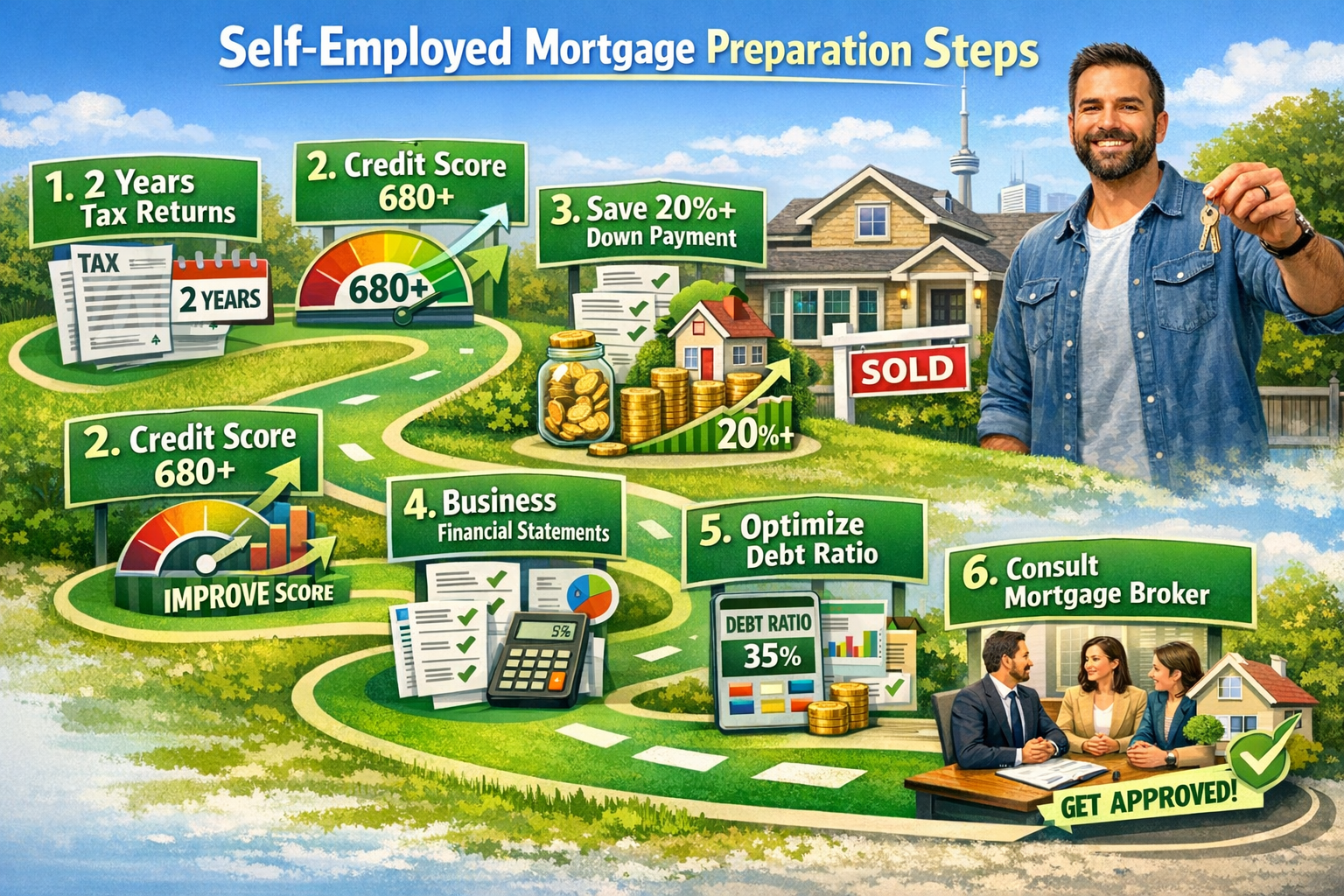
Understanding how self-employed borrowers in Toronto can secure insurable mortgage rates in 2026 requires recognizing that self-employment doesn’t have to be a disadvantage—with proper preparation, it can demonstrate financial sophistication and business acumen that strengthens your profile.
The current mortgage environment offers genuine opportunity. With insurable 5-year fixed rates at 3.69%[1], variable rates at 3.35%[1], and Bank of Canada policy expected to remain stable through much of 2026[6], well-prepared self-employed borrowers can access historically favorable financing.
Success requires:
✅ Strategic preparation beginning 12+ months before application ✅ Comprehensive documentation that clearly demonstrates income stability ✅ Credit optimization to achieve scores of 680 or higher ✅ Sufficient down payment of 20% or more to access insurable rates ✅ Professional guidance from experienced mortgage brokers who understand self-employed lending ✅ Realistic expectations about qualification requirements and timelines
The barriers that prevent many self-employed borrowers from accessing insurable rates—income verification complexity, credit requirements, down payment thresholds, and debt service ratios—are all surmountable with knowledge and preparation.
Toronto’s competitive real estate market demands that self-employed buyers approach mortgage qualification with the same strategic thinking they apply to their businesses. By treating mortgage preparation as a business project with clear milestones, documentation requirements, and success metrics, entrepreneurs can systematically overcome each obstacle.
Your Next Steps
If you’re a self-employed professional in Toronto planning to purchase a home in 2026:
- Start today with a comprehensive financial assessment
- Gather documentation systematically over the coming months
- Consult professionals including mortgage brokers and accountants
- Optimize your financial profile through credit improvement and debt reduction
- Obtain pre-approval before serious property searching
- Act decisively when you find the right property
For personalized guidance tailored to your specific self-employment situation, consider booking a free mortgage consultation with experienced professionals who specialize in helping self-employed borrowers navigate the qualification process.
The path to securing insurable mortgage rates as a self-employed borrower in Toronto requires more effort than traditional employment, but the reward—homeownership at the lowest available rates—makes the journey worthwhile. With current rates near historical lows and stable policy environment, 2026 presents an excellent opportunity to turn your entrepreneurial success into residential real estate ownership.
For additional resources on self-employed mortgages, explore our comprehensive guides on obtaining a mortgage when you’re self-employed, easier qualification strategies for self-employed borrowers, and empowering self-employed entrepreneurs’ homeownership dreams.
References
[1] Current Mortgage Rates Ontario – https://www.ratehub.ca/current-mortgage-rates-ontario
[2] Rates – https://www.nbc.ca/personal/mortgages/rates.html
[3] Mortgage Report – https://rates.ca/mortgage-report
[4] Self Employed Mortgage Rates – https://www.nerdwallet.com/ca/p/best/mortgages/self-employed-mortgage-rates
[5] Posted Interest Rates Offered By Chartered Banks – https://www.bankofcanada.ca/rates/banking-and-financial-statistics/posted-interest-rates-offered-by-chartered-banks/
[6] Mortgage Rate Forecast – https://www.truenorthmortgage.ca/blog/mortgage-rate-forecast
[7] Bank Of Canada Rate Announcement Jan 28th 2026 – https://www.independentmortgages.ca/bank-of-canada-rate-announcement-jan-28th-2026
 Previous Page