February 7, 2026
Documentation Requirements for Self-Employed Mortgage Approval in Toronto: A Complete Guide
Share this article:



Manzeel is an award-winning Mortgage Broker and the Owner of the Toronto-based mortgage, Everything Mortgages.
With 16 years of experience in the Canadian mortgage industry and a formal background in mortgage underwriting, Manzeel’s lending expertise gives him unique insight into whether a deal is feasible which empowers his clients to make more informed lending decisions faster.
He has been recognized as one of Canada’s Top 10 Mortgage Brokers by the national Canadian Mortgage Professionals (CMP) Association. Him and his team of 18 mortgage agents are proud to offer a mortgage experience that's built on honesty, trust, and integrity. He prides himself on the brokerage’s dedication to deliver an excellent client experience throughout the entire home loan process from pre-approval to post-funding.
Since moving to Toronto in 1998, Manzeel has successfully launched and scaled several businesses from the ground up, ranging from a mortgage brokerage and a vast real estate investment portfolio to a private financing eCommerce platform. He continues to be a leader in the real estate industry as he uses his analytical expertise to seek new real estate investment opportunities.
As a tech junkie and avid sports enthusiast, when Manzeel’s not working with clients, you can find him reading technology blogs, playing squash or watching tennis with his two boys.
Getting approved for a mortgage when you’re self-employed in Toronto isn’t impossible—but it does require more paperwork than traditional employees face. While salaried workers can simply provide a T4 slip and recent pay stubs, self-employed borrowers need to present a comprehensive documentation package that proves income stability, business legitimacy, and financial responsibility. Understanding the Documentation Requirements for Self-Employed Mortgage Approval in Toronto: A Complete Guide can mean the difference between mortgage approval and rejection in 2026’s competitive real estate market.
Toronto’s housing market remains one of Canada’s most expensive, making mortgage qualification especially critical for entrepreneurs, freelancers, and business owners. Lenders view self-employed applicants as higher-risk borrowers because income can fluctuate from year to year. However, with the right documentation strategy and thorough preparation, self-employed professionals can successfully secure competitive mortgage rates and terms.
This comprehensive guide walks through every document Toronto lenders require, explains why each piece matters, and provides strategic advice on presenting your financial profile in the strongest possible light.
Key Takeaways
✅ Notice of Assessment (NOA) for 2-3 years is the primary income verification document that self-employed borrowers must provide to demonstrate consistent earnings history
✅ Business financial statements, bank statements (6-12 months), and HST/GST documentation prove business legitimacy and current tax compliance status
✅ Minimum credit score of 600 is required by most lenders and mortgage insurers, with both personal and business credit evaluated during the approval process
✅ Business registration documents and proof of principal ownership verify that you have a majority stake in an established, legitimate business operation
✅ Strategic document presentation and working with specialized mortgage brokers significantly increases approval odds for self-employed applicants in Toronto’s competitive market
Understanding Why Self-Employed Mortgage Documentation Differs
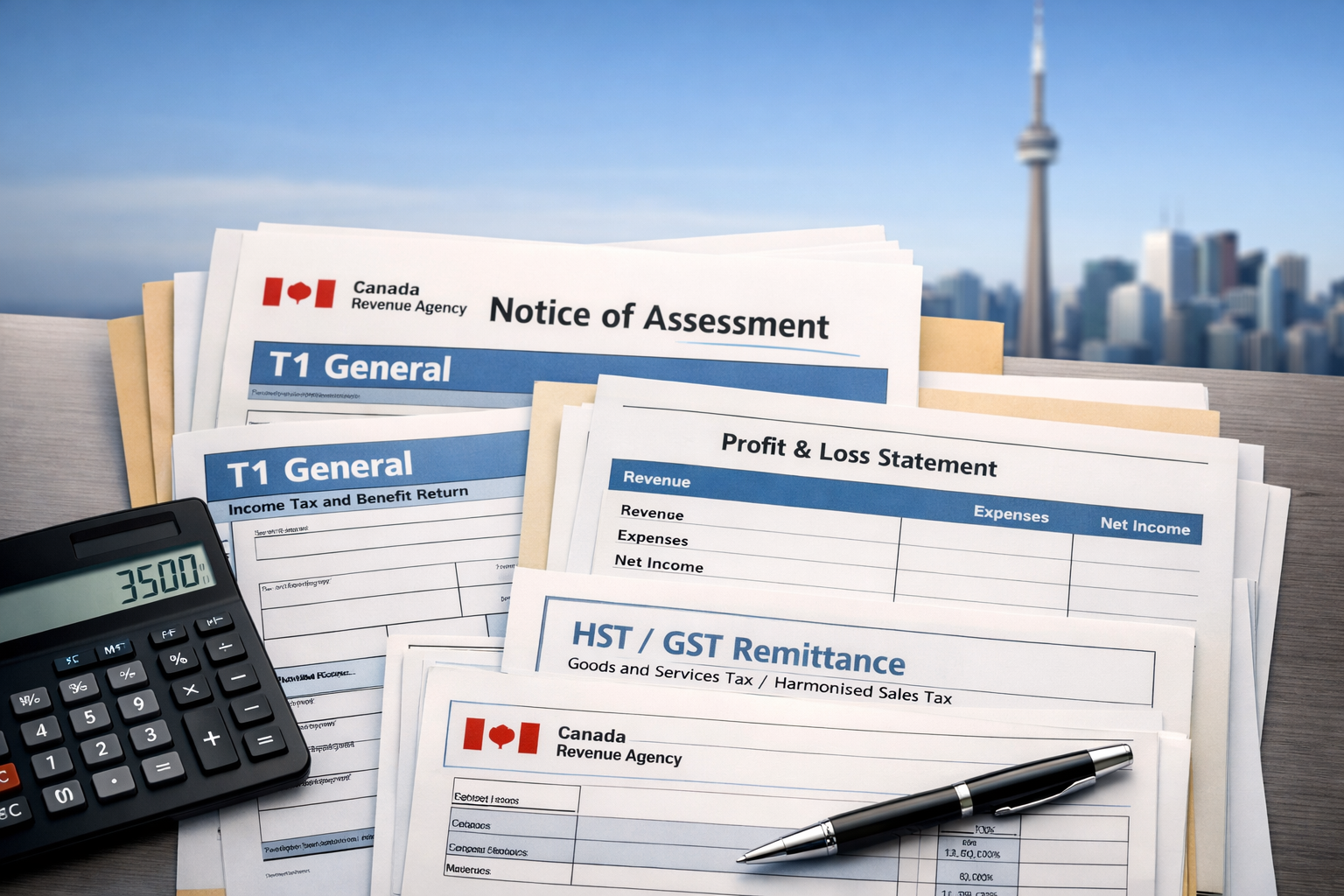
Traditional employees have straightforward income verification. They receive regular paychecks, their employer deducts taxes automatically, and they receive annual T4 slips that summarize their earnings. Mortgage lenders can quickly verify this information and assess their ability to repay a loan.
Self-employed individuals operate in a fundamentally different financial landscape. Income fluctuates based on business performance, tax deductions reduce reported income, and there’s no employer to verify employment status. From a lender’s perspective, this creates uncertainty and risk.
The Lender’s Perspective on Self-Employment Risk
Mortgage lenders evaluate risk through several lenses when reviewing self-employed applications:
- Income stability: Can the borrower maintain consistent earnings over the mortgage term?
- Business viability: Is the business established and likely to continue operating?
- Tax compliance: Does the borrower meet all tax obligations and report income accurately?
- Financial management: Does the applicant demonstrate responsible money management?
To answer these questions, lenders require extensive documentation that provides a comprehensive view of both personal and business finances. The best self-employed mortgage broker in Toronto understands these requirements and can help position your application strategically.
Traditional vs. Self-Employed Documentation Comparison
| Traditional Employee | Self-Employed Borrower |
|---|---|
| Recent pay stubs (2-3 months) | Notice of Assessment (2-3 years) |
| T4 slip (current year) | T1 General forms (2-3 years) |
| Employment letter | Business financial statements |
| Personal credit check | Personal AND business credit checks |
| N/A | Business registration documents |
| N/A | HST/GST payment proof |
| N/A | Business bank statements (6-12 months) |
This comparison highlights why self-employed mortgage applications require more preparation time and organizational effort. The good news? Once you understand what’s needed, gathering these documents becomes a manageable process.
Core Tax Documentation: The Foundation of Your Application
Tax documentation forms the absolute foundation of any self-employed mortgage application in Toronto. Unlike traditional employment verification, lenders rely heavily on Canada Revenue Agency (CRA) documents to confirm your income history and tax compliance.
Notice of Assessment (NOA): Your Primary Income Proof
The Notice of Assessment is the single most important document in your mortgage application package. This official CRA document confirms that you’ve filed your taxes and shows your reported income for a specific tax year[1][3].
Why lenders require NOAs:
- Provides independent, third-party income verification from the CRA
- Confirms you’re compliant with tax filing obligations
- Shows income trends over multiple years
- Cannot be easily falsified or manipulated
Most Toronto lenders require 2-3 years of NOAs to establish an income pattern[1][3]. This multi-year requirement helps lenders identify whether your income is stable, growing, or declining—critical information for assessing repayment ability.
💡 Pro Tip: If your most recent tax year shows significantly higher income than previous years, be prepared to explain the increase with supporting business documentation like new contracts or client agreements.
T1 General Tax Return Forms
Alongside your NOAs, lenders require your complete T1 General tax return forms for the same 2-3 year period[1][3]. While the NOA summarizes your tax assessment, the T1 General provides detailed information about:
- All sources of income (business, investment, rental, etc.)
- Business expenses and deductions claimed
- Tax credits and deductions applied
- Net income calculations
The T1 General is mandatory minimum documentation for self-employed borrowers who cannot provide T4 slips[1]. Lenders use these forms to understand your complete financial picture and verify the income calculations shown on your NOA.
How Lenders Calculate Your Qualifying Income
Understanding how lenders calculate qualifying income helps you prepare realistic expectations. Most lenders use one of these methods:
Two-Year Average Method: Add your net business income from the past two years and divide by two. This provides a conservative income estimate that accounts for year-to-year fluctuations.
Example:
- Year 1 net income: $85,000
- Year 2 net income: $95,000
- Qualifying income: ($85,000 + $95,000) ÷ 2 = $90,000
Declining Income Consideration: If your income is declining year-over-year, some lenders may use the most recent (lower) year as your qualifying income, or they may decline the application entirely.
This calculation method explains why many self-employed individuals qualify for smaller mortgages than their current income might suggest. Working with innovative mortgage solutions for self-employed Canadians can help you explore alternative qualification methods.
Tax Compliance Red Flags to Avoid
Certain tax-related issues can immediately disqualify your mortgage application:
❌ Outstanding tax debt: Any unpaid taxes to CRA must be resolved before approval
❌ Unfiled tax returns: Missing years create immediate disqualification
❌ Significant year-over-year income drops: May indicate business instability
❌ Excessive write-offs: Reducing taxable income too aggressively limits qualifying income
The key is finding the right balance between legitimate tax optimization and maintaining sufficient reported income for mortgage qualification. Many self-employed professionals work with accountants to develop tax strategies that support both objectives.
Business Verification Documentation: Proving Legitimacy and Stability
Beyond tax returns, Toronto lenders require comprehensive business documentation that proves your enterprise is legitimate, established, and likely to continue generating income. These documents provide context that tax forms alone cannot convey.
Business Financial Statements
Business financial statements are essential supporting documents that lenders typically require for a 2-year period[1][3]. These statements demonstrate business stability, profitability trends, and overall financial health.
Required financial statements usually include:
Income Statements (Profit & Loss):
- Shows revenue, expenses, and net profit over a specific period
- Demonstrates business profitability trends
- Helps lenders assess income sustainability
Balance Sheets:
- Lists business assets, liabilities, and equity
- Shows overall business financial position
- Indicates whether the business has positive net worth
Cash Flow Statements:
- Tracks money flowing in and out of the business
- Demonstrates liquidity and operational efficiency
- Shows ability to meet financial obligations
For established businesses, these statements should be prepared by a professional accountant or bookkeeper. Lenders give more weight to professionally prepared statements than self-generated spreadsheets.
Business Bank Statements
Recent business bank statements covering 6-12 months provide real-time evidence of business activity and cash flow[1][7]. These statements are particularly important for stated-income mortgage applications where full documentation may not be available.
What lenders look for in business bank statements:
- Consistent deposit patterns indicating regular business revenue
- Adequate cash reserves to cover business expenses
- No signs of financial distress (overdrafts, NSF fees, etc.)
- Transaction patterns that align with reported business type
Bank statements also help lenders verify that the income shown on your tax returns reflects actual business activity. Significant discrepancies between bank deposits and reported income raise red flags.
HST/GST Documentation and Tax Compliance
If your business generates more than $30,000 in annual revenue, you’re required to register for and collect HST/GST. Lenders require full proof of HST/GST payment to confirm you’re meeting all sales tax obligations[1][3].
Required HST/GST documentation includes:
- GST/HST Account Number registration
- Recent remittance receipts showing payments are current
- Filed GST/HST returns for the past 2 years
- Proof that no outstanding balances exist
Why this matters: Outstanding tax obligations—whether income tax, HST, or GST—can derail your mortgage application. Lenders view tax non-compliance as a serious risk factor that indicates financial irresponsibility.
Business Registration and Ownership Documentation
Lenders need to verify that your business is legitimate and that you have a controlling ownership stake. Required documentation includes[1][3]:
Business Registration Documents:
- Articles of Incorporation (for incorporated businesses)
- Business Number (BN) registration from CRA
- Provincial business registration or name registration
- Current, valid business license
Proof of Principal Ownership:
- Corporate share certificates showing majority ownership
- Partnership agreements (for partnerships)
- Sole proprietorship registration (for sole proprietors)
- Shareholder agreements
Most lenders require that you own at least 51% of the business to use its income for mortgage qualification. Minority shareholders or partners may face additional documentation requirements or need to provide alternative income sources.
For specialized professionals, such as physicians, there are tailored programs available—learn more about self-employed mortgages for doctors and similar professional categories.
Credit Requirements and Financial Position Documentation
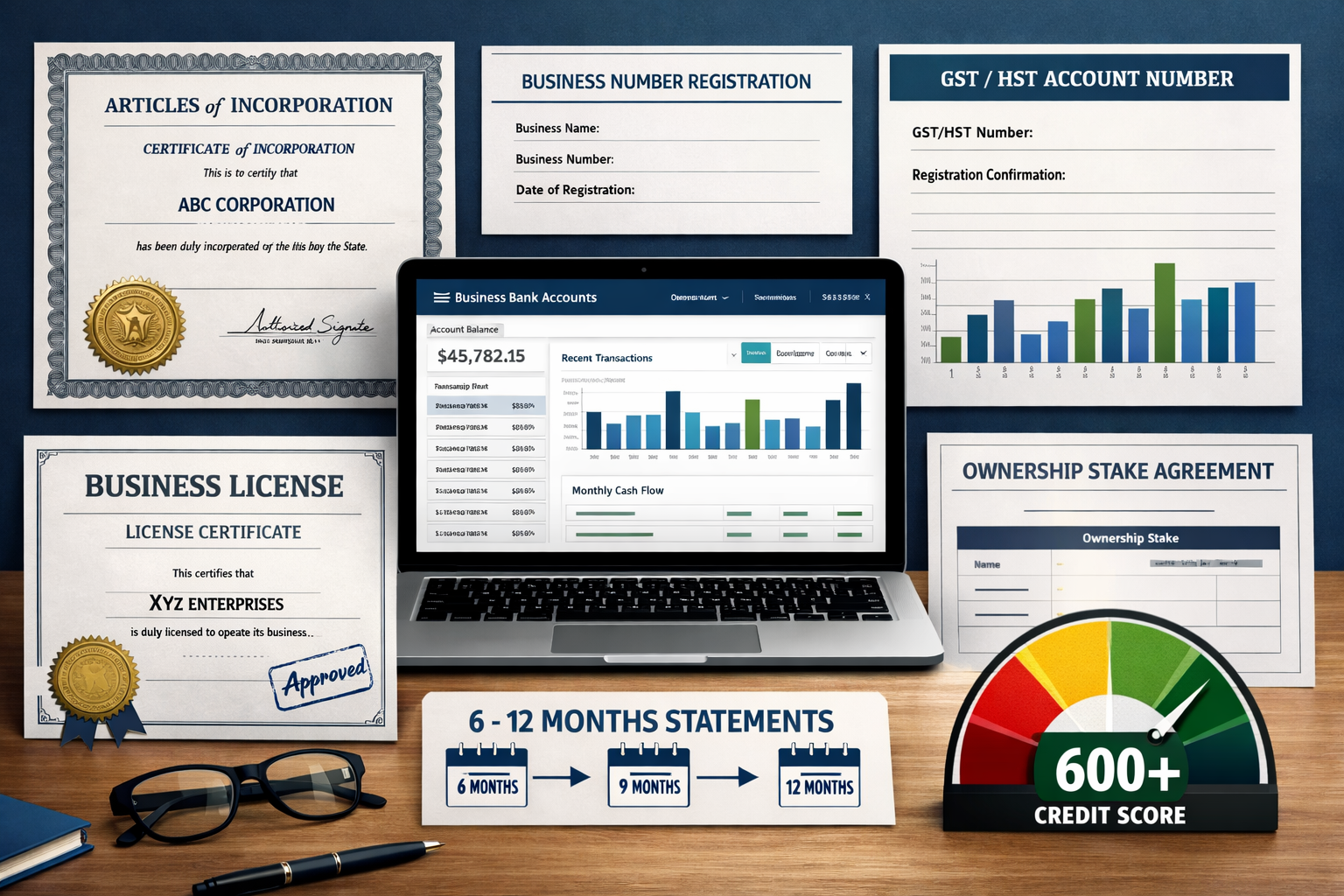
Beyond income verification and business documentation, lenders evaluate your overall financial position through credit scores, down payment sources, and debt obligations.
Personal and Business Credit Score Requirements
Both personal and business credit scores must be evaluated during the self-employed mortgage approval process[1][3]. This dual credit assessment provides lenders with a comprehensive view of your financial responsibility.
Minimum Credit Score Requirements:
- 600 minimum for most traditional lenders and mortgage insurers[1][3]
- 680+ recommended for best rates and terms
- 700+ may qualify for premium programs with lower documentation requirements
What affects your credit scores:
- Payment history on all credit accounts (35% of score)
- Credit utilization ratio (30% of score)
- Length of credit history (15% of score)
- Credit mix and new credit inquiries (20% of score)
For self-employed borrowers with credit scores below 600, alternative lending options may be available, though typically at higher interest rates. Understanding mortgage pre-approval in Ontario can help you assess where you stand before formally applying.
Down Payment Documentation
Lenders require clear evidence that your down payment funds come from legitimate sources and are not borrowed money. Required documentation includes:
Acceptable Down Payment Sources:
- Personal savings accounts (90-day history required)
- Investment account withdrawals (RRSP, TFSA, non-registered)
- Sale of assets (vehicles, property, etc.)
- Gift from immediate family (with gift letter)
Required Documentation:
- Bank statements showing down payment accumulation
- Investment statements showing current balances
- Sale agreements for assets being sold
- Gift letters confirming funds are non-repayable
Down Payment Requirements by Property Value:
- 5% minimum for properties up to $500,000
- 10% for the portion between $500,000-$1,000,000
- 20% minimum for properties over $1,000,000
Evidence that down payment funds are not gifted but come from personal savings or assets strengthens your application[1]. While gift funds are acceptable, lenders prefer to see that self-employed borrowers have accumulated their own capital.
Debt Service Ratios and Supporting Documentation
Lenders calculate two critical ratios to assess your ability to carry mortgage debt:
Gross Debt Service (GDS) Ratio: (Monthly housing costs ÷ Gross monthly income) × 100
Housing costs include: mortgage principal and interest, property taxes, heating, and 50% of condo fees (if applicable).
Maximum GDS: 32-39% depending on lender and program
Total Debt Service (TDS) Ratio: (Monthly housing costs + all other debt payments ÷ Gross monthly income) × 100
Other debts include: credit cards, car loans, lines of credit, student loans, and other obligations.
Maximum TDS: 40-44% depending on lender and program
To calculate these ratios accurately, lenders require documentation of all existing debts:
- Credit card statements
- Loan agreements
- Lines of credit statements
- Lease agreements
- Child support or alimony obligations
Paying down high-interest debt before applying can significantly improve your debt service ratios and increase your mortgage qualification amount.
Strategic Documentation for Strengthening Your Application
Beyond the mandatory documentation requirements, savvy self-employed borrowers include additional strategic documents that strengthen their applications and demonstrate future income potential.
Revenue Contracts and Future Income Documentation
Forward-looking revenue contracts showing expected business income for the next 1-2 years can significantly strengthen your application[1][3]. These documents demonstrate income stability and business growth potential.
Valuable contract documentation includes:
- Signed client agreements with payment schedules
- Recurring revenue contracts (retainers, subscriptions)
- Government contracts or corporate agreements
- Purchase orders from established clients
- Letters of intent from new clients
For freelancers seeking mortgages, contract documentation can be especially powerful because it demonstrates pipeline and future earnings that may not yet appear on tax returns.
Professional Credentials and Industry Documentation
Depending on your profession, additional credentials can support your application:
Professional Designations:
- CPA, CA, CGA designations (accountants)
- P.Eng designation (engineers)
- Medical licenses (doctors, dentists)
- Legal credentials (lawyers, paralegals)
- Trade certifications (electricians, plumbers)
These credentials demonstrate professional legitimacy and suggest stable, long-term earning potential in your field.
Letters of Explanation for Income Fluctuations
If your income shows significant year-over-year changes, a well-written letter of explanation can provide context that raw numbers cannot convey.
Effective letters of explanation address:
- Reasons for income increases or decreases
- Business expansion or contraction decisions
- Industry-specific seasonal patterns
- Major client gains or losses
- Economic factors affecting your sector
Example scenario: A freelance marketing consultant shows a 30% income drop in 2024 compared to 2023. The letter explains that the borrower deliberately reduced work hours to complete a professional certification that has since resulted in higher-paying contracts (supported by new contract documentation).
Additional Supporting Documents
Other documents that can strengthen your application include:
📄 Client testimonials or references demonstrating business reputation
📄 Industry awards or recognition showing professional standing
📄 Business growth projections prepared by your accountant
📄 Proof of business insurance indicating established operations
📄 Commercial lease agreements showing stable business location
While not mandatory, these supplementary documents paint a comprehensive picture of a stable, successful business operation.
Special Programs and Alternative Documentation Options
Not all self-employed borrowers fit the traditional documentation model. Several alternative programs exist in Toronto’s mortgage market for entrepreneurs with unique circumstances.
Stated Income Programs
Stated income mortgages allow self-employed borrowers to qualify based on declared income without providing full tax documentation[7]. These programs typically require:
- Larger down payments (20-35%)
- Higher interest rates (0.5-2% above prime programs)
- Extensive business bank statements (12+ months)
- Strong credit scores (680+)
- Proof of business registration and operation
Stated income programs work well for borrowers who:
- Write off significant business expenses, reducing taxable income
- Have recently started a business (less than 2 years)
- Experience significant income growth not yet reflected in tax returns
- Earn substantial income not fully captured on tax returns
Property Value and Loan Limits in Toronto
Different programs have varying property value caps and loan limits. For example, National Bank’s self-employed program has a maximum property value of $1,500,000, with loan limits reaching $750,000 in the Toronto metropolitan area[2].
Understanding these limits helps you target appropriate properties and programs during your home search.
Programs for Specific Self-Employment Types
Certain professions have access to specialized mortgage programs:
Medical Professionals: Doctors, dentists, and veterinarians often qualify for special programs with reduced documentation requirements due to stable income potential.
Incorporated Professionals: Professionals who operate through corporations may access programs that consider retained earnings and dividends differently than traditional self-employment income.
Real Estate Investors: Self-employed individuals investing in rental properties can often use rental income projections to supplement qualification income.
Working with Specialized Mortgage Brokers
The complexity of self-employed mortgage documentation makes working with specialized brokers particularly valuable. Experienced brokers:
✅ Know which lenders have the most flexible self-employed programs
✅ Understand how to present documentation for maximum impact
✅ Can identify alternative programs when traditional options don’t fit
✅ Help you avoid common mistakes self-employed homebuyers make
✅ Navigate complex income calculations and documentation requirements
Mortgage brokers have access to multiple lenders and can shop your application to find the best fit, rather than limiting you to a single bank’s programs.
Organizing and Presenting Your Documentation Package
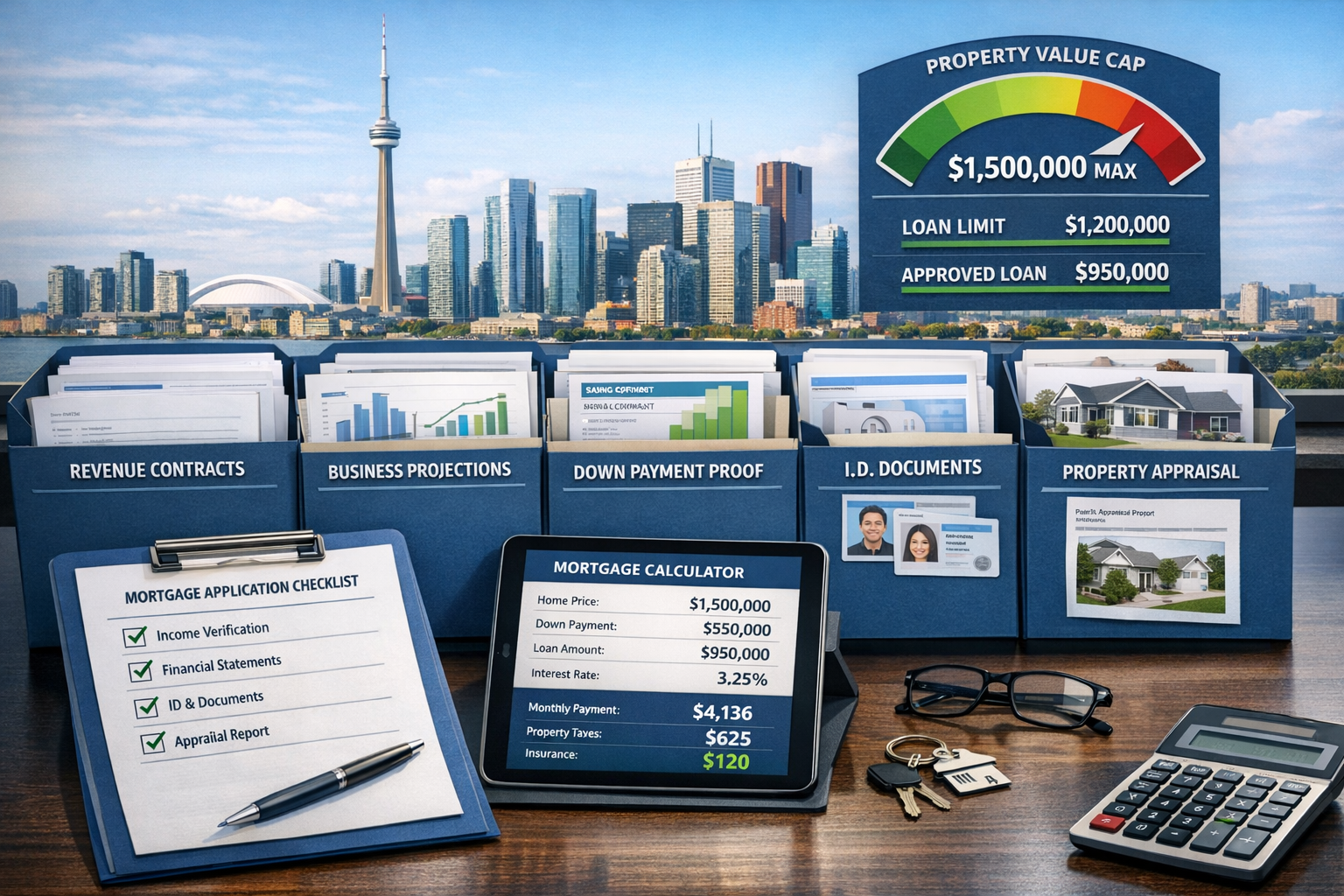
Having all the required documents is only half the battle—presenting them in an organized, professional manner significantly impacts how lenders perceive your application.
Creating a Comprehensive Documentation Checklist
Before submitting your application, verify you have every required document:
Tax Documentation:
- Notice of Assessment (2-3 years)
- T1 General tax returns (2-3 years)
- Business tax returns (2-3 years)
Business Verification:
- Business financial statements (2 years)
- Business bank statements (6-12 months)
- Articles of Incorporation or business registration
- Business license (current)
- GST/HST registration and remittance receipts
- Proof of principal ownership
Credit and Financial Position:
- Personal credit report
- Business credit report
- Down payment source documentation
- Bank statements (90 days)
- Investment statements
- Debt statements (all existing obligations)
Supporting Documentation:
- Revenue contracts or client agreements
- Professional credentials
- Letters of explanation (if needed)
- Personal identification
- Proof of Canadian residency or citizenship
Document Organization Best Practices
Create a logical folder structure:
- Personal Tax Documents
- Business Tax Documents
- Business Registration and Licensing
- Financial Statements
- Bank Statements
- Credit Reports
- Down Payment Documentation
- Supporting Documents
Label everything clearly:
- Use consistent file naming: “2024_NOA_JohnSmith.pdf”
- Include dates and tax years
- Separate personal and business documents
- Create a table of contents for physical submissions
Provide both digital and physical copies:
- Scan all documents at high resolution (300 DPI minimum)
- Save as searchable PDFs
- Organize in clearly labeled digital folders
- Maintain physical copies in a binder with tabs
Timeline for Document Gathering
8-12 weeks before application:
- Request NOAs from CRA if you don’t have recent copies
- Contact your accountant for business financial statements
- Order credit reports to identify any issues
- Begin organizing existing documentation
6-8 weeks before application:
- Gather business bank statements
- Compile HST/GST documentation
- Collect business registration documents
- Prepare letters of explanation if needed
4-6 weeks before application:
- Assemble down payment documentation
- Update business financial statements
- Gather revenue contracts and supporting documents
- Review everything for completeness
2-4 weeks before application:
- Meet with mortgage broker for pre-review
- Address any identified gaps or issues
- Finalize organization and presentation
- Prepare for potential lender questions
Starting early prevents last-minute scrambling and gives you time to address any documentation gaps before they derail your application.
Common Documentation Mistakes to Avoid
❌ Incomplete tax filing history: Missing even one year can disqualify you
❌ Outdated business financial statements: Statements older than 6 months may not be accepted
❌ Insufficient bank statement history: Providing only 3 months when 6-12 are required
❌ Unexplained large deposits: Any unusual deposits need documentation showing legitimate sources
❌ Inconsistent information: Discrepancies between different documents raise red flags
❌ Poor quality scans: Illegible documents delay processing and create frustration
❌ Missing signatures: Unsigned documents may not be accepted as valid
Taking time to review your complete package before submission prevents delays and demonstrates professionalism to lenders.
Navigating the Application Process from Documentation to Approval
Understanding the complete mortgage application journey helps you anticipate requirements and timelines for self-employed approval in Toronto.
Pre-Qualification vs. Pre-Approval
Pre-Qualification:
- Informal estimate based on self-reported information
- No documentation required initially
- No credit check performed
- Not binding on the lender
- Useful for initial planning only
Pre-Approval:
- Formal assessment based on full documentation review
- Requires complete documentation package
- Includes credit check
- Rate hold for 90-120 days (typically)
- Demonstrates serious buyer status to sellers
For self-employed borrowers, obtaining a formal pre-approval is particularly valuable because it confirms that lenders have reviewed your complex documentation and approved your qualification. This gives you confidence when making offers in Toronto’s competitive market.
The Underwriting Process for Self-Employed Applications
After submitting your application and documentation, the underwriting process typically follows these stages:
Stage 1: Initial Review (2-5 days)
- Verification that all required documents are present
- Initial income calculations
- Credit report review
- Identification of any obvious red flags
Stage 2: Detailed Analysis (5-10 days)
- Comprehensive income verification
- Business viability assessment
- Tax compliance verification
- Debt service ratio calculations
- Property appraisal ordering
Stage 3: Conditional Approval (1-3 days)
- Approval subject to specific conditions
- Request for additional documentation if needed
- Clarification of any questions or concerns
Stage 4: Final Approval (2-5 days)
- All conditions satisfied
- Final underwriting sign-off
- Commitment letter issued
- Rate confirmation
Self-employed applications typically take 2-4 weeks longer than traditional employment applications due to the additional documentation review required.
Responding to Lender Questions and Requests
During underwriting, expect additional questions or documentation requests:
Common follow-up requests:
- Explanation of specific business expenses
- Clarification of income calculations
- Additional bank statements
- Updated business financial statements
- Verification of specific contracts or clients
- Letters of explanation for credit issues
Best practices for responding:
- Respond promptly (within 24-48 hours)
- Provide exactly what’s requested
- Include clear explanations
- Maintain professional communication
- Keep your broker informed of all communications
Quick, thorough responses to lender requests keep your application moving forward and demonstrate reliability.
What to Do If Your Application Is Declined
If your initial application is declined, don’t panic. Self-employed borrowers have several options:
1. Understand the specific reasons for decline:
- Insufficient income
- Credit score issues
- Debt service ratio problems
- Business stability concerns
- Documentation gaps
2. Address the identified issues:
- Wait for additional tax year to show income growth
- Pay down debt to improve ratios
- Improve credit score through responsible credit use
- Gather additional supporting documentation
3. Explore alternative lender programs:
- B-lenders with more flexible criteria
- Credit unions with relationship-based lending
- Private lenders for short-term solutions
- Stated income programs
4. Consider adjusting your home purchase plans:
- Look at lower-priced properties
- Increase your down payment
- Add a co-signer with traditional employment
- Wait 6-12 months to strengthen your application
Working with an experienced mortgage broker who specializes in self-employed mortgages increases your chances of finding an approval path even after an initial decline.
Maintaining Documentation for Future Mortgage Needs
Your relationship with mortgage documentation doesn’t end at approval. Maintaining organized records supports future refinancing, renewals, and additional property purchases.
Ongoing Documentation Organization
Create a permanent mortgage file containing:
- All application documents
- Approval letters and commitments
- Final mortgage agreement
- Property appraisal
- Title documents
- Insurance policies
Maintain annual updates:
- File each year’s NOA immediately upon receipt
- Update business financial statements annually
- Keep current business registration documents
- Maintain 2-3 years of bank statements
- Track major business contracts and changes
Planning for Renewal and Refinancing
When your mortgage term ends (typically 5 years), you’ll either renew with your current lender or refinance with a new one. Refinancing with a new lender requires full documentation again, while simple renewals typically don’t.
Renewal considerations for self-employed borrowers:
- Keep documentation current even if staying with same lender
- Consider refinancing if your financial position has strengthened
- Explore whether you now qualify for better programs
- Evaluate whether refinancing makes sense given current rates
Building Equity for Future Opportunities
Strong documentation and successful mortgage management create opportunities for future financial moves:
Home Equity Line of Credit (HELOC): Use built equity for business investment, renovations, or other purposes. Requires updated income documentation.
Investment Property Purchase: Leverage existing home equity and strong documentation history to expand into rental properties.
Business Expansion Financing: Demonstrated mortgage responsibility strengthens applications for business loans and lines of credit.
Mortgage Portability: If you need to move before your term ends, well-maintained documentation makes porting your mortgage to a new property smoother.
Conclusion: Your Roadmap to Self-Employed Mortgage Success in Toronto
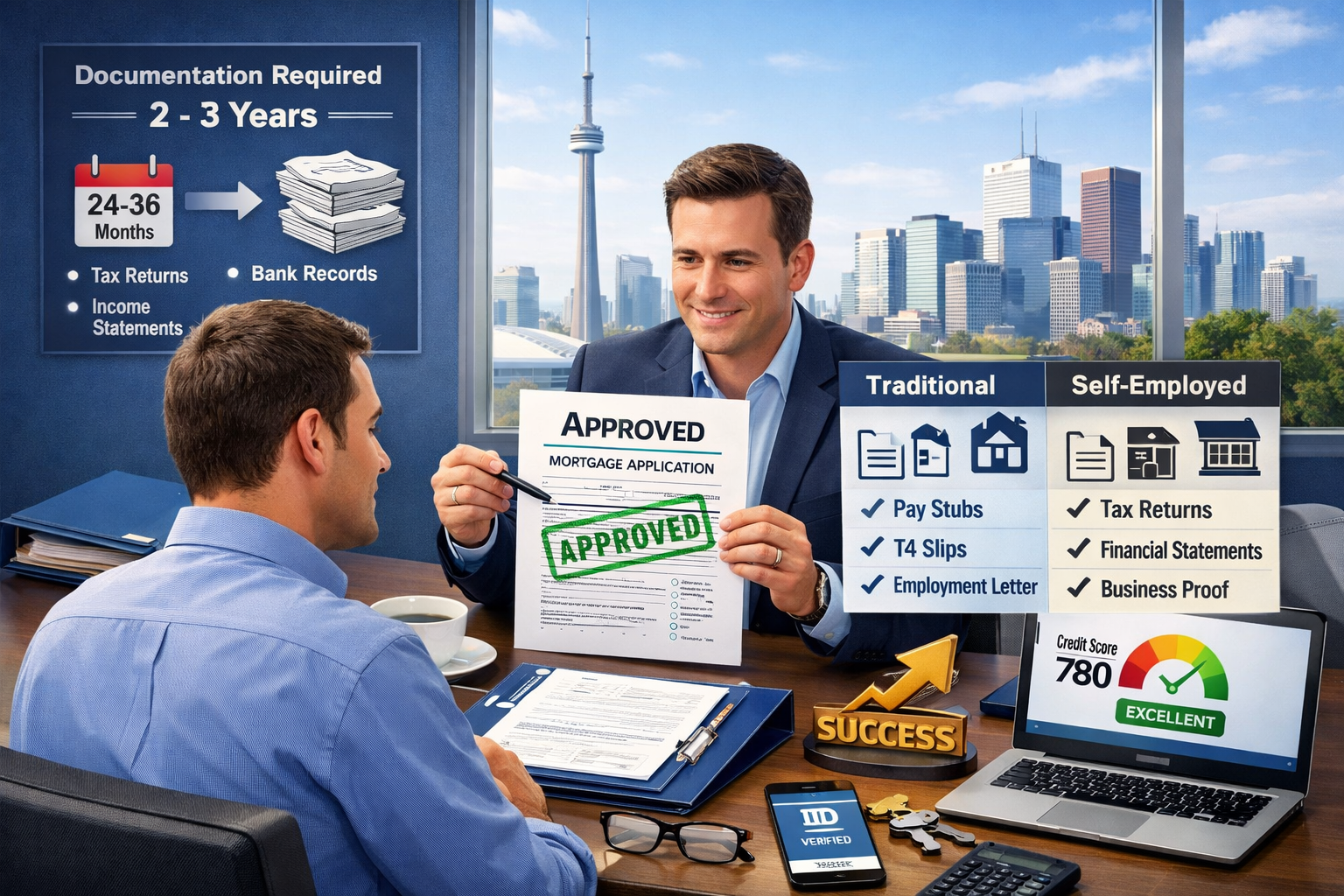
Securing mortgage approval as a self-employed borrower in Toronto requires significantly more documentation than traditional employment, but it’s entirely achievable with proper preparation and strategic presentation. The Documentation Requirements for Self-Employed Mortgage Approval in Toronto: A Complete Guide outlined in this article provides the foundation for building a compelling mortgage application.
Remember the essential documentation categories:
📋 Core tax documents: NOAs and T1 General forms for 2-3 years
📋 Business verification: Financial statements, bank statements, and registration documents
📋 Credit and financial position: Credit reports, down payment proof, and debt documentation
📋 Strategic additions: Revenue contracts, professional credentials, and explanatory letters
Success in the self-employed mortgage process comes down to three key factors:
- Early preparation: Start gathering documents 8-12 weeks before applying
- Professional organization: Present documents in a clear, logical, comprehensive package
- Expert guidance: Work with mortgage professionals who specialize in self-employed applications
Your Next Steps
Immediate actions (this week):
- Request your most recent NOAs from CRA if you don’t have copies
- Contact your accountant about preparing current business financial statements
- Pull your personal and business credit reports to identify any issues
- Calculate your estimated qualifying income using the two-year average method
Short-term actions (next 2-4 weeks):
- Schedule a consultation with a mortgage broker specializing in self-employed applications
- Begin organizing your documentation using the checklist provided in this guide
- Gather business bank statements and HST/GST documentation
- Identify any documentation gaps and create a plan to address them
Medium-term actions (next 1-3 months):
- Complete your comprehensive documentation package
- Obtain mortgage pre-approval to confirm your qualification
- Begin your Toronto property search with confidence in your budget
- Maintain organized records for quick responses to any lender questions
The Toronto real estate market rewards prepared buyers. By understanding and assembling the Documentation Requirements for Self-Employed Mortgage Approval in Toronto: A Complete Guide, you position yourself as a serious, qualified purchaser ready to compete effectively in one of Canada’s most competitive housing markets.
Don’t let self-employment status become a barrier to homeownership. With the right documentation strategy and professional support, self-employed borrowers can secure competitive mortgage terms and achieve their Toronto real estate goals in 2026 and beyond.
References
[1] Self Employed Mortgage Options Qualifications In Canada – https://www.nesto.ca/mortgage-basics/self-employed-mortgage-options-qualifications-in-canada/
[2] Self Employed – https://www.nbc.ca/personal/mortgages/self-employed.html
[3] Self Employed Mortgage Requirements – https://www.frankmortgage.com/blog/self-employed-mortgage-requirements
[4] Self Employed Mortgage – https://www.ratehub.ca/self-employed-mortgage
[5] New Canada Mortgage Programs – https://peterpaley.com/new-canada-mortgage-programs/
[6] Self Employed Mortgage – https://www.rbcroyalbank.com/mortgages/self-employed-mortgage.html
[7] Guide – https://tridacmortgages.com/services/self-employed-mortgage/guide/
 Previous Page