February 16, 2026
Rent vs Buy Analysis for Toronto First-Time Buyers: Why 2026 Ownership Beats High Rents
Share this article:



Manzeel is an award-winning Mortgage Broker and the Owner of the Toronto-based mortgage, Everything Mortgages.
With 16 years of experience in the Canadian mortgage industry and a formal background in mortgage underwriting, Manzeel’s lending expertise gives him unique insight into whether a deal is feasible which empowers his clients to make more informed lending decisions faster.
He has been recognized as one of Canada’s Top 10 Mortgage Brokers by the national Canadian Mortgage Professionals (CMP) Association. Him and his team of 18 mortgage agents are proud to offer a mortgage experience that's built on honesty, trust, and integrity. He prides himself on the brokerage’s dedication to deliver an excellent client experience throughout the entire home loan process from pre-approval to post-funding.
Since moving to Toronto in 1998, Manzeel has successfully launched and scaled several businesses from the ground up, ranging from a mortgage brokerage and a vast real estate investment portfolio to a private financing eCommerce platform. He continues to be a leader in the real estate industry as he uses his analytical expertise to seek new real estate investment opportunities.
As a tech junkie and avid sports enthusiast, when Manzeel’s not working with clients, you can find him reading technology blogs, playing squash or watching tennis with his two boys.
The Toronto housing market in 2026 presents a unique opportunity that hasn’t existed in years. While headlines scream about affordability challenges and market uncertainty, rental prices have dropped to 44-month lows and mortgage rates have stabilized around 4.5%. For first-time buyers watching from the sidelines, this convergence of factors creates a compelling case to reconsider the rent-versus-buy equation. The Rent vs Buy Analysis for Toronto First-Time Buyers: Why 2026 Ownership Beats High Rents reveals surprising truths about long-term wealth building that challenge conventional wisdom about waiting for the “perfect” market conditions.
Despite monthly ownership costs running $1,000-$1,500 higher than renting comparable units, the financial mathematics of homeownership in Toronto’s current market favor buyers willing to commit for five years or longer. This comprehensive analysis breaks down the real numbers, hidden costs, and wealth-building potential that make 2026 a pivotal year for first-time buyers to transition from tenant to owner.
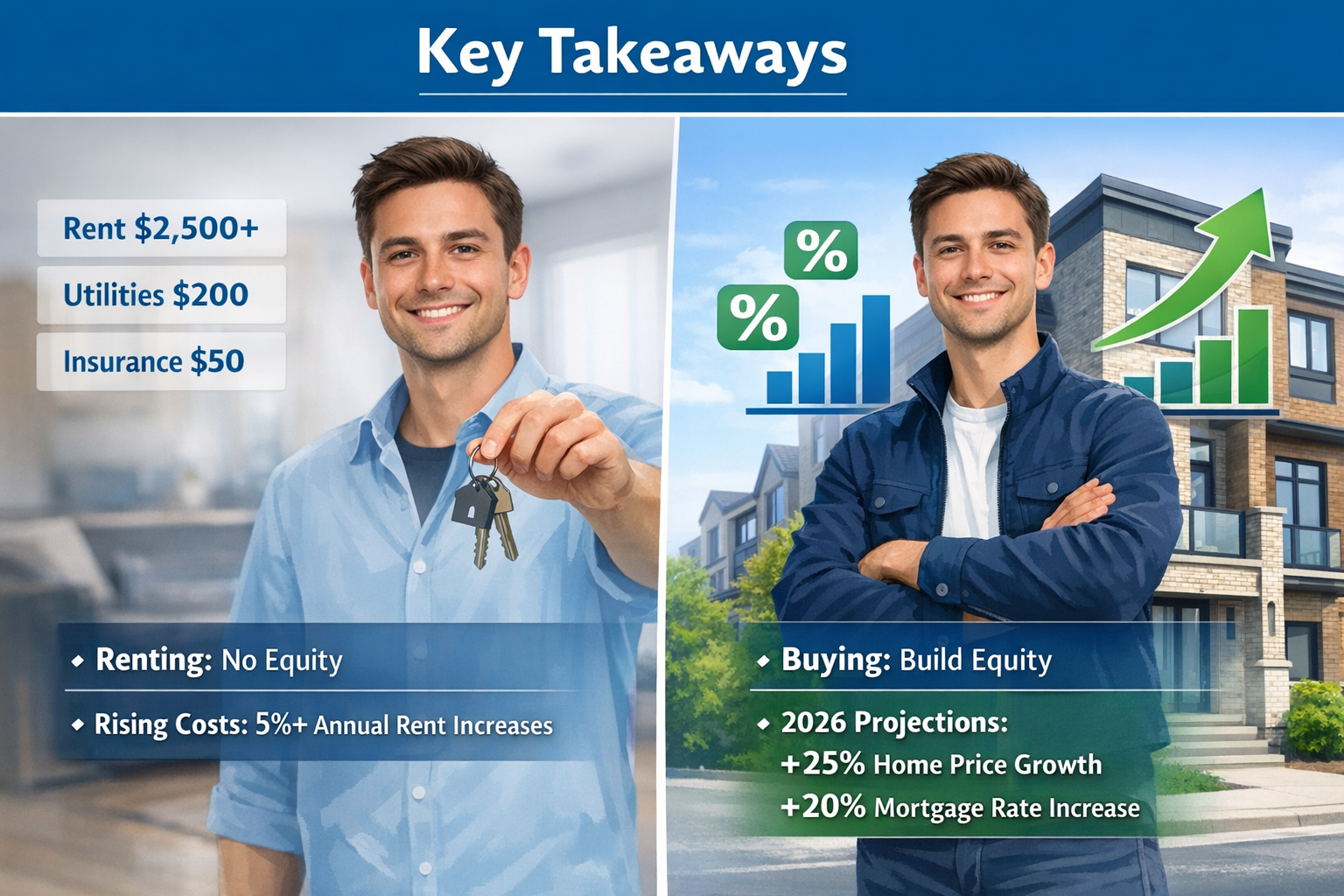
Key Takeaways
✅ Toronto rents hit 44-month lows in January 2026, with average one-bedroom units at $2,495—down 4.6% year-over-year, creating favorable conditions for comparison analysis[7]
✅ Break-even timeline is 5-6 years for Toronto condo buyers, after which ownership accumulates approximately $248,000 in net advantage over renting through equity building and appreciation[1]
✅ Monthly ownership costs $1,000-$1,500 more than renting ($3,500-$4,000 vs $2,300-$2,600), but long-term wealth accumulation dramatically favors buyers[3]
✅ Entry-level condos under $750K offer the fastest path to ownership with down payments around $140,000 plus $20,950 in land transfer taxes[1]
✅ Current 4.5% mortgage rates create predictable monthly costs and long-term housing stability unavailable to renters[1]
Understanding the 2026 Toronto Housing Landscape
Current Market Conditions Creating Opportunity
The Toronto real estate market in 2026 looks dramatically different from the frenzied conditions of 2021-2022. Rental rates have softened significantly, with one-bedroom apartments averaging $2,495—the lowest level since September 2022[7]. This represents a 4.6% year-over-year decline and gives renters unprecedented negotiating power with landlords.
Simultaneously, the condo market has experienced substantial price pressure, particularly in the studio and small one-bedroom segment. These units, which account for roughly 41% of condo sales, have seen the steepest price declines, with properties now available in the $300,000-$400,000 range[3]. This investor-driven supply glut emerged as rising interest rates and declining investor confidence pushed speculative buyers to exit the market.
For first-time buyers, this creates a rare window where both purchase prices and carrying costs have moderated from their peaks. Five-year fixed mortgage rates at 4.5% represent a significant improvement from the 6%+ rates of 2023-2024[1]. Combined with softer purchase prices, the monthly cost of ownership—while still higher than renting—has become more manageable for qualified buyers.
The vacancy rate in Toronto sits at approximately 3%, indicating a relatively balanced market according to CMHC data[1]. This equilibrium contrasts sharply with the extreme tenant scarcity of previous years, when vacancy rates below 1% gave landlords overwhelming pricing power.
Why Monthly Costs Tell Only Part of the Story
When conducting a Rent vs Buy Analysis for Toronto First-Time Buyers: Why 2026 Ownership Beats High Rents, many people focus exclusively on monthly cash flow. This narrow view misses the fundamental wealth-building equation that separates renting from owning.
Current monthly costs break down as follows:
Renting a comparable one-bedroom condo:
- Rent: $2,300-$2,600
- Tenant insurance: $30-$50
- Utilities (if not included): $100-$150
- Total: $2,430-$2,800 monthly
Owning a $700,000 one-bedroom condo:
- Mortgage payment (4.5%, 25-year amortization on $560,000): $3,090
- Property taxes: $250
- Condo fees: $650
- Insurance: $100
- Utilities: $150
- Total: $4,240 monthly
The $1,440-$1,810 monthly premium for ownership appears substantial. However, this comparison ignores three critical factors:
- Principal repayment builds equity with each mortgage payment
- Property appreciation adds to net worth without additional monthly cost
- Rent increases erode purchasing power over time while mortgage payments remain stable
A first-time buyer making that $3,090 monthly mortgage payment isn’t simply paying for housing—approximately $1,000 of each payment goes toward principal reduction in the early years, increasing as the amortization progresses. This forced savings mechanism creates wealth accumulation that renters must replicate through disciplined investing.
For those exploring their options, understanding how to save and buy your first home provides essential guidance on building the down payment and preparing for ownership costs.
The Financial Mathematics: Breaking Down the 5-Year Comparison
Real Numbers for a $700,000 Toronto Condo Purchase
Let’s examine the detailed financial analysis for a typical first-time buyer scenario: purchasing a $700,000 one-bedroom condo in a desirable Toronto neighborhood versus continuing to rent a comparable unit.
Initial Investment Requirements:
💰 Down Payment (20%): $140,000
💰 Ontario Land Transfer Tax: $20,950
💰 Legal Fees & Closing Costs: $3,000-$5,000
💰 Total Upfront Investment: $163,950-$165,950
This substantial upfront cost represents the primary barrier for most first-time buyers. However, those with smaller down payments (5-10%) can access mortgage insurance through CMHC, though this increases monthly carrying costs significantly.
Five-Year Ownership Analysis:
Over a five-year holding period, assuming 3% annual property appreciation (conservative by Toronto historical standards), the financial outcomes look dramatically different than monthly cost comparisons suggest[1]:
| Year | Property Value | Mortgage Balance | Equity Built | Cumulative Appreciation |
|---|---|---|---|---|
| 1 | $721,000 | $543,200 | $16,800 | $21,000 |
| 2 | $742,630 | $525,800 | $34,200 | $42,630 |
| 3 | $764,909 | $507,700 | $52,300 | $64,909 |
| 4 | $787,856 | $488,800 | $71,200 | $87,856 |
| 5 | $811,492 | $469,100 | $90,900 | $111,492 |
By year five, the buyer has accumulated approximately $90,900 in principal repayment plus $111,492 in appreciation, totaling $202,392 in gross wealth creation. After deducting the higher monthly costs paid compared to renting (approximately $72,000 over five years), the net advantage approaches $130,000-$150,000[1].
The Renter’s Alternative Investment Strategy
Critics of homeownership argue that renters can achieve similar wealth by investing their down payment and monthly savings. Let’s examine this scenario objectively.
Renter’s Investment Opportunity:
A renter who keeps their $140,000 down payment invested at a conservative 5% annual return would accumulate approximately $178,650 after five years. Additionally, saving the $1,500 monthly difference between ownership and rental costs at the same 5% return would add approximately $102,000.
Total renter wealth after 5 years: $280,650
However, this calculation makes several unrealistic assumptions:
🚫 Perfect investment discipline (most renters don’t invest 100% of housing cost savings)
🚫 No lifestyle inflation as income increases
🚫 Consistent 5% returns without market volatility
🚫 No emergency withdrawals from investment accounts
🚫 Zero rent increases over the five-year period
In reality, behavioral economics research shows that forced savings mechanisms (like mortgage principal repayment) create significantly more wealth than voluntary investment programs for most people. The homeowner’s equity builds automatically, while the renter must exercise continuous discipline.
Furthermore, rent increases averaging 2.5% annually would push the renter’s monthly costs from $2,600 to approximately $2,940 by year five, narrowing the monthly savings gap and reducing investment capacity[1][2].
Break-Even Analysis: When Does Ownership Win?
The break-even point—when cumulative ownership benefits exceed cumulative costs—occurs at approximately 5-6 years for Toronto condo buyers in 2026[1]. This timeline accounts for:
- Transaction costs (land transfer tax, legal fees, realtor commissions upon sale)
- Higher monthly carrying costs compared to renting
- Opportunity cost of down payment capital
- Equity accumulation through principal repayment
- Property appreciation at conservative 3% annually
Break-even timeline varies by scenario:
📊 Optimistic scenario (5% appreciation, 4.0% rates): 3-4 years
📊 Moderate scenario (3% appreciation, 4.5% rates): 5-6 years
📊 Conservative scenario (2% appreciation, 5.0% rates): 6-7 years
📊 Flat market scenario (0% appreciation): 10+ years
For buyers purchasing larger properties ($1.2 million+), break-even extends to 6-7 years due to higher transaction costs (approximately $60,000 in land transfer tax plus $50,000+ in realtor commissions)[1].
This analysis demonstrates why the Rent vs Buy Analysis for Toronto First-Time Buyers: Why 2026 Ownership Beats High Rents emphasizes the importance of commitment timeline. Buyers who plan to relocate within 3-4 years face significant financial risk, while those committed for 7+ years position themselves for substantial wealth creation.
Working with professionals who understand these nuances is crucial. Mortgage brokers in Toronto can help first-time buyers navigate qualification requirements and find optimal financing structures.
Hidden Costs and Overlooked Benefits of Each Option
The True Cost of Renting in Toronto’s 2026 Market
While rental rates have softened to multi-year lows, renting carries hidden costs and opportunity costs that don’t appear on monthly statements:
Financial Costs:
💸 Rent increases: Even with current rent control (2.5% guideline for 2026), tenants face annual increases that compound over time. A $2,500 monthly rent becomes $2,821 after five years of guideline increases.
💸 Moving costs: Renters relocate more frequently than owners, incurring costs for movers, truck rentals, damage deposits, and potential overlap between leases. Average moving costs in Toronto range from $800-$2,000.
💸 Lack of equity building: Every rent payment provides housing but builds zero personal wealth. Over five years, a renter pays approximately $156,000-$180,000 in rent with nothing to show for it beyond housing consumed.
💸 Opportunity cost of stability: Renters cannot make improvements, customize their space, or benefit from neighborhood appreciation. The psychological and financial value of “putting down roots” remains unavailable.
Non-Financial Costs:
🏚️ Lack of control: Landlords can choose not to renew leases, sell properties, or change terms within legal limits. Renters face constant uncertainty about long-term housing security.
🏚️ Renovation restrictions: Most leases prohibit significant modifications, limiting personalization and preventing renters from optimizing their living space.
🏚️ Pet restrictions: Many Toronto landlords prohibit pets or charge substantial deposits, limiting lifestyle choices for animal lovers.
🏚️ Noise and neighbor issues: Renters have limited recourse for dealing with disruptive neighbors or building management problems.
For first-time buyers evaluating whether condo living in Toronto makes sense, understanding these hidden rental costs provides important context.
The Hidden Costs of Homeownership
Conducting an honest Rent vs Buy Analysis for Toronto First-Time Buyers: Why 2026 Ownership Beats High Rents requires acknowledging that ownership carries costs beyond mortgage payments:
Ongoing Ownership Costs:
🏠 Property taxes: Toronto’s residential property tax rate averages 0.6-0.7% of assessed value annually. For a $700,000 condo, expect $4,200-$4,900 yearly ($350-$410 monthly).
🏠 Condo fees: Average $650-$750 monthly for a one-bedroom unit, covering building maintenance, amenities, insurance, and reserve fund contributions. These fees typically increase 3-4% annually.
🏠 Maintenance and repairs: While condo fees cover common elements, owners remain responsible for in-unit repairs. Budget $1,000-$2,000 annually for appliance repairs, plumbing issues, and general maintenance.
🏠 Special assessments: Condo boards can levy special assessments for major building repairs not covered by reserve funds. While uncommon, these can reach $5,000-$20,000 per unit for significant projects.
🏠 Insurance: Homeowner insurance costs $800-$1,500 annually for a Toronto condo, compared to $300-$600 for tenant insurance.
Transaction Costs:
💰 Ontario Land Transfer Tax: Calculated on a sliding scale, totaling $20,950 for a $700,000 purchase. First-time buyers receive a maximum $4,000 rebate, reducing the net cost to $16,950[1].
💰 Legal fees: Expect $1,500-$3,000 for purchase closing, plus additional disbursements for title insurance, registration, and searches.
💰 Home inspection: Professional inspections cost $400-$600 but provide essential protection against hidden defects.
💰 Moving costs: Similar to renters, but owners typically hire professional movers given the long-term nature of the move ($1,200-$2,500).
💰 Selling costs: When eventually selling, expect 4-5% in realtor commissions plus legal fees ($28,000-$35,000 on a $700,000 sale).
These costs explain why short-term ownership (under 5 years) rarely makes financial sense. The transaction costs alone consume most appreciation gains, making the break-even timeline critical to understand.
The Stability Premium: Quantifying Peace of Mind
Beyond pure financial calculations, homeownership provides intangible benefits that significantly impact quality of life:
🏡 Housing cost predictability: Fixed-rate mortgages lock in the largest housing expense for 5+ years, enabling accurate long-term budgeting. Renters face annual uncertainty about rent increases.
🏡 Forced savings mechanism: Mortgage principal repayment creates automatic wealth building without requiring active decision-making or investment knowledge.
🏡 Community investment: Owners invest more heavily in neighborhood relationships, local businesses, and community involvement, creating social capital.
🏡 Customization freedom: Owners can renovate, paint, upgrade, and modify their space to perfectly match their lifestyle and preferences.
🏡 Generational wealth building: Real estate ownership represents the primary wealth-building vehicle for middle-class Canadian families, enabling down payment assistance for children and retirement security.
🏡 Inflation hedge: Real estate typically appreciates with inflation, protecting purchasing power while fixed-rate mortgages become easier to service as incomes rise.
While these benefits resist precise quantification, surveys consistently show homeowners report higher life satisfaction and financial security than renters with comparable incomes. This “stability premium” represents real value even if it doesn’t appear on spreadsheets.
Strategic Considerations for Toronto First-Time Buyers in 2026
Optimal Property Types for First-Time Ownership
Not all Toronto properties offer equal value propositions for first-time buyers. The Rent vs Buy Analysis for Toronto First-Time Buyers: Why 2026 Ownership Beats High Rents reveals that certain property types dramatically outperform others:
🏆 Best Option: One-Bedroom Condos ($500,000-$750,000)
✅ Lowest entry barrier: Down payments of $100,000-$150,000 make these accessible to dual-income professionals
✅ Strong rental demand: If circumstances change, these units rent quickly at rates covering most ownership costs
✅ Manageable monthly costs: Total carrying costs of $3,200-$4,000 remain within reach for household incomes of $100,000-$130,000
✅ Appreciation potential: Well-located units in established neighborhoods show consistent long-term appreciation
✅ Lower transaction costs: Land transfer tax and selling costs consume smaller percentages of total value
⚠️ Proceed with Caution: Studios and Micro-Units ($300,000-$500,000)
While these offer the absolute lowest entry price, they present challenges:
❌ Limited appreciation: Smallest units typically appreciate slower than one-bedroom properties
❌ Lifestyle limitations: Most buyers outgrow studios within 3-5 years, forcing earlier-than-optimal sales
❌ Investor competition: These units attract investors, creating price volatility during market shifts
❌ Resale challenges: Smaller buyer pool can extend selling timelines during market downturns
🏠 Stretch Option: Two-Bedroom Condos or Townhouses ($750,000-$1,000,000)
For buyers with larger down payments or higher incomes:
✅ Growing family accommodation: Provides space for children without requiring near-term relocation
✅ Stronger long-term appreciation: Larger units typically appreciate faster in percentage terms
✅ Rental income potential: Extra bedroom enables house-hacking strategies or future rental income
❌ Higher carrying costs: Monthly expenses of $4,500-$6,000 require household incomes of $150,000+
❌ Larger transaction costs: Land transfer tax exceeds $30,000, extending break-even timeline
❌ Down payment barrier: 20% down payment requires $150,000-$200,000 saved
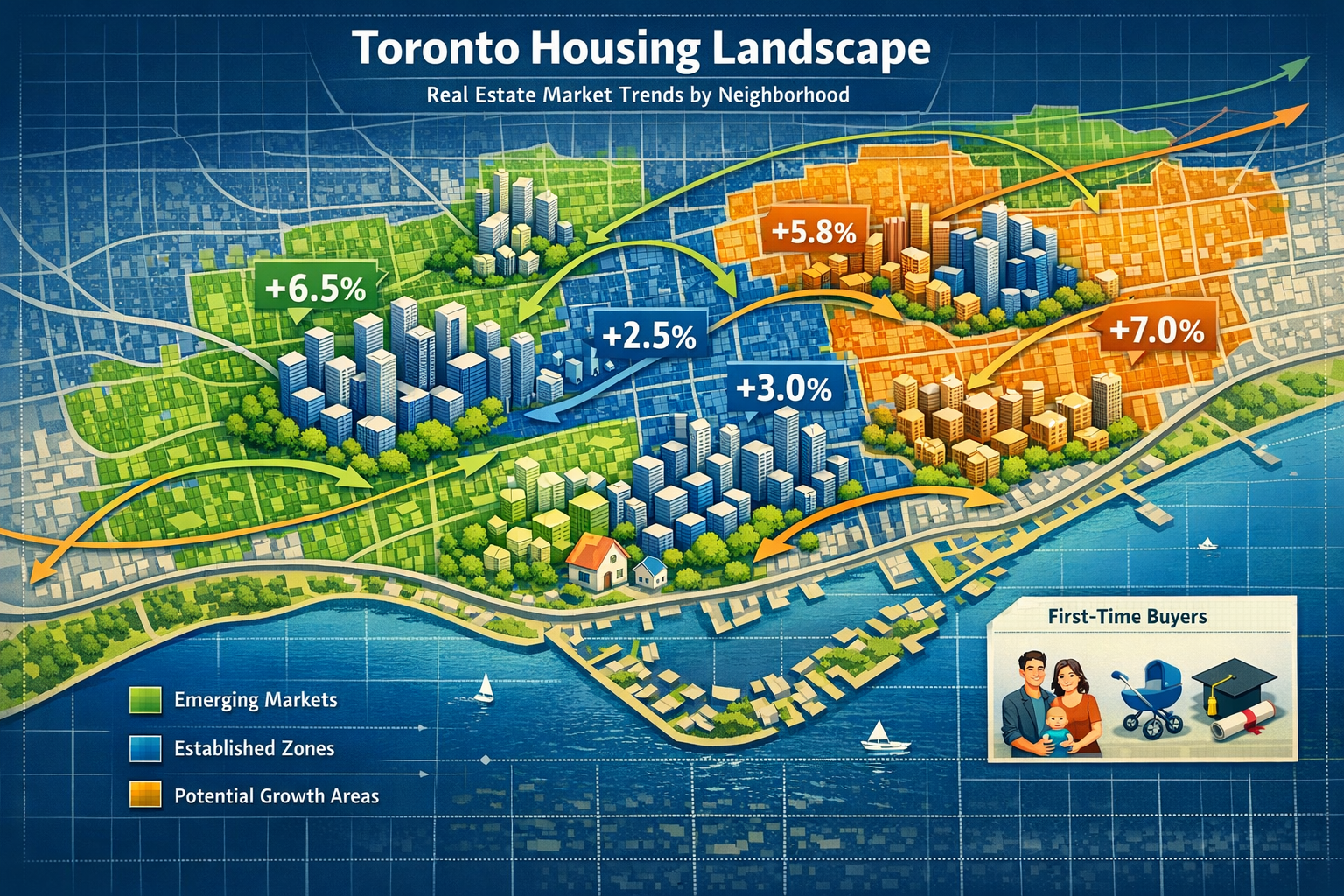
Neighborhood Selection Strategy
Location dramatically impacts both immediate affordability and long-term appreciation. Smart first-time buyers in 2026 should consider:
🎯 Emerging Neighborhoods with Transit Access:
Areas like Liberty Village, Leslieville, and Junction Triangle offer:
- Condo prices 15-25% below downtown core
- Strong rental demand from young professionals
- Ongoing neighborhood improvement and amenity development
- Future appreciation potential as areas mature
🎯 Established Neighborhoods with Recent Price Softening:
Areas like North York Centre, Scarborough Town Centre, and Etobicoke Centre provide:
- Excellent transit connectivity (subway access)
- Mature amenities and services
- Recent price corrections creating entry opportunities
- Strong immigrant demand supporting long-term values
⚠️ Avoid Oversupplied Micro-Markets:
Certain pockets have experienced extreme condo development, creating supply gluts:
- CityPlace/Fort York area (oversupply of investor units)
- Vaughan Metropolitan Centre (speculative development outpacing demand)
- Markham downtown (high vacancy rates in new buildings)
These areas may take 5-10 years to absorb current supply, limiting near-term appreciation potential.
Financing Strategies for Optimal Outcomes
The mortgage structure chosen significantly impacts long-term financial outcomes. First-time buyers should consider:
Fixed vs. Variable Rate Decision:
With 5-year fixed rates at 4.5% in early 2026[1], the fixed-versus-variable decision carries less risk than in previous years:
📊 Choose fixed-rate if:
- Planning to stay in the property 5+ years
- Monthly budget has limited flexibility for payment increases
- Risk tolerance is low
- Expecting interest rates to remain stable or increase
📊 Choose variable-rate if:
- Comfortable with payment fluctuations
- Believe rates will decrease further in 2026-2027
- Can afford 1-2% payment increases if rates rise
- Planning shorter ownership timeline (3-5 years)
Amortization Length Strategy:
While 25-year amortization is standard, buyers with financial flexibility should consider:
✅ 25-year amortization: Balances monthly affordability with reasonable payoff timeline
✅ 20-year amortization: Reduces total interest paid by $40,000-$60,000 on a $560,000 mortgage, builds equity faster
✅ 30-year amortization: Available for some first-time buyers, reduces monthly payments by $200-$300 but increases total interest significantly
Accelerated Payment Options:
Most lenders allow accelerated bi-weekly payments (26 payments annually instead of 24 monthly payments). This simple change:
- Reduces 25-year amortization to approximately 22 years
- Saves $25,000-$35,000 in total interest
- Builds equity 15-20% faster
- Costs only $50-$75 more monthly
Understanding closing costs is essential for budgeting. First-time buyers should review comprehensive closing cost information for Toronto homebuyers to avoid surprises.
Income Requirements and Qualification
Mortgage qualification in 2026 requires meeting both ratio tests and stress test requirements:
Gross Debt Service Ratio (GDS):
- Maximum 32-35% of gross income toward housing costs
- For $4,000 monthly housing costs, requires minimum $137,000 household income
Total Debt Service Ratio (TDS):
- Maximum 42-44% of gross income toward all debt obligations
- Car loans, student loans, and credit card minimums reduce available housing budget
Stress Test Requirement:
- Must qualify at higher of contract rate + 2% or 5.25%
- For 4.5% mortgage, must qualify at 6.5%
- Effectively requires 20-25% more income than actual payment suggests
Minimum Income by Property Price:
| Purchase Price | Down Payment | Monthly Payment | Minimum Income Required |
|---|---|---|---|
| $500,000 | $100,000 | $3,200 | $100,000 |
| $600,000 | $120,000 | $3,700 | $115,000 |
| $700,000 | $140,000 | $4,200 | $130,000 |
| $800,000 | $160,000 | $4,700 | $145,000 |
These calculations assume minimal other debt obligations. Buyers with car payments, student loans, or credit card debt require higher incomes to qualify.
When Renting Still Makes Sense: Honest Assessment
Scenarios Where Renting Beats Buying
Despite the compelling Rent vs Buy Analysis for Toronto First-Time Buyers: Why 2026 Ownership Beats High Rents, certain situations favor continued renting:
❌ Short-Term Toronto Residence (Under 5 Years)
Buyers planning to relocate within 5 years face significant financial risk:
- Transaction costs consume most appreciation gains
- Break-even timeline extends to 5-6 years minimum
- Job transfers, relationship changes, or career pivots become financially costly
- Better to rent and invest down payment capital in liquid assets
❌ Unstable Employment or Income
Homeownership requires consistent income to service mortgage obligations:
- Contract workers without guaranteed renewals
- Commission-based sales professionals with volatile income
- Recent graduates in probationary employment periods
- Entrepreneurs with unpredictable business income
For self-employed professionals, specialized mortgage products exist. Learn more about mortgages for self-employed borrowers to understand qualification pathways.
❌ Insufficient Down Payment or Emergency Fund
Stretching to buy without adequate reserves creates dangerous vulnerability:
- Minimum 10-15% down payment required for reasonable mortgage insurance costs
- Additional 6-12 months expenses in emergency fund essential
- Unexpected repairs, job loss, or market downturns can force distressed sales
- Better to rent while building financial cushion
❌ High Existing Debt Loads
Buyers carrying significant consumer debt should prioritize debt elimination:
- Credit card balances above $10,000
- Car loans with payments exceeding $500 monthly
- Student loans requiring $800+ monthly payments
- These obligations prevent mortgage qualification or create unsustainable total debt loads
❌ Desire for Maximum Lifestyle Flexibility
Some life stages prioritize flexibility over wealth building:
- Young professionals exploring career paths
- Individuals considering international opportunities
- Those uncertain about long-term relationship status
- People valuing travel and experiences over asset accumulation
The Opportunity Cost of Waiting
While certain situations favor renting, indefinitely postponing homeownership carries significant opportunity costs:
📉 Appreciation Missed:
Every year of waiting means missing potential appreciation. On a $700,000 property appreciating at 3% annually:
- Year 1 delay: $21,000 appreciation missed
- Year 3 delay: $64,909 cumulative appreciation missed
- Year 5 delay: $111,492 cumulative appreciation missed
📉 Equity Building Missed:
Principal repayment creates forced savings that renters must replicate through disciplined investing:
- Year 1 delay: $16,800 equity building missed
- Year 3 delay: $52,300 cumulative equity missed
- Year 5 delay: $90,900 cumulative equity missed
📉 Rising Future Prices:
Waiting for prices to fall further can backfire if:
- Interest rates remain stable or decrease, stimulating demand
- Immigration continues driving population growth in Toronto
- Supply constraints prevent significant new construction
- Inflation pushes replacement costs higher
The “perfect” market timing rarely exists. Buyers who waited for crashes in 2015, 2017, and 2019 missed substantial appreciation while rents increased, making future purchases even more difficult.
Taking Action: Your Path from Renter to Owner in 2026
90-Day Action Plan for Serious First-Time Buyers
For Toronto renters ready to transition to ownership, this structured approach maximizes success probability:
Month 1: Financial Assessment and Preparation
✅ Review credit reports from both Equifax and TransUnion
✅ Calculate realistic budget including all ownership costs
✅ Assess down payment and closing cost savings
✅ Identify debt reduction priorities
✅ Research mortgage pre-qualification requirements
✅ Consult mortgage broker for preliminary assessment
✅ Review government programs (First-Time Home Buyer Incentive, Home Buyers’ Plan)
Month 2: Market Research and Team Building
✅ Define target neighborhoods based on budget and lifestyle
✅ Research recent sales in target areas
✅ Interview real estate agents specializing in first-time buyers
✅ Attend open houses to calibrate expectations
✅ Obtain formal mortgage pre-approval
✅ Identify real estate lawyer for eventual closing
✅ Calculate true affordability including all carrying costs
Month 3: Active House Hunting and Offer Preparation
✅ Intensify property search in target areas
✅ Schedule property viewings for serious candidates
✅ Conduct comparative market analysis for properties of interest
✅ Arrange professional inspections for offer-worthy properties
✅ Prepare offer strategy with real estate agent
✅ Submit offers on suitable properties
✅ Negotiate terms and finalize purchase agreement
Essential Resources and Professional Support
Successfully navigating the Rent vs Buy Analysis for Toronto First-Time Buyers: Why 2026 Ownership Beats High Rents requires assembling the right professional team:
🏆 Mortgage Broker
Independent mortgage brokers access 30+ lenders, finding optimal rates and terms that individual buyers cannot access directly. Benefits include:
- Rate comparison across all major lenders
- Specialized products for unique situations
- Negotiating leverage for better terms
- No cost to buyers (lenders pay broker fees)
- Ongoing support through closing process
🏆 Real Estate Agent
Experienced buyer’s agents provide:
- Neighborhood expertise and market knowledge
- Access to pre-market listings
- Negotiation skills to secure better prices
- Coordination of inspections and due diligence
- Protection from common first-time buyer mistakes
🏆 Real Estate Lawyer
Essential for:
- Title searches and insurance
- Purchase agreement review
- Closing document preparation
- Fund disbursement and registration
- Protection against legal issues
🏆 Home Inspector
Professional inspections identify:
- Structural defects and safety issues
- Required repairs and maintenance
- Building envelope problems
- Mechanical and electrical concerns
- Estimated repair costs for negotiation
Government Programs and Incentives for 2026
First-time buyers in Toronto can access several programs reducing entry barriers:
🇨🇦 First-Time Home Buyer Incentive
Shared equity mortgage with Government of Canada:
- 5-10% of purchase price provided as shared equity
- No monthly payments required
- Repayment required upon sale or after 25 years
- Reduces monthly mortgage payments by $200-$300
- Eligibility requires household income under $120,000
🇨🇦 Home Buyers’ Plan (HBP)
Withdraw from RRSP for down payment:
- Maximum $35,000 per person ($70,000 per couple)
- Tax-free withdrawal if repaid over 15 years
- Repayment begins second year after withdrawal
- Excellent for buyers with RRSP savings
- No tax penalty if repayment schedule maintained
🇨🇦 First-Time Home Buyer Land Transfer Tax Rebate
Ontario provides:
- Maximum $4,000 rebate on provincial land transfer tax
- Available only to first-time buyers
- Reduces upfront closing costs significantly
- Automatically applied at closing
🇨🇦 GST/HST New Housing Rebate
For new construction purchases:
- Partial rebate of GST/HST paid
- Maximum rebate approximately $30,000
- Reduces effective purchase price
- Builder often applies rebate directly to purchase price
These programs collectively reduce entry barriers by $30,000-$50,000, making ownership accessible to buyers who might otherwise remain renters.
Conclusion: Making Your Decision with Confidence
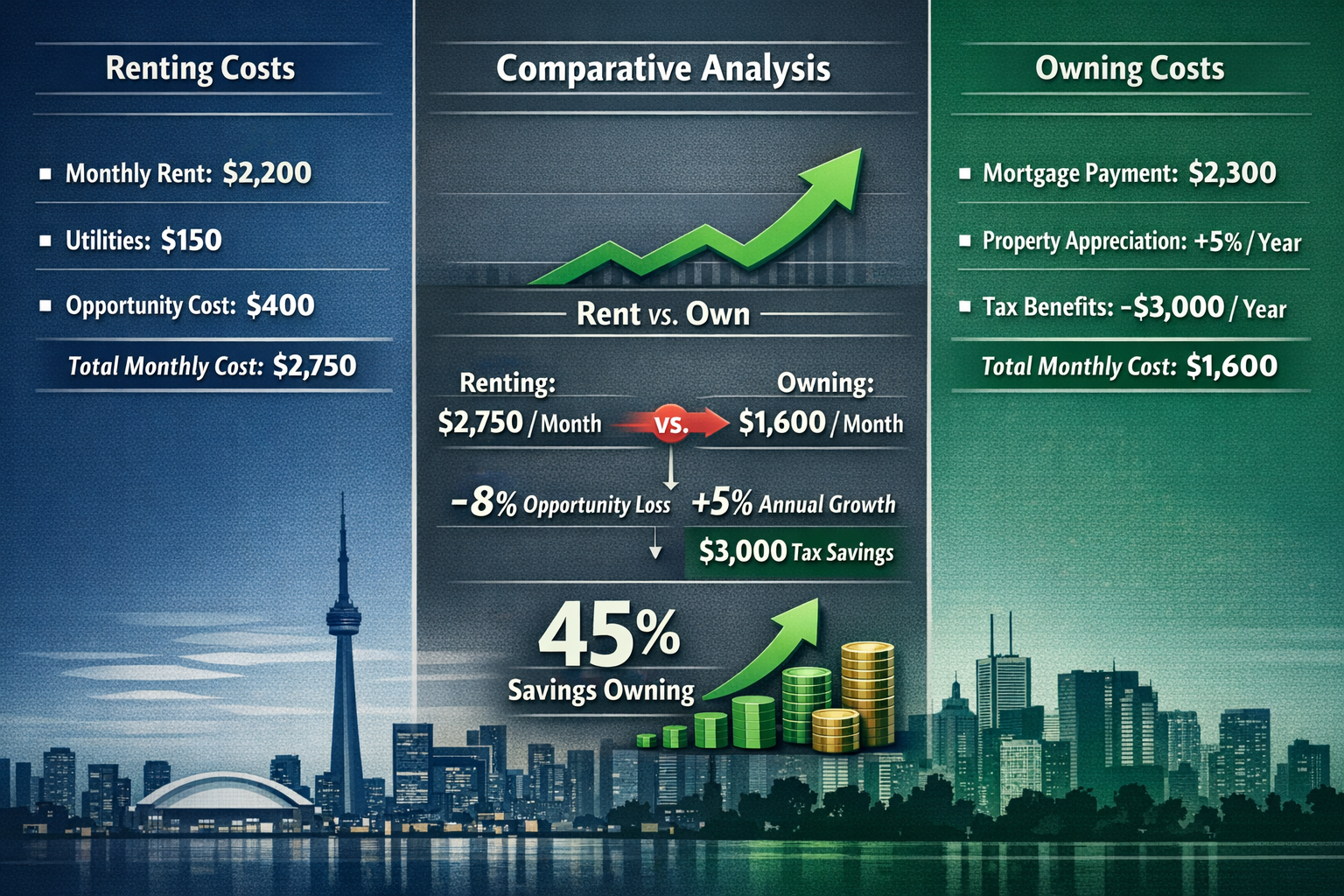
The Rent vs Buy Analysis for Toronto First-Time Buyers: Why 2026 Ownership Beats High Rents reveals a nuanced picture that defies simple answers. While monthly ownership costs remain $1,000-$1,500 higher than renting comparable units, the five-year break-even timeline and subsequent wealth accumulation strongly favor buyers who can commit to medium-term ownership.
Key decision factors include:
✅ Timeline commitment: Buyers planning 5+ years in Toronto benefit substantially from ownership
✅ Financial readiness: Down payment of $100,000-$150,000 plus emergency reserves required
✅ Income stability: Consistent household income of $100,000-$130,000 enables comfortable qualification
✅ Lifestyle priorities: Those valuing stability and wealth building over maximum flexibility benefit from buying
✅ Market timing: 2026 presents favorable conditions with softened prices and stabilized rates
The current market environment—with rental rates at 44-month lows, mortgage rates stabilized at 4.5%, and condo prices moderating—creates a window of opportunity that may not persist. First-time buyers who have prepared financially and can commit to medium-term ownership should seriously consider transitioning from renting to owning.
However, this decision remains deeply personal. Buyers facing employment uncertainty, planning near-term relocations, or lacking adequate financial reserves should continue renting while building stability. The opportunity cost of waiting must be balanced against the risk of premature purchase.
Your Next Steps
If you’re ready to explore homeownership:
1️⃣ Schedule a consultation with an experienced mortgage broker to assess qualification and financing options
2️⃣ Review your credit report and address any issues that might impact mortgage approval
3️⃣ Calculate your true affordability including all ownership costs, not just mortgage payments
4️⃣ Research target neighborhoods balancing price, lifestyle, and appreciation potential
5️⃣ Build your professional team including real estate agent, lawyer, and inspector
6️⃣ Create a realistic timeline for transitioning from renter to owner
7️⃣ Take action rather than waiting for perfect market conditions that may never materialize
If you’re continuing to rent:
1️⃣ Develop a concrete savings plan to build down payment and emergency reserves
2️⃣ Invest the difference between rental and ownership costs in diversified portfolios
3️⃣ Monitor the market for shifts in pricing, rates, or supply conditions
4️⃣ Address qualification barriers such as credit issues, debt loads, or income instability
5️⃣ Set specific milestones for when you’ll revisit the rent-versus-buy decision
6️⃣ Maximize current rental value through negotiation and strategic neighborhood selection
The Toronto housing market in 2026 offers genuine opportunities for prepared first-time buyers willing to commit to ownership. While the decision carries complexity and risk, the long-term wealth-building potential and stability benefits make homeownership a powerful financial and lifestyle choice for those ready to take the leap.
The question isn’t whether ownership beats renting in absolute terms—it’s whether ownership beats renting for your specific situation in 2026. Armed with comprehensive analysis, professional guidance, and honest self-assessment, Toronto first-time buyers can make this decision with confidence and clarity.
References
[1] Rent Vs Buy Toronto Calculator Analysis – https://houseindex.ca/blog/rent-vs-buy-toronto-calculator-analysis
[2] Should You Buy Or Rent In Toronto In 2025 The Real Costs Explained – https://www.vanessacopeland.com/blog/should-you-buy-or-rent-in-toronto-in-2025-the-real-costs-explained
[3] Watch – https://www.youtube.com/watch?v=m38iZRUfvu0
[4] Why 2026 Could Be A Year To Rent Not Buy – https://www.moneysense.ca/spend/real-estate/why-2026-could-be-a-year-to-rent-not-buy/
[5] Rent Vs Buy Calculator Decision Guide 2026 – https://bestrates.ca/rent-vs-buy-calculator-decision-guide-2026
[6] Watch – https://www.youtube.com/watch?v=6Gk2Qk0kvhg
[7] Canada Rental Market Rents Decrease January 2026 – https://globalnews.ca/news/11659448/canada-rental-market-rents-decrease-january-2026/
[8] Housing Market Outlook – https://www.cmhc-schl.gc.ca/professionals/housing-markets-data-and-research/market-reports/housing-market/housing-market-outlook
 Previous Page