March 8, 2026
Why Toronto Homeowners Are Ditching Banks for Private Mortgages in 2026: Real Stories and Stats
Share this article:



Manzeel is an award-winning Mortgage Broker and the Owner of the Toronto-based mortgage, Everything Mortgages.
With 16 years of experience in the Canadian mortgage industry and a formal background in mortgage underwriting, Manzeel’s lending expertise gives him unique insight into whether a deal is feasible which empowers his clients to make more informed lending decisions faster.
He has been recognized as one of Canada’s Top 10 Mortgage Brokers by the national Canadian Mortgage Professionals (CMP) Association. Him and his team of 18 mortgage agents are proud to offer a mortgage experience that's built on honesty, trust, and integrity. He prides himself on the brokerage’s dedication to deliver an excellent client experience throughout the entire home loan process from pre-approval to post-funding.
Since moving to Toronto in 1998, Manzeel has successfully launched and scaled several businesses from the ground up, ranging from a mortgage brokerage and a vast real estate investment portfolio to a private financing eCommerce platform. He continues to be a leader in the real estate industry as he uses his analytical expertise to seek new real estate investment opportunities.
As a tech junkie and avid sports enthusiast, when Manzeel’s not working with clients, you can find him reading technology blogs, playing squash or watching tennis with his two boys.
Banks are saying “no” more often — and Toronto homeowners are finding other doors to knock on. 🏠
Frozen HELOCs. Failed stress tests. Renewal shock. In 2026, a growing number of GTA residents are discovering that the traditional banking system no longer fits their financial reality. The trend of why Toronto homeowners are ditching banks for private mortgages in 2026 is not just a headline — it is backed by hard data, real borrower stories, and a shifting mortgage landscape that is reshaping how Canadians access their home equity.
This article breaks down the key forces driving this shift, what private mortgages actually cost, and what homeowners should know before making the move.
Key Takeaways 📌
- Bank inflexibility — including HELOC freezes, low appraisals, and rigid income requirements — is pushing GTA homeowners toward private lenders
- Private mortgages now represent 15.8% of Ontario’s mortgage market by count, driven by renewal stress and tightened bank rules [1]
- Approval speed (24–48 hours vs. weeks) and equity-based lending are the top reasons borrowers choose private over bank
- Private mortgage rates run 8.99–13.99%, higher than bank rates, but offer flexibility that banks simply cannot match [2]
- The 2026 renewal wave is creating urgency — 60% of renewing borrowers face higher payments, with Ontario absorbing 38% of national renewals [10]
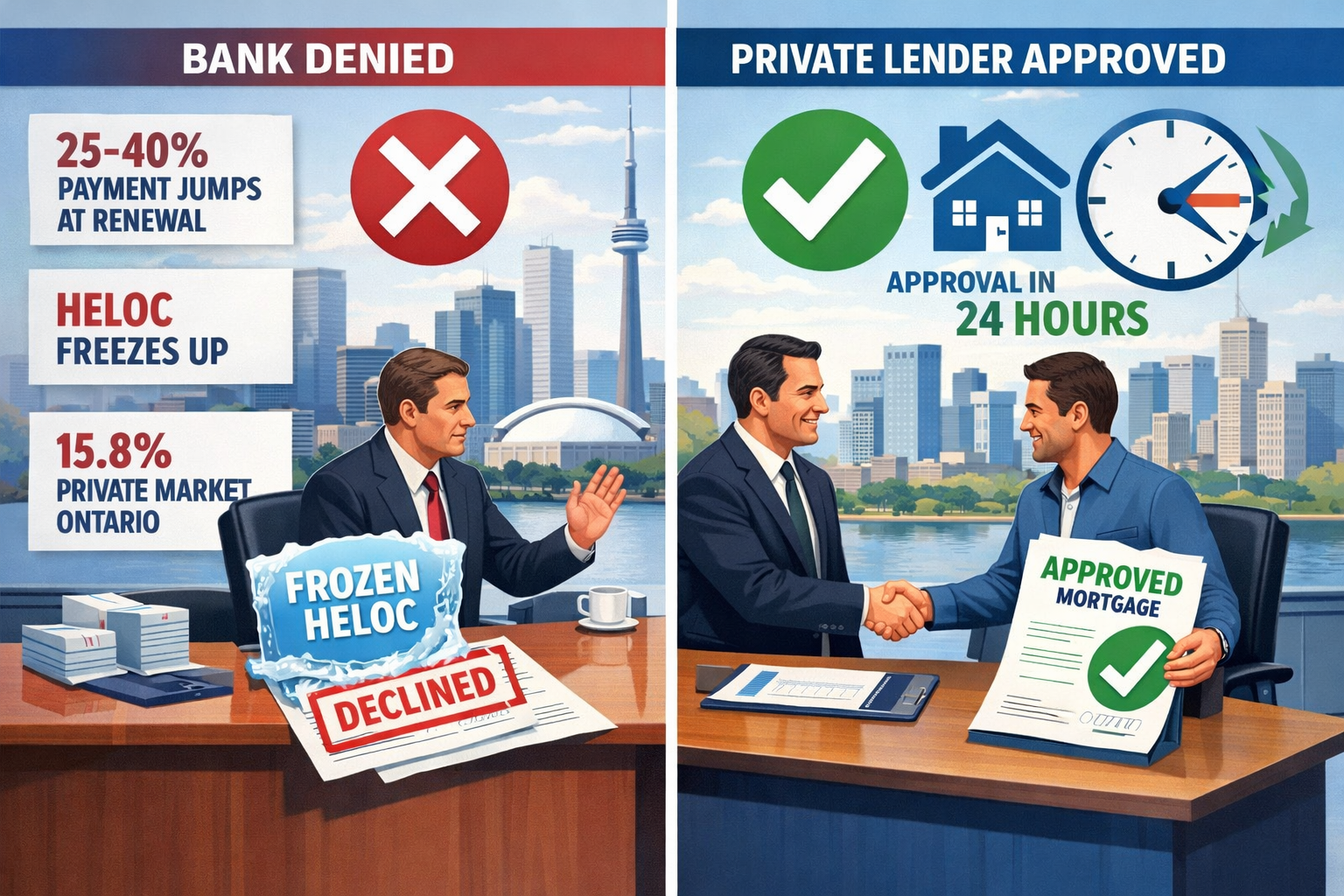
The Breaking Point: Why Banks Are Losing GTA Borrowers in 2026
The story of why Toronto homeowners are ditching banks for private mortgages in 2026 starts with a simple word: inflexibility.
🔒 HELOC Freezes Are Leaving Homeowners Stranded
Home equity lines of credit (HELOCs) were once a reliable safety net for Toronto homeowners. In 2026, many are finding those lines quietly reduced or frozen — even when their property values have held steady. Banks are tightening risk exposure amid economic uncertainty, leaving asset-rich but cash-constrained homeowners with no access to their own equity.
For homeowners planning renovations or debt consolidation, this is a serious problem. Private second mortgages, starting at approximately 11.99%, are filling that gap [1].
📉 The Renewal Wave Is Hitting Hard
The Bank of Canada held its policy rate at 2.25% on both January 28 and March 6, 2026, keeping the prime rate at 4.45% [4]. While rates have softened from their 2023 peaks, a massive renewal wave is still creating payment shock. Bank of Canada staff notes flag 60% of renewing borrowers will see payment increases in 2026, with Ontario absorbing 38% of 438,000 national renewals [10].
For many Toronto homeowners, renewal means facing a 25–40% jump in monthly payments — a figure that is pushing many to explore every alternative available [1]. Understanding how Bank of Canada policy decisions affect your mortgage is more important than ever.
📋 Stricter Rules Are Blocking Legitimate Borrowers
New OSFI Capital Adequacy Requirements (CAR 2026), effective January 1, 2026, now prohibit double-counting rental income for multiple properties. This has reduced investor borrowing power by up to 23% in some cases [5]. Combined with the mortgage stress test — which requires qualifying at rates well above the contract rate — many self-employed borrowers, investors, and those with non-traditional income are simply being turned away.
For self-employed Torontonians, qualifying for a mortgage without T4 slips has become a key challenge that private lenders are uniquely positioned to solve.

Real Stories Behind the Statistics 📖
The numbers tell part of the story. The real picture comes from the types of borrowers turning to private lenders across the GTA.
Story Type 1: The Self-Employed Business Owner
A freelance consultant in North York earns strong income but writes off significant business expenses. On paper, her declared income falls short of bank requirements. She owns a semi-detached home worth $1.1 million with $400,000 in equity. A bank declines her refinance application. A private lender approves her within 48 hours — based on the property’s value, not her tax return [6].
This is not unusual. Empowering self-employed entrepreneurs toward homeownership requires lenders who look beyond traditional income documents.
Story Type 2: The Investor Facing Renewal Shock
A Scarborough landlord owns three properties. Under new OSFI rules, his rental income can no longer be counted across all properties the same way. His bank declines to renew at the same terms. With TRREB forecasting a surge of 100,000 sidelined buyers re-entering the GTA market in late 2026 [3], he needs a bridge solution fast. A private mortgage buys him time to restructure and refinance properly.
Story Type 3: The Homeowner Consolidating Debt
A couple in Etobicoke wants to consolidate $80,000 in high-interest debt using their home equity. Their HELOC was frozen. Their bank appraisal came in lower than expected. A private second mortgage, secured against their home equity, solves the problem — albeit at a higher rate. Understanding how to use home equity effectively is critical in this type of scenario.
Banks vs. Private Lenders: A Side-by-Side Comparison
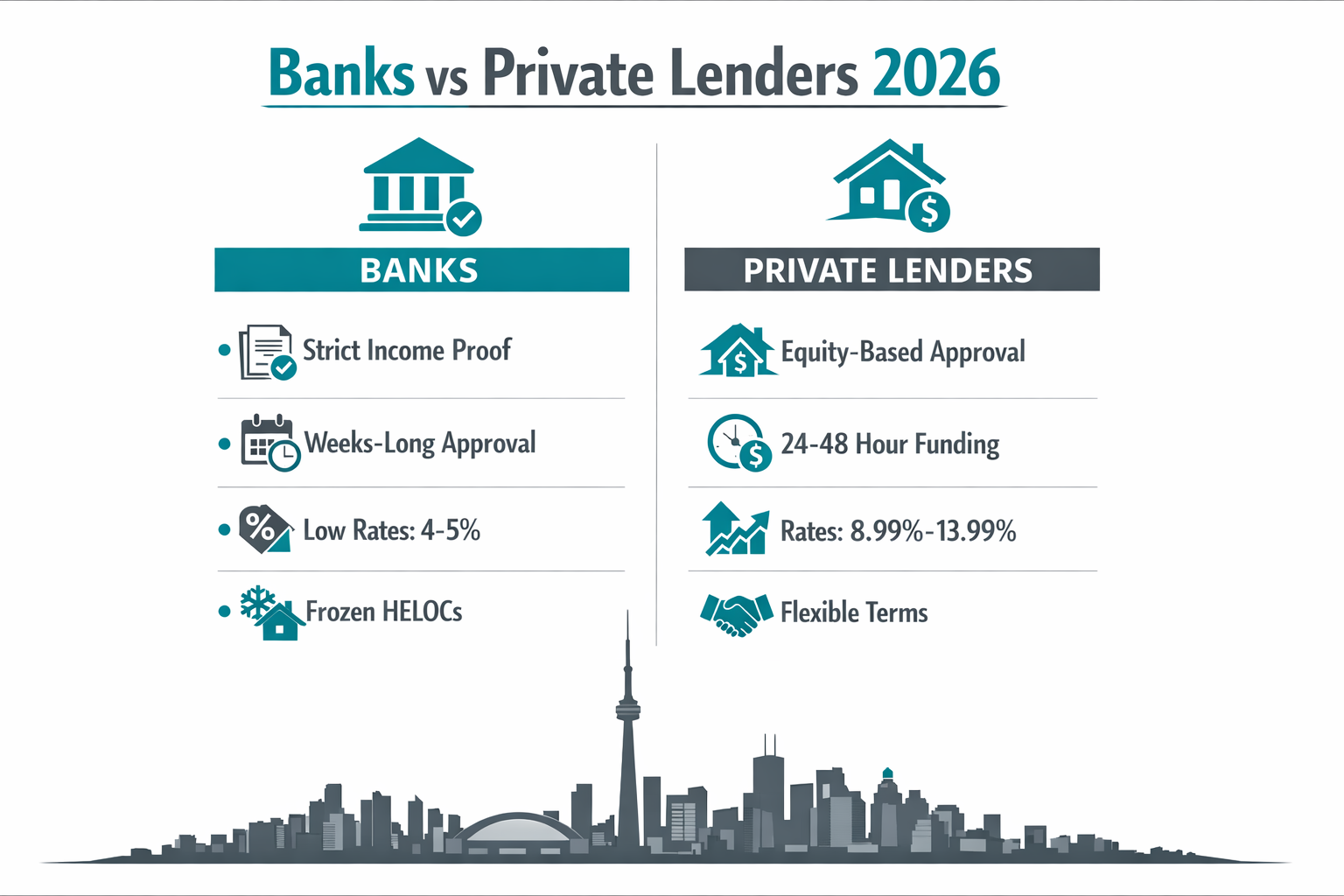
Here is how the two options stack up for Toronto borrowers in 2026:
| Feature | Banks / A-Lenders | Private Lenders |
|---|---|---|
| Interest Rate | ~4–5% | 8.99–13.99% [2] |
| Approval Time | 2–4 weeks | 24–48 hours [2] |
| Income Requirement | Strict (T4, NOA) | Flexible / equity-based |
| Credit Score | 680+ typically | More flexible |
| Stress Test | Required | Not always required |
| HELOC Access | Being frozen/reduced | Private 2nd available |
| Ideal For | Stable T4 employees | Self-employed, investors, renewal bridge |
💬 “Private mortgages are not a last resort — they are a workable option for borrowers whose assets outpace what banks are willing to acknowledge.” — Lendworth Capital, 2026 [1]
The trade-off is clear: lower rates with banks, but faster and more flexible with private lenders. For many GTA homeowners in 2026, speed and flexibility are worth the premium.
To understand the full picture of lender options, reviewing banks vs. alternative private lenders is a smart starting point.
The Stats That Explain the Shift 📊
The data behind why Toronto homeowners are ditching banks for private mortgages in 2026 paints a compelling picture:
- 🏦 $1.95 trillion — Canadian mortgage debt as of early 2026, up 2.6% year-over-year, with Ontario renewals amplifying demand for equity-based lending
- 📈 15.8% — Private mortgages’ share of Ontario’s mortgage market by count (FSRA, latest available data) [1]
- ⚠️ 25–40% — Payment increase faced by many GTA homeowners at renewal [1]
- 🏘️ 100,000 — Buyers estimated to be waiting on the GTA sidelines, many needing bridge financing [3]
- 📉 0.7% — CMHC’s projected Canadian economic growth for 2026, with trade tensions and unemployment weighing on housing
- 🔁 438,000 — National mortgage renewals in 2026, with Ontario absorbing 38% [10]
These figures explain why Canada’s 2026 mortgage rate forecasts are creating so much anxiety — and why private lenders are seeing record demand.
What to Watch Out For ⚠️
Private mortgages are a powerful tool, but they come with real costs and risks:
- Higher rates (8.99–13.99%) mean significantly higher monthly payments [2]
- Shorter terms (typically 1–2 years) require a clear exit strategy — usually refinancing back to a conventional lender
- Lender fees and broker fees add to the total cost of borrowing
- Not all private lenders are equal — working with a licensed mortgage broker helps ensure fair terms
Before committing, homeowners should also understand the importance of home appraisals in the mortgage process, since private lending decisions hinge heavily on property value.
Conclusion: Is a Private Mortgage Right for You? 🏡
The shift away from banks is not about distrust — it is about fit. In 2026, Toronto’s housing market is complex, renewal pressure is real, and bank rules are tighter than ever. For homeowners who are asset-rich but face income documentation challenges, credit bruising, or urgent timelines, private mortgages offer a practical bridge.
Actionable next steps:
- ✅ Assess your equity — Private lenders lend based on property value. Know your current home value and outstanding mortgage balance.
- ✅ Define your exit strategy — Private mortgages are short-term tools. Plan how you will refinance within 12–24 months.
- ✅ Work with a licensed mortgage broker — A broker can compare private lenders, negotiate rates, and ensure you avoid predatory terms.
- ✅ Review your renewal options early — Do not wait until renewal to explore alternatives. Start 6 months ahead.
- ✅ Understand total cost of borrowing — Factor in lender fees, broker fees, and legal costs alongside the interest rate.
The private mortgage market is not a sign of a broken system — it is a sign of a diversifying one. Toronto homeowners who understand their options are better positioned to protect their equity, bridge financial gaps, and move forward with confidence in 2026.
References
[1] Ontario Homeowners Are Using Private Mortgages To Survive 2026 Heres Why Banks Arent The First Call Anymore – https://www.lendworth.ca/blog/lendworth-blog-1/ontario-homeowners-are-using-private-mortgages-to-survive-2026-heres-why-banks-arent-the-first-call-anymore-717
[2] Toronto Private Mortgage Rates 2026 What Homeowners Really Pay And How To Get Approved Fast – https://www.lendworth.ca/blog/lendworth-blog-1/toronto-private-mortgage-rates-2026-what-homeowners-really-pay-and-how-to-get-approved-fast-486
[3] GTA Home Sales Expected To Surge In The Second Half Of 2026 What Toronto Buyers And Investors Need To Know – https://www.lendworth.ca/blog/lendworth-blog-1/gta-home-sales-expected-to-surge-in-the-second-half-of-2026-what-toronto-buyers-and-investors-need-to-know-799
[4] Bank Of Canada Interest Rate Schedule – https://www.nesto.ca/mortgage-basics/bank-of-canada-interest-rate-schedule/
[5] New Mortgage Rules – https://www.aaronsantos.net/blog/newmortgagerules
[6] The Bank Said No Why GTA Homeowners Are Turning To Private Mortgages In 2026 – https://www.lendworth.ca/blog/lendworth-blog-1/the-bank-said-no-why-gta-homeowners-are-turning-to-private-mortgages-in-2026-482
[7] Private Mortgage Lenders Vs Banks – https://certifiedmortgagebroker.com/private-mortgage-lender-toronto/private-mortgage-lenders-vs-banks/
[10] Staff Analytical Note 2025-21 – https://www.bankofcanada.ca/2025/07/staff-analytical-note-2025-21/
 Previous Page