March 9, 2026
Private Mortgages for First-Time Buyers in Toronto: Navigating 2026 Affordability Challenges
Share this article:



Manzeel is an award-winning Mortgage Broker and the Owner of the Toronto-based mortgage, Everything Mortgages.
With 16 years of experience in the Canadian mortgage industry and a formal background in mortgage underwriting, Manzeel’s lending expertise gives him unique insight into whether a deal is feasible which empowers his clients to make more informed lending decisions faster.
He has been recognized as one of Canada’s Top 10 Mortgage Brokers by the national Canadian Mortgage Professionals (CMP) Association. Him and his team of 18 mortgage agents are proud to offer a mortgage experience that's built on honesty, trust, and integrity. He prides himself on the brokerage’s dedication to deliver an excellent client experience throughout the entire home loan process from pre-approval to post-funding.
Since moving to Toronto in 1998, Manzeel has successfully launched and scaled several businesses from the ground up, ranging from a mortgage brokerage and a vast real estate investment portfolio to a private financing eCommerce platform. He continues to be a leader in the real estate industry as he uses his analytical expertise to seek new real estate investment opportunities.
As a tech junkie and avid sports enthusiast, when Manzeel’s not working with clients, you can find him reading technology blogs, playing squash or watching tennis with his two boys.
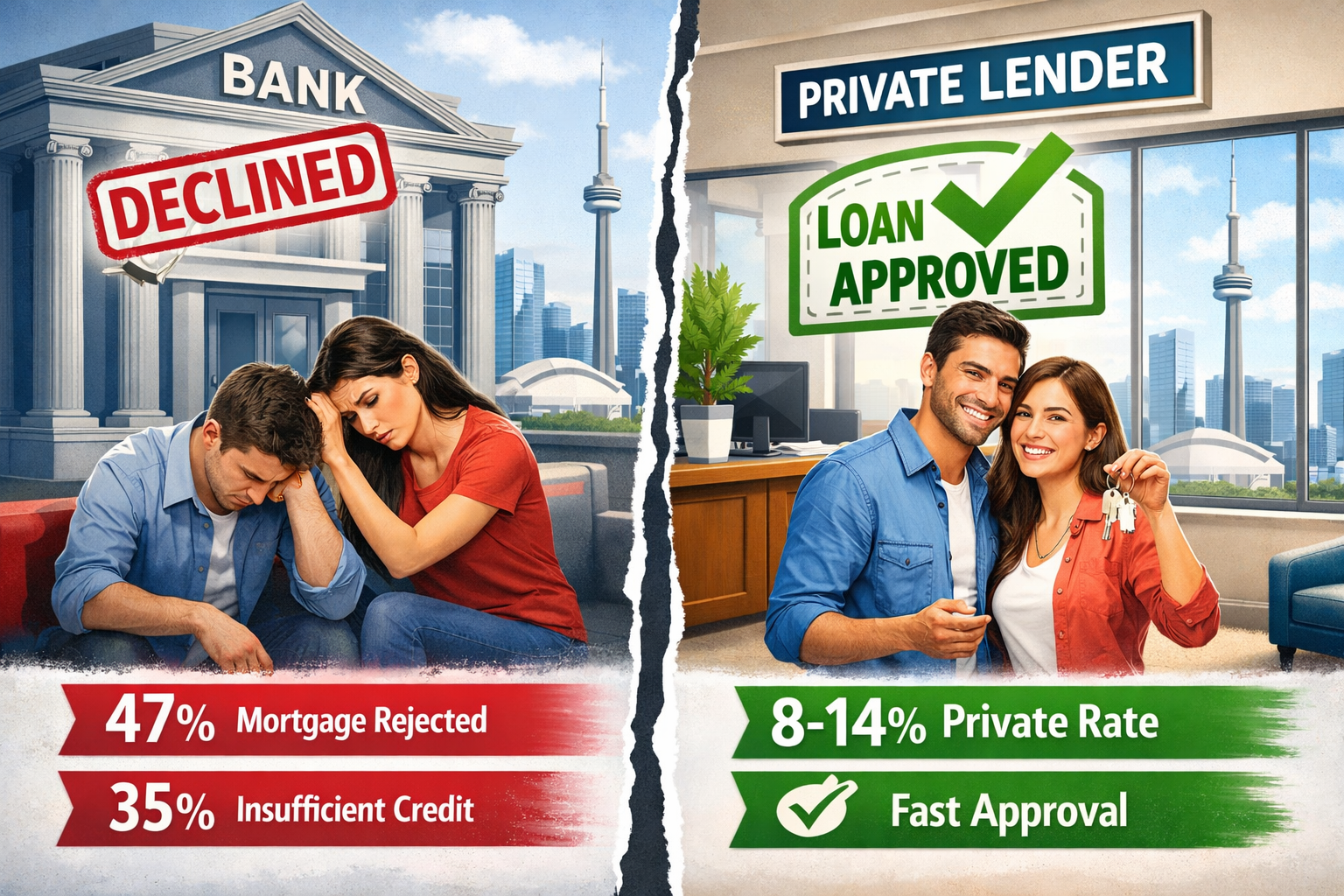
With Toronto’s benchmark home price falling 7.9% year-over-year to $938,800 in February 2026 and inventory climbing to five months of supply, a genuine window of opportunity has opened for first-time buyers [2]. Yet strict bank qualification rules still block many Canadians from crossing the ownership threshold. That’s exactly where private mortgages for first-time buyers in Toronto: navigating 2026 affordability challenges becomes a game-changing strategy — offering a fast, flexible path into the market when traditional lenders say no.
Key Takeaways 🏡
- Private mortgages offer 24–48 hour approvals and flexible qualification, ideal for buyers banks turn away.
- Toronto’s buyer’s market in 2026 means more negotiating power and lower entry prices for first-timers.
- Private mortgage rates typically run 8–14%, making them a short-term bridge — not a permanent solution.
- Government incentives (30-year amortizations, $1.5M insured cap, FHSA) can reduce or eliminate the need for private financing.
- A clear exit strategy — refinancing to a B-lender or bank within 12–24 months — is essential before signing any private mortgage.
Why 2026 Is a Turning Point for Toronto First-Time Buyers
Toronto’s housing market has undergone a meaningful reset. TRREB data from February 2026 confirms five months of supply — firmly in buyer’s market territory — giving first-timers real negotiating leverage they haven’t had in years [6]. Condo oversupply and declining prices have created an accessible entry point, particularly in the under-$750K segment [4].
At the same time, federal rule changes that took effect in December 2024 are reshaping who can qualify for insured mortgages:
| Policy Change | Impact on First-Time Buyers |
|---|---|
| Insured mortgage cap raised to $1.5M | More homes qualify for insured financing |
| 30-year amortizations allowed | Monthly payments drop ~9–10% |
| FHSA + RRSP Home Buyers’ Plan | Up to $100K in tax-advantaged down payment savings |
💬 “The combination of lower prices, more supply, and expanded federal rules makes 2026 a genuinely different entry point for Toronto first-timers.” — [getwhatyouwant.ca][1]
These shifts are also pressuring private lenders to compete harder on affordability. Still, for buyers with non-standard income, bruised credit, or self-employment income, banks remain a tough sell [3]. That’s where the private lending landscape becomes critical.
To understand how recent policy shifts affect your buying timeline, the guide on why 2026 is the perfect time for first-time buyers to enter Toronto’s cooling housing market provides helpful context.
Understanding Private Mortgages for First-Time Buyers in Toronto: Navigating 2026 Affordability Challenges

What Is a Private Mortgage?
A private mortgage is a loan funded by an individual investor or a private lending company — not a bank, credit union, or regulated financial institution. Approval is based primarily on the property’s equity value, not the borrower’s income or credit score.
For a detailed breakdown of how this works in practice, the full guide to getting a mortgage with a private lender covers every step of the process.
Who Uses Private Mortgages in 2026?
Private mortgages are commonly used by first-time buyers who:
- ✅ Are self-employed with limited provable income
- ✅ Have recent credit issues (bankruptcy, consumer proposal)
- ✅ Hold non-traditional income (gig work, contract roles)
- ✅ Need fast approval to compete on a deal
- ✅ Are bridging a gap while rebuilding credit for bank qualification
OSFI’s Capital Adequacy Requirements (CAR 2026), which took effect in Q1 2026, tightened bank lending further by restricting debt ratio calculations and eliminating rental income double-counting [3]. This has pushed more first-time buyer files toward private lenders — particularly those with investment property aspirations or complex financial profiles.
The True Cost of Going Private
Private mortgage rates in Toronto currently range from 8–14% annually, depending on the property’s loan-to-value (LTV) ratio. Here’s how that stacks up against other lending tiers:
| Lender Type | Typical 2026 Rate | Approval Speed | Flexibility |
|---|---|---|---|
| A-Lender (Big Bank) | 4.5–5.5% | 2–4 weeks | Low |
| B-Lender (Trust Co.) | 5–6.5% | 1–2 weeks | Moderate |
| Private Lender | 8–14% | 24–48 hours | High |
⚠️ Key insight: Private mortgages are a bridge tool, not a long-term solution. The goal is to qualify, build equity, and refinance to a lower-rate lender within 12–24 months.
For buyers who may qualify for a B-lender solution, checking current B-lender mortgage rates in Toronto is a smart first step before committing to private financing.
Strategies for Navigating Private Mortgages and 2026 Affordability Challenges
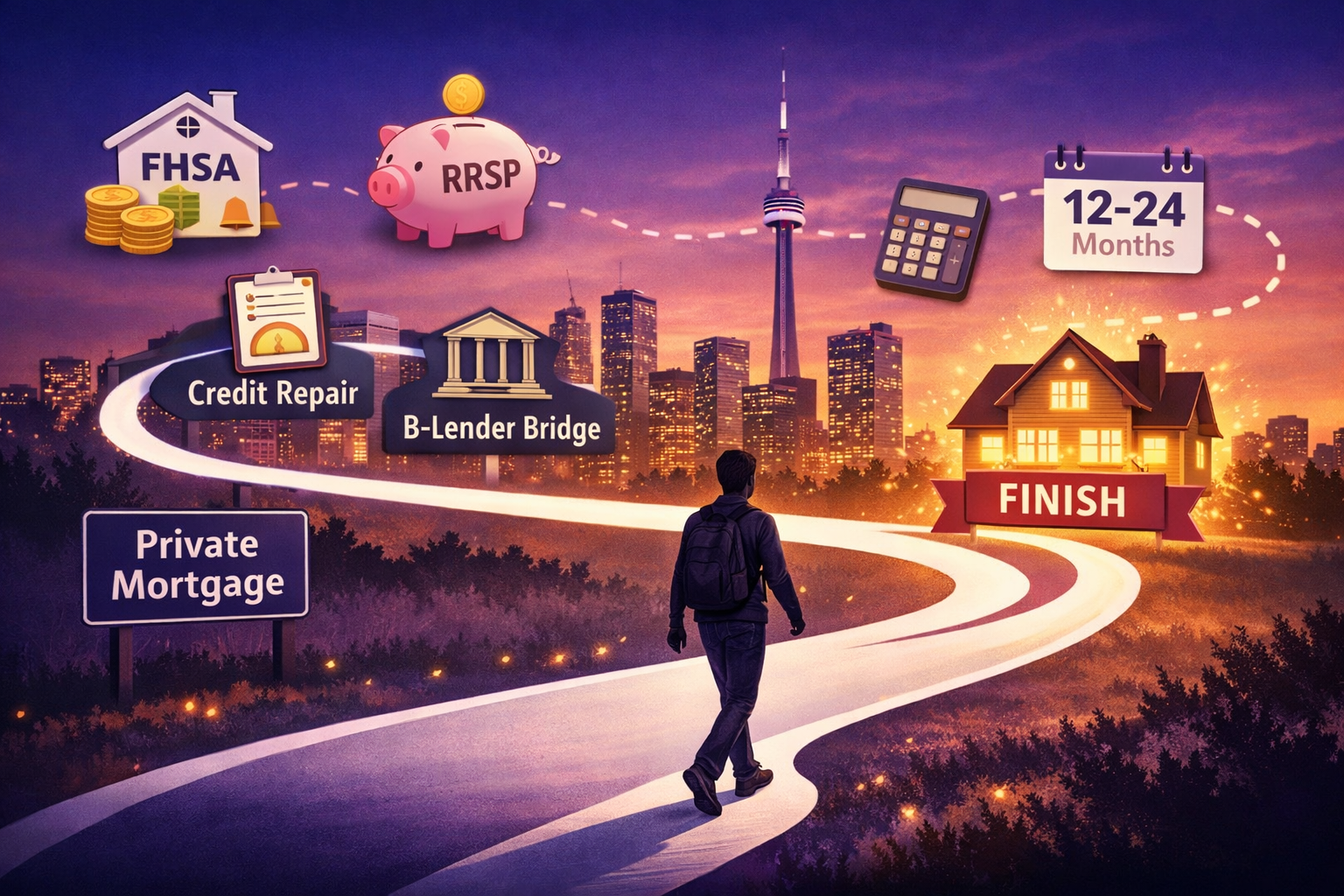
Step 1: Exhaust Government Incentives First 🏛️
Before turning to private lending, first-time buyers should maximize every government tool available:
- FHSA (First Home Savings Account): Contribute up to $8,000/year, tax-deductible, tax-free on withdrawal for a qualifying home purchase.
- RRSP Home Buyers’ Plan: Withdraw up to $35,000 ($70,000 per couple) tax-free.
- Combined: Up to $100K in tax-advantaged down payment funds — enough to meet the 20% threshold on a $500K property without touching private lending.
- 30-year amortization: Available on insured mortgages for first-time buyers purchasing new builds, reducing monthly payments significantly [1][5].
These tools directly reduce or eliminate the need for private financing by lowering the down payment burden and improving monthly cash flow.
Step 2: Know Your Exit Strategy Before You Enter
The biggest mistake first-time buyers make with private mortgages is signing without a clear plan to exit. A solid exit strategy includes:
- Set a 12–24 month timeline to refinance into a B-lender or A-lender
- Actively repair credit during the private mortgage term — pay all bills on time, reduce utilization
- Document income consistently (especially for self-employed buyers) to meet bank requirements at renewal
- Monitor property value — rising equity improves refinancing options
For self-employed buyers specifically, understanding how to qualify for mortgages without T4 slips in 2026 can accelerate the path back to conventional lending.
Step 3: Work With a Licensed Mortgage Broker
Ontario’s February 2026 regulatory proposals would expand Level 1 mortgage agents’ access to CMHC-approved insured lenders, while adding suitability assessment requirements for private mortgage recommendations. This means buyers will have stronger consumer protections when working with licensed brokers.
A broker can:
- 🔍 Compare private lenders side-by-side
- 📋 Assess whether a B-lender is a better fit
- 🛡️ Ensure the private mortgage meets new suitability standards
- 📅 Build a refinancing roadmap from day one
The growing demand for alternative and private lender mortgages reflects how mainstream these options have become — but broker guidance remains essential.
Step 4: Target the Right Property Segment
Private mortgages work best when the underlying asset is strong. In 2026, Toronto’s under-$750K segment — primarily condos and townhomes — offers the best combination of:
- Lower entry price (reducing private loan size and interest costs)
- Strong rental demand (supporting cash flow if needed)
- Liquidity (easier to sell or refinance if plans change)
With 45% of 2026 GTA buyers being first-timers, competition in this segment is real but manageable [2]. Exploring strategies to outpace competition in Toronto’s stabilizing market can sharpen your competitive edge.
Common Questions About Private Mortgages in Toronto
❓ Can I get a private mortgage with bad credit? Yes. Private lenders focus on property equity, not credit scores. A minimum 20–25% down payment is typically required.
❓ How quickly can I get approved? Most private lenders in Toronto approve within 24–48 hours — significantly faster than banks.
❓ Are private mortgages regulated? Private mortgage brokers must be licensed in Ontario. New 2026 regulations are adding suitability requirements for added consumer protection.
❓ What happens at the end of a private mortgage term? Most private mortgages are 1-year terms. The goal is to refinance into a B-lender or bank at renewal. If credit has improved, this is very achievable.
Conclusion: Your Private Mortgage Action Plan for 2026 🎯
Private mortgages for first-time buyers in Toronto: navigating 2026 affordability challenges represent a legitimate, strategic path into homeownership — but only when used with discipline and a clear plan.
Here are your actionable next steps:
- Maximize FHSA and RRSP contributions to reduce how much private financing you need.
- Get pre-qualified through a licensed mortgage broker who can compare private, B-lender, and A-lender options side by side.
- Target the under-$750K segment where Toronto’s buyer’s market gives you real negotiating power.
- Build your exit strategy first — commit to credit repair and income documentation from day one.
- Review Ontario’s new suitability rules to ensure any private mortgage recommendation meets regulatory standards.
Toronto’s market reset in 2026 is real. Prices are lower, inventory is higher, and flexible financing tools are more accessible than ever. With the right strategy, first-time buyers can use private mortgages as a stepping stone — not a stumbling block — to long-term homeownership.
References
[1] Finally Ready To Buy Why 2026 Is Different For Toronto First Time Buyers – https://www.getwhatyouwant.ca/finally-ready-to-buy-why-2026-is-different-for-toronto-first-time-buyers
[2] Toronto Housing Market – https://wowa.ca/toronto-housing-market
[3] Newmortgagerules – https://www.aaronsantos.net/blog/newmortgagerules
[4] Toronto Housing Market Outlook – https://www.nesto.ca/home-buying/toronto-housing-market-outlook/
[5] Playing By New Rules What Changed For Toronto Real Estate In 2025 2026 – https://www.getwhatyouwant.ca/playing-by-new-rules-what-changed-for-toronto-real-estate-in-2025-2026
[6] Trreb Market Watch February 2026 – https://www.skt.ca/blog/trreb-market-watch-february-2026
 Previous Page