March 19, 2026
Self-Employed Income Verification in a Volatile Market: Adapting Your Tax Strategy for 2026-2027 Renewals
Share this article:



Manzeel is an award-winning Mortgage Broker and the Owner of the Toronto-based mortgage, Everything Mortgages.
With 16 years of experience in the Canadian mortgage industry and a formal background in mortgage underwriting, Manzeel’s lending expertise gives him unique insight into whether a deal is feasible which empowers his clients to make more informed lending decisions faster.
He has been recognized as one of Canada’s Top 10 Mortgage Brokers by the national Canadian Mortgage Professionals (CMP) Association. Him and his team of 18 mortgage agents are proud to offer a mortgage experience that's built on honesty, trust, and integrity. He prides himself on the brokerage’s dedication to deliver an excellent client experience throughout the entire home loan process from pre-approval to post-funding.
Since moving to Toronto in 1998, Manzeel has successfully launched and scaled several businesses from the ground up, ranging from a mortgage brokerage and a vast real estate investment portfolio to a private financing eCommerce platform. He continues to be a leader in the real estate industry as he uses his analytical expertise to seek new real estate investment opportunities.
As a tech junkie and avid sports enthusiast, when Manzeel’s not working with clients, you can find him reading technology blogs, playing squash or watching tennis with his two boys.
For years, self-employed Canadians have played the tax minimization game masterfully—writing off every possible expense, maximizing deductions, and keeping their taxable income as low as legally possible. This strategy has saved thousands in annual tax payments. However, when mortgage renewal time arrives, these same aggressive tax strategies can become a significant liability. Self-Employed Income Verification in a Volatile Market: Adapting Your Tax Strategy for 2026-2027 Renewals requires a fundamental shift in thinking for entrepreneurs and independent contractors facing upcoming mortgage renewals.
The 2026 mortgage landscape presents unique challenges. With economic volatility affecting income stability and lenders tightening verification requirements, Self-Employed borrowers must now balance two competing priorities: minimizing tax liability while maintaining sufficient documented income for mortgage qualification. This comprehensive guide explores how to strategically optimize your tax approach throughout 2026 to position yourself for successful mortgage renewals in 2027.
Key Takeaways
✅ Strategic income reporting in 2026 directly impacts 2027 mortgage renewal success—lenders typically review the two most recent Notice of Assessments (NOAs)
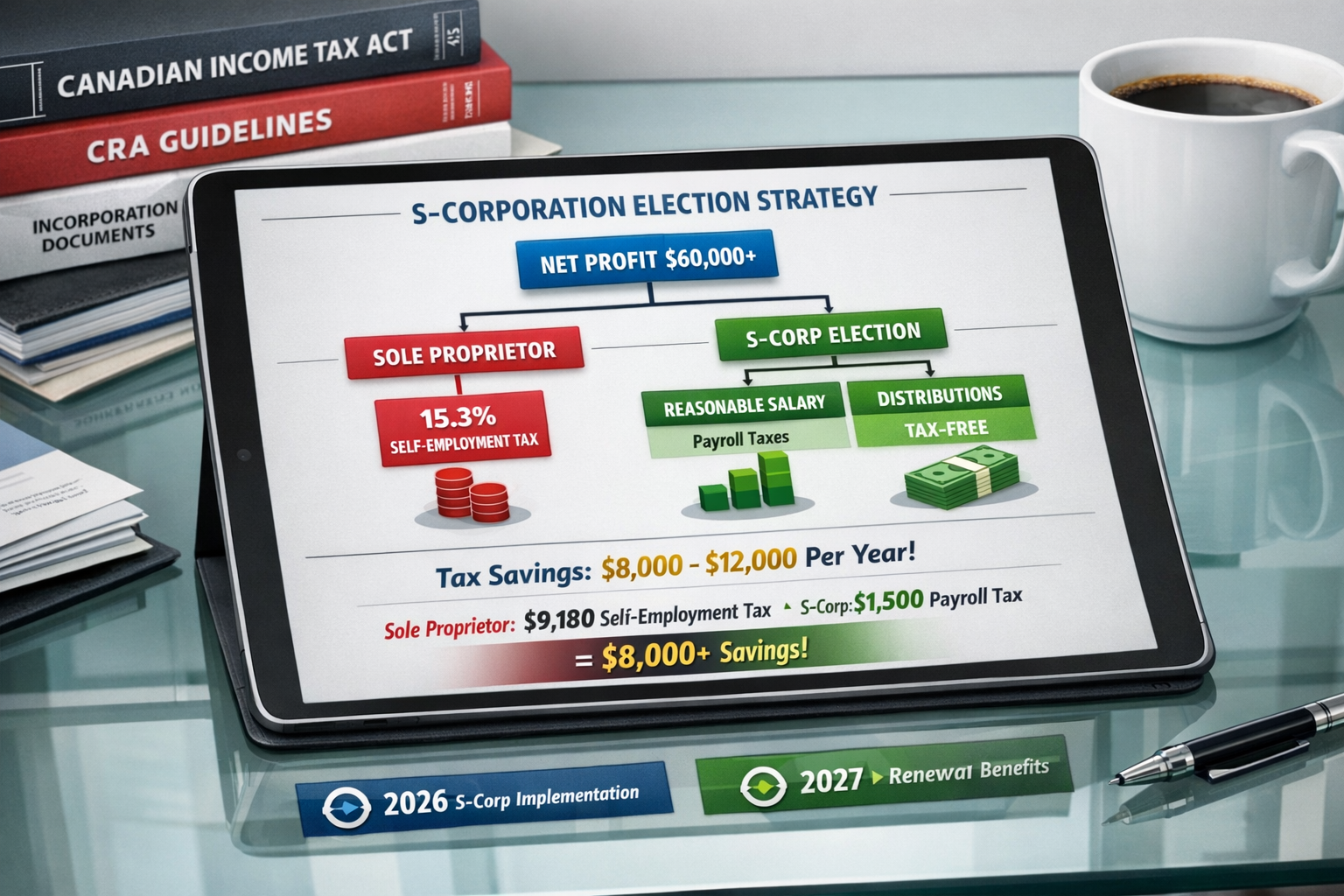
💰 S-Corporation election can reduce self-employment taxes by $8,000-$12,000 annually while maintaining higher documented income for mortgage purposes
📊 The 2026 Social Security wage base increased to $184,500, meaning high-income self-employed individuals face higher tax obligations that require careful planning [1]
🏦 Alternative income verification methods like bank statement mortgages provide flexibility but often come with higher interest rates than traditional documentation
⏰ Starting tax optimization 18-24 months before renewal gives you the best positioning for favorable mortgage terms and rates
Understanding the Self-Employed Income Verification Challenge
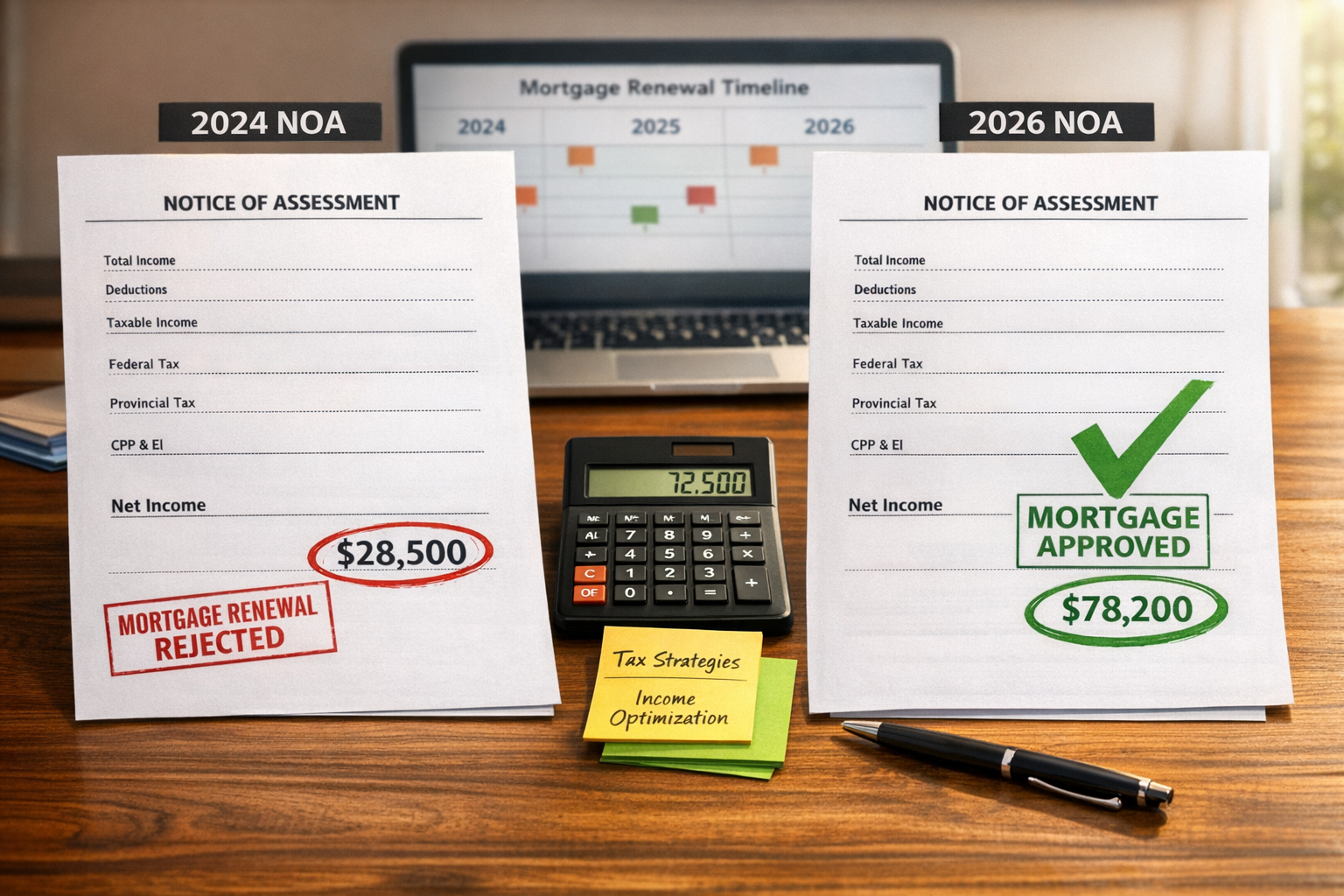
Self-employed borrowers face a paradox that traditional employees never encounter. While W-2 employees have their income automatically documented through employer reporting, entrepreneurs must prove their income through tax returns—the same documents they’ve strategically minimized to reduce tax liability.
The Traditional Tax Minimization Trap
For self-employed Canadians, aggressive tax planning typically involves:
- Maximizing business expense deductions (home office, vehicle, meals, travel)
- Income splitting with family members through salary payments
- Timing income and expense recognition to minimize annual tax burden
- Utilizing all available tax credits and deductions
While these strategies are entirely legal and financially prudent from a tax perspective, they create a documented income profile that may not reflect your true earning capacity. When lenders review your Notice of Assessment, they see only the net income you’ve reported—not your gross revenue or actual cash flow.
How Lenders Evaluate Self-Employed Income in 2026
Canadian mortgage lenders typically use one of several methods to verify self-employed income:
Traditional Documentation Method:
- Two years of complete tax returns (T1 Generals)
- Two years of Notice of Assessments from CRA
- Business financial statements (if incorporated)
- Average net income calculation over two years
Alternative Verification Methods:
- Bank statement mortgages using 12-24 months of business deposits
- Self-declared income mortgages with higher down payments
- Stated income programs through alternative lenders
The challenge intensifies during volatile economic periods. Lenders become more conservative, requiring stronger documentation and often scrutinizing income stability more carefully. If your 2024 and 2025 NOAs show significantly reduced income due to aggressive tax planning, your 2027 renewal may face complications—even if your actual business performance remains strong.
The 2026-2027 Renewal Timeline
Understanding the timeline is crucial for strategic planning:
Current Position (Early 2026):
- Your 2024 tax return is filed and assessed
- Your 2025 tax return will be filed by April 30, 2026
- These two NOAs will be used for most 2027 renewals
Strategic Window:
- Your 2025 tax planning decisions (being finalized now in early 2026) still matter
- Your 2026 tax year represents your last opportunity to optimize before 2027 renewals
- Income reporting decisions made throughout 2026 will appear on your 2026 NOA (filed in spring 2027)
This timeline means self-employed borrowers with renewals in late 2027 or early 2028 still have time to implement strategic changes. Those with mid-2027 renewals have limited options and should focus on alternative verification methods if their recent NOAs show insufficient income.
Self-Employed Income Verification in a Volatile Market: Strategic Tax Planning for 2026
The key to successful mortgage renewal lies in strategic tax optimization—not tax minimization. This approach balances legitimate tax reduction with maintaining sufficient documented income for lending purposes.
The S-Corporation Election Advantage
One of the most powerful strategies for self-employed individuals earning $60,000 or more in net profit is electing S-Corporation status. This structure provides significant benefits for both tax reduction and income verification [1].
How S-Corp Election Works:
When you operate as an S-Corporation, you split your income into two categories:
- Reasonable salary (subject to payroll taxes)
- Distributions (not subject to self-employment taxes)
Tax Savings Example:
| Structure | Net Profit | SE Tax (15.3%) | Total Tax |
|---|---|---|---|
| Sole Proprietor | $100,000 | $14,130 | $14,130 |
| S-Corporation | $100,000 | $7,650* | $7,650 |
| Annual Savings | – | – | $6,480 |
*Assumes $50,000 reasonable salary, $50,000 distributions
The self-employment tax rate for 2026 remains 15.3%, consisting of 12.4% for Social Security and 2.9% for Medicare, applied to 92.35% of net earnings [1]. However, the Social Security wage base increased to $184,500 for 2026, meaning high-income self-employed individuals pay Social Security tax on more earnings than in previous years [1].
Optimizing the Qualified Business Income (QBI) Deduction
The Qualified Business Income deduction has become permanent with expanded provisions for 2026. This deduction allows eligible self-employed individuals to deduct up to 20% of qualified business income, significantly reducing taxable income while maintaining higher gross income figures [4].
2026 QBI Enhancements:
- Higher phaseout limits: $70,000 (single) and $150,000 (married filing jointly)
- Minimum $400 deduction for businesses earning at least $1,000 in qualified income
- Expanded eligibility for service-based businesses [4]
Strategic Application for Mortgage Qualification:
The QBI deduction is particularly valuable because it reduces your taxable income without reducing your net business income—the figure lenders focus on. This means you can show higher income to lenders while still achieving tax savings.
Balancing Deductions with Income Documentation
Not all business deductions impact mortgage qualification equally. Understanding which deductions lenders add back to income can help you make strategic decisions.
Deductions Typically Added Back by Lenders:
- Depreciation and amortization
- Non-cash expenses
- One-time extraordinary expenses
- Capital cost allowance (CCA)
Deductions That Reduce Qualifying Income:
- Cash operating expenses
- Salaries and wages
- Cost of goods sold
- Rent and utilities
Strategic Approach for 2026:
- Continue taking legitimate depreciation deductions—these reduce taxes but often get added back by lenders
- Time major equipment purchases strategically—consider whether immediate expensing or depreciation serves your goals better
- Document extraordinary expenses separately—one-time costs can often be explained and excluded from income calculations
- Maintain detailed expense categorization—clear records help lenders understand your true income picture
For self-employed borrowers in Toronto and the GTA, understanding these nuances is particularly important given the region’s competitive mortgage market. Securing a mortgage without traditional T4 slips requires demonstrating strong, consistent income through alternative documentation.
Income Smoothing Strategies
Volatile income presents challenges for mortgage qualification. Lenders prefer consistent, predictable earnings. If your business experiences significant year-to-year fluctuations, consider these smoothing strategies:
Contract Timing:
- Distribute large contracts across tax years when possible
- Avoid concentrating all income in a single year followed by a low-income year
Billing Practices:
- Implement consistent monthly retainer agreements
- Use progress billing for large projects rather than lump-sum payments
Income Deferral:
- Consider deferring late-year income to the following year if it creates a more consistent two-year average
- Balance this against tax planning objectives
Corporate Structure:
- If incorporated, use salary and dividend combinations to create consistent personal income
- Retain earnings in corporate accounts during high-revenue years for distribution during slower periods
Adapting Your Tax Strategy: Practical Implementation for 2026-2027 Renewals

Implementation requires systematic changes to your business operations and financial management. The following strategies provide actionable steps for optimizing your position throughout 2026.
Establishing Separate Business Banking
One of the most fundamental—yet often overlooked—strategies is maintaining completely separate business and personal finances. This separation serves multiple purposes for mortgage qualification [3].
Benefits for Income Verification:
- Clear audit trail of business income and expenses
- Simplified bank statement mortgage applications
- Reduced audit risk from CRA
- Professional presentation to lenders
- Easier expense substantiation
Implementation Steps:
- Open dedicated business accounts at a separate institution from your personal banking
- Obtain a business credit card used exclusively for business expenses
- Establish clear protocols for all business transactions flowing through business accounts
- Pay yourself consistently through regular transfers from business to personal accounts
- Document all transfers with clear descriptions and purposes
Business record-keeping remains critical for both tax compliance and mortgage qualification [3]. Lenders view organized financial records as evidence of business stability and professional management.
Quarterly Tax Planning Reviews
Rather than addressing taxes only at year-end, implement quarterly reviews to optimize your position throughout 2026.
Q1 2026 Review (January-March):
- Finalize 2025 tax return strategy before April 30 deadline
- Project 2026 income and expense scenarios
- Identify major deductions and timing opportunities
- Set income targets for mortgage qualification
Q2 2026 Review (April-June):
- Assess actual Q1-Q2 performance against projections
- Adjust estimated tax payments if needed
- Review expense categorization and documentation
- Consider mid-year strategic adjustments
Q3 2026 Review (July-September):
- Calculate year-to-date income and projected year-end position
- Identify opportunities for income acceleration or deferral
- Plan major equipment purchases or expense timing
- Evaluate S-Corp election benefits if not already implemented
Q4 2026 Review (October-December):
- Finalize year-end tax strategies
- Maximize retirement contributions if beneficial
- Complete planned equipment purchases
- Prepare documentation for 2027 mortgage renewal
Documentation Excellence
Superior documentation distinguishes successful self-employed mortgage applications from declined ones. In 2026’s competitive lending environment, comprehensive records demonstrate professionalism and reduce lender risk perception.
Essential Documentation Systems:
📁 Income Documentation:
- All invoices issued (even if paid immediately)
- Payment receipts and bank deposit records
- Contract agreements showing ongoing relationships
- Client testimonials or letters confirming ongoing work
📁 Expense Documentation:
- Digital copies of all receipts (apps like Dext or Receipt Bank)
- Mileage logs for vehicle expenses
- Home office calculation worksheets
- Credit card statements with expense categorization
📁 Financial Statements:
- Monthly profit and loss statements
- Balance sheets (if incorporated)
- Cash flow projections
- Year-over-year comparison reports
📁 Business Continuity Evidence:
- Long-term client contracts
- Recurring revenue agreements
- Business licenses and professional certifications
- Marketing materials and business development plans
This level of documentation supports not only traditional mortgage applications but also alternative income verification methods that may offer more favorable terms for self-employed borrowers.
Working with Tax Professionals
The complexity of balancing tax optimization with mortgage qualification makes professional guidance invaluable. However, not all tax professionals understand mortgage lending requirements.
Selecting the Right Tax Advisor:
Look for professionals who:
- Have experience with self-employed clients seeking mortgages
- Understand both tax law and lending requirements
- Can model different scenarios showing tax and lending impacts
- Communicate proactively about strategic opportunities
- Coordinate with your mortgage broker when appropriate
Key Conversations to Have:
- “I have a mortgage renewal in 2027—how should this influence my 2026 tax strategy?”
- “What’s the optimal balance between tax savings and documented income for my situation?”
- “Should I consider S-Corp election or other structural changes?”
- “Which deductions will lenders likely add back to my income?”
- “How can we document my true earning capacity beyond what appears on my NOA?”
Many self-employed borrowers benefit from working with both a tax professional and a specialized mortgage broker who understands self-employed mortgage qualification. This team approach ensures all aspects of your financial strategy align with your homeownership goals.
Alternative Income Verification Options for 2026-2027 Renewals

Even with optimal tax planning, some self-employed borrowers may find traditional income verification challenging. Fortunately, the Canadian mortgage market offers several alternative pathways, particularly relevant for those whose recent NOAs don’t reflect current earning capacity.
Bank Statement Mortgage Programs
Bank statement mortgages have evolved significantly, offering viable alternatives for self-employed borrowers with strong cash flow but lower documented net income.
How Bank Statement Programs Work:
Instead of tax returns, lenders analyze 12-24 months of business bank statements to calculate average monthly deposits. This approach captures your gross income flow rather than net taxable income, often resulting in higher qualifying income.
Typical Requirements:
- 12-24 months of business bank statements
- 10-20% down payment (higher than conventional)
- Good credit score (typically 650+)
- Demonstrated business stability (usually 2+ years)
- Separate business banking accounts
Calculating Qualifying Income:
Lenders typically use one of these methods:
- Gross deposit method: Total deposits × percentage (often 50-75%)
- Average monthly method: Average monthly deposits over review period
- Expense ratio method: Deposits minus documented business expenses
Bank statement mortgage rates in 2026 vary by lender but typically range from 0.25% to 1.5% higher than conventional rates, depending on down payment size and credit profile.
Self-Declared Income Programs
For borrowers with significant assets or equity, self-declared income programs offer maximum flexibility with minimal documentation requirements.
Typical Program Features:
- Minimal income verification (often just a signed declaration)
- Higher down payment requirements (typically 20-35%)
- Rates 1-3% higher than conventional mortgages
- Shorter amortization periods (often 25 years maximum)
- Focus on property equity and exit strategy
Best Suited For:
- High-net-worth individuals with complex income structures
- Business owners with significant unreported cash flow
- Recent immigrants with substantial foreign assets
- Borrowers between business transitions
These programs work particularly well for mortgage renewals and refinancing when you have significant equity but documentation challenges.
Alternative Lender Solutions
Beyond traditional banks, alternative lenders (B-lenders and private lenders) offer more flexible underwriting for self-employed borrowers.
B-Lender Characteristics:
- More flexible income verification requirements
- Accept lower credit scores (typically 600+)
- Consider compensating factors (equity, assets, business stability)
- Rates typically 0.5-2% higher than A-lenders
- May add back more deductions to income calculations
Private Lender Options:
- Focus primarily on property value and equity
- Minimal income verification
- Short-term solutions (6-12 months typical)
- Higher rates (typically 7-12%)
- Useful as bridge financing while improving documentation
For Toronto-area borrowers, understanding how to navigate the 2026 mortgage stress test remains important even with alternative verification methods, as qualifying rates still apply to most programs.
Hybrid Verification Approaches
Some lenders offer hybrid programs combining multiple verification methods:
Tax Returns + Bank Statements:
- Uses tax returns as baseline
- Supplements with bank statements to demonstrate higher income
- May average the two methods
- Typically offers better rates than bank statement alone
Business Financial Statements + Personal Tax Returns:
- For incorporated businesses
- Reviews corporate financial statements alongside personal returns
- Considers retained earnings and business equity
- Useful when significant income remains in corporation
Asset-Based Qualification:
- Considers total net worth, not just income
- Includes investment portfolios, business value, real estate equity
- May require professional business valuation
- Typically requires substantial assets (often $1M+)
Preparing for Alternative Verification
If you anticipate needing alternative verification for your 2027 renewal, start preparing now:
For Bank Statement Programs:
- Ensure all business income flows through dedicated business accounts
- Avoid co-mingling personal and business funds
- Maintain consistent deposit patterns
- Document the source of large or unusual deposits
- Keep business accounts in good standing (no NSFs or overdrafts)
For Self-Declared Programs:
- Build equity through property appreciation and mortgage paydown
- Maintain excellent credit scores
- Document assets comprehensively
- Prepare explanations for income structure
- Consider timing renewal when property values are strong
For All Alternative Programs:
- Start conversations with specialized mortgage brokers early
- Understand rate and fee differences
- Compare multiple lender options
- Consider short-term alternative financing with plans to refinance to conventional terms once documentation improves
- Review self-employed mortgage renewal options specific to Toronto borrowers
Building Your 2026-2027 Renewal Action Plan
Success requires a comprehensive, proactive approach. The following action plan provides a roadmap for self-employed borrowers preparing for upcoming renewals.
Immediate Actions (Next 30 Days)
✅ Assess Your Current Position:
- Review your 2024 and 2025 NOAs (or projections)
- Calculate your current qualifying income using lender formulas
- Identify gaps between current documentation and renewal needs
- Determine your renewal timeline and urgency
✅ Engage Professional Support:
- Consult with a tax professional about 2026 optimization strategies
- Connect with a mortgage broker specializing in self-employed borrowers
- Discuss S-Corp election or other structural changes if beneficial
- Request a pre-qualification assessment for your renewal
✅ Organize Financial Records:
- Implement separate business banking if not already done
- Set up digital receipt management system
- Create organized folders for all income and expense documentation
- Begin tracking metrics lenders value (consistent deposits, client retention, etc.)
Short-Term Actions (Next 3-6 Months)
📊 Implement Tax Strategy Adjustments:
- Begin S-Corp election process if pursuing this strategy
- Adjust expense timing and categorization based on professional advice
- Implement income smoothing strategies for consistent monthly earnings
- Maximize deductions that lenders add back (depreciation, etc.)
📊 Enhance Documentation:
- Establish quarterly financial statement preparation
- Create client contract summaries showing ongoing relationships
- Document business development activities and pipeline
- Prepare narratives explaining income fluctuations or business model
📊 Explore Lender Options:
- Research which lenders offer best terms for your situation
- Understand conventional versus alternative lender requirements
- Compare bank statement program requirements across lenders
- Identify backup options if primary strategy faces challenges
Long-Term Actions (6-18 Months Before Renewal)
🎯 Optimize Tax Filings:
- File 2026 tax return strategically (by April 30, 2027)
- Ensure all income is properly documented and reported
- Maximize legitimate deductions while maintaining qualifying income
- Request and review NOA immediately upon receipt
🎯 Build Lender Confidence:
- Maintain excellent credit scores (750+ ideal)
- Avoid major credit applications in months before renewal
- Keep debt service ratios favorable
- Document business stability and growth trajectory
🎯 Prepare Renewal Application:
- Gather all required documentation in advance
- Prepare written explanations for any unusual items
- Create professional package presenting your financial strength
- Consider timing renewal slightly early to avoid rate increases
Special Considerations for Different Business Structures
Sole Proprietors:
- Focus on clean separation of business and personal expenses
- Consider incorporation or S-Corp election if earning $60,000+ net profit
- Emphasize business longevity and client relationships
- Document all income sources comprehensively
Incorporated Business Owners:
- Balance salary and dividend mix strategically
- Maintain corporate financial statements professionally
- Consider retained earnings impact on personal income
- Document shareholder loans and corporate structure clearly
Partnership and Multi-Member LLCs:
- Clarify your ownership percentage and income allocation
- Provide partnership agreements and K-1 forms
- Document stability of partnership arrangements
- Show your specific income share consistently
Contractors and Consultants:
- Emphasize long-term client relationships
- Provide contracts showing ongoing or recurring work
- Document industry demand and specialized skills
- Consider specialized programs for IT consultants and similar professionals
Conclusion
Self-Employed Income Verification in a Volatile Market: Adapting Your Tax Strategy for 2026-2027 Renewals requires a fundamental shift from pure tax minimization to strategic tax optimization. The aggressive deduction strategies that served you well in the past may now compromise your ability to secure favorable mortgage renewal terms in 2027.
The good news? With proper planning and implementation throughout 2026, self-employed borrowers can achieve both objectives: reducing tax liability while maintaining sufficient documented income for mortgage qualification. The strategies outlined in this guide—from S-Corporation election to enhanced documentation practices to alternative verification methods—provide multiple pathways to renewal success.
Key Success Factors:
🎯 Start early: The 18-24 month window before renewal is your strategic planning period
💼 Professional guidance: Work with tax advisors and mortgage brokers who understand both sides of the equation
📈 Strategic optimization: Balance tax savings with income documentation needs
📋 Documentation excellence: Maintain organized, comprehensive financial records
🔄 Flexibility: Understand multiple verification pathways and lender options
The Canadian mortgage market in 2026 offers more options for self-employed borrowers than ever before. Whether you pursue traditional verification with optimized tax returns, bank statement programs, or alternative lender solutions, success comes from proactive planning and strategic implementation.
Your Next Steps:
- Schedule a consultation with a mortgage broker specializing in self-employed borrowers to assess your specific situation
- Review your 2025 tax return (being finalized now) with an eye toward mortgage implications
- Implement separate business banking if you haven’t already done so
- Create a quarterly review schedule for 2026 to monitor progress toward your income documentation goals
- Explore comprehensive self-employed mortgage resources to understand all available options
The path to successful mortgage renewal in 2027 begins with the decisions you make today in 2026. By adapting your tax strategy now, you’ll position yourself for the best possible rates and terms when renewal time arrives—without sacrificing the tax benefits that make self-employment financially rewarding.
Remember: your mortgage renewal doesn’t have to be stressful or uncertain. With the right strategy, professional support, and proactive planning, you can navigate the verification requirements confidently while maintaining both your tax efficiency and your homeownership goals.
References
[1] Self Employment Tax Guide – https://www.sdocpa.com/self-employment-tax-guide/
[3] Self Employed Tax Strategies – https://www.kiplinger.com/taxes/self-employed-tax-strategies
[4] Looking Ahead To 2026 Tax Planning For The Self Employed And Working Retirees – https://www.firstnbtc.com/blog/looking-ahead-to-2026-tax-planning-for-the-self-employed-and-working-retirees
 Previous Page