March 24, 2026
Local Private Mortgage Lenders: Your Complete Guide to Alternative Home Financing
Share this article:



Manzeel is an award-winning Mortgage Broker and the Owner of the Toronto-based mortgage, Everything Mortgages.
With 16 years of experience in the Canadian mortgage industry and a formal background in mortgage underwriting, Manzeel’s lending expertise gives him unique insight into whether a deal is feasible which empowers his clients to make more informed lending decisions faster.
He has been recognized as one of Canada’s Top 10 Mortgage Brokers by the national Canadian Mortgage Professionals (CMP) Association. Him and his team of 18 mortgage agents are proud to offer a mortgage experience that's built on honesty, trust, and integrity. He prides himself on the brokerage’s dedication to deliver an excellent client experience throughout the entire home loan process from pre-approval to post-funding.
Since moving to Toronto in 1998, Manzeel has successfully launched and scaled several businesses from the ground up, ranging from a mortgage brokerage and a vast real estate investment portfolio to a private financing eCommerce platform. He continues to be a leader in the real estate industry as he uses his analytical expertise to seek new real estate investment opportunities.
As a tech junkie and avid sports enthusiast, when Manzeel’s not working with clients, you can find him reading technology blogs, playing squash or watching tennis with his two boys.

Last updated: March 24, 2026
Quick Answer: Private Mrtgage lenders are individuals or companies that provide home loans outside the traditional banking system. Searching for “private mortgage lenders near me” connects borrowers with local financing options that offer faster approvals, more flexible credit requirements, and access to funding when banks say no. These loans typically carry higher interest rates (8–15%) than conventional mortgages, so they work best as short-term or bridge solutions.
Key Takeaways
- Private lenders focus on property value and equity, not just credit scores — making them accessible to Self-Employed Borrowers, those with past credit issues, or investors who need fast funding.
- Interest rates are higher: private mortgage rates typically range from 8–15%, compared to conventional 30-year fixed rates hovering around 6–6.5% in 2026. [3][6]
- Approval is faster: many private lenders can close in days rather than the weeks or months a bank may require.
- The market is growing fast: Q1 2025 saw over $33.2 billion in private lending originations, up from $30.7 billion in Q1 2024. [1]
- Credit score minimums are lower, but most private lenders still want to see sufficient home equity (often 25–35% down or existing equity).
- Private mortgages are best used as short-term tools — to bridge a gap, rebuild credit, or close a deal quickly — before refinancing into a conventional loan.
- Working with a licensed mortgage broker is the most reliable way to find reputable private mortgage lenders in your local area.
- DSCR loans (popular with real estate investors) grew 43% in originations from Q1 2024 to Q1 2025, showing strong demand for investment-property private financing. [1]
What Is a Private Mortgage Lender and How Does It Work?
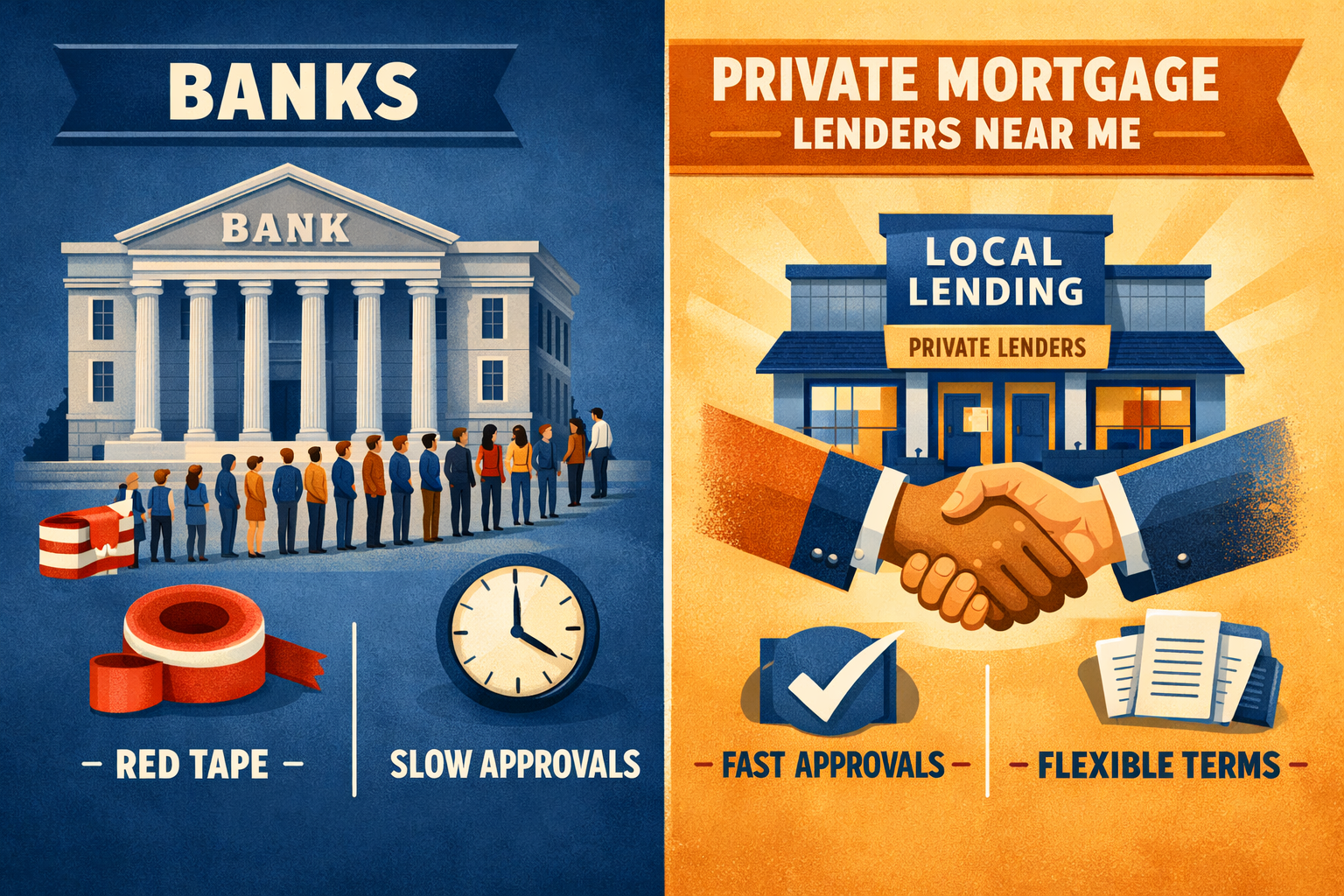
A private mortgage lender is any non-bank entity — an individual investor, a mortgage investment corporation (MIC), or a private lending company — that funds home loans using their own capital. Unlike banks, private lenders are not bound by the same federal underwriting rules, which gives them more room to say yes when banks cannot.
Here’s how the basic process works:
- Borrower applies — usually through a mortgage broker or directly with the lender.
- Lender evaluates the property — the home’s value and the borrower’s equity position are the primary factors.
- Terms are negotiated — interest rate, loan-to-value (LTV) ratio, term length, and fees are agreed upon.
- A home appraisal is ordered — understanding the importance of home appraisals in the mortgage process is critical here, since the property value determines how much a private lender will fund.
- Funds are disbursed — often within days to a few weeks.
Common mistake: Many borrowers assume private lenders have no standards at all. In reality, most require a maximum LTV of 65–80%, meaning the borrower must have meaningful equity or a solid down payment.
What Are the Advantages of Using a Private Mortgage Lender Instead of a Traditional Bank?
Private lenders offer several concrete advantages over banks — particularly for borrowers who fall outside standard qualification criteria.
Key advantages:
| Advantage | Private Lender | Traditional Bank |
|---|---|---|
| Approval speed | Days to 2 weeks | 30–90 days |
| Credit score focus | Low emphasis | High emphasis |
| Income documentation | Flexible | Strict (T4s, NOAs) |
| Property types | Broad | Narrower |
| Loan customization | High | Low |
| Interest rates | 8–15% [3] | ~6–6.5% [6] |
Who benefits most from private lending:
- Self-employed borrowers who can’t easily document income through traditional means (see our guide to securing a mortgage for self-employed Canadians)
- Borrowers recovering from bankruptcy or consumer proposals who need time to rebuild their credit profile
- Real estate investors who need fast financing to secure a deal before competitors
- Homeowners facing renewal denial from their current lender (learn what happens if your mortgage renewal is denied)
- Those with non-traditional income such as rental income, commissions, or foreign earnings
💡 Pull quote: “Private lending is not a last resort — for the right borrower, it’s a strategic bridge to better financing.”
One important caveat: The higher cost of private financing means borrowers should have a clear exit strategy — usually refinancing into a bank or B-lender Mortgage within 1–3 years once their financial profile improves.
How Do I Find Reputable Private Mortgage Lenders Near Me?
Finding trustworthy private mortgage lenders near me requires more than a quick Google search. The private lending market is less regulated than banking, so due diligence matters.
The most reliable methods:
- Work with a licensed mortgage broker. Brokers maintain networks of vetted private lenders and can match borrowers to the right fit based on property type, credit situation, and loan size. This is the single most effective approach.
- Contact a Mortgage Investment Corporation (MIC). MICs pool investor capital to fund private mortgages and are regulated under securities law in Canada, adding a layer of accountability.
- Ask a real estate attorney or accountant. Professionals who work in real estate transactions often know reputable local private lenders by reputation.
- Check provincial or state licensing databases. In Ontario, for example, private mortgage lenders and brokers must be licensed under the Mortgage Brokerages, Lenders and Administrators Act.
- Real estate investor networks and associations. Local real estate investment groups often have referral relationships with private lenders.
Red flags to avoid:
- Lenders who ask for large upfront fees before any documents are reviewed
- No physical address or verifiable business registration
- Pressure to sign quickly without time to review terms
- Rates that seem unusually low for private lending (could be bait-and-switch)
For a deeper look at what to expect, the complete guide to getting a mortgage with a private lender covers the full process from application to closing.
What Credit Score Do I Need to Qualify for a Private Mortgage Loan?
Private lenders do not have a universal minimum credit score — most will lend to borrowers with scores as low as 500 or even lower in some cases, provided the property equity is strong. This is the defining difference from conventional lenders, who typically require a minimum score of 680 (or 720+ for the best rates).
How private lenders actually evaluate credit:
- LTV ratio is the primary factor. A borrower with a 550 credit score and 40% equity in a property is often more attractive than one with a 650 score and 5% down.
- Reason for low credit matters. A temporary setback (medical bills, job loss) is viewed differently than a pattern of missed payments.
- Recent credit behavior counts. Lenders want to see that the borrower is trending upward, even if the overall score is low.
General credit score tiers for private lending:
| Credit Score Range | Likely Outcome |
|---|---|
| 650+ | Access to most private lenders; better rates |
| 550–649 | Approved with strong equity; higher rates |
| 500–549 | Possible with 35%+ equity; limited lenders |
| Below 500 | Very difficult; requires exceptional equity |
If rebuilding credit is part of the plan, reviewing how to improve your credit score in Canada can help shorten the time needed before refinancing into conventional financing.
Edge case: Borrowers who have recently been discharged from bankruptcy can sometimes access private mortgages immediately after discharge, though they should expect maximum LTV restrictions and higher rates. For more detail, see the guide to getting approved for a mortgage after bankruptcy.

What Types of Properties Can I Finance Through Private Mortgage Lending?
Private lenders are generally more flexible about property types than banks — but they still have limits, and those limits are tied to how easily the property could be sold if the borrower defaults.
Property types commonly financed by private lenders:
- Residential homes (single-family, detached, semi-detached)
- Condominiums (though some lenders avoid small or rural condo buildings)
- Multi-unit residential properties (duplexes, triplexes, fourplexes)
- Mixed-use properties (commercial/residential combination)
- Rural and vacant land (with restrictions; higher rates)
- Properties needing renovation that banks won’t finance due to condition
- Cottages and recreational properties
Properties private lenders are cautious about:
- Remote rural properties with limited comparable sales
- Properties with environmental issues or title complications
- Highly specialized commercial properties
- New construction without a completion guarantee
Choose private lending for a property if: the property has strong value in a marketable area but doesn’t meet conventional lender standards due to its condition, zoning, or use type.
Real estate investors financing rental properties should also be aware of the growing DSCR (Debt Service Coverage Ratio) loan market. DSCR loan originations grew 43% from Q1 2024 to Q1 2025, reflecting strong investor demand for income-property financing that qualifies based on rental income rather than personal income. [1]
How Do Private Mortgage Interest Rates Compare to Conventional Bank Rates?
Private mortgage rates are significantly higher than conventional bank rates — this is the most important cost consideration for any borrower.
Rate comparison at a glance (2026 estimates):
| Loan Type | Typical Rate Range |
|---|---|
| Conventional bank (30-yr fixed) | ~6.0–6.5% [6] |
| B-lender / alternative lender | ~6.5–8.5% |
| Private mortgage lender | 8–15% [3] |
The gap exists because private lenders take on more risk (lower credit scores, unconventional properties, less documentation) and fund loans from private capital rather than insured deposits. That risk premium is built into the rate.
Other costs to factor in:
- Lender fees: 1–3% of the loan amount (sometimes called “points”)
- Broker fees: typically 1–2% for arranging the loan
- Legal fees: both parties usually require independent legal counsel
- Appraisal fees: required to confirm property value
How to reduce the total cost:
- Offer a larger down payment or demonstrate more equity — lower LTV means lower risk, which can bring rates down
- Borrow for a shorter term with a clear refinancing plan
- Work with a broker who has access to multiple private lenders and can negotiate on your behalf
For context on how conventional rates are moving, see the mortgage rate guide covering fixed and variable options.
Who Should (and Shouldn’t) Use a Private Mortgage Lender?
Private lending is a tool, not a universal solution. Knowing whether it fits your situation saves time and money.
Good fit — consider a private mortgage if:
- A bank or B-lender has declined the application
- Financing is needed quickly (within days or weeks)
- The property type doesn’t meet conventional guidelines
- Income is self-employed, commission-based, or difficult to document
- A short-term bridge loan is needed between buying and selling
Not a good fit — avoid private lending if:
- The borrower qualifies for conventional financing (the rate difference is too costly)
- There is no clear plan to exit the private loan within 1–3 years
- The higher monthly payments would create financial strain
- The borrower is relying on the private lender to overlook serious financial problems without a recovery plan
The private lending market is growing rapidly — Q1 2025 saw 7,565 active private lenders originate loans, a 20%+ increase from Q1 2024 [1] — which means more competition and, in some cases, better terms for borrowers. But more options also mean more due diligence is needed to find the right lender.
For Ontario-specific options, the overview of private mortgage options in Ontario provides a useful starting point.
How Is the Private Mortgage Market Changing in 2026?
The private lending market is expanding, and several trends are shaping what borrowers can expect in 2026.
Key trends:
- Non-QM lending is growing. Non-qualified mortgage lenders expect originations to continue increasing throughout 2026 [9], creating more options for borrowers who don’t fit standard bank criteria.
- Secondary markets are heating up. Cities like Tampa-St. Petersburg and Greenville, SC saw 38–40% growth in private lending originations [1], showing that private lending is no longer just a big-city phenomenon.
- Underwriting is tightening slightly. As the market matures, lenders with strong borrower relationships and track records are getting preferential terms [5].
- Bridge loans and second mortgages are in high demand. Borrowers locked into low-rate first mortgages are turning to private second-position loans to access equity without giving up their existing rate [5]. For more on this, see second mortgages vs. refinancing.
- DSCR products are expanding. The number of private lenders offering DSCR loans grew 25% from Q1 2024 to Q1 2025 [1], giving real estate investors more choices.
The overall mortgage lending market is projected to grow at a 9.80% CAGR between 2025 and 2034 [3], with private and alternative lending capturing a meaningful share of that growth.
Frequently Asked Questions
Q: Are private mortgage lenders regulated? A: Regulation varies by location. In Canada, private lenders who broker or administer mortgages must be licensed under provincial mortgage legislation. Individual private investors lending their own money may face fewer requirements, which is why working through a licensed broker adds protection.
Q: How long does a private mortgage term typically last? A: Most private mortgages are short-term — commonly 1 to 3 years. They are designed as bridge solutions, not long-term financing. Borrowers are expected to refinance into conventional lending once their financial profile improves.
Q: Can I use a private mortgage to buy a home, or only to refinance? A: Both are possible. Private lenders fund purchases, refinances, second mortgages, and equity take-outs. The property must have sufficient value to support the loan.
Q: Do private lenders report to credit bureaus? A: Most private lenders do not report payment history to credit bureaus, which means on-time payments may not directly improve a credit score. However, successfully completing a private mortgage term and refinancing into conventional financing is itself a positive step.
Q: What is the maximum loan-to-value ratio for a private mortgage? A: Most private lenders cap LTV at 65–80% of the property’s appraised value. Some will go higher in strong urban markets, but this typically comes with significantly higher rates.
Q: Can self-employed borrowers use private mortgages? A: Yes — this is one of the most common use cases. Private lenders focus on property equity rather than T4 income, making them well-suited for self-employed borrowers who have difficulty meeting bank documentation requirements.
Q: What happens if I can’t repay a private mortgage? A: Private lenders can initiate foreclosure or power of sale proceedings, similar to a bank. Because private lenders are often more focused on the property than the borrower’s long-term relationship, they may move faster than a bank would in a default situation.
Q: Is there a prepayment penalty on private mortgages? A: Terms vary by lender. Some private mortgages have open terms (no penalty to repay early), while others charge 3 months’ interest. Always confirm prepayment terms before signing.
Q: How do I know if a private lender is legitimate? A: Verify their licensing through the provincial or state regulatory body, ask for references from past borrowers, and have an independent lawyer review all loan documents before signing.
Q: What’s the difference between a private lender and a B-lender? A: B-lenders (also called alternative lenders) are regulated financial institutions — trust companies, credit unions, or monoline lenders — that have more flexibility than major banks but still follow institutional underwriting rules. Private lenders operate outside this framework entirely and have the most flexibility, but also the highest rates.
Conclusion: Is a Private Mortgage the Right Move?
Private mortgage lenders fill a genuine gap in the financing market — one that’s growing larger as more borrowers fall outside the increasingly strict criteria of traditional banks. For the right borrower, a private mortgage is a practical, time-limited tool: a way to close a deal, access equity, or stabilize finances while working toward conventional financing.
Actionable next steps:
- Assess your situation honestly. Do you qualify for a bank or B-lender mortgage? If yes, pursue that route first. If no, private lending may be the right bridge.
- Contact a licensed mortgage broker. This is the fastest and safest way to access reputable private mortgage lenders near me in your local market.
- Know your numbers. Calculate what the higher interest rate and fees will cost monthly and over the full term. Make sure the payment is sustainable.
- Build your exit plan. Before taking a private mortgage, identify the specific steps — credit repair, income documentation, debt reduction — that will allow refinancing into conventional financing within 1–3 years.
- Get independent legal advice. Have a real estate lawyer review all private mortgage documents before signing.
The private lending market in 2026 offers more options than ever before — but more options require more informed decisions. Start with a broker, understand the costs, and treat a private mortgage as the bridge it’s designed to be.
References
[1] Tier II and III Markets Surge – https://aaplonline.com/articles/market-trends/tier-ii-and-iii-markets-surge/
[3] Private Mortgages in 2026: What Home Buyers Need to Know Before You Borrow – https://www.amerisave.com/learn/private-mortgages-in-what-home-buyers-need-to-know-before-you-borrow
[5] Private Lending Outlook 2026 – https://worthavenuecapital.com/private-lending-outlook-2026/
[6] 2026 Mortgage Industry Outlook: Key Trends Impacting Home Ownership – https://www.fnbo.com/insights/mortgage/2026/2026-mortgage-industry-outlook-key-trends-impacting-home-ownership
[9] Non-QM Lenders Expect More Growth in 2026 – https://www.insidemortgagefinance.com/articles/236826-non-qm-lenders-expect-more-growth-in-2026
 Previous Page