March 14, 2026
Private Mortgages for Toronto Homeowners Battling 450% Delinquency Surge: Survival Tactics in March 2026
Share this article:



Manzeel is an award-winning Mortgage Broker and the Owner of the Toronto-based mortgage, Everything Mortgages.
With 16 years of experience in the Canadian mortgage industry and a formal background in mortgage underwriting, Manzeel’s lending expertise gives him unique insight into whether a deal is feasible which empowers his clients to make more informed lending decisions faster.
He has been recognized as one of Canada’s Top 10 Mortgage Brokers by the national Canadian Mortgage Professionals (CMP) Association. Him and his team of 18 mortgage agents are proud to offer a mortgage experience that's built on honesty, trust, and integrity. He prides himself on the brokerage’s dedication to deliver an excellent client experience throughout the entire home loan process from pre-approval to post-funding.
Since moving to Toronto in 1998, Manzeel has successfully launched and scaled several businesses from the ground up, ranging from a mortgage brokerage and a vast real estate investment portfolio to a private financing eCommerce platform. He continues to be a leader in the real estate industry as he uses his analytical expertise to seek new real estate investment opportunities.
As a tech junkie and avid sports enthusiast, when Manzeel’s not working with clients, you can find him reading technology blogs, playing squash or watching tennis with his two boys.
💬 “Over 2,800 Toronto families are now 90+ days behind on their mortgages — and the June 2026 renewal wave hasn’t even hit yet.”
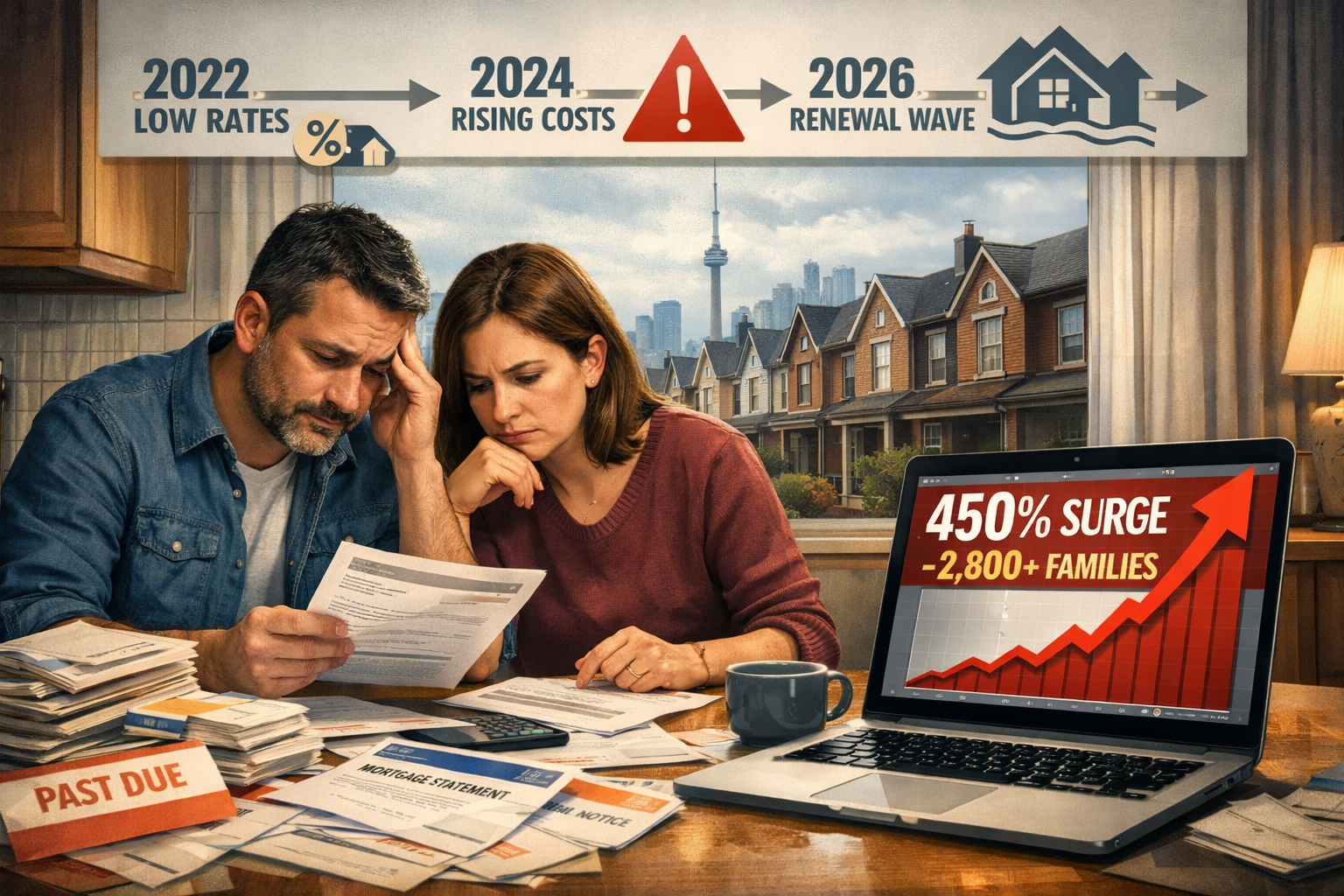
The numbers are alarming. Private Mortgages for Toronto Homeowners Battling 450% Delinquency Surge: Survival Tactics in March 2026 is not just a headline — it’s a financial emergency playing out in real time across the Greater Toronto Area (GTA). Since early 2022, mortgage arrears in Toronto have surged nearly 450%, leaving thousands of homeowners staring down Power of Sale notices, frozen HELOCs, and impossible renewal terms [1]. With over one million mortgages set to renew in June 2026, the window to act is narrowing fast.
This guide breaks down what’s happening, why private mortgages are becoming a critical lifeline, and exactly how distressed Toronto homeowners can protect their properties before it’s too late.
Key Takeaways 📌
- 2,797+ Toronto families were 90+ days delinquent as of Q3 2025, with projections reaching 3,500 by mid-2026 [10]
- Power of Sale listings in the GTA have risen 543% since 2022, signaling acute distress [1]
- Private mortgages (7–9% rates) are replacing traditional renewals for homeowners who miss the B-lender window
- Starting your renewal strategy 120–180 days early is now the minimum standard recommended by mortgage experts [1]
- CMHC confirms Toronto is Canada’s #1 hotspot for mortgage arrears concentration [4][5]
Understanding the 450% Delinquency Surge Hitting Toronto Homeowners
The Numbers Behind the Crisis
Toronto’s mortgage delinquency crisis didn’t appear overnight. It is the direct result of a perfect storm: ultra-low pandemic-era rates (some as low as 1.77%), aggressive buying in 2020–2021, a sharp rate-hike cycle, and now a brutal renewal wave [7].
Here’s where things stand in March 2026:
| Metric | Figure | Source |
|---|---|---|
| Toronto families 90+ days delinquent | ~2,797 (Q3 2025) | [1] |
| Projected delinquencies by mid-2026 | ~3,500 (0.5% rate) | [10] |
| GTA 90+ day delinquency rate | 0.39% | [2] |
| Ontario YoY delinquency increase | ~90% | [2] |
| Power of Sale listings increase since 2022 | +543% | [1] |
| Mortgages renewing in June 2026 | 1 million+ | [1] |
The GTA’s 0.39% delinquency rate is double British Columbia’s rate, making Toronto the undisputed epicenter of Canada’s mortgage stress [2]. CMHC’s February 2026 report confirms Toronto will lead Canada in persistent delinquency growth through Q4 2026, driven by high household debt, investor exits, and a weakening GTA labor market [4].
Why Toronto Is Uniquely Vulnerable
Three forces are colliding in Toronto that don’t exist at the same intensity elsewhere:
- The Renewal Wave — Mortgages locked in at historic lows in 2021 are now renewing at rates 15–26% higher, adding up to $576/month in new payment costs for fixed-rate borrowers [7]
- Investor Exits — Condo investors who bought at peak prices are selling at a loss or defaulting, flooding the market with distressed inventory
- HELOC Freezes — Major banks are tightening underwriting and freezing home equity lines of credit, removing the safety valve many homeowners relied on
💬 Tania Bourassa-Ochoa, CMHC Deputy Chief Economist, noted in February 2026: “The mortgage delinquency story is localized and concentrated” — and Toronto is at the center of it. [5]
For homeowners navigating the 2026 mortgage renewal shock through refinancing, understanding this landscape is the critical first step.

How Private Mortgages for Toronto Homeowners Battling the 450% Delinquency Surge Actually Work
What Is a Private Mortgage?
A private mortgage is a loan secured against real estate, funded by individual investors or private lending companies rather than banks or credit unions. In Ontario’s current environment, they have become a critical bridge for homeowners who:
- Have missed one or more mortgage payments
- Have been declined by A-lenders (major banks) or B-lenders
- Need fast approval to stop a Power of Sale proceeding
- Are self-employed with irregular income documentation
To understand the full mechanics, the complete guide on how private mortgages work in Ontario is an essential resource.
Private vs. Traditional Renewal: The Real Trade-Off
| Feature | Traditional Renewal (A-Lender) | B-Lender | Private Mortgage |
|---|---|---|---|
| Typical Rate (2026) | ~3.84% | 7–9% | 8–12% |
| Credit Score Required | 680+ | 600–680 | Flexible |
| Approval Speed | 2–4 weeks | 1–2 weeks | 24–72 hours |
| Income Verification | Strict | Moderate | Property-based |
| Term Length | 1–5 years | 1–3 years | 6–24 months |
| Lender Fees | Low | Moderate | Higher (1–3%) |
Private mortgages cost more — that’s the honest truth. But for a homeowner facing a Power of Sale, paying 10% interest for 12 months while rebuilding credit is far less damaging than losing the property entirely.
The growing demand for private and alternative B-lender mortgages reflects exactly this calculation being made by thousands of GTA homeowners right now.
Who Qualifies for a Private Mortgage in 2026?
Private lenders in Ontario primarily evaluate:
- ✅ Equity position — Most require 20–35% equity in the property
- ✅ Property location — Toronto properties are highly desirable to private lenders
- ✅ Exit strategy — A clear plan to refinance back to a traditional lender within 12–24 months
- ✅ Ability to service the debt — Even basic income verification helps
For homeowners who have already missed payments, understanding what happens if your mortgage renewal is denied is a crucial next step before approaching any lender.
Survival Tactics in March 2026: Your Step-by-Step Transition Plan
Private Mortgages for Toronto Homeowners Battling the 450% Delinquency Surge — Action Steps
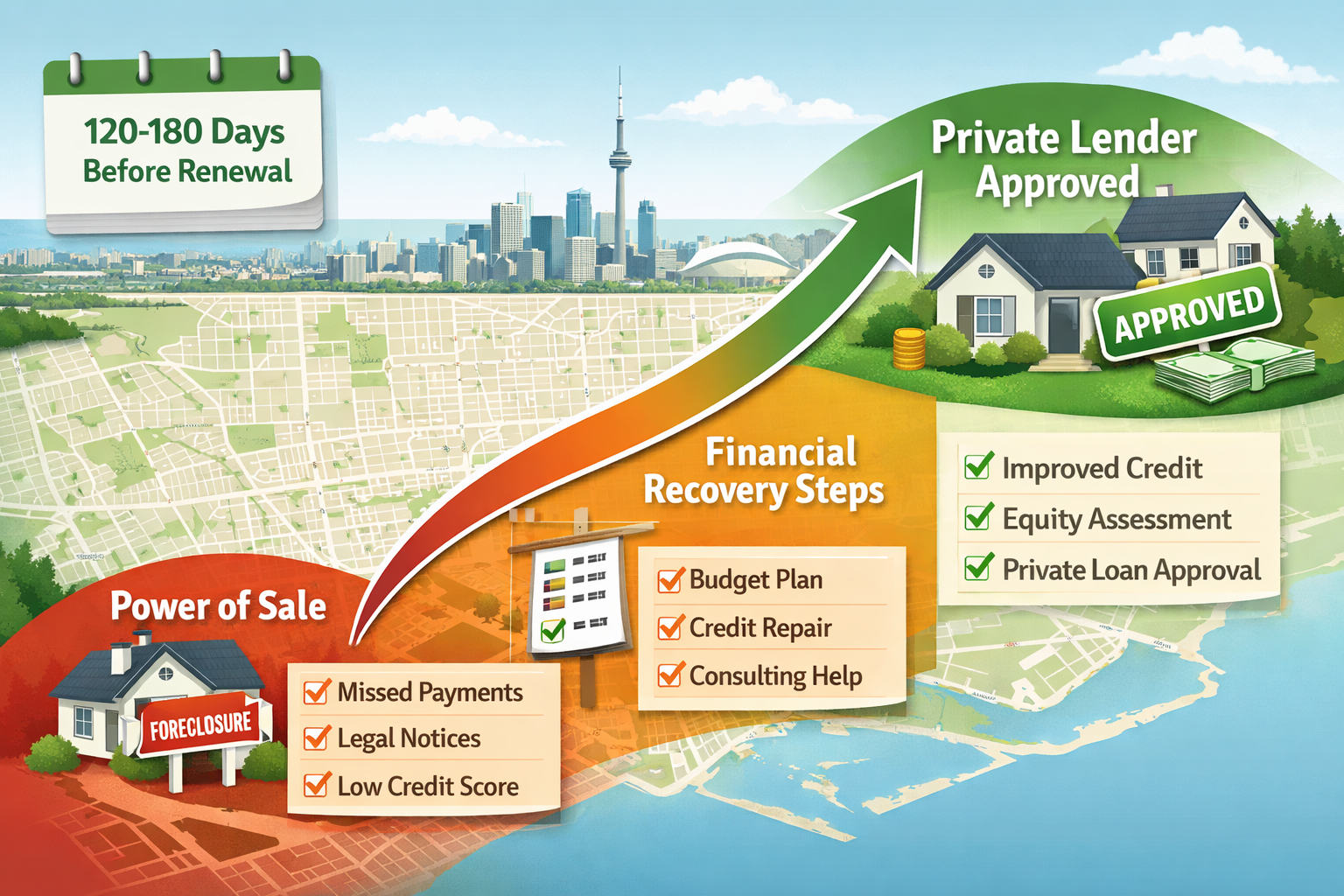
The clock is ticking. Here is a practical roadmap for homeowners in distress:
🗓️ Step 1: Start 120–180 Days Before Renewal
Mortgage expert Marcus Chen (CollectorHQ) is explicit: begin your renewal strategy 120–180 days early [1]. Once a borrower hits 90+ days in arrears, B-lender rates of 7–9% become the floor — and private rates push higher. Early action preserves options.
🔍 Step 2: Audit Your Equity Position
Request a current property appraisal. Toronto home values, while softer than 2022 peaks, still leave many homeowners with significant equity — the primary currency in private lending. Inventory sits at 5.0 months as of February 2026, meaning properties still sell [3].
📋 Step 3: Gather Your Financial Picture
Compile:
- Last 2 years of tax returns or Notice of Assessment
- 3–6 months of bank statements
- Current mortgage statement showing arrears
- Property tax receipts
Self-employed borrowers should review how self-employed borrowers in Toronto can navigate the 2026 mortgage stress test — private lenders are often more flexible here.
🤝 Step 4: Work With a Licensed Mortgage Broker
A broker with access to private lender networks can:
- Match your file to the right lender in 24–48 hours
- Negotiate lender fees (typically 1–3% of the loan)
- Structure the mortgage with a realistic exit plan
Avoid going directly to private lenders without representation — fees and terms vary wildly.
📈 Step 5: Build Your Exit Strategy Immediately
A private mortgage is a bridge, not a destination. From day one, work toward:
- Repairing credit (target 650+ for B-lender, 680+ for A-lender)
- Stabilizing income documentation
- Reducing other high-interest debt
The debt consolidation mortgage approach can be powerful here — rolling high-interest consumer debt into a private mortgage at a lower blended rate while clearing your credit profile.
🏦 Step 6: Understand the Stress Test for Re-Entry
When the time comes to refinance back to a traditional lender, you’ll need to pass the mortgage stress test. Planning for this from the start — rather than being surprised at renewal — is what separates homeowners who recover from those who don’t.
🚨 Warning Signs You Need to Act NOW
Don’t wait if you’re experiencing:
- Missed or late mortgage payments in the last 6 months
- A renewal letter with a rate significantly higher than your current rate
- A frozen or reduced HELOC
- Declining rental income from an investment property
- A Power of Sale notice or legal correspondence from your lender
💬 “The mortgage delinquency crisis in Toronto is real, but it is not inevitable for every homeowner. The difference between those who survive and those who lose their homes often comes down to timing and access to the right advice.” [1]
Conclusion: Don’t Wait for the Wave to Hit 🏠
The 450% surge in Toronto mortgage delinquencies is not a distant warning — it is the current reality for nearly 2,800 families, with projections pointing toward 3,500 by mid-2026 [10]. The June 2026 renewal wave will test over one million mortgages, and the GTA’s K-shaped recovery means some homeowners will thrive while others face Power of Sale proceedings [3][4].
Private mortgages are not a perfect solution — but they are a powerful one when used strategically and with a clear exit plan. They buy time, preserve equity, and prevent the permanent financial damage of a forced sale.
✅ Actionable Next Steps
- Call a licensed mortgage broker today if you are within 6 months of renewal or already in arrears
- Get a property appraisal to confirm your equity position
- Start your credit repair plan now — even small improvements open bigger doors
- Explore all options including B-lenders, debt consolidation mortgages, and private bridges before defaulting
- Do not ignore lender communications — proactive engagement always produces better outcomes than avoidance
Toronto homeowners who act in March 2026 still have options. Those who wait until summer may not.
References
[1] Mortgage Delinquency Crisis In Toronto 2026 When Should Private Mortgages Replace Traditional Renewals – https://everythingmortgages.ca/blog/mortgage-delinquency-crisis-in-toronto-2026-when-should-private-mortgages-replace-traditional-renewals/
[2] Why Canadian Banks Are Quietly Preparing For A Wave Of Mortgage Defaults – https://victoria.estate/blog/why-canadian-banks-are-quietly-preparing-for-a-wave-of-mortgage-defaults
[3] GTA Housing Market Update (YouTube) – https://www.youtube.com/watch?v=Cg4RXP-3Vq4
[4] Mortgage Renewal Wave Strains Some Regions Borrowers – https://www.cmhc-schl.gc.ca/observer/2026/mortgage-renewal-wave-strains-some-regions-borrowers
[5] Toronto Is Fast Becoming Canada’s Hotspot For Mortgage Arrears – https://www.mpamag.com/ca/mortgage-industry/industry-trends/toronto-is-fast-becoming-canadas-hotspot-for-mortgage-arrears/565202
[6] GTA Housing Market Update What February 2026 Means For Central Toronto Buyers And Sellers – https://lomeirwin.com/2026/03/05/gta-housing-market-update-what-february-2026-means-for-central-toronto-buyers-and-sellers/
[7] The 26 Payment Shock Reality Why Toronto Fixed Rate Renewers Are Turning To Private Mortgages In 2026 – https://everythingmortgages.ca/blog/the-26-payment-shock-reality-why-toronto-fixed-rate-renewers-are-turning-to-private-mortgages-in-2026/
[8] Financial Stability Indicators – https://www.bankofcanada.ca/rates/indicators/financial-stability-indicators/
[9] Toronto Housing Market – https://wowa.ca/toronto-housing-market
[10] Toronto Mortgage Delinquency Analysis (YouTube) – https://www.youtube.com/watch?v=PMEJjgmzh78
 Previous Page