March 20, 2026
The 2-Year Business History Barrier: How New Self-Employed Entrepreneurs in Toronto Can Qualify for Mortgages
Share this article:



Manzeel is an award-winning Mortgage Broker and the Owner of the Toronto-based mortgage, Everything Mortgages.
With 16 years of experience in the Canadian mortgage industry and a formal background in mortgage underwriting, Manzeel’s lending expertise gives him unique insight into whether a deal is feasible which empowers his clients to make more informed lending decisions faster.
He has been recognized as one of Canada’s Top 10 Mortgage Brokers by the national Canadian Mortgage Professionals (CMP) Association. Him and his team of 18 mortgage agents are proud to offer a mortgage experience that's built on honesty, trust, and integrity. He prides himself on the brokerage’s dedication to deliver an excellent client experience throughout the entire home loan process from pre-approval to post-funding.
Since moving to Toronto in 1998, Manzeel has successfully launched and scaled several businesses from the ground up, ranging from a mortgage brokerage and a vast real estate investment portfolio to a private financing eCommerce platform. He continues to be a leader in the real estate industry as he uses his analytical expertise to seek new real estate investment opportunities.
As a tech junkie and avid sports enthusiast, when Manzeel’s not working with clients, you can find him reading technology blogs, playing squash or watching tennis with his two boys.
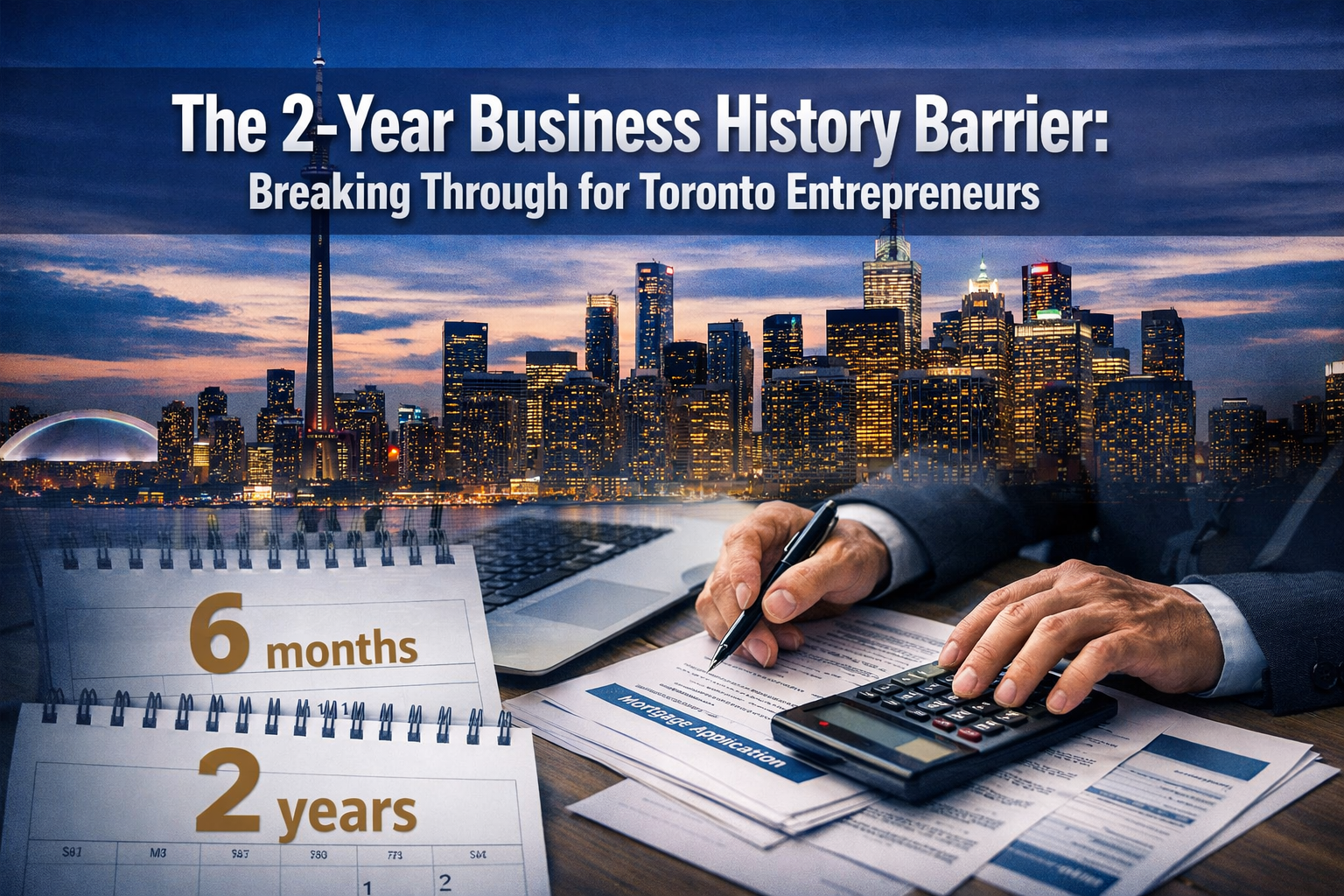
Starting a business in Toronto is exciting, but when it comes time to buy a home, many new entrepreneurs hit a frustrating roadblock: the 2-year business history barrier. Traditional lenders require at least two years of tax returns to prove income stability, leaving newly self-employed professionals feeling locked out of homeownership. But here’s the good news—alternative pathways exist that don’t require waiting two full years.
The 2-Year Business History Barrier: How New Self-Employed Entrepreneurs in Toronto Can Qualify for Mortgages is a challenge that thousands of business owners face in 2026, yet many don’t realize that stated-income programs, alternative lenders, and strategic documentation can open doors much sooner than expected. This comprehensive guide reveals exactly how new entrepreneurs can navigate mortgage qualification without the traditional 2-year wait.
Key Takeaways
✅ Traditional lenders require 2 years of tax documentation, but Alternative Lenders accept as little as 6 months of bank statements for stated-income mortgages
✅ New entrepreneurs need a minimum 10% down payment (versus 5% for those with 2+ years of history) and can borrow up to 90% of home value with mortgage insurance
✅ Credit scores matter more for newer businesses—maintain at least 600 to qualify, with stronger scores improving approval odds
✅ Documentation strategy is critical—business bank statements, contracts, invoices, and proof of recurring revenue replace traditional tax returns
✅ Working with specialized mortgage brokers who understand self-employed applications dramatically increases approval chances for entrepreneurs under 2 years
Understanding the 2-Year Business History Barrier for Self-Employed Borrowers
Why Traditional Lenders Require Two Years
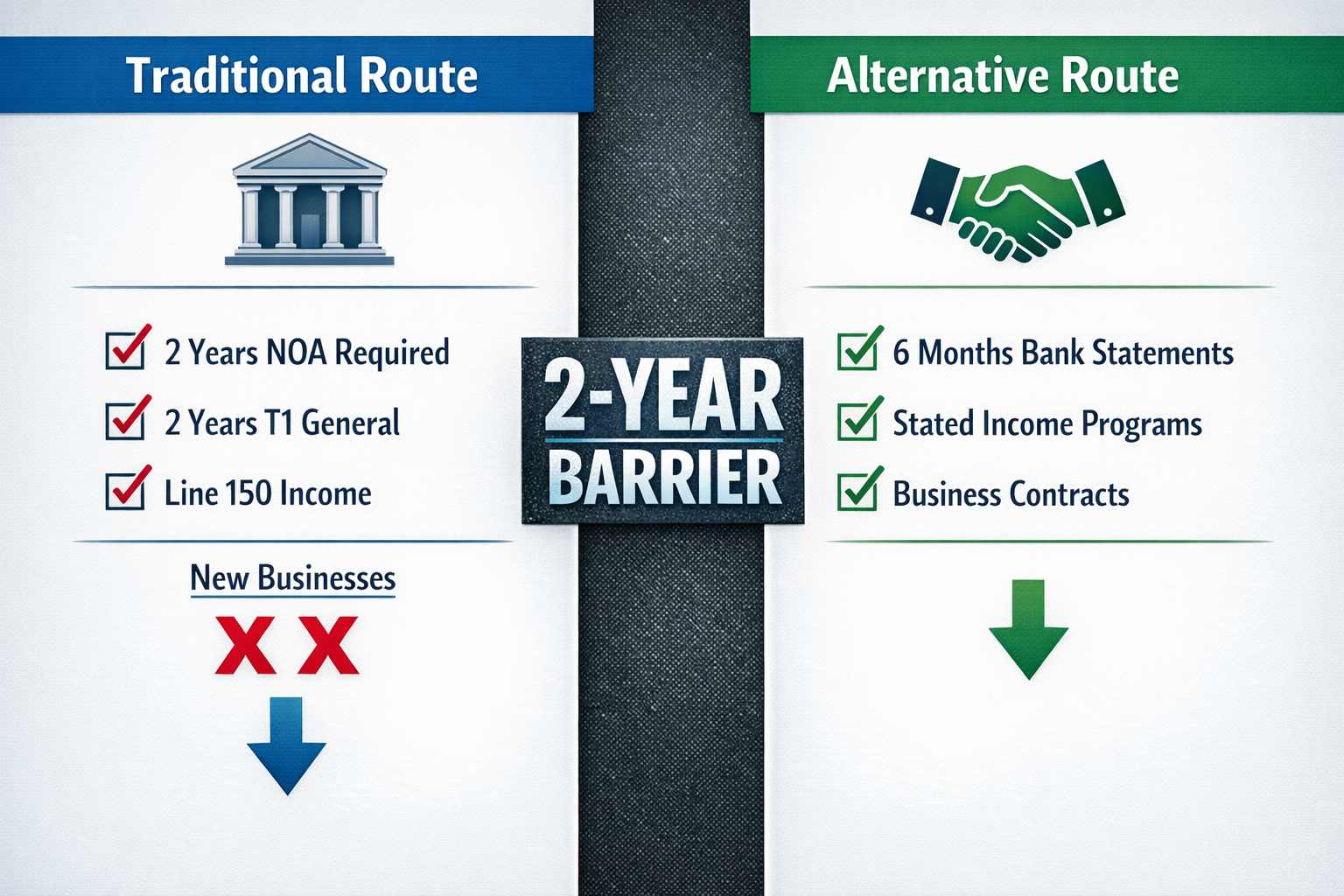
Major banks and A-lenders in Canada have maintained the 2-year income documentation requirement as their baseline standard for Self-Employed Mortgage applicants in 2026. This policy exists because lenders want to see consistent, provable income over multiple tax years to assess risk accurately [3].
Traditional lenders specifically require:
- Two years of Notices of Assessment (NOA) from the Canada Revenue Agency
- Two years of T1 General tax returns showing business income
- Line 150 net income as the primary qualification metric
- Consistent or increasing income trends across both years
For established business owners, this makes sense. But for new entrepreneurs in Toronto—whether you’re a freelance consultant, independent contractor, e-commerce owner, or professional service provider—this creates an impossible catch-22: you can’t prove two years of income you haven’t yet earned.
The Reality for New Toronto Entrepreneurs
Toronto’s entrepreneurial landscape is thriving, with thousands launching businesses in technology, consulting, creative services, and professional trades each year. Many of these new business owners earn strong, stable incomes from day one, yet traditional mortgage qualification treats them as high-risk simply due to the calendar.
Consider these common scenarios:
💼 IT consultant who left corporate employment to start their own practice, earning $120,000+ annually but only 8 months into business
🏗️ Licensed contractor who launched their own construction company after years of experience, with signed contracts worth $200,000+ but only 1 year of tax filings
📊 Marketing consultant who built a client roster generating $8,000+ monthly but hasn’t filed their second tax return yet
All of these professionals have real, verifiable income—they simply can’t meet the arbitrary 2-year threshold that traditional lenders demand.
How New Self-Employed Entrepreneurs Can Qualify Without 2 Years of History
Stated-Income Mortgages: The 6-Month Solution
The most accessible pathway for The 2-Year Business History Barrier: How New Self-Employed Entrepreneurs in Toronto Can Qualify for Mortgages is through stated-income mortgage programs offered by alternative lenders. These programs specifically serve self-employed borrowers who cannot provide traditional tax documentation [1].
Key requirements for stated-income mortgages:
📋 Minimum 6 months of business bank statements showing consistent deposits and active operations [7]
💰 At least 10% down payment (compared to 5% minimum for traditional applications) [3]
📊 Credit score of 600 minimum for at least one borrower [1]
🏠 Maximum 90% loan-to-value ratio with mortgage default insurance through Sagen MI or Canada Guaranty [1]
These programs work by evaluating your actual cash flow rather than your filed tax returns. Lenders review your business banking activity to confirm that money is consistently coming in, demonstrating business viability without requiring two years of NOAs.
Documentation That Replaces Tax Returns
When you can’t provide two years of tax history, alternative lenders accept different forms of proof to verify your income and business stability:
Business bank statements (6-12 months): Your most important document, showing regular deposits, business expenses, and positive cash flow patterns [7]
Signed contracts and invoices: Proof of ongoing work and future income, especially valuable for project-based businesses [3]
Business registration and licensing: Demonstrates legitimacy and compliance with provincial regulations
GST/HST registration and payment records: Shows you’re operating properly and meeting tax obligations (critical—any outstanding balances are red flags) [3]
Client testimonials or letters: Third-party validation of your business relationships and reliability
Profit and loss statements: Even unaudited statements prepared by you or your bookkeeper help demonstrate financial health
For professionals in specialized fields, additional documentation can strengthen applications. Self-employed lawyers, doctors, and IT consultants often have professional credentials and client contracts that provide additional credibility.
The Gross-Up Income Strategy
One powerful technique that mortgage brokers use in 2026 is the “gross-up” method for calculating self-employed income [2]. This approach recognizes that self-employed individuals often write off legitimate business expenses that reduce their taxable income but don’t reflect their true earning power.
For example, if your Line 150 shows $60,000 but your actual business revenue was $100,000 (with $40,000 in deductible expenses like vehicle, home office, equipment), some lenders will “gross up” your income by adding back a portion of those expenses to better reflect your actual earning capacity [2].
This strategy works best when:
- You have strong business bank statements showing higher gross revenue
- Your expenses are clearly business-related and documented
- You’re working with a broker who understands how to present this to lenders
Alternative Lender Options and Requirements in Toronto
Types of Lenders That Work With New Entrepreneurs
Understanding the Canadian lending landscape helps you target the right institutions for your situation. Here’s how different lender categories approach The 2-Year Business History Barrier:
A-Lenders (Traditional Banks)
Who they are: Major banks like RBC, TD, Scotiabank, BMO, CIBC, and National Bank
Requirements: Strict 2-year income documentation through NOAs and T1 Generals [4]
Best for: Established self-employed individuals with 2+ years of consistent income history
Not suitable for: Entrepreneurs with less than 2 years in business
B-Lenders (Alternative Lenders)
Who they are: Federally regulated financial institutions like Equitable Bank, MCAP, First National, and specialized mortgage finance companies
Requirements: More flexible—often accept stated-income with 6-12 months of bank statements [1]
Interest rates: Typically 0.5-2% higher than A-lenders
Best for: New entrepreneurs with strong credit (600+) and 10-20% down payment
Advantages: Can qualify without 2-year tax history, faster approval processes
C-Lenders (Private Lenders)
Who they are: Private mortgage investment corporations, individual investors, and specialized private lending firms
Requirements: Minimal income documentation, focus primarily on property value and equity
Interest rates: Significantly higher (8-15%+ in 2026)
Best for: Very new businesses (under 6 months), credit challenges, or bridge financing
Strategy: Often used as short-term solutions (1-2 years) until you can qualify with B or A lenders
For more information on this option, explore Private Mortgage options in Ontario.
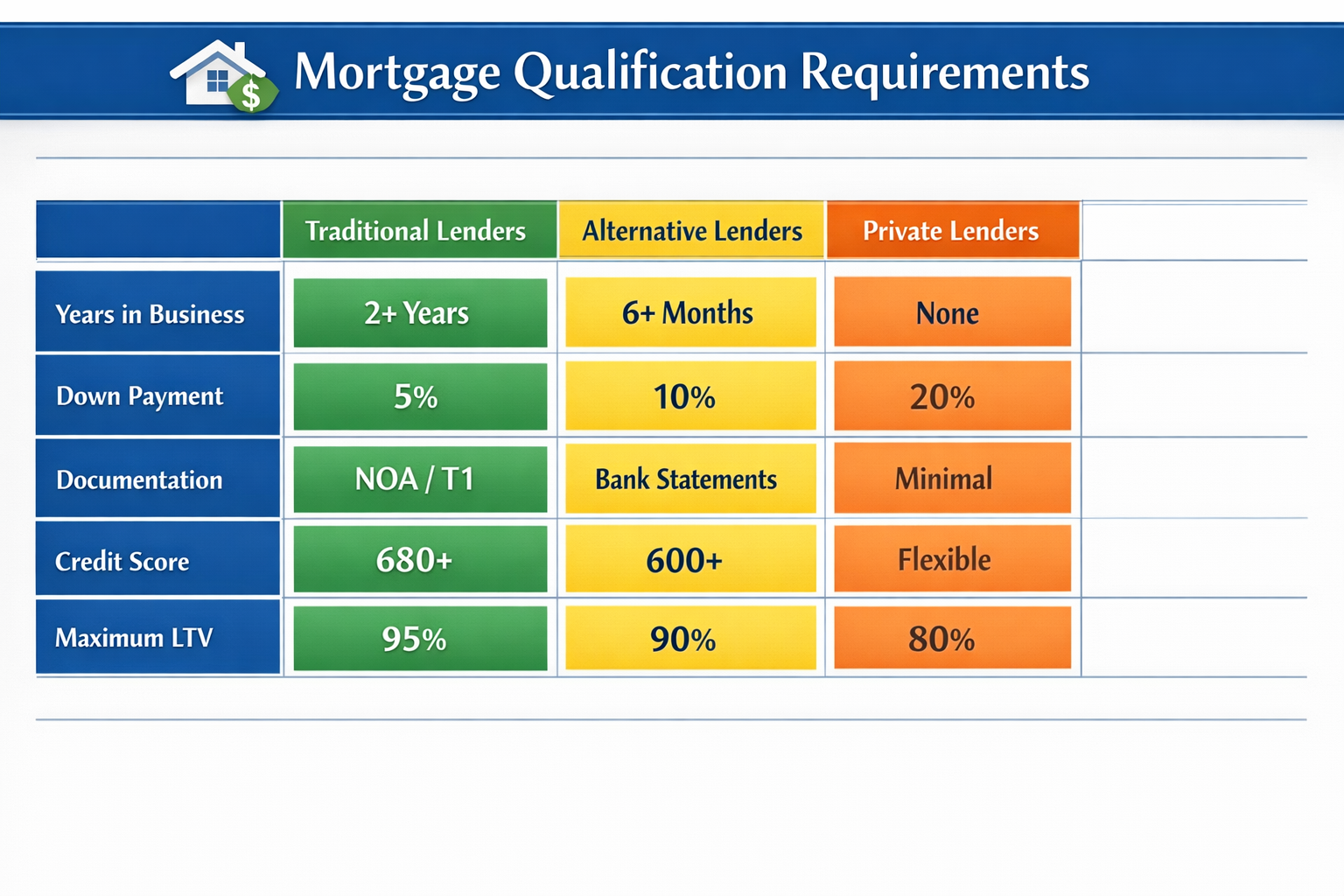
Comparing Qualification Requirements
| Requirement | A-Lenders | B-Lenders | C-Lenders |
|---|---|---|---|
| Years in Business | 2+ years | 6+ months | No minimum |
| Minimum Down Payment | 5% | 10-20% | 20-35% |
| Credit Score | 680+ | 600+ | Flexible |
| Income Documentation | 2 years NOA + T1 | Bank statements | Minimal |
| Maximum LTV | 95% (with insurance) | 90% (with insurance) | 65-80% |
| Interest Rate Range | Prime + 0-1% | Prime + 0.5-2% | 8-15%+ |
| Property Value Limits | No limit | Varies ($750K-$1.5M) [4] | Varies |
Toronto-Specific Considerations
Toronto’s real estate market presents unique challenges for self-employed borrowers:
Higher property values: The average Toronto home price requires larger down payments, making the 10% minimum for stated-income programs more substantial
Income verification scrutiny: Toronto lenders are particularly careful about income documentation due to higher loan amounts
Property value caps: Some alternative lenders impose maximum property values (e.g., National Bank’s $750,000 loan limit in the Toronto area) [4]
Competition: High demand means lenders can be selective, making strong applications even more critical
Understanding closing costs in Toronto is also essential, as these additional expenses can add 1.5-4% to your total home purchase cost.
Building a Strong Mortgage Application as a New Entrepreneur
Critical Success Factors for Approval
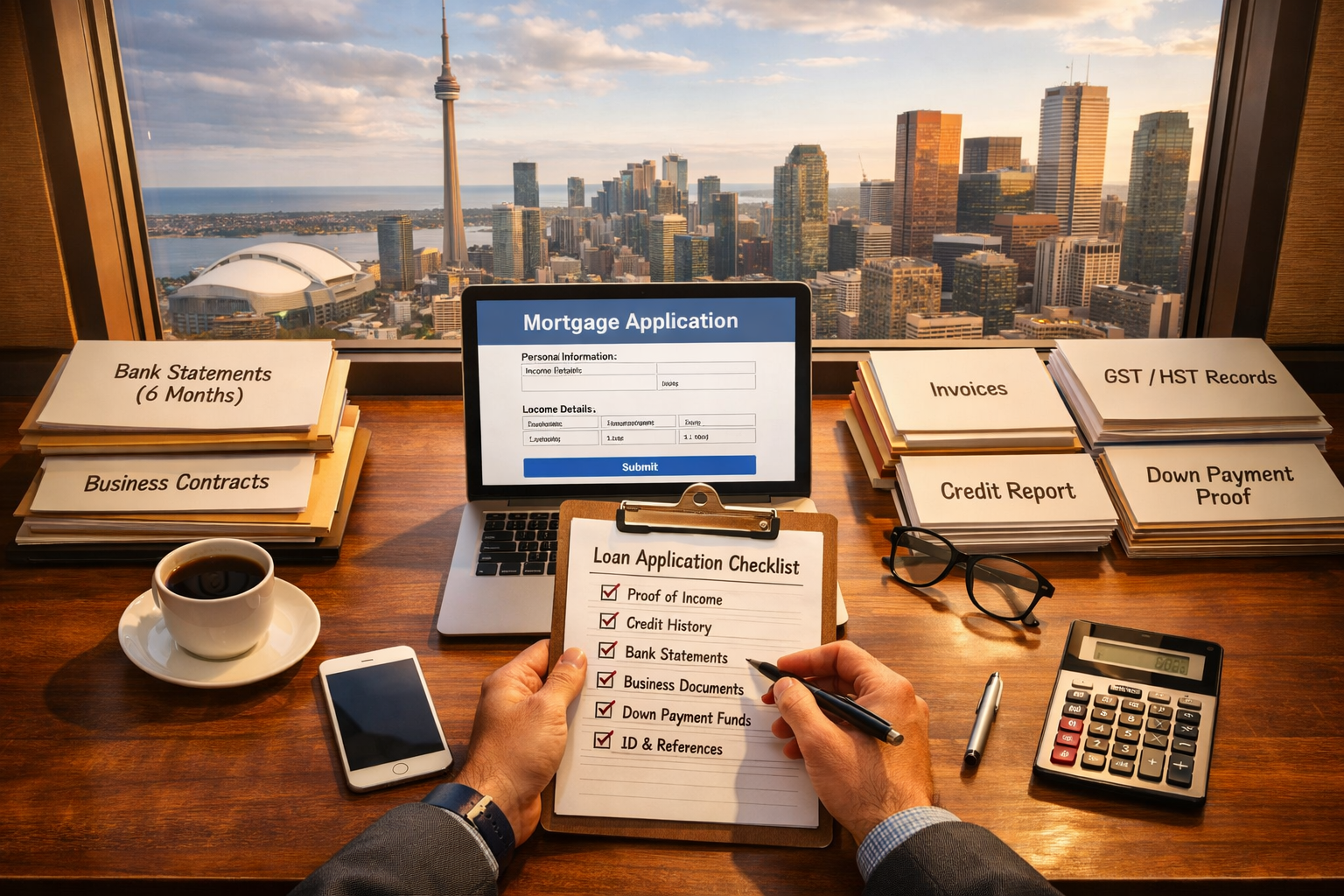
When you’re working around The 2-Year Business History Barrier, every element of your application matters more. Here’s what makes the difference between approval and rejection:
1. Credit Score Optimization 🎯
Your personal credit becomes even more important when you can’t provide extensive business history. Target these benchmarks:
- Minimum 600: Required for most B-lender stated-income programs [1]
- 650+: Opens more lender options with better rates
- 700+: Significantly improves approval odds and rate offerings
Action steps:
- Check your credit report for errors and dispute any inaccuracies
- Pay down credit card balances below 30% utilization
- Never miss payments in the 6-12 months before applying
- Avoid opening new credit accounts during the application period
Learn more about the role of credit scores in mortgage approval.
2. Down Payment Strategy 💵
Since stated-income programs require minimum 10% down (versus 5% for traditional applications), your down payment source and size matter significantly [3]:
Acceptable sources:
- Personal savings accumulated before or after starting your business
- RRSP withdrawals through the Home Buyers’ Plan (up to $60,000 for first-time buyers in 2026)
- Gifts from immediate family members (with proper gift letters)
- Sale proceeds from a previous property
Optimal strategy: Aim for 15-20% down if possible. This:
- Eliminates mortgage insurance premiums
- Reduces your monthly payments
- Improves lender confidence
- May qualify you for better rates
3. Business Banking Documentation 📊
Your business bank statements are your most powerful tool. Lenders specifically look for:
✅ Consistent monthly deposits: Regular income patterns demonstrate stability
✅ Adequate operating balance: Maintaining positive balances shows financial management
✅ Clear business activity: Transactions that clearly relate to your business operations
✅ No NSF or overdrafts: Clean banking history signals reliability
✅ Separation from personal accounts: Dedicated business banking demonstrates professionalism
Pro tip: If your business banking is messy or mixed with personal transactions, consider opening a dedicated business account and running clean operations through it for 6 months before applying.
4. Tax Compliance 📋
Even though you don’t have 2 years of tax history, what you do have must be impeccable:
⚠️ No outstanding CRA balances: Any money owed to the CRA—especially unpaid HST/GST—is a major red flag that can kill your application [3]
✅ Current on all tax obligations: File and pay everything on time
✅ Registered for GST/HST if required: Shows you’re operating legitimately
✅ Clean tax history: Previous years (if you were employed before) should show no issues
5. Proof of Business Viability 🚀
Alternative lenders want to see that your business is real, active, and likely to continue generating income:
Strong indicators:
- Signed contracts extending into the future
- Recurring clients or subscription revenue
- Professional website and business presence
- Business licenses and professional certifications
- Growing client base or revenue trends
- Positive online reviews or testimonials
For specific professions: If you’re in a specialized field, emphasize your credentials and track record. Resources like our guides for self-employed business owners provide additional strategies.
Common Mistakes to Avoid
🚫 Mixing personal and business finances: Keep separate accounts and clear records
🚫 Applying too early: Wait until you have at least 6 solid months of business banking
🚫 Hiding or downplaying income: Be transparent about all revenue sources
🚫 Ignoring credit score issues: Address problems before applying, not during
🚫 Going directly to banks: Traditional banks will likely reject you—start with brokers
🚫 Providing incomplete documentation: Missing documents delay or derail applications
For a comprehensive list, review common mistakes to avoid when applying for a mortgage.
Working With Mortgage Brokers Who Specialize in Self-Employed Applications
Why Broker Expertise Matters
The single most important decision you’ll make when navigating The 2-Year Business History Barrier: How New Self-Employed Entrepreneurs in Toronto Can Qualify for Mortgages is choosing the right mortgage professional. Not all brokers are created equal when it comes to self-employed applications.
What specialized brokers provide:
🎯 Access to alternative lenders: Brokers work with dozens of B-lenders who accept stated-income applications—lenders you can’t access directly
📊 Application strategy: They know exactly how to present your income, structure your documentation, and position your application for approval
💡 Gross-up calculations: Experienced brokers understand how to maximize your qualifying income using legitimate strategies [2]
⏱️ Time savings: Instead of getting rejected by multiple banks, brokers match you with appropriate lenders immediately
💰 Rate shopping: Brokers can compare offers from multiple alternative lenders to find your best rate
🛡️ Problem-solving: If issues arise, brokers know how to address lender concerns and salvage applications
Questions to Ask Potential Brokers
When interviewing mortgage brokers, ask these specific questions to identify self-employed specialists:
“What percentage of your clients are self-employed?” (Look for 30%+)
“How many clients have you helped who had less than 2 years of business history?” (Should have multiple recent examples)
“Which alternative lenders do you work with for stated-income mortgages?” (Should name specific B-lenders)
“What’s your success rate with self-employed applications?” (Should be 70%+ for qualified applicants)
“Can you explain how gross-up income calculations work?” (Should demonstrate clear understanding)
“What documentation will you need from me specifically?” (Should provide detailed, customized list)
The Broker-Guided Application Process
Here’s what to expect when working with a specialized broker:
Step 1: Initial Consultation (30-60 minutes)
- Review your business situation and income
- Assess your credit and down payment
- Determine realistic qualification amount
- Explain available lender options
Step 2: Documentation Gathering (1-2 weeks)
- Provide business bank statements (6-12 months)
- Submit contracts, invoices, and business records
- Authorize credit check
- Provide down payment verification
Step 3: Application Strategy (1 week)
- Broker prepares your application package
- Calculates optimal income presentation
- Selects target lenders
- Addresses potential concerns proactively
Step 4: Lender Submission (1-2 weeks)
- Broker submits to selected lender(s)
- Responds to any additional documentation requests
- Negotiates terms and rates
- Manages underwriting process
Step 5: Approval and Closing (2-4 weeks)
- Receive conditional approval
- Complete any final requirements
- Finalize rate and terms
- Close on your property
Total timeline: Typically 6-8 weeks from initial consultation to closing for well-prepared applicants.
Before starting the process, it’s wise to understand the importance of qualifying for a mortgage before buying property.
Strategic Pathways for Different Business Stages
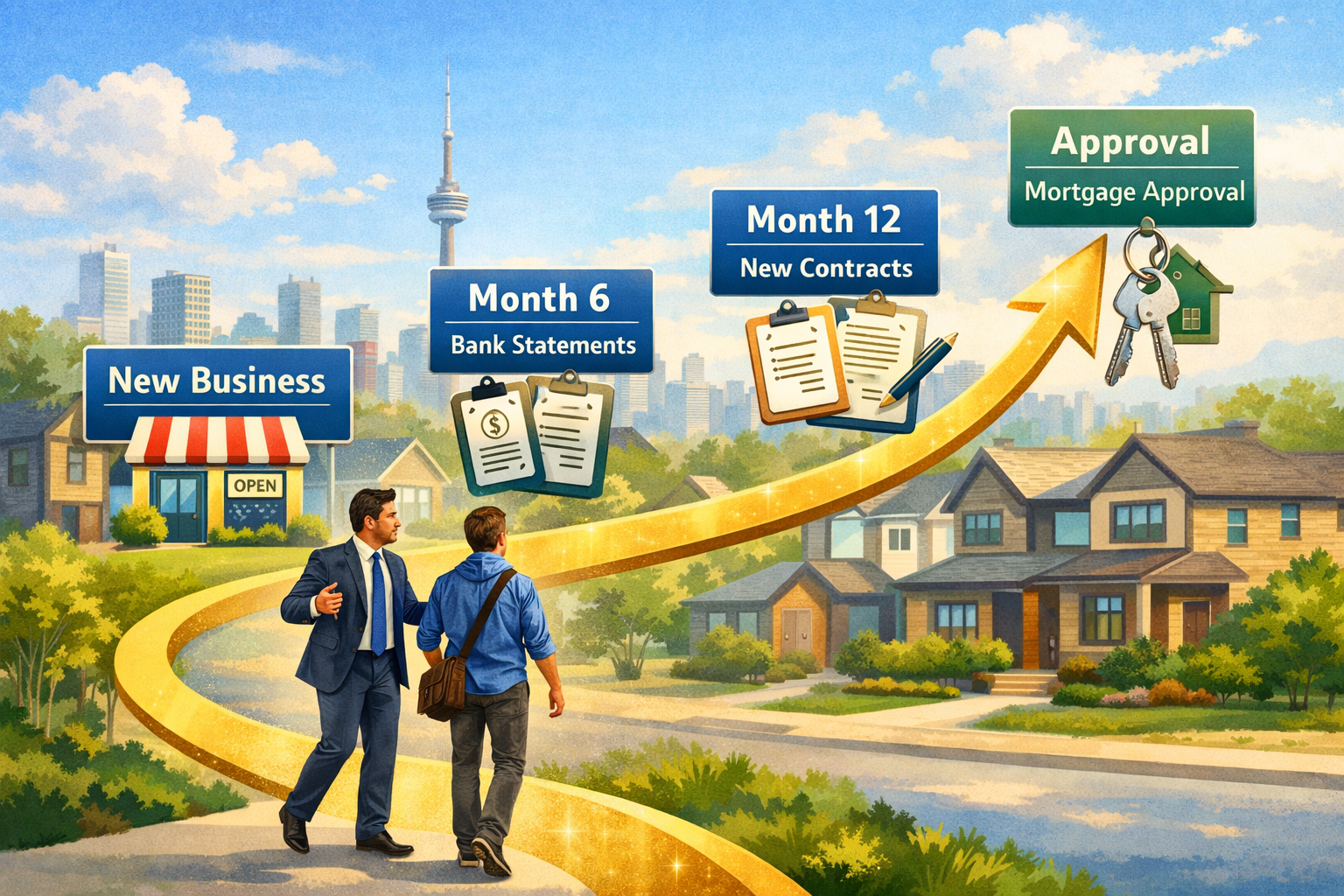
If You’re 6-12 Months Into Business
Your best options:
- Stated-income mortgages through B-lenders [1]
- Focus on building strong business banking records
- Aim for 15-20% down payment if possible
Action plan:
- Open dedicated business bank account if you haven’t already
- Ensure 6+ months of consistent deposits are documented
- Gather all contracts and invoices showing ongoing work
- Check and optimize your personal credit score
- Save for 10-15% down payment plus closing costs
- Connect with specialized mortgage broker
- Prepare comprehensive business documentation package
Realistic expectations:
- Interest rates 1-2% higher than A-lender rates
- Maximum 90% LTV with mortgage insurance
- More documentation requirements than traditional applications
- Approval possible but requires strong overall application
If You’re 12-24 Months Into Business
Your best options:
- Stated-income programs with stronger positioning [1]
- Consider waiting until 2-year mark if you’re close (within 6 months)
- Potentially qualify for better B-lender programs
Action plan:
- File your first full tax return if you haven’t yet
- Continue building business banking documentation
- Maintain or improve credit score
- Accumulate larger down payment (15-20%+)
- Document business growth and stability
- Consider waiting until 24-month mark if very close
- Work with broker to compare stated-income vs. waiting
Strategic decision: If you’re 18-20 months into business, calculate whether waiting 4-6 months to hit the 2-year mark would save you significant interest costs versus buying now with a stated-income program.
If You’re Under 6 Months Into Business
Your best options:
- Private lenders for short-term financing [C-lenders]
- Consider waiting until 6-month mark for B-lender access
- Focus on building documentation during waiting period
Action plan:
- Establish excellent business banking practices immediately
- Document everything—contracts, invoices, revenue
- Build or maintain strong personal credit
- Save aggressively for down payment (20%+ ideal)
- Consider short-term private financing if purchase is urgent
- Plan to refinance to B or A lender after 6-12 months
- Consult with broker about optimal timing
Reality check: If you’re very new (under 3 months), seriously consider waiting. The cost difference between private lending (8-15%+ rates) and B-lending (prime + 1-2%) is substantial. Unless there’s a compelling reason to buy immediately, patience often saves tens of thousands of dollars.
Special Considerations for Specific Professions
Certain professions have unique advantages or considerations:
Licensed professionals (lawyers, doctors, engineers):
- Professional credentials add credibility
- May qualify for specialized programs
- See our guides for self-employed lawyers and doctors
IT consultants and tech contractors:
- Contract work is well-understood by lenders
- Strong hourly rates help qualification
- Review our IT consultant mortgage guide
Real estate investors:
- Consider implications for future rental property investments
- See investing in rental properties as self-employed
Conclusion: Your Roadmap to Mortgage Approval as a New Toronto Entrepreneur
The 2-Year Business History Barrier: How New Self-Employed Entrepreneurs in Toronto Can Qualify for Mortgages is not an insurmountable obstacle—it’s a challenge with clear, proven solutions. While traditional banks maintain rigid 2-year requirements, the alternative lending landscape in 2026 offers viable pathways for entrepreneurs at every business stage.
Key success factors to remember:
✅ Stated-income programs work with as little as 6 months of business banking history
✅ Documentation is everything—clean, comprehensive records make or break applications
✅ Credit scores matter more when business history is limited—maintain 600+ minimum
✅ Down payment size improves options—aim for 10-20% to access better programs
✅ Specialized brokers are essential—they know which lenders work with newer businesses
✅ Tax compliance is non-negotiable—any CRA balances will derail your application
✅ Timing matters—applying at 6, 12, or 24 months each opens different options
Your Next Steps
If you’re ready to apply now:
- Gather your documentation: 6-12 months of business bank statements, contracts, invoices, business registration, and GST/HST records
- Check your credit: Obtain your credit report and address any issues
- Calculate your down payment: Confirm you have 10-20% plus closing costs
- Connect with a specialized broker: Find a mortgage professional experienced with self-employed applications in Toronto
- Prepare your business story: Be ready to explain your business model, revenue sources, and growth trajectory
If you need more time:
- Establish clean business banking: Open dedicated business accounts and maintain clear records
- Build your credit score: Pay everything on time and reduce credit utilization
- Save aggressively: Accumulate 15-20% down payment for better options
- Document everything: Keep all contracts, invoices, and business records organized
- Stay tax compliant: File and pay all obligations on time
- Consult a broker early: Get advice on optimal timing and documentation strategy
The path to homeownership as a new self-employed entrepreneur in Toronto requires more preparation than traditional employment, but it’s absolutely achievable. With the right strategy, documentation, and professional guidance, you can overcome the 2-year barrier and secure the home you want—without waiting years to qualify.
Don’t let outdated lending requirements delay your homeownership dreams. Start building your application strategy today, and take the first step toward your Toronto home.
For more comprehensive guidance on mortgages for self-employed borrowers, explore our detailed resources and connect with mortgage professionals who specialize in helping entrepreneurs achieve their homeownership goals.
References
[1] Self Employed Mortgage Options Qualifications In Canada – https://www.nesto.ca/mortgage-basics/self-employed-mortgage-options-qualifications-in-canada/
[2] Selfemployed Heres How To Qualify For A Mortgage In 2026 – https://toddaverymortgages.secureapponline.com/news-and-events/news/selfemployed-heres-how-to-qualify-for-a-mortgage-in-2026/
[3] Self Employed Mortgage – https://www.ratehub.ca/self-employed-mortgage
[4] Self Employed – https://www.nbc.ca/personal/mortgages/self-employed.html
[7] Guide – https://tridacmortgages.com/services/self-employed-mortgage/guide/
 Previous Page