March 13, 2026
Toronto Private Mortgages for Newcomer Investors: Navigating 2026 CMHC Restrictions and Equity Pathways
Share this article:



Manzeel is an award-winning Mortgage Broker and the Owner of the Toronto-based mortgage, Everything Mortgages.
With 16 years of experience in the Canadian mortgage industry and a formal background in mortgage underwriting, Manzeel’s lending expertise gives him unique insight into whether a deal is feasible which empowers his clients to make more informed lending decisions faster.
He has been recognized as one of Canada’s Top 10 Mortgage Brokers by the national Canadian Mortgage Professionals (CMP) Association. Him and his team of 18 mortgage agents are proud to offer a mortgage experience that's built on honesty, trust, and integrity. He prides himself on the brokerage’s dedication to deliver an excellent client experience throughout the entire home loan process from pre-approval to post-funding.
Since moving to Toronto in 1998, Manzeel has successfully launched and scaled several businesses from the ground up, ranging from a mortgage brokerage and a vast real estate investment portfolio to a private financing eCommerce platform. He continues to be a leader in the real estate industry as he uses his analytical expertise to seek new real estate investment opportunities.
As a tech junkie and avid sports enthusiast, when Manzeel’s not working with clients, you can find him reading technology blogs, playing squash or watching tennis with his two boys.
Every year, thousands of skilled immigrants arrive in Toronto with capital, ambition, and a clear plan to build wealth through real estate — only to hit a wall of bureaucratic restrictions that seem designed for someone else’s financial story. In 2026, that wall just got taller. Toronto Private Mortgages for Newcomer Investors: Navigating 2026 CMHC Restrictions and Equity Pathways has become one of the most searched topics in GTA real estate circles, and for good reason. CMHC has rolled out sweeping changes to its mortgage insurance program, tightening rules that disproportionately affect newcomers. But where one door closes, another opens — and private mortgage lending is stepping into the gap.
Key Takeaways 🏠
- CMHC’s February 2026 overhaul significantly raised insurance premiums and imposed new rental income restrictions, making traditional financing harder for newcomers.
- Private mortgage lenders approve based on property equity, not employment history — a critical advantage for recent immigrants.
- The equity pathway strategy allows newcomers to use private financing as a bridge, then refinance with B-lenders or banks once Canadian credit history is established.
- Multi-title property bundling has been eliminated by CMHC, pushing investors toward single-title multi-family buildings (5+ units).
- Bank of Canada rates are forecast to hold at 2.25% through early 2026, providing a relatively stable borrowing environment for private mortgage planning [3].

Understanding the 2026 CMHC Landscape for Newcomer Investors
The Canada Mortgage and Housing Corporation has never been a newcomer-friendly institution by design — it was built for the salaried, the credit-established, and the long-term resident. But 2026’s changes have sharpened that edge considerably.
What Changed on February 12, 2026?
On February 12, 2026, CMHC implemented a comprehensive overhaul of its MLI Select mortgage insurance program, driven by international Basel 3 banking standards and new federal capital reserve requirements [2]. Here is what changed:
| Change | Old Rule | New Rule (2026) |
|---|---|---|
| Ground-up construction insurance premium (>90% financing) | ~4–5% | ~7% [2] |
| Acquisition/renovation premium | Variable | 5.9%–6.15% by LTV [2] |
| Occupancy penalty | None | +0.25% if not fully occupied at projected rents [2] |
| Rental income resets | Allowed at market rate on turnover | CPI-only increases [2] |
| Environmental compliance | Remediation allowed during construction | 100% site confirmation required before disbursement [2] |
| Multi-title property bundling | Permitted | Eliminated [2] |
💬 “When a city’s housing regulations become 10% more restrictive, house prices increase by approximately 14%.” — CMHC Research, 2026
This regulatory tightening is already showing up in the data. CMHC reported further slowing of housing starts in February 2026, with no turnaround in sight — a troubling signal for anyone counting on new supply to soften Toronto’s market.
Why Newcomers Are Disproportionately Affected
Newcomers face a compounding problem. CMHC insurance is typically required when a down payment is under 20%, and qualifying requires stable Canadian income history. Most newcomers — even those with significant overseas assets — lack the T4 slips, Notice of Assessments, and two-year employment records that traditional lenders demand. For a deeper look at how income documentation affects mortgage eligibility, see this guide on getting a mortgage in Canada with a new job.
The elimination of multi-title bundling is particularly damaging. Many newcomer investors preferred to acquire several smaller properties across the GTA. That strategy is now effectively locked out of CMHC-insured financing [2].
Toronto Private Mortgages for Newcomer Investors: Navigating 2026 CMHC Restrictions and Equity Pathways Through Alternative Lending
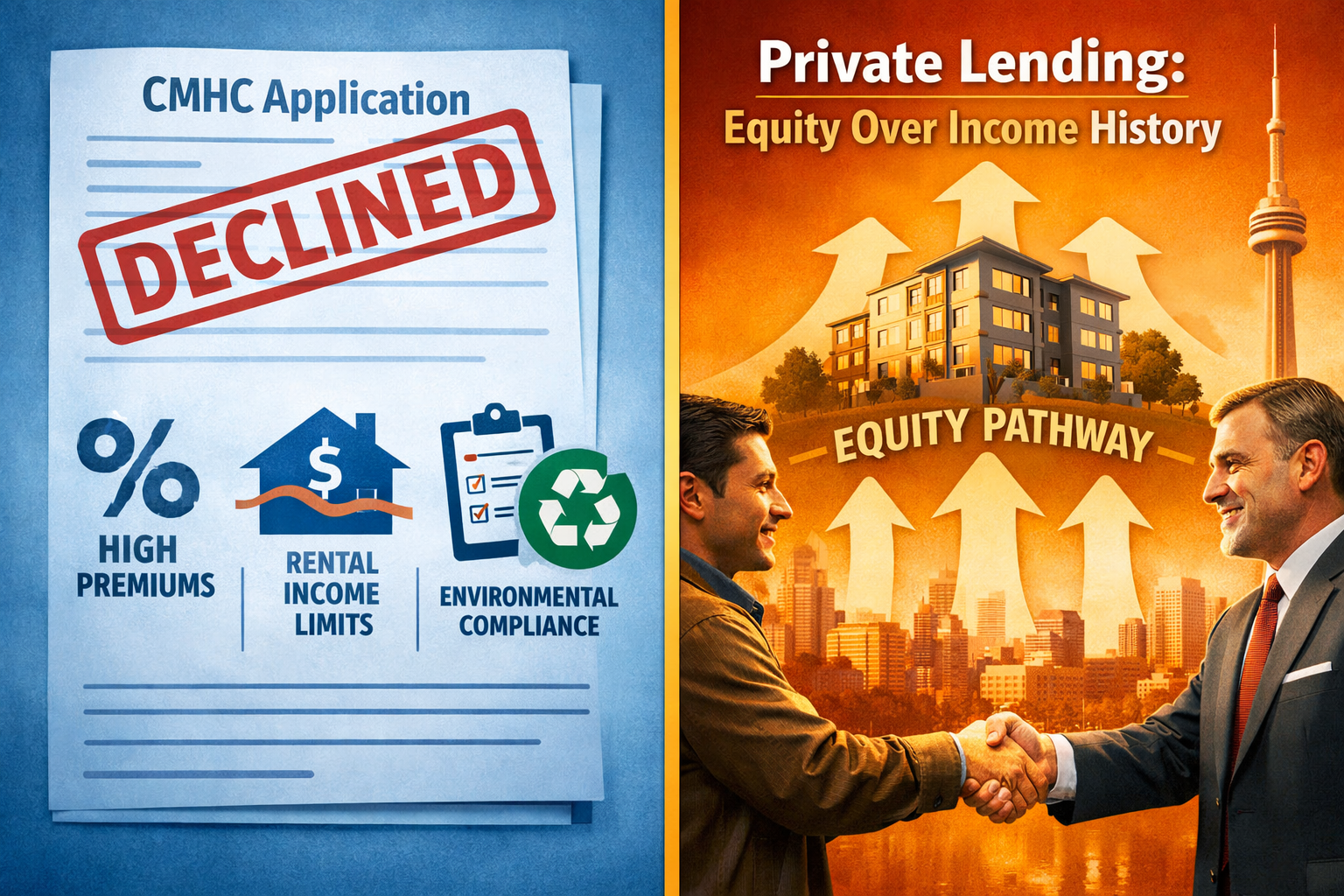
This is where the private mortgage market becomes not just useful — but essential.
How Private Mortgages Work for Newcomers
Private mortgage lenders operate outside the CMHC framework. They are not bound by stress tests, income verification requirements, or the same capital reserve rules that govern banks. Their primary underwriting criterion is simple: how much equity is in the property?
This is transformative for newcomers who arrive with:
- 💰 Significant down payments (often 25–40%) from overseas savings or family support
- 🏗️ Interest in multi-family or income-producing Toronto properties
- 📋 Limited or no Canadian credit history
- 🧾 Non-traditional income (foreign business income, remittances, self-employment)
Private lenders like Alpine Credits, Cannect, and Canadalend currently hold a small but growing share of the Canadian mortgage market [10]. While Big 6 banks dominate at roughly 67% market share, private lenders offer what banks cannot: approval based on asset value, not employment history.
For newcomers who are also self-employed or run businesses, understanding how self-employed borrowers can qualify for mortgages without T4 slips in 2026 is equally critical.
The B-Lender Bridge: A Middle Path
Between big banks and private lenders sit B-lenders and monoline lenders — institutions like First National, MCAP, and CMLS. These lenders control approximately 9% of the Canadian mortgage market and offer more flexible underwriting than banks, at rates lower than private lenders.
The strategic sequence for newcomer investors often looks like this:
- ✅ Year 1–2: Secure private mortgage with 30–40% equity, purchase GTA multi-family property
- ✅ Year 2–3: Build Canadian credit history, establish rental income documentation
- ✅ Year 3–4: Refinance with a B-lender at improved rates
- ✅ Year 4–5: Qualify for conventional bank financing or HELOC access
This pathway mirrors what successful newcomer investors are already doing across Etobicoke, North York, and Scarborough. For those exploring the current market window, this first-time buyers guide to Etobicoke and North York emerging markets in 2026 provides valuable neighbourhood-level context.
Real-World Scenario: The Equity Pathway in Action
Consider a newcomer investor who arrived in Toronto in 2024 from the Philippines with $280,000 CAD in savings. By mid-2026, she has:
- No Canadian credit history
- Rental income from a basement unit (undocumented by Canadian standards)
- A target: a 6-unit apartment building in Scarborough listed at $1.1M
Through a private lender:
- Down payment: $330,000 (30%)
- Private mortgage: $770,000 at ~9–11% interest
- 12-month term with interest-only payments
After 18 months of documented Canadian rental income and two credit card accounts, she refinances with a B-lender at 6.5% — saving hundreds per month and building toward long-term equity.
Understanding second mortgage options in Toronto can also help newcomers unlock equity from an initial property to fund subsequent acquisitions.
Navigating 2026 CMHC Restrictions and Equity Pathways: Practical Steps for Newcomer Investors

What to Look for in a Private Mortgage Lender
Not all private lenders are equal. The market is consolidating — FSRA’s 2024 survey confirmed that individual private lenders are losing ground to institutional operators. This is actually good news for borrowers: institutional private lenders tend to offer more transparent terms, better compliance, and more consistent underwriting.
Key criteria when evaluating private lenders:
- 📊 Loan-to-Value (LTV) limits — Most cap at 65–75% LTV for investment properties
- 📅 Term length — Typically 1–2 years; ensure exit strategy is feasible
- 💸 Interest rates — Expect 8–12% in 2026’s environment
- 📝 Lender fees — Usually 1–3% of loan value
- 🔍 Transparency — Avoid lenders who cannot clearly explain all costs
The Bank of Canada has held its benchmark rate at 2.25% for two consecutive announcements, with Scotiabank forecasting a potential rise to 2.75% by year-end [3]. This means private mortgage rates are unlikely to drop significantly — but they also won’t spike dramatically in the near term.
Costs Newcomers Must Budget For
Beyond the mortgage itself, newcomer investors must account for several Toronto-specific costs. The comprehensive guide to closing costs in Toronto is essential reading before signing any purchase agreement.
Additionally, Toronto’s Vacant Home Tax can catch newcomer investors off guard if a property sits unoccupied during renovation or tenant transition. Understanding Toronto’s Vacant Home Tax can save thousands in unexpected penalties.
The Stress Test Reality
Even B-lenders apply a version of the mortgage stress test. For newcomers planning their refinancing exit from a private mortgage, understanding how stress testing works in the Canadian mortgage market is non-negotiable preparation.
Shared Equity and Alternative Structures
Some newcomer investors are also exploring shared equity arrangements — where a co-investor or equity partner shares ownership in exchange for contributing to the down payment. This can reduce the private mortgage amount required and improve LTV ratios. Learn more about what a shared equity mortgage means in Canada before pursuing this route.
Conclusion: Your Action Plan for 2026
Toronto Private Mortgages for Newcomer Investors: Navigating 2026 CMHC Restrictions and Equity Pathways is not just a financing challenge — it is a strategic opportunity. While CMHC’s 2026 rule changes have raised barriers for institutional financing, they have simultaneously elevated the importance of the private lending market as a genuine, equity-based pathway to Toronto real estate ownership.
The newcomers who will succeed in 2026 are those who:
- Accept the private mortgage as a bridge, not a destination — plan your refinancing exit from day one
- Prioritize single-title multi-family properties (5+ units) that align with the new CMHC framework for future refinancing
- Document everything — Canadian rental income, bank statements, and credit-building activity from the moment of purchase
- Work with a licensed mortgage broker who specializes in alternative lending and newcomer profiles
- Budget conservatively — account for private lender fees, closing costs, and the Vacant Home Tax in all projections
Toronto’s real estate market remains one of Canada’s most resilient long-term investment environments. The rules have changed, but the equity opportunity has not. With the right private mortgage strategy, newcomer investors can still build lasting wealth in the GTA — one property at a time. 🏙️
References
[1] Investors – https://www.trilend.com/investors/ [2] Watch – https://www.youtube.com/watch?v=sLso4AyiVdw [3] Mortgage Rates Toronto – https://www.ratehub.ca/mortgage-rates-toronto [4] bensonmortgages.ca – https://bensonmortgages.ca [5] 2026 2028 Accessibility Plan – https://www.cmhc-schl.gc.ca/about-us/corporate-reporting/transparency/accessibility-at-cmhc/2026-2028-accessibility-plan [6] Toronto Ontario – https://myperch.io/mortgage-rates-canada/toronto-ontario/ [7] Mortgages For Newcomers – https://www.td.com/ca/en/personal-banking/solutions/new-to-canada/mortgages-for-newcomers [8] Government Announces Boldest Mortgage Reforms In Decades To Unlock Homeownership For More Canadians – https://www.canada.ca/en/department-finance/news/2024/09/government-announces-boldest-mortgage-reforms-in-decades-to-unlock-homeownership-for-more-canadians.html [9] Mortgages Rates – https://www.scotiabank.com/ca/en/personal/rates-prices/mortgages-rates.html [10] Mortgage Investor Canada – https://wowa.ca/mortgage-investor-canada
 Previous Page