February 23, 2026
Vertical SaaS Showdown: 8 Industry-Specific Tools Dominating 2025 Markets
Share this article:



Manzeel is an award-winning Mortgage Broker and the Owner of the Toronto-based mortgage, Everything Mortgages.
With 16 years of experience in the Canadian mortgage industry and a formal background in mortgage underwriting, Manzeel’s lending expertise gives him unique insight into whether a deal is feasible which empowers his clients to make more informed lending decisions faster.
He has been recognized as one of Canada’s Top 10 Mortgage Brokers by the national Canadian Mortgage Professionals (CMP) Association. Him and his team of 18 mortgage agents are proud to offer a mortgage experience that's built on honesty, trust, and integrity. He prides himself on the brokerage’s dedication to deliver an excellent client experience throughout the entire home loan process from pre-approval to post-funding.
Since moving to Toronto in 1998, Manzeel has successfully launched and scaled several businesses from the ground up, ranging from a mortgage brokerage and a vast real estate investment portfolio to a private financing eCommerce platform. He continues to be a leader in the real estate industry as he uses his analytical expertise to seek new real estate investment opportunities.
As a tech junkie and avid sports enthusiast, when Manzeel’s not working with clients, you can find him reading technology blogs, playing squash or watching tennis with his two boys.
The software-as-a-service landscape is experiencing a dramatic shift in 2026. While horizontal SaaS platforms once ruled the market, a new breed of specialized solutions is taking center stage. Vertical SaaS Showdown: 8 Industry-Specific Tools Dominating 2025 Markets reveals how tailored software platforms are revolutionizing entire industries—from construction sites to hospital operating rooms. With the vertical SaaS market valued at $94.86 billion in 2026 and growing rapidly, these industry-focused tools are proving that specialization beats generalization when it comes to solving real business problems. 🚀
The numbers tell a compelling story. Companies using vertical SaaS solutions report higher retention rates, better revenue efficiency, and stronger competitive advantages compared to their horizontal counterparts. This isn’t just about software anymore—it’s about understanding the unique workflows, regulations, and challenges that define each industry.
Key Takeaways
- Vertical SaaS platforms outperform horizontal solutions in retention and revenue efficiency, with the market reaching $94.86 billion in 2026
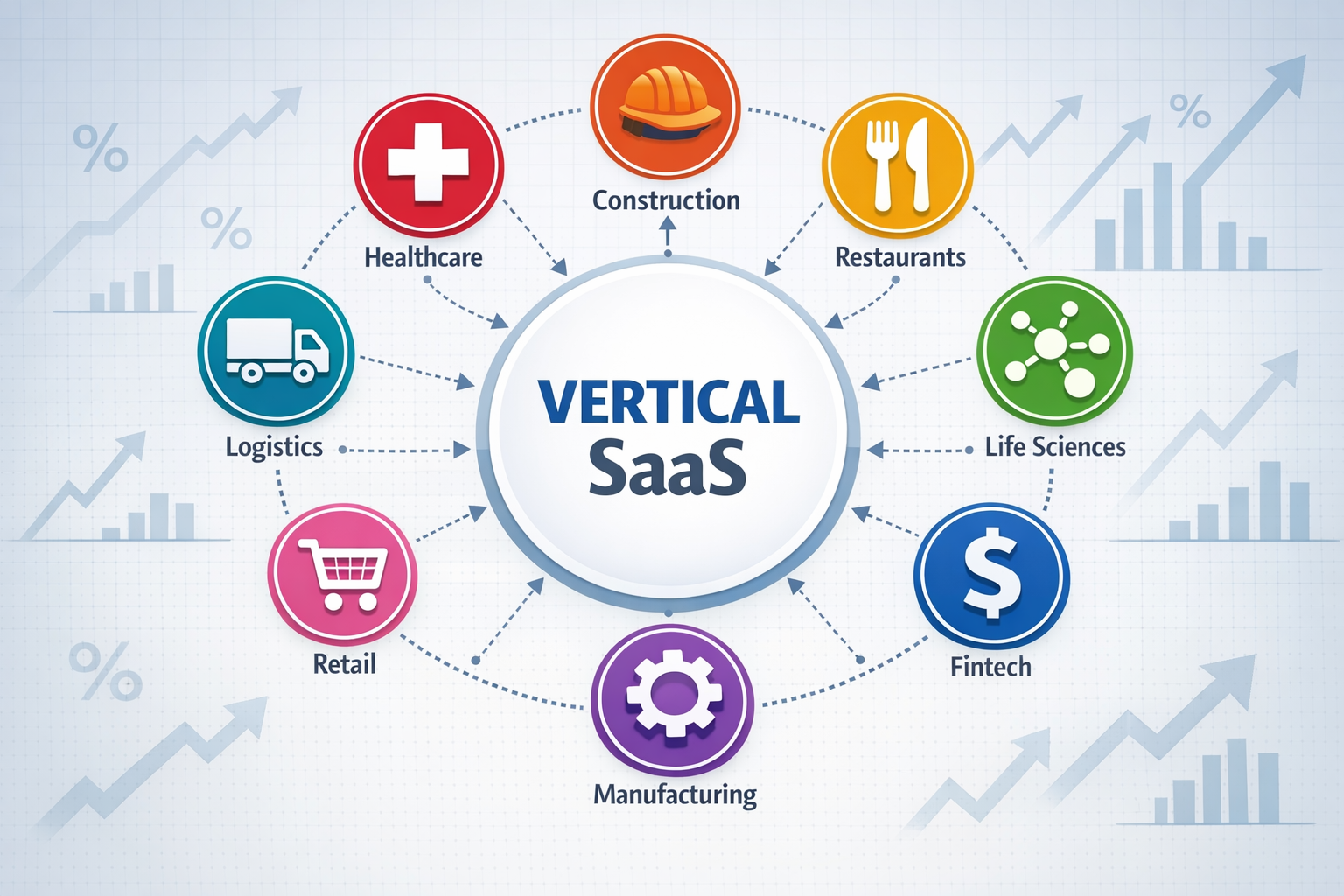
- Eight industry-specific tools are leading the charge across healthcare, construction, restaurants, life sciences, fintech, manufacturing, retail, and logistics
- Embedded finance features are becoming standard, with many platforms earning more from payments and lending than traditional subscriptions
- AI capabilities combined with industry expertise give vertical SaaS platforms a significant competitive edge over generic tools
- M&A activity exceeded 2,600 transactions in 2025, signaling massive consolidation and growth opportunities in the vertical SaaS space
Understanding the Vertical SaaS Revolution
What Makes Vertical SaaS Different?
Unlike horizontal SaaS platforms that serve multiple industries with generic features, vertical SaaS solutions are built from the ground up for specific sectors. These platforms understand industry jargon, comply with sector-specific regulations, and integrate seamlessly with existing workflows.
Think of it this way: a horizontal project management tool might work for any business, but a construction-specific platform knows about building permits, safety compliance, and subcontractor management. This deep specialization creates stickier customers who can’t easily switch to competitors.
The benefits are clear:
- Higher customer retention rates (often exceeding 95%)
- Better unit economics through industry-specific upsells
- Stronger competitive moats that are harder to replicate
- Premium pricing power due to specialized value delivery
- Faster implementation with pre-built industry workflows
The Market Dynamics Driving Growth
Several powerful forces are propelling the Vertical SaaS Showdown: 8 Industry-Specific Tools Dominating 2025 Markets forward. Private equity investments in enterprise SaaS reached $1.38 billion in just the first seven months of 2025—up from $833 million for all of 2024. This capital influx is fueling rapid expansion and consolidation.
Additionally, embedded finance capabilities are transforming vertical SaaS from simple software subscriptions into comprehensive financial platforms. Many vertical SaaS companies now process over $1 billion in payment volumes, earning more from transaction fees than software licenses. The embedded finance market is growing at 32.8% annually and is projected to explode through 2030.
Much like how mortgage brokers provide specialized expertise in the financial services sector, vertical SaaS platforms offer deep domain knowledge that generic software simply cannot match.
The 8 Industry-Specific Tools Leading the Vertical SaaS Showdown
1. Veeva Systems: Life Sciences Dominance 🧬
Veeva Systems has established itself as the undisputed leader in life sciences vertical SaaS. Founded in 2007 and going public in 2013, Veeva provides cloud-based solutions specifically designed for pharmaceutical and biotechnology companies.
Key offerings include:
- Vault QMS for quality management and drug approval processes
- AI-driven sales tools that help pharmaceutical reps target healthcare providers
- Secure cloud storage compliant with FDA regulations
- Clinical trial management systems
- Regulatory submission software
Veeva’s success stems from understanding the complex regulatory environment of life sciences. Their platforms help companies navigate FDA requirements, manage clinical trials, and bring drugs to market faster. This specialization has made Veeva nearly irreplaceable for major pharmaceutical companies.
2. Procore Technologies: Construction’s Digital Foundation 🏗️
Procore Technologies is transforming how construction projects are managed worldwide. Founded in 2002 and going public in 2021, Procore now operates in over 125 countries, connecting owners, general contractors, and specialty contractors on a single platform.
Core capabilities:
- Project management with real-time collaboration
- Financial management including budgeting and invoicing
- Quality and safety compliance tracking
- Document management with version control
- Mobile-first design for on-site access
Construction is notoriously fragmented, with multiple stakeholders, complex timelines, and tight margins. Procore eliminates inefficiencies by centralizing communication, documentation, and workflows. The platform reduces project delays, prevents cost overruns, and improves safety compliance—all critical factors in construction success.
3. Toast: Revolutionizing Restaurant Operations 🍽️
Toast has become the go-to platform for restaurants and hospitality businesses seeking to modernize their operations. This vertical SaaS solution combines point-of-sale (POS) systems with inventory management, online ordering, and payment processing.
Toast’s comprehensive features:
- Cloud-based POS with offline functionality
- Barcode integration for accurate order-taking
- Inventory tracking with automated reordering
- Kitchen display systems for order management
- Customer loyalty programs
- Integrated payment processing
The restaurant industry operates on razor-thin margins, making efficiency critical. Toast understands the unique challenges of food service—from managing perishable inventory to coordinating front-of-house and back-of-house operations. By embedding payments directly into their platform, Toast also captures transaction revenue, creating a powerful dual-revenue model.
4. Epic Systems: Healthcare’s Electronic Health Pioneer 🏥
Epic Systems pioneered electronic health monitoring (EHM) solutions that have become the backbone of modern healthcare delivery. Epic’s platforms centralize patient data, making it accessible in real-time to healthcare providers across different facilities.
Epic’s transformative solutions:
- Comprehensive EHR (Electronic Health Records)
- Patient portal for appointment scheduling and test results
- Clinical decision support tools
- Revenue cycle management
- Population health analytics
- Interoperability with other healthcare systems
Healthcare providers using Epic report improved patient outcomes, reduced medical errors, and better care coordination. The platform’s ability to aggregate patient data across multiple touchpoints creates a complete health picture that supports better clinical decisions.
Similar to how understanding credit scores is crucial in mortgage approvals, Epic’s comprehensive patient data is essential for quality healthcare delivery.
5. Impala InTech: Custom Vertical Software Excellence 💼
Impala InTech stands out by creating highly customized vertical software solutions across multiple industries including healthcare, fintech, manufacturing, retail, and logistics. Unlike one-size-fits-all platforms, Impala InTech tailors each solution to eliminate industry-specific inefficiencies.
Impala InTech’s approach:
- Custom workflow design based on industry best practices
- Integration with legacy systems
- Scalable architecture for growing businesses
- Industry-specific compliance built-in
- Dedicated support teams with domain expertise
This customization-first approach allows Impala InTech to serve industries that are often overlooked by larger vertical SaaS providers. By deeply understanding each sector’s unique challenges, they create solutions that deliver immediate value and strong ROI.
6. Vertical SaaS in Fintech: Embedded Finance Leaders 💳
The fintech sector has seen explosive growth in vertical SaaS platforms that embed financial services directly into industry workflows. These platforms are projected to exceed $84 billion in 2023, growing at 32.8% annually through 2030.
Key fintech vertical SaaS capabilities:
- Embedded payments within industry-specific workflows
- Lending products tailored to sector needs
- Banking-as-a-service integrations
- Automated reconciliation and accounting
- Compliance management for financial regulations
For example, construction platforms now offer contractor financing, while healthcare platforms provide patient payment plans. This embedded approach creates seamless experiences and generates significant transaction revenue beyond software subscriptions.
Just as self-employed borrowers need specialized mortgage solutions, businesses in various industries benefit from fintech tools designed specifically for their operational realities.
7. Manufacturing and Supply Chain Vertical SaaS ⚙️
Manufacturing vertical SaaS platforms address the complex challenges of production planning, inventory management, and supply chain coordination. These tools integrate with IoT sensors, robotics, and quality control systems to optimize manufacturing operations.
Manufacturing vertical SaaS features:
- Production scheduling with capacity planning
- Quality management systems (QMS)
- Supply chain visibility across vendors
- Predictive maintenance using AI
- Compliance tracking for industry standards
- Real-time inventory optimization
Manufacturers using vertical SaaS report reduced downtime, lower inventory costs, and improved product quality. The platforms’ ability to integrate with existing manufacturing execution systems (MES) and enterprise resource planning (ERP) tools makes them invaluable for digital transformation initiatives.
8. Retail and E-commerce Vertical Platforms 🛒
Retail vertical SaaS solutions help merchants manage omnichannel operations, from in-store POS to online marketplaces. These platforms understand retail-specific challenges like seasonal inventory, promotional pricing, and customer experience management.
Retail vertical SaaS capabilities:
- Unified commerce across all sales channels
- Inventory management with demand forecasting
- Customer relationship management (CRM)
- Loyalty program management
- Analytics and reporting on sales trends
- Integrated payment processing
The retail landscape has become increasingly complex, with customers expecting seamless experiences across physical stores, websites, and mobile apps. Vertical SaaS platforms designed for retail provide the infrastructure to deliver these experiences while maintaining operational efficiency.
Why Vertical SaaS Outperforms Horizontal Solutions
Superior Retention and Revenue Metrics
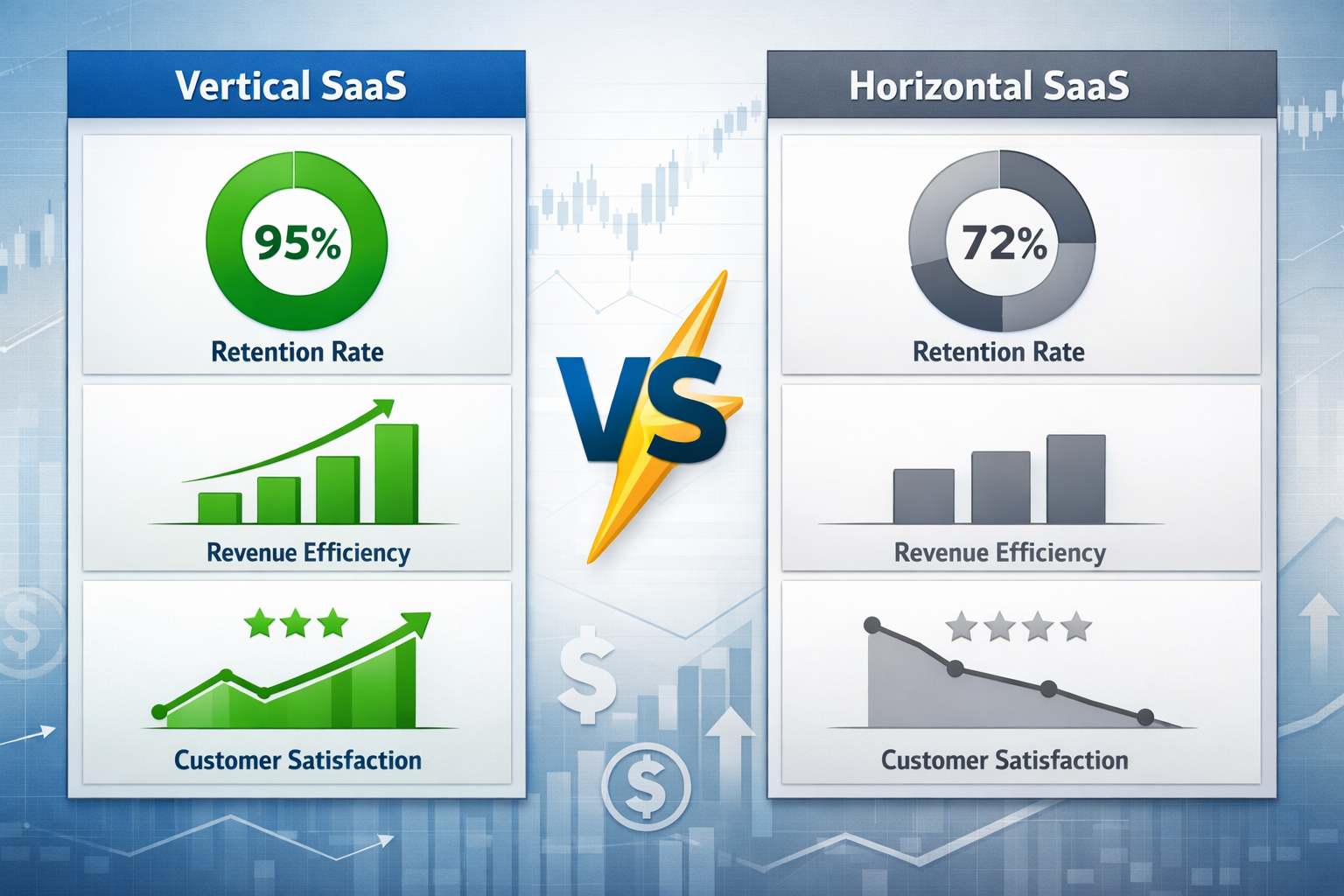
The Vertical SaaS Showdown: 8 Industry-Specific Tools Dominating 2025 Markets demonstrates clear performance advantages. Industry data from 2025 confirms that vertical SaaS platforms consistently outperform horizontal competitors in key metrics:
| Metric | Vertical SaaS | Horizontal SaaS |
|---|---|---|
| Customer Retention | 95%+ | 85-90% |
| Net Revenue Retention | 120-130% | 100-110% |
| Time to Value | 2-4 weeks | 3-6 months |
| Customer Lifetime Value | 3-5x higher | Baseline |
| Gross Margins | 75-85% | 70-80% |
These superior metrics stem from several factors:
Deep product-market fit: Vertical platforms solve specific problems that generic tools cannot address effectively.
Higher switching costs: Industry-specific customizations and integrations make it difficult for customers to change platforms.
Expansion revenue: Vertical platforms can upsell industry-specific modules and services that horizontal platforms cannot offer.
Network effects: Within industries, vertical platforms often become the standard, creating powerful network effects.
The AI Advantage in Vertical SaaS
Artificial intelligence is amplifying the advantages of vertical SaaS platforms. According to a May 2025 Bond Capital report, vertical platforms leverage proprietary industry data to become true “domain experts” that can unbundle legacy tools.
AI capabilities in vertical SaaS:
- Predictive analytics using industry-specific data patterns
- Automated workflows based on sector best practices
- Intelligent recommendations informed by peer benchmarks
- Natural language processing trained on industry terminology
- Computer vision for industry-specific applications
For example, construction vertical SaaS platforms use AI to predict project delays based on weather patterns, permit approval times, and subcontractor availability. Healthcare platforms use AI to identify patients at risk of readmission. These capabilities are only possible with deep industry data and expertise.
Much like how mortgage stress testing uses specific financial criteria to assess borrower capacity, vertical SaaS AI models use industry-specific parameters to deliver accurate predictions and recommendations.
Investment and M&A Trends Shaping the Vertical SaaS Landscape
Record-Breaking Deal Activity
The vertical SaaS market experienced unprecedented M&A activity in 2025, with over 2,600 global transactions. This consolidation wave is driven by several factors:
Strategic buyers seeking to expand into new verticals or strengthen existing positions. Large horizontal SaaS companies are acquiring vertical specialists to add industry depth to their portfolios.
Private equity interest has surged, with PE firms recognizing the superior unit economics and retention rates of vertical platforms. PE investments in enterprise SaaS reached $1.38 billion in the first seven months of 2025 alone.
Vertical platforms becoming acquirers: As vertical SaaS companies mature and generate strong cash flows, they’re beginning to acquire complementary solutions in their industries, creating comprehensive vertical stacks.
What Buyers Are Looking For
Acquirers in the Vertical SaaS Showdown: 8 Industry-Specific Tools Dominating 2025 Markets prioritize specific characteristics:
✅ Strong vertical specialization with deep industry expertise
✅ AI capabilities that leverage proprietary industry data
✅ Scale within target industries with market leadership positions
✅ Embedded finance features generating transaction revenue
✅ High retention rates demonstrating product stickiness
✅ Expansion revenue potential through additional modules
Top investors like Bessemer Venture Partners and Accel continue to drive vertical SaaS funding, particularly in underserved sectors where legacy software dominates. The heightened M&A and IPO activity signals dynamic opportunities throughout 2026.
Choosing the Right Vertical SaaS Solution for Your Business

Key Evaluation Criteria
When selecting a vertical SaaS platform, businesses should consider several critical factors:
1. Industry Specialization Depth
- Does the platform truly understand your industry’s workflows?
- Are features built specifically for your sector, or just configured?
- Does the vendor employ industry experts who speak your language?
2. Integration Capabilities
- Can the platform connect with your existing systems?
- Are APIs available for custom integrations?
- Does it support industry-standard data formats?
3. Compliance and Security
- Does the platform meet industry-specific regulatory requirements?
- What certifications does the vendor maintain (SOC 2, HIPAA, etc.)?
- How is data protected and backed up?
4. Scalability and Performance
- Can the platform grow with your business?
- What are the performance benchmarks for your industry?
- Are there usage limits that could constrain growth?
5. Total Cost of Ownership
- What is the all-in cost including implementation, training, and support?
- Are there hidden fees for data storage, API calls, or additional users?
- What is the expected ROI timeline?
Similar to how working with a mortgage broker provides expert guidance through complex financial decisions, partnering with the right vertical SaaS vendor requires careful evaluation of expertise, capabilities, and long-term value.
Implementation Best Practices
Successfully deploying vertical SaaS requires a structured approach:
Phase 1: Discovery and Planning (2-4 weeks)
- Map current workflows and pain points
- Define success metrics and KPIs
- Identify integration requirements
- Establish project governance
Phase 2: Configuration and Integration (4-8 weeks)
- Configure platform for your specific needs
- Build integrations with existing systems
- Migrate historical data
- Set up user roles and permissions
Phase 3: Testing and Training (2-4 weeks)
- Conduct user acceptance testing
- Train staff on new workflows
- Create documentation and support resources
- Run parallel operations if needed
Phase 4: Launch and Optimization (Ongoing)
- Go live with phased rollout
- Monitor adoption and usage metrics
- Gather user feedback
- Continuously optimize configurations
The Future of Vertical SaaS: What’s Next for 2026 and Beyond
Emerging Trends to Watch
The Vertical SaaS Showdown: 8 Industry-Specific Tools Dominating 2025 Markets is just the beginning. Several trends will shape the next phase of vertical SaaS evolution:
🔮 Hyper-Verticalization: Platforms will target increasingly narrow niches. Instead of “healthcare,” expect solutions for “pediatric dental practices” or “outpatient surgery centers.”
🤖 AI-First Architecture: New vertical SaaS platforms will be built AI-first, using machine learning to automate industry-specific tasks from day one.
💰 Embedded Finance Expansion: More vertical platforms will offer lending, insurance, and banking services, with embedded finance becoming table stakes rather than differentiator.
🔗 Vertical Platform Ecosystems: Leading vertical SaaS companies will create app marketplaces and partner ecosystems, becoming operating systems for entire industries.
🌐 Global Expansion: Successful vertical SaaS platforms will expand internationally, adapting to regional regulations and market conditions while maintaining industry focus.
Opportunities for Entrepreneurs and Investors
The vertical SaaS market presents significant opportunities for both entrepreneurs and investors:
For Entrepreneurs:
- Identify industries still using legacy software or manual processes
- Focus on sectors with strong regulatory requirements creating barriers to entry
- Build deep domain expertise through industry partnerships
- Start with a narrow niche and expand adjacently
- Prioritize retention and expansion revenue over rapid customer acquisition
For Investors:
- Look for vertical platforms with 95%+ retention rates
- Prioritize companies with embedded finance capabilities
- Seek platforms with proprietary industry data assets
- Value AI capabilities that leverage domain expertise
- Consider both early-stage opportunities and consolidation plays
Just as understanding market dynamics is crucial for mortgage decisions, recognizing vertical SaaS trends is essential for investment success in this rapidly evolving sector.
Conclusion: Embracing the Vertical SaaS Revolution
The Vertical SaaS Showdown: 8 Industry-Specific Tools Dominating 2025 Markets represents more than just a technology trend—it’s a fundamental shift in how businesses leverage software to compete and grow. With the market valued at $94.86 billion in 2026 and continuing to expand rapidly, vertical SaaS platforms are proving that deep industry specialization delivers superior value compared to generic horizontal solutions.
From Veeva Systems transforming life sciences to Procore revolutionizing construction, from Toast reshaping restaurants to Epic Systems pioneering healthcare technology, these eight industry-specific tools demonstrate the power of purpose-built solutions. Their success stems from understanding the unique workflows, regulations, and challenges that define each sector.
Your Next Steps
Whether you’re a business leader evaluating software options, an entrepreneur considering a vertical SaaS venture, or an investor seeking opportunities, here are actionable steps to take:
For Business Leaders:
- Audit your current software stack to identify gaps that vertical SaaS could fill
- Research vertical platforms specific to your industry and request demos
- Calculate the total cost of ownership including implementation and training
- Start with a pilot program in one department or location before full rollout
- Measure ROI rigorously using industry-specific KPIs
For Entrepreneurs:
- Identify underserved industries still relying on legacy software or manual processes
- Build domain expertise through industry partnerships and advisory boards
- Focus on solving specific pain points rather than building comprehensive platforms initially
- Prioritize retention metrics from day one to build sustainable growth
- Consider embedded finance as a revenue diversification strategy
For Investors:
- Screen for vertical platforms with 95%+ retention rates and strong unit economics
- Evaluate AI capabilities and proprietary data assets that create competitive moats
- Assess market size and growth potential within target industries
- Review management teams for deep industry expertise and execution track record
- Monitor M&A activity for consolidation opportunities and exit potential
The vertical SaaS revolution is accelerating, and the winners will be those who recognize that specialization beats generalization in delivering real business value. As we move through 2026, expect continued innovation, consolidation, and growth in this dynamic sector. The question isn’t whether vertical SaaS will dominate—it’s which platforms will emerge as the definitive solutions for their industries. 🚀
 Previous Page