June 26, 2026
What This Week’s Stock Market Selloff Means for Canadian Mortgage Rates
Share this article:



Manzeel is an award-winning Mortgage Broker and the Owner of the Toronto-based mortgage, Everything Mortgages.
With 16 years of experience in the Canadian mortgage industry and a formal background in mortgage underwriting, Manzeel’s lending expertise gives him unique insight into whether a deal is feasible which empowers his clients to make more informed lending decisions faster.
He has been recognized as one of Canada’s Top 10 Mortgage Brokers by the national Canadian Mortgage Professionals (CMP) Association. Him and his team of 18 mortgage agents are proud to offer a mortgage experience that's built on honesty, trust, and integrity. He prides himself on the brokerage’s dedication to deliver an excellent client experience throughout the entire home loan process from pre-approval to post-funding.
Since moving to Toronto in 1998, Manzeel has successfully launched and scaled several businesses from the ground up, ranging from a mortgage brokerage and a vast real estate investment portfolio to a private financing eCommerce platform. He continues to be a leader in the real estate industry as he uses his analytical expertise to seek new real estate investment opportunities.
As a tech junkie and avid sports enthusiast, when Manzeel’s not working with clients, you can find him reading technology blogs, playing squash or watching tennis with his two boys.
Last updated: June 26, 2026
Quick Answer: A turbulent week for the Nasdaq and TSX does not automatically push Canadian mortgage rates higher. In fact, when stock markets sell off sharply, investors often move money into government bonds — which pushes bond yields down and can actually pull fixed mortgage rates lower. Understanding this relationship is one of the most practical things a GTA homebuyer or renewer can know right now.
Key Takeaways
- The Nasdaq Composite fell roughly 4% this week on AI valuation fears and a reported OpenAI IPO delay, per Bloomberg and The New York Times.
- Mega-cap tech stocks — Apple, Nvidia, Microsoft, Amazon, Meta — all posted weekly losses; Apple fell over 6%.
- Stock market selloffs often trigger a “flight to safety” into government bonds, which pushes bond yields down.
- Canadian fixed mortgage rates are priced off Government of Canada (GoC) bond yields, not the Bank of Canada’s overnight rate or the stock market directly.
- The Bank of Canada held its overnight rate steady in June 2026 — the key anchor for variable-rate mortgages.
- Falling bond yields during a selloff can create a window for borrowers to lock in competitive fixed rates.
- The PCE inflation gauge (the U.S. Fed’s preferred measure) hit its highest level since April 2023, adding uncertainty to the rate-cut timeline on both sides of the border.
- GTA homebuyers and renewers should watch GoC 5-year bond yields — not the TSX — as the real signal for fixed mortgage rate direction.
- Speaking with a mortgage broker before a rate hold expires is especially valuable during volatile periods like this one.
Table of Contents
- This Week in the Markets: A Quick Recap
- Why Tech Stocks Are Sliding
- The Counterintuitive Link Between Stock Selloffs and Mortgage Rates
- How Bond Yields Set Fixed Mortgage Rates in Canada
- Fixed vs. Variable: Which Side Wins Right Now
- What This Means for GTA Homebuyers and Renewers Today
- Should You Lock In a Rate Right Now?
- Frequently Asked Questions
This Week in the Markets: A Quick Recap

The week of June 22–26, 2026 was a rough one for tech investors — but a potentially useful one for Canadian mortgage watchers.
The Nasdaq Composite was tracking a roughly 4% weekly loss by Thursday, according to Bloomberg. The S&P 500 was down just over 1% on the week, while the Dow Jones Industrial Average was actually up about 0.6% — a clear signal that money was rotating out of growth and into defensive, value-oriented sectors.
What drove the selloff?
- The New York Times reported that OpenAI may delay its highly anticipated IPO into 2027, citing weak post-IPO performance of comparable mega-cap offerings and ongoing volatility in AI-related shares.
- AI valuation concerns spread quickly. If the most talked-about AI company in the world is hesitating to go public, investors started asking harder questions about the revenue justification behind sky-high AI stock valuations.
- The VanEck Semiconductor ETF (SMH) fell over 5% on the week — even as Micron delivered blowout earnings and its stock jumped 15.7%, lifting some chip names like SanDisk, Applied Materials, and Western Digital.
- Apple dropped over 6%, partly tied to its own MacBook and iPad price increases, per CNBC.
On the macro side, the U.S. Personal Consumption Expenditures (PCE) price index — the Federal Reserve’s preferred inflation gauge — came in at its highest level since April 2023. That complicates the case for near-term rate cuts. University of Michigan consumer sentiment improved slightly week-over-week but remained near historic lows, per Trading Economics. Oil prices (Brent and WTI) eased as Middle East tensions showed signs of de-escalation, though the situation remains fragile.
For Canadian mortgage holders, the important question isn’t “how bad was the selloff?” It’s “what does this do to bond yields?”
Why Tech Stocks Are Sliding
The short answer: the market is asking whether AI spending is actually generating enough revenue to justify the valuations built up over the past two years.
This isn’t just about one bad week. It’s a broader re-rating of the AI infrastructure trade.
The core tension:
- Big tech companies have poured hundreds of billions into AI infrastructure — data centres, chips, model training. The assumption was that revenue would follow quickly.
- The reported OpenAI IPO delay, per The New York Times, suggests even insiders aren’t confident the public market is ready to price that growth story at current valuations.
- Micron’s blowout earnings showed genuine chip demand exists — but the broader SMH ETF still fell over 5%, per Bloomberg. That tells you the selloff is about sentiment and valuation, not just fundamentals.
The rotation into the Dow (defensive stocks, industrials, financials) while the Nasdaq bleeds is a classic “risk-off” signal. And risk-off moves have a direct, often overlooked effect on mortgage rates.
The Counterintuitive Link Between Stock Selloffs and Mortgage Rates
Here’s the part most homeowners don’t know: a bad week for the stock market can actually be good news for someone looking to lock in a fixed mortgage rate.
When investors get nervous — whether it’s AI valuation fears, geopolitical risk, or inflation surprises — they move money out of equities and into the safety of government bonds. That’s called a “flight to safety.”
When demand for government bonds rises, bond prices go up. And when bond prices go up, yields go down. Think of it like a seesaw: price up, yield down.
Why does that matter for your mortgage?
Canadian fixed mortgage rates are priced primarily off Government of Canada (GoC) bond yields — specifically the 5-year GoC bond. When those yields fall, lenders have more room to offer lower fixed rates. The stock market chaos that worries equity investors can, in the same moment, create a window for mortgage borrowers.
This is not a guarantee — lenders also factor in their own funding costs and competitive positioning. But historically, sharp equity selloffs have coincided with meaningful drops in bond yields, and those drops do eventually flow through to fixed mortgage rate offers.
So when you see a headline like “Nasdaq down 4% this week,” the mortgage-relevant question to ask is: “Where did GoC 5-year yields go?”
How Bond Yields Set Fixed Mortgage Rates in Canada
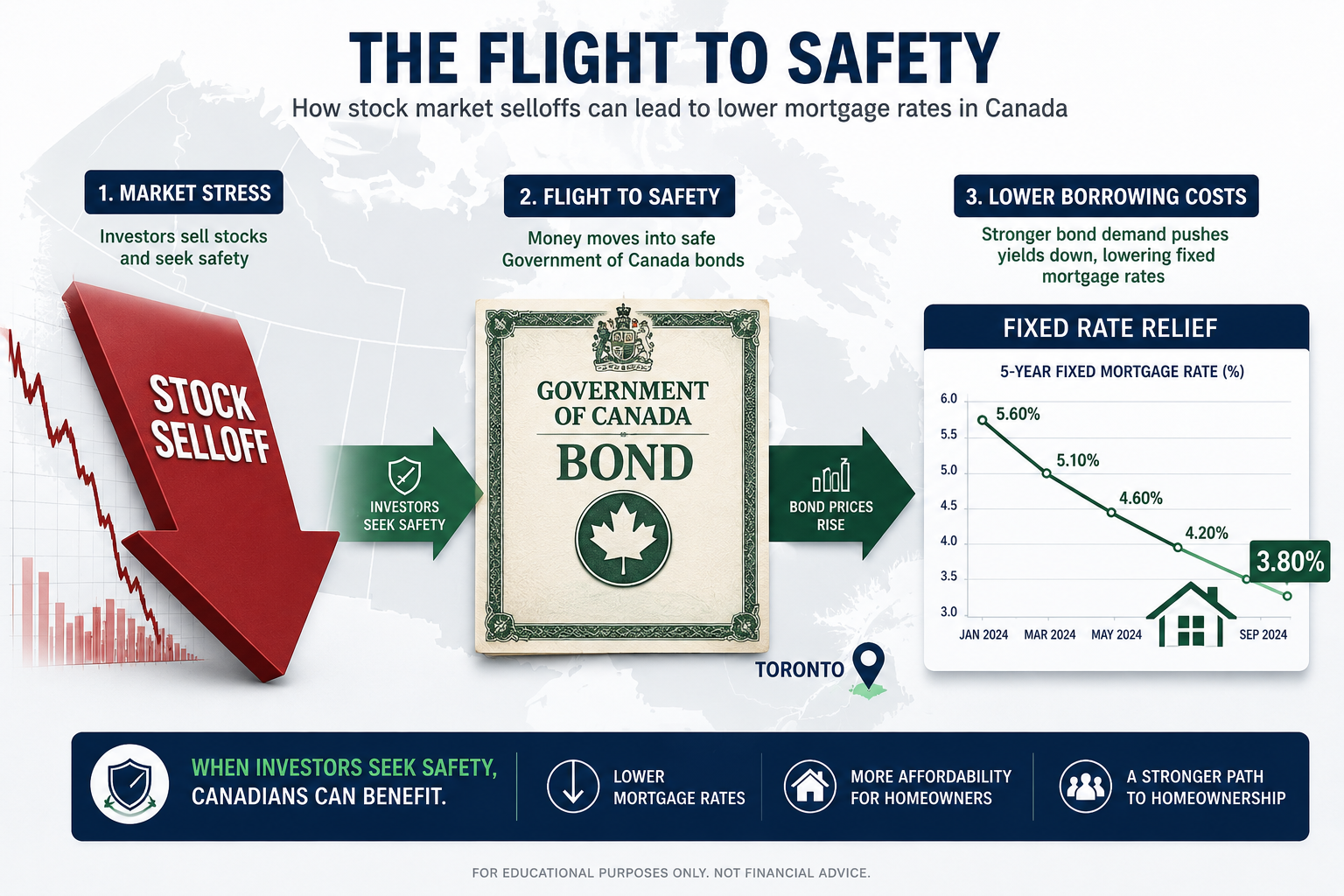
Fixed mortgage rates in Canada are not set by the Bank of Canada. That’s a common misconception worth clearing up directly.
The Bank of Canada’s overnight rate drives variable mortgage rates and home equity lines of credit (HELOCs). Fixed rates are a different story entirely.
How fixed rates actually get priced:
- Lenders look at GoC bond yields — primarily the 5-year Government of Canada bond — as their benchmark.
- GoC yields move closely in line with U.S. Treasury yields, because Canadian and American bond markets are deeply integrated. When U.S. Treasuries rally (yields fall) on a risk-off week, GoC yields typically follow.
- On top of the bond yield, lenders add a “spread” — their margin to cover funding costs, risk, and profit. That spread can widen or narrow depending on competition and market conditions.
- The final fixed mortgage rate a borrower sees is roughly: GoC 5-year yield + lender spread.
This week’s equity selloff, if it pushes investors into bonds, would put downward pressure on GoC yields. That’s the mechanism connecting the Nasdaq’s bad week to a potentially better fixed mortgage rate for a GTA buyer.
For more context on how Bank of Canada decisions interact with your mortgage, see this breakdown of how Bank of Canada policy decisions affect your mortgage.
It’s also worth noting that U.S. tariff uncertainty has previously moved Canadian fixed mortgage rates in similar ways — another example of global market forces shaping what Canadians pay at renewal.
Fixed vs. Variable: Which Side Wins Right Now
The Bank of Canada held its overnight rate steady at its June 2026 meeting. That’s the key backdrop for variable-rate mortgages.
Variable rates are tied directly to lenders’ prime rates, which move with the Bank of Canada’s overnight rate. A hold means no immediate change to variable mortgage payments — for now.
What variable-rate holders should watch:
- The PCE inflation data from the U.S. (highest since April 2023, per Bloomberg) adds pressure to the “higher for longer” narrative. If the Fed holds or delays cuts, the Bank of Canada has less room to move independently without weakening the Canadian dollar.
- Consumer sentiment in Canada remains cautious, which can dampen inflation — a potential argument for future cuts.
- If the Bank of Canada does cut later in 2026, variable-rate holders benefit automatically. But the timing is genuinely uncertain right now.
What fixed-rate borrowers are watching:
- GoC 5-year bond yields. A flight-to-safety week like this one can push those yields lower, which may create a brief window for competitive fixed rates.
- Lender competition. Canadian mortgage lenders have been competitive in the spring and early summer market, and that spread compression can benefit borrowers even when yields are flat.
The honest framing: variable rates offer potential upside if the Bank of Canada cuts, but carry more uncertainty in an environment where inflation is still sticky. Fixed rates offer certainty, and a volatile equity market may actually help compress the rate you can lock in.
For a deeper look at how these two options compare across different market conditions, the fixed vs. variable rates comprehensive guide is worth reading before your next renewal conversation.
If you hold a variable-rate mortgage, it’s also worth understanding how trigger rates work — a concept that became very relevant during the 2022–2023 rate cycle and could matter again if volatility spikes.
What This Means for GTA Homebuyers and Renewers Today

The GTA housing market doesn’t exist in a vacuum. When global equity markets get choppy, local mortgage conditions shift — sometimes in your favour.
If you’re buying and need a pre-approval:
- A rate hold from a lender locks in a rate for a set period (typically 90–130 days) while you shop. In a volatile rate environment, getting that hold in place early is a low-cost insurance policy.
- Bond yields can move quickly. A rate that looks competitive today may look even better in two weeks — or it may not. The point is that waiting without a hold means you’re fully exposed to whatever the market does.
- Getting pre-approved and stress-tested before you make an offer also means you know your real budget — not just your hoped-for budget.
If you’re renewing in the next 6–12 months:
- Most lenders allow you to lock in a renewal rate 120–180 days before your term ends. In a volatile market, that early lock-in option has real value.
- The risk of waiting: if a surprise inflation print or a geopolitical event pushes bond yields back up, the rate you could have locked in last month may not be available next month.
- The risk of locking too early: if yields fall further (as a sustained flight-to-safety would suggest), you may miss a lower rate. A mortgage broker can help you weigh this against your specific renewal date and risk tolerance.
The rotation story matters here too. The Dow’s 0.6% gain this week — while the Nasdaq fell 4% — reflects money moving into financials and industrials. Canadian bank stocks, which are a large part of the TSX, tend to hold up better in this kind of rotation. That’s a signal that the broader Canadian financial system isn’t in distress — just recalibrating.
Should You Lock In a Rate Right Now?
This is the question every GTA homeowner is asking this week. Here’s a practical framework — not a prediction.
Consider locking in a fixed rate if:
- Your renewal is within the next 6 months and you haven’t started shopping yet.
- You’re buying a home and want certainty in your monthly payment for budgeting.
- You’re risk-averse and the idea of a payment increase keeps you up at night.
- GoC 5-year bond yields have dropped meaningfully this week — check with a broker for the current read.
Consider staying variable or waiting if:
- You have a longer runway before renewal (12+ months) and can absorb short-term rate movement.
- You believe the Bank of Canada will cut rates before your renewal — and you want to benefit from those cuts automatically.
- You have financial flexibility to handle a modest payment increase if rates move against you.
The role of a mortgage broker right now:
A broker doesn’t just find you a rate. In a week like this one — where bond yields, equity markets, inflation data, and central bank policy are all moving at once — a broker translates what’s happening in the market into what it means for your specific mortgage. Your renewal date, your amortization remaining, your income structure, your risk tolerance: all of it shapes the right answer.
Generic advice doesn’t work here. A personalised review does.
For context on how broker access compares to going directly to a bank, especially in a shifting rate environment, see the benefits of using a mortgage broker in a post-COVID real estate market.
And if you’re watching bond yields closely, this earlier piece on bond yields plummeting and rate cuts on the horizon gives useful context on how quickly these windows can open and close.
.cg-tracker{font-family:system-ui,sans-serif;max-width:560px;margin:2rem auto;background:#f8fafc;border:1px solid #dde3ea;border-radius:10px;padding:1.4rem;color:#1a2533} .cg-tracker h3{margin:0 0 .6rem;font-size:1.05rem;color:#0a3d6b} .cg-tracker p.cg-sub{margin:0 0 1rem;font-size:.82rem;color:#556} .cg-row{display:flex;align-items:center;gap:.7rem;margin:.45rem 0;background:#fff;border-radius:7px;padding:.55rem .8rem;border:1px solid #e2e8f0} .cg-label{flex:1;font-size:.85rem;font-weight:600;color:#1a2533} .cg-pill{font-size:.78rem;font-weight:700;padding:.22rem .65rem;border-radius:20px;white-space:nowrap} .cg-down{background:#dcfce7;color:#166534} .cg-up{background:#fee2e2;color:#991b1b} .cg-hold{background:#fef9c3;color:#854d0e} .cg-note{font-size:.75rem;color:#667;margin-top:.9rem;line-height:1.5;border-top:1px solid #e2e8f0;padding-top:.7rem}
Canadian Fixed Mortgage Rate Signal Tracker
Week of June 22–26, 2026 — Key indicators and their typical effect on fixed mortgage rates
GoC 5-Year Bond Yield Pressure Down — Rate Positive Nasdaq Composite (weekly) -4% — Flight-to-Safety Signal Bank of Canada Overnight Rate Hold — Variable Rates Stable U.S. PCE Inflation (May 2026) Highest Since Apr 2023 — Caution Equity-to-Bond Rotation Active — Supports Lower YieldsThis tracker is for educational purposes only and does not constitute financial advice. Mortgage rate direction depends on multiple factors. Speak with a licensed mortgage broker for advice specific to your situation.
Frequently Asked Questions
What causes stock market volatility? Stock market volatility is driven by a mix of factors: unexpected economic data (like a surprise inflation reading), geopolitical events, earnings misses or beats from major companies, shifts in investor sentiment, and changes in central bank policy expectations. This week, AI valuation concerns and the reported OpenAI IPO delay were the primary triggers, per Bloomberg and The New York Times.
How does stock market volatility affect mortgage rates in Canada? Indirectly, and often in a counterintuitive way. Sharp equity selloffs push investors into government bonds (flight to safety), which raises bond prices and lowers yields. Since Canadian fixed mortgage rates are priced off Government of Canada bond yields, falling yields can create downward pressure on fixed rates — even while the stock market is falling.
Are Canadian mortgage rates going up or down right now? The Bank of Canada held its overnight rate steady in June 2026, keeping variable rates stable for now. Fixed rates are influenced by GoC bond yields, which have been under downward pressure from this week’s equity selloff. The direction from here depends on inflation data, Bank of Canada decisions, and how long the flight-to-safety trade holds. Watch GoC 5-year bond yields as your primary signal.
What is the relationship between the stock market and interest rates? The relationship is not direct — it runs through the bond market. When stocks fall sharply, money flows into bonds, pushing yields lower. Lower yields can reduce fixed mortgage rates. Separately, central banks (like the Bank of Canada) set overnight rates based on inflation and economic conditions, not stock market performance. Variable mortgage rates follow the overnight rate; fixed rates follow bond yields.
How long does it take for market changes to affect mortgage rates? Bond yield changes can flow through to lender rate offers within days — sometimes within 24–48 hours for the most competitive lenders. However, lenders don’t always pass on every yield movement immediately. They factor in their own funding costs, competitive positioning, and how long they expect the yield move to last. A sustained drop in GoC yields over several weeks is more likely to produce a meaningful fixed rate reduction than a single-day move.
Can you get a mortgage if the stock market crashes? Yes. A stock market crash does not directly affect mortgage qualification in Canada. Lenders assess your income, credit score, debt ratios, and the property value — not your investment portfolio (unless you’re using portfolio assets as part of your down payment or income verification). In fact, a crash-driven flight to safety can lower bond yields and potentially improve the fixed rates available to you.
Fixed vs. variable rate mortgage during volatile markets — which is better? It depends on your timeline and risk tolerance. In a volatile-but-falling-yield environment like this week, fixed rates may become more attractive as GoC yields drop. Variable rates benefit if the Bank of Canada cuts its overnight rate — but the timing of those cuts is uncertain given sticky inflation. There’s no universal answer; the right choice depends on your renewal date, financial flexibility, and how you’d handle a payment increase.
Should I refinance my mortgage before rates go up? If you’re considering refinancing, the key question is whether the rate you can lock in today is meaningfully better than what you’re currently paying — and whether the prepayment penalty makes the math work. In a volatile rate environment, a mortgage broker can run the numbers for your specific situation. For a full breakdown, see this guide on all about mortgage refinancing.
What mortgage rate should I expect in Canada in 2026? Specific rate predictions aren’t something any responsible source should make — too many variables are in play. What’s reasonable to say: fixed rates are influenced by GoC bond yields (currently under downward pressure from the equity selloff), and variable rates are anchored to the Bank of Canada’s overnight rate (on hold as of June 2026). A broker can show you what’s actually available from multiple lenders right now, which is more useful than any forecast.
How do Bank of Canada rate changes affect my mortgage? The Bank of Canada’s overnight rate directly affects variable-rate mortgages and HELOCs — when it goes up, your rate goes up; when it cuts, your rate drops. Fixed mortgage rates are not directly tied to the overnight rate; they follow GoC bond yields instead. This is why you can have a Bank of Canada hold (no change to variable rates) at the same time as fixed rates are moving — because bond yields are moving independently.
Conclusion
This week’s market selloff is a useful reminder that stock market volatility and Canadian mortgage rates don’t move in lockstep — and understanding why can save you from making a reactive decision at exactly the wrong moment.
The Nasdaq’s rough week, driven by AI valuation concerns and the reported OpenAI IPO delay, has pushed investors toward the safety of government bonds. That flight-to-safety trade puts downward pressure on GoC bond yields — the actual benchmark behind your fixed mortgage rate. Meanwhile, the Bank of Canada’s June 2026 rate hold keeps variable rates steady for now, even as sticky U.S. inflation data clouds the path ahead.
What to do next:
- If your mortgage renews in the next 6–12 months, start the conversation now. Don’t wait for certainty — it rarely arrives.
- Watch GoC 5-year bond yields, not the TSX or the Nasdaq, as your real signal for fixed rate direction.
- Get a rate hold in place if you’re actively buying. It costs nothing and protects you from upside rate movement.
- If you’re on a variable rate, understand your trigger rate and what a Bank of Canada cut (or hold) means for your payments.
The team at Everything Mortgages works with GTA homebuyers and homeowners every day — through rate cycles, market swings, and everything in between. If this week’s market news has you wondering whether to lock in, renew early, or simply understand your options, reach out for a no-pressure conversation. Your mortgage strategy should be built around your life — not around a single week’s headlines.
 Previous Page