February 12, 2026
Why 2026 is the Perfect Entry Point for First-Time Buyers in Toronto’s Cooling Market
Share this article:



Manzeel is an award-winning Mortgage Broker and the Owner of the Toronto-based mortgage, Everything Mortgages.
With 16 years of experience in the Canadian mortgage industry and a formal background in mortgage underwriting, Manzeel’s lending expertise gives him unique insight into whether a deal is feasible which empowers his clients to make more informed lending decisions faster.
He has been recognized as one of Canada’s Top 10 Mortgage Brokers by the national Canadian Mortgage Professionals (CMP) Association. Him and his team of 18 mortgage agents are proud to offer a mortgage experience that's built on honesty, trust, and integrity. He prides himself on the brokerage’s dedication to deliver an excellent client experience throughout the entire home loan process from pre-approval to post-funding.
Since moving to Toronto in 1998, Manzeel has successfully launched and scaled several businesses from the ground up, ranging from a mortgage brokerage and a vast real estate investment portfolio to a private financing eCommerce platform. He continues to be a leader in the real estate industry as he uses his analytical expertise to seek new real estate investment opportunities.
As a tech junkie and avid sports enthusiast, when Manzeel’s not working with clients, you can find him reading technology blogs, playing squash or watching tennis with his two boys.
For years, first-time homebuyers in Toronto watched from the sidelines as prices soared beyond reach and bidding wars became the norm. But 2026 has brought a dramatic shift. Why 2026 is the Perfect Entry Point for First-Time Buyers in Toronto’s Cooling Market isn’t just optimistic speculation—it’s backed by concrete market data showing prices below $1 million for the first time since 2019, sales down nearly 20%, and inventory levels that finally favor buyers over sellers. 🏠
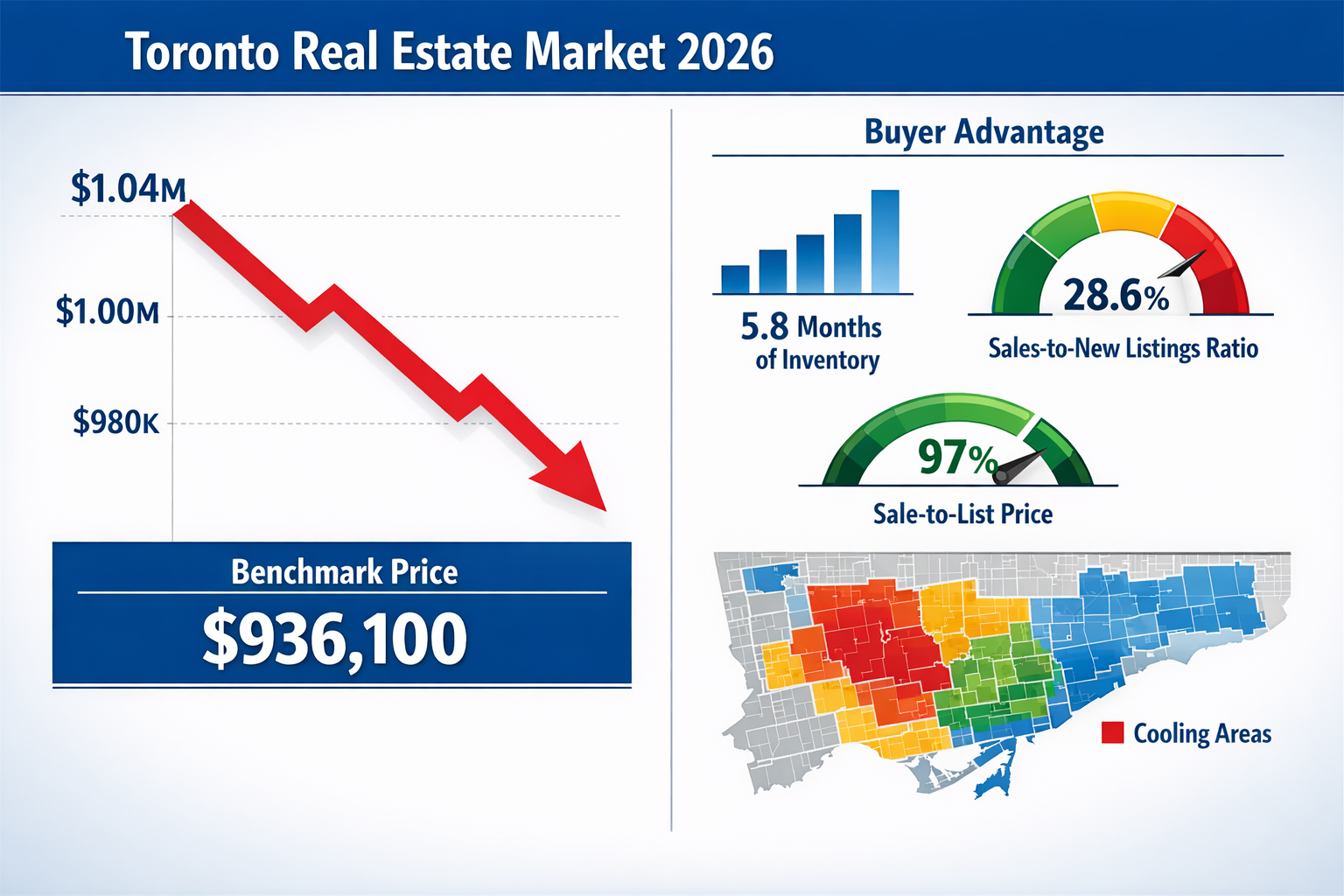
The Greater Toronto Area’s real estate landscape has transformed from a competitive seller’s market into a genuine buyer’s opportunity. With benchmark prices at $936,100 (down 8.0% year-over-year) and average selling prices at $973,289 (down 6.5%), the market has crossed a psychological threshold that seemed impossible just two years ago.[2] Combined with reduced competition, extended viewing times, and real negotiating power, first-time buyers now have advantages that haven’t existed in over half a decade.
This comprehensive guide explores exactly why the current market conditions create an unprecedented window of opportunity and how aspiring homeowners can capitalize on these favorable circumstances.
Key Takeaways
- Historic price declines: Toronto’s average home price dropped below $1 million to $973,289, with benchmark prices at $936,100—representing the most affordable entry point since 2019.[2][4]
- Buyer’s market established: With 5.8 months of inventory supply and a sales-to-new-listings ratio of just 28.6%, buyers now hold significant negotiating leverage for the first time in years.[2]
- Reduced competition: Home sales plummeted 19.9% year-over-year, meaning substantially fewer competing buyers and more time to make informed decisions (67 days average market time).[2]
- Condo opportunities: The condo segment offers exceptional value with prices down 11% and 8 months of inventory in Toronto—ideal for first-time buyers seeking entry-level pricing.[2][3]
- Strategic timing window: Prices are expected to stabilize in the second half of 2026, making early 2026 purchases potentially the best value before market correction.[5][7]
Understanding the Market Shift: Why 2026 is the Perfect Entry Point for First-Time Buyers in Toronto’s Cooling Market
The Numbers Tell a Compelling Story
The transformation of Toronto’s real estate market from seller-dominated to buyer-favorable represents one of the most significant shifts in recent history. January 2026 data reveals the extent of this change across multiple critical metrics.
Price Corrections Across All Segments
The GTA’s average home sold price of $973,289 marks a 6.5% year-over-year decrease—the first time prices have dipped below the $1 million threshold since 2019.[2][4] Even more telling, the benchmark price sits at $936,100, down 8.0% year-over-year, providing a more accurate picture of typical home values across the region.[2]
These aren’t minor fluctuations. They represent meaningful affordability improvements that directly impact down payment requirements and monthly mortgage obligations. For a first-time buyer, the difference between a $1.04 million home (2025 average) and a $973,289 home (2026 average) translates to approximately $13,400 less in down payment at 20%, or $267 less in monthly payments on a 25-year mortgage at 5% interest.
The median price tells an even more dramatic story. At $840,000 for the GTA (down 7.7% year-over-year) and $749,500 for the City of Toronto specifically (down 6.3%), the middle of the market has become substantially more accessible.[2] This matters enormously for first-time buyers who typically target entry-level properties rather than luxury homes that skew average prices upward.
Sales Activity Collapse Creates Opportunity
Home sales plummeted 19.9% year-over-year in January 2026, with only 3,082 sales recorded across the entire GTA.[2] This dramatic decline in transaction volume isn’t just a statistic—it fundamentally changes the buyer experience.
The breakdown by property type reveals where opportunities are strongest:
- Detached homes: Sales down 14%
- Semi-detached homes: Sales down 20%
- Townhomes: Sales down 24%
- Condos: Sales down 26%[2]
The condo market deserves special attention from first-time buyers. With sales falling 26% year-over-year and Toronto condos carrying 8 months of inventory—approaching record highs—this segment offers exceptional negotiating leverage.[2][3] Condo prices have declined approximately 11% year-over-year, making them particularly attractive entry points for buyers with limited down payments.[3]
Buyer’s Market Conditions Firmly Established
The technical definition of a buyer’s market—six months of inventory supply—has been decisively crossed. With 5.8 months of supply in January 2026, the market has shifted from the competitive seller’s market that characterized 2021-2023.[2][4]
What This Means in Practice
Active listings stood at 17,975 as of January 2026, up 4.8% year-over-year, while new listings totaled 10,774.[2] This elevated inventory provides buyers with:
✅ Substantial selection across neighborhoods and price points
✅ Time to compare properties without pressure
✅ Ability to be selective about location, condition, and features
✅ Leverage to negotiate repairs, closing dates, and inclusions
The sales-to-new-listings ratio (SNLR) decreased to 28.6% in January 2026, down from 31.0% in January 2025.[2] This metric reveals that fewer than three in ten newly listed properties are selling—a stark contrast to markets where multiple offers drive prices above asking.
Negotiating Power Has Shifted
Perhaps the most tangible evidence of the buyer’s market: homes sold for 97% of asking price on average in January 2026, compared to 99% in January 2025.[2] This 3% discount from list price represents real negotiating room that didn’t exist in previous years when homes routinely sold above asking with multiple competing offers.
For first-time buyers navigating the mortgage stress test, this 3% negotiating advantage can make the difference between qualifying and falling short. On a $900,000 property, negotiating to $873,000 (3% below asking) reduces the required down payment by $5,400 and improves debt service ratios.
Extended Market Time Benefits Informed Decision-Making
Average days on market increased to 67 days in January 2026 from 55 days in January 2025—a 22% increase in the time properties sit unsold.[2] This extended timeline fundamentally changes the home-buying experience for first-time purchasers.
Advantages of Longer Market Times
🏡 Multiple viewings without pressure: Visit properties twice or three times to evaluate thoroughly
🏡 Professional inspections: Schedule comprehensive home inspections without rushing
🏡 Neighborhood research: Visit the area at different times of day and week
🏡 Financial preparation: Ensure mortgage pre-approval and down payment are optimized
🏡 Comparative analysis: View competing properties before making offers
This stands in stark contrast to the 2021-2022 market where properties sold within days, often with offers due before inspections could be completed. First-time buyers, who typically need more time to navigate the process, benefit enormously from this slower pace.
Understanding stress testing requirements and securing proper mortgage pre-approval becomes much more manageable when buyers aren’t racing against artificial deadlines created by competitive bidding.
Strategic Advantages for First-Time Buyers in 2026
Reduced Competition from Other Purchasers
The 19.9% year-over-year decline in sales activity means substantially fewer competing buyers in the market.[2] This reduction in competition manifests in several practical ways that directly benefit first-time purchasers.
Fewer Bidding Wars
Multiple-offer situations, which dominated the 2021-2023 market, have become increasingly rare in 2026. The combination of elevated inventory and reduced buyer activity means most properties receive single offers or no offers at all during their initial listing period.
For first-time buyers, this eliminates several stressors:
- No pressure to waive conditions: Buyers can include financing and inspection conditions without fear of losing to unconditional offers
- Rational pricing: Offers can be based on property value rather than emotional bidding escalation
- Time to consult professionals: Mortgage brokers, real estate lawyers, and home inspectors can be properly engaged
- Reduced anxiety: The psychological toll of competing against multiple buyers is eliminated
More Negotiating Leverage
With sellers competing for fewer buyers rather than buyers competing for limited inventory, negotiation dynamics have reversed. First-time purchasers can now:
💰 Request price reductions based on comparable sales
💰 Negotiate repairs or credits for issues identified in inspections
💰 Ask for closing cost assistance or flexible possession dates
💰 Include contingencies without weakening their offer position
💰 Walk away from properties that don’t meet their criteria
This leverage is particularly valuable for buyers who may need sellers to accommodate RRSP Home Buyers’ Plan withdrawal timelines or other first-time buyer considerations.
The Condo Market: Exceptional Entry-Level Opportunities
The condominium segment represents the most compelling opportunity for first-time buyers in 2026. With sales down 26% and inventory at 8 months in Toronto specifically, this market offers unparalleled value.[2][3]
Why Condos Make Sense for First-Time Buyers
Condos have traditionally served as the entry point for first-time purchasers due to lower absolute prices, smaller down payment requirements, and central locations. In 2026, these advantages are amplified by market conditions:
| Metric | 2025 | 2026 | Change |
|---|---|---|---|
| Average Condo Price | ~$750,000 | ~$667,500 | -11% |
| Months of Inventory | 6.2 | 8.0 | +29% |
| Sales Volume | 4,160 | 3,078 | -26% |
| Days on Market | 48 | 62 | +29% |
Price Declines Create Affordability
The 11% year-over-year price decline in condos translates to approximately $82,500 less on a typical unit.[3] This reduction:
- Lowers the minimum down payment by $16,500 (at 20%)
- Reduces monthly mortgage payments by approximately $410 (25-year amortization, 5% rate)
- Improves qualification ratios for buyers near the edge of approval
- Creates equity opportunity if prices stabilize as forecast
Inventory Levels Favor Buyers
Eight months of condo inventory in Toronto represents near-record supply levels, giving buyers exceptional selection and negotiating position.[2][3] This inventory includes:
- New construction completions: Developers offering incentives to close sales
- Investor liquidations: Landlords exiting due to rental market softness
- Upgraders listing: Existing owners moving to larger properties
- Assignment sales: Pre-construction buyers unable to close
Each of these seller categories brings different motivations, many of which favor negotiation and flexible terms for qualified buyers.
Location and Lifestyle Benefits
Condos typically offer:
- Central locations: Proximity to employment, transit, and amenities
- Lower maintenance: No yard work, snow removal, or exterior repairs
- Building amenities: Gyms, party rooms, concierge services
- Security: Controlled access and often 24-hour security
- Predictable costs: Condo fees cover many variable homeownership expenses
For first-time buyers, particularly younger professionals or couples without children, these features align well with lifestyle priorities while offering the most accessible price points in the current market.
Interest Rate Environment Supports Affordability
The Bank of Canada rate stands at 2.25% as of early 2026, down from pandemic-era highs of 5.00%.[1] This lower rate environment translates directly to more affordable mortgage payments and improved qualification ratios.
Current Mortgage Rate Landscape
Major banks and lenders are offering competitive rates across fixed and variable products:
- 5-year fixed rates: 4.49% – 5.19%
- 5-year variable rates: 4.99% – 5.49%
- 3-year fixed rates: 4.69% – 5.39%
These rates, while higher than the ultra-low pandemic period, remain historically reasonable and are expected to remain stable or decline modestly through 2026.[1]
Qualification Becomes More Achievable
Lower rates improve qualification in two ways:
- Lower stress test qualification rate: With rates in the mid-4% range, the stress test qualification rate (contract rate plus 2% or 5.25%, whichever is higher) becomes more manageable
- Lower actual payments: Monthly mortgage obligations decrease, improving debt service ratios
For first-time buyers working with mortgage professionals to navigate mortgage renewal challenges, the current rate environment provides breathing room that didn’t exist during 2023-2024’s peak rate period.
Rate Stability Expected
Forecasts from RBC, TD, BMO, and CMHC predict moderate growth of 3-5% by year-end 2026, suggesting rates will remain relatively stable throughout the year.[1] This stability allows buyers to:
- Lock in predictable payments with fixed-rate mortgages
- Plan budgets confidently without fear of dramatic rate increases
- Time purchases strategically without rushing due to rate concerns
Timing Considerations: Why 2026 is the Perfect Entry Point for First-Time Buyers in Toronto’s Cooling Market
Price Stabilization Expected in Second Half of 2026
The Toronto Regional Real Estate Board (TRREB) forecasts that average selling prices will likely be lower year-over-year in the first half of 2026 before stabilizing in the second half.[5][7] This projection creates a strategic timing window for first-time buyers.
The Early 2026 Opportunity
Purchasing in the first half of 2026—particularly in Q1 and early Q2—positions buyers to:
📊 Capture maximum price declines: Buy while prices are still falling before stabilization
📊 Avoid future competition: Enter before stabilization attracts sidelined buyers back to market
📊 Build equity through recovery: Benefit from price appreciation when stabilization occurs
📊 Lock in favorable terms: Secure mortgages before potential rate increases later in year
Historical Context
Toronto’s real estate market has historically demonstrated resilience following correction periods. The 2017-2018 correction saw prices decline approximately 15% before recovering and surpassing previous peaks within 24 months. While past performance doesn’t guarantee future results, the pattern suggests that buying during correction periods often yields long-term value.
The current correction differs from 2017-2018 in several ways:
- More gradual decline: 6.5-8.0% versus 15% rapid drop
- Fundamental demand: Strong immigration and population growth continue
- Supply constraints: Limited new construction relative to population growth
- Infrastructure investment: Major transit and development projects underway
These factors suggest that the current price stabilization forecast is credible and that early 2026 purchases may represent optimal timing.
Market Sentiment and Buyer Confidence
While affordability pressures and constrained buyer confidence contributed to the market slowdown, these same factors have created the opportunity now available to qualified first-time buyers.[2][4]
Who Can Capitalize
First-time buyers positioned to take advantage of current conditions typically have:
- Stable employment: Secure income to qualify for mortgages
- Saved down payments: 10-20% of purchase price accumulated
- Good credit: Scores above 680 for optimal mortgage approval
- Realistic expectations: Understanding of total homeownership costs
- Professional guidance: Mortgage broker and realtor relationships established
The market has effectively self-selected for serious, qualified buyers while discouraging speculative activity and marginal purchasers. This creates a healthier, more sustainable market environment.
Psychological Advantages
Buying in a cooling market offers psychological benefits:
- Less FOMO pressure: Decisions based on value rather than fear of missing out
- Rational analysis: Time and space to evaluate properties objectively
- Reduced stress: Slower pace allows for thorough due diligence
- Confidence in value: Knowing you’re buying near a market bottom
These intangible factors contribute to better decision-making and greater long-term satisfaction with purchases.
Practical Strategies for First-Time Buyers in 2026

Maximizing Negotiating Power
With homes selling for 97% of asking price on average and properties sitting for 67 days, first-time buyers have tangible negotiating leverage.[2] Effective strategies include:
Research Comparable Sales
Understanding recent sale prices in your target neighborhood provides the foundation for strong negotiations. Key resources:
- MLS sold data: Review actual sale prices (not just list prices) for comparable properties
- Price per square foot: Calculate and compare across similar properties
- Days on market: Properties listed longer often have more motivated sellers
- Price reductions: Track how many times sellers have reduced asking prices
Make Informed Offers
Rather than offering full asking price, consider:
- Starting 5-7% below asking: On properties listed more than 30 days
- Requesting seller concessions: Closing cost assistance, included appliances, or repair credits
- Including conditions: Financing and inspection conditions protect your interests
- Flexible closing dates: Accommodate seller needs in exchange for price concessions
Leverage Inspection Findings
Professional home inspections typically reveal issues that can be negotiated:
- Request repairs: Ask sellers to fix significant issues before closing
- Negotiate price reductions: Reduce price by estimated repair costs
- Request credits: Receive closing credits to address issues yourself
- Walk away if necessary: Serious structural or system issues may warrant terminating the deal
Working with experienced professionals who understand important mortgage features ensures your offers are structured to maximize both negotiating power and financing approval.
Targeting the Right Property Types and Locations
Strategic first-time buyers focus their search on segments offering the best value and future appreciation potential.
Condo Apartments (Best Value)
As discussed, condos offer:
- Lowest absolute prices: $600,000-$750,000 range in many areas
- Highest inventory: 8 months supply creates selection and leverage
- Steepest discounts: 11% price declines year-over-year
- Central locations: Proximity to employment and transit
Townhomes (Middle Ground)
Townhomes provide:
- More space than condos: Typically 1,200-1,800 square feet
- Outdoor space: Small yards or patios
- Family-friendly: Multiple bedrooms and bathrooms
- Moderate prices: $800,000-$1,000,000 in many suburbs
- Sales down 24%: Reduced competition in this segment
Emerging Neighborhoods
Consider areas with:
- Transit expansion: Future subway or LRT stations increase value
- Development activity: New amenities and services coming
- Relative affordability: Lower current prices with growth potential
- Strong fundamentals: Good schools, safety, and community features
Areas like Scarborough (Eglinton East LRT), North York (Yonge North extension), and Etobicoke (waterfront redevelopment) offer growth potential at more accessible price points than established downtown neighborhoods.
Optimizing Financing and Down Payments
Securing the right mortgage structure maximizes purchasing power and long-term affordability.
Down Payment Strategies
First-time buyers have several options:
💵 Minimum down payment (5-10%): Requires CMHC insurance but minimizes upfront cash
💵 20% down payment: Avoids insurance premiums, reduces monthly payments
💵 RRSP Home Buyers’ Plan: Withdraw up to $35,000 per person ($70,000 per couple) tax-free
💵 Gifted down payments: Family assistance can supplement savings
💵 First Home Savings Account: Tax-free contributions and withdrawals for first-time buyers
The RRSP Home Buyers’ Plan deserves special consideration as it allows first-time buyers to leverage retirement savings without immediate tax consequences, though repayment is required over 15 years.
Mortgage Product Selection
Key considerations:
✔️ Fixed vs. variable: Fixed rates provide payment certainty; variable rates may offer savings if rates decline
✔️ Amortization period: 25 years is standard; longer periods reduce payments but increase total interest
✔️ Payment frequency: Accelerated bi-weekly payments reduce amortization and total interest
✔️ Prepayment privileges: Ability to make lump sum payments or increase regular payments
✔️ Portability: Option to transfer mortgage to a new property
Working with a mortgage broker provides access to multiple lenders and products, often securing better rates and terms than approaching a single bank directly.
Qualification Optimization
Maximize approval chances by:
📋 Improving credit scores: Pay down credit cards, avoid new credit applications
📋 Reducing debt: Eliminate or minimize car loans, student loans, and credit card balances
📋 Increasing income: Document all income sources, including bonuses and commissions
📋 Saving reserves: Demonstrate 3-6 months of mortgage payments in savings
📋 Getting pre-approved: Understand exact borrowing capacity before shopping
For those with non-traditional income, exploring opportunities for self-employed Canadians may reveal additional qualification pathways.
Understanding Total Ownership Costs
First-time buyers must budget beyond just the mortgage payment to ensure sustainable homeownership.
Monthly Carrying Costs
A comprehensive budget includes:
| Expense Category | Typical Monthly Cost | Notes |
|---|---|---|
| Mortgage payment | $3,000-$4,500 | Principal and interest on $700K-$900K |
| Property taxes | $300-$500 | Varies by municipality and assessment |
| Condo fees (if applicable) | $400-$700 | Includes maintenance, utilities, amenities |
| Home insurance | $100-$200 | Required by lenders |
| Utilities | $150-$300 | Heat, hydro, water (if not in condo fees) |
| Maintenance reserve | $200-$400 | 1% of home value annually |
| Total | $4,150-$6,600 | Varies by property type and size |
Upfront Costs
Beyond the down payment, budget for:
- Land transfer tax: 0.5-2.5% of purchase price (rebates available for first-time buyers)
- Legal fees: $1,500-$3,000 for real estate lawyer
- Home inspection: $500-$800
- Appraisal: $300-$500 (if required by lender)
- Moving costs: $500-$2,000
- Immediate repairs/improvements: $2,000-$10,000+
First-Time Buyer Incentives
Take advantage of available programs:
- Land Transfer Tax Rebate: Up to $4,000 in Ontario, $8,475 in Toronto
- GST/HST New Housing Rebate: For new construction purchases
- First Home Savings Account: Tax deductions on contributions
- Home Buyers’ Amount: $1,500 tax credit (federal)
These incentives can reduce upfront costs by $5,000-$15,000 for qualifying first-time buyers.
Long-Term Value Proposition
Building Equity Through Market Recovery
Purchasing during a market correction positions buyers to benefit from subsequent appreciation when prices stabilize and recover.
Historical Recovery Patterns
Toronto’s real estate market has demonstrated consistent long-term appreciation despite periodic corrections:
- 1989-1996: Significant correction followed by steady recovery
- 2008-2009: Brief decline during financial crisis, rapid recovery
- 2017-2018: 15% correction, full recovery within 18 months
- 2020: Pandemic dip, followed by record appreciation
While past performance doesn’t guarantee future results, Toronto’s fundamental drivers—immigration, employment growth, limited land supply, and infrastructure investment—suggest long-term value appreciation is likely.
Equity Accumulation
Even with modest 3-5% annual appreciation forecast for late 2026 and beyond, equity builds through:[1]
- Price appreciation: Market value increases over time
- Mortgage principal reduction: Each payment reduces loan balance
- Forced savings: Homeownership requires regular payments that build wealth
- Leverage: 20% down payment controls 100% of asset appreciation
Example Scenario
Purchase: $900,000 condo in Q1 2026
Down payment: $180,000 (20%)
Mortgage: $720,000 at 4.79% (5-year fixed)
After 5 years:
- Principal paid: ~$90,000
- Appreciation (3% annually): ~$143,000
- Total equity: $413,000 ($180,000 + $90,000 + $143,000)
- Return on investment: 129% on initial $180,000
This illustrative example demonstrates how homeownership builds wealth even with conservative appreciation assumptions.
Lifestyle and Stability Benefits
Beyond financial considerations, homeownership provides intangible benefits particularly valuable to first-time buyers:
🏠 Stability: No landlord, no rent increases, no forced moves
🏠 Customization: Ability to renovate, decorate, and personalize
🏠 Community: Stronger neighborhood connections and belonging
🏠 Pride: Ownership satisfaction and accomplishment
🏠 Control: Decisions about property are yours alone
For many first-time buyers, these lifestyle factors justify homeownership even beyond pure financial calculations.
Tax Advantages
Canadian homeowners benefit from several tax advantages:
- Principal residence exemption: No capital gains tax on sale of primary residence
- No tax on imputed rent: Unlike investment properties, living in your own home isn’t taxable income
- RRSP Home Buyers’ Plan: Tax-free down payment withdrawal
- First Home Savings Account: Tax-deductible contributions and tax-free withdrawals
These advantages improve the after-tax return on homeownership relative to renting and investing.
Risks and Considerations
Potential Market Volatility
While current conditions favor buyers, risks exist:
⚠️ Further price declines: Prices could fall beyond current levels before stabilizing
⚠️ Interest rate increases: Rising rates could reduce affordability and property values
⚠️ Economic recession: Job losses or income reductions could impact ability to maintain payments
⚠️ Oversupply in condos: Continued new construction completions could pressure condo prices
Mitigation Strategies
Reduce risks by:
- Buying for long-term: Plan to hold property 5+ years to weather volatility
- Maintaining reserves: Keep 6-12 months expenses in emergency fund
- Locking in rates: Fixed-rate mortgages provide payment certainty
- Buying conservatively: Don’t maximize borrowing capacity; leave cushion
- Choosing quality: Well-located, well-maintained properties hold value better
Condo-Specific Considerations
Condo buyers face unique risks:
- Condo fee increases: Special assessments or fee hikes impact affordability
- Building quality: Poorly maintained buildings lose value
- Rental restrictions: Some buildings limit rental opportunities
- Reserve fund adequacy: Insufficient reserves lead to special assessments
Due Diligence
Protect yourself by:
- Reviewing status certificate: Examine reserve fund, fee history, and pending issues
- Researching building reputation: Check online reviews and talk to residents
- Understanding bylaws: Ensure rules align with your lifestyle
- Inspecting common areas: Assess maintenance quality and building condition
Opportunity Cost
Committing to homeownership involves trade-offs:
- Reduced flexibility: Selling and moving is more complex than ending a lease
- Capital tied up: Down payment could potentially earn returns elsewhere
- Maintenance responsibility: Time and money required for upkeep
- Market timing risk: Possibility of buying before further declines
Decision Framework
Homeownership makes sense when:
- ✅ Planning to stay in Toronto 5+ years
- ✅ Financially stable with secure employment
- ✅ Comfortable with property maintenance responsibilities
- ✅ Down payment and reserves adequately saved
- ✅ Monthly costs are sustainable within budget
Taking Action: Next Steps for First-Time Buyers

Step 1: Financial Preparation (1-3 Months)
Assess Current Financial Position
- Calculate net worth and available down payment funds
- Review credit reports and scores (aim for 680+)
- Document income sources and employment stability
- List all debts and monthly obligations
- Determine realistic budget for monthly housing costs
Optimize Finances
- Pay down high-interest debt to improve qualification ratios
- Avoid new credit applications or major purchases
- Accumulate additional savings for down payment and reserves
- Maximize RRSP contributions if using Home Buyers’ Plan
- Contribute to First Home Savings Account if eligible
Get Pre-Approved
- Connect with mortgage broker or lender
- Provide required documentation (income verification, credit authorization)
- Understand maximum borrowing capacity
- Receive pre-approval letter valid for 90-120 days
- Clarify mortgage product options and rates
Understanding mortgage stress testing requirements before shopping ensures realistic expectations and prevents disappointment.
Step 2: Market Research and Property Search (1-2 Months)
Define Criteria
- Preferred neighborhoods and commute considerations
- Property type (condo, townhome, semi-detached)
- Minimum bedrooms, bathrooms, and square footage
- Must-have features versus nice-to-have amenities
- Maximum price range based on pre-approval
Research Market
- Review recent comparable sales in target areas
- Attend open houses to understand current inventory
- Monitor new listings and price reductions
- Identify properties sitting on market 30+ days
- Research neighborhood amenities, schools, and development plans
Engage Real Estate Professional
- Interview 2-3 buyer’s agents with first-time buyer experience
- Discuss representation agreement and commission structure
- Establish communication preferences and search parameters
- Leverage agent’s market knowledge and negotiation skills
- Schedule property viewings
Step 3: Property Evaluation and Offer (2-4 Weeks)
Thorough Property Assessment
- View properties multiple times at different times of day
- Evaluate condition, layout, and functionality
- Review condo status certificate (if applicable)
- Research property history (previous sales, time on market)
- Assess neighborhood fit and lifestyle compatibility
Professional Inspection
- Hire qualified home inspector (budget $500-$800)
- Attend inspection to ask questions and understand findings
- Review detailed inspection report
- Identify any deal-breakers or significant issues
- Use findings to inform offer price and conditions
Make Strategic Offer
- Determine offer price based on comparables and property condition
- Include appropriate conditions (financing, inspection, status certificate review)
- Specify desired closing date and any requested inclusions
- Submit offer through your real estate agent
- Be prepared to negotiate terms with seller
Step 4: Closing Process (4-8 Weeks)
Secure Financing
- Finalize mortgage application with chosen lender
- Provide any additional documentation requested
- Arrange for property appraisal (if required)
- Review and sign mortgage commitment
- Lock in interest rate (if not already done)
Legal and Administrative
- Retain real estate lawyer (budget $1,500-$3,000)
- Review purchase agreement and title search
- Arrange for title insurance
- Calculate and prepare for closing costs (land transfer tax, legal fees, adjustments)
- Arrange home insurance (required before closing)
Final Preparations
- Complete final walk-through inspection before closing
- Arrange utilities transfer and setup
- Plan moving logistics
- Prepare certified cheque for closing costs
- Receive keys and take possession
Conclusion
Why 2026 is the Perfect Entry Point for First-Time Buyers in Toronto’s Cooling Market is more than a catchy headline—it’s a reality supported by compelling market data and favorable conditions that haven’t existed in years. With average prices below $1 million for the first time since 2019, sales down nearly 20%, inventory at elevated levels, and genuine negotiating power returned to buyers, the current market represents an unprecedented opportunity window. 🎯
The combination of reduced competition, extended market times, buyer-favorable inventory levels, and strategic timing before expected price stabilization creates ideal conditions for first-time purchasers who have prepared financially and are ready to act. The condo market, in particular, offers exceptional value with prices down 11% and 8 months of inventory providing substantial selection and leverage.
Success requires strategic preparation: optimizing finances, securing mortgage pre-approval, conducting thorough research, making informed offers, and working with experienced professionals who understand the unique needs of first-time buyers. Those who approach the market with realistic expectations, adequate reserves, and a long-term perspective position themselves to build equity, achieve homeownership goals, and benefit from Toronto’s fundamental long-term value drivers.
The window of opportunity won’t remain open indefinitely. As prices stabilize in the second half of 2026 and sidelined buyers return to the market, current advantages will diminish. First-time buyers who act decisively in early-to-mid 2026 stand to capture maximum value at the optimal point in the market cycle.
Your Next Steps:
- Connect with a mortgage professional to understand your borrowing capacity and explore financing options
- Review your finances to optimize credit, reduce debt, and maximize down payment funds
- Research target neighborhoods and property types that align with your budget and lifestyle
- Engage a buyer’s agent with first-time buyer experience to guide your search
- Start viewing properties to understand current market conditions and identify opportunities
- Make informed offers that leverage current buyer-favorable conditions
- Act with confidence knowing you’re entering the market at an optimal time
The perfect entry point for first-time buyers in Toronto’s cooling market is here. The question isn’t whether conditions are favorable—the data clearly shows they are. The question is whether you’re prepared to capitalize on this opportunity before it passes.
References
[1] Gta Real Estate Market 2026 2026 – https://rcibrealestate.ca/gta-real-estate-market-2026-2026/
[2] Toronto Housing Market – https://wowa.ca/toronto-housing-market
[3] Watch – https://www.youtube.com/watch?v=D8zN33TPq5g
[4] Market Update February 2026 – https://www.remaxultimate.com/News/1435179/market-update-february-2026
[5] Gta Home Sales And Prices Expected To Remain Stable In 2026 Amid Ongoing Affordability Pressures – https://trreb.ca/gta-home-sales-and-prices-expected-to-remain-stable-in-2026-amid-ongoing-affordability-pressures/
[7] Gta Home Sales And Prices Expected To Remain Stable In 2026 Amid Ongoing Affordability Pressures 1035783929 – https://markets.businessinsider.com/news/stocks/gta-home-sales-and-prices-expected-to-remain-stable-in-2026-amid-ongoing-affordability-pressures-1035783929
[8] Housing Market Outlook – https://www.cmhc-schl.gc.ca/professionals/housing-markets-data-and-research/market-reports/housing-market/housing-market-outlook
 Previous Page