April 9, 2026
Vendor Take-Back Mortgage Canada: What It Is, How It Works and Risks to Know
Share this article:



Manzeel is an award-winning Mortgage Broker and the Owner of the Toronto-based mortgage, Everything Mortgages.
With 16 years of experience in the Canadian mortgage industry and a formal background in mortgage underwriting, Manzeel’s lending expertise gives him unique insight into whether a deal is feasible which empowers his clients to make more informed lending decisions faster.
He has been recognized as one of Canada’s Top 10 Mortgage Brokers by the national Canadian Mortgage Professionals (CMP) Association. Him and his team of 18 mortgage agents are proud to offer a mortgage experience that's built on honesty, trust, and integrity. He prides himself on the brokerage’s dedication to deliver an excellent client experience throughout the entire home loan process from pre-approval to post-funding.
Since moving to Toronto in 1998, Manzeel has successfully launched and scaled several businesses from the ground up, ranging from a mortgage brokerage and a vast real estate investment portfolio to a private financing eCommerce platform. He continues to be a leader in the real estate industry as he uses his analytical expertise to seek new real estate investment opportunities.
As a tech junkie and avid sports enthusiast, when Manzeel’s not working with clients, you can find him reading technology blogs, playing squash or watching tennis with his two boys.
Some Toronto-area sellers are now receiving more vendor take-back mortgage proposals in a single month than they saw in the previous five years combined — a striking sign of just how much Canada’s lending landscape has shifted. If you’re buying or selling property in Ontario in 2026 and haven’t heard of a vendor take-back (VTB) mortgage, this guide is for you.
A Vendor Take-Back Mortgage Canada: What It Is, How It Works and Risks to Know is no longer a niche concept — it’s becoming a practical tool for buyers who can’t clear today’s tighter bank hurdles and for sellers who want to move properties in a slower market. In this article, we’ll break down exactly what VTB mortgages are, how they work in the Canadian context, and the real risks both sides need to understand before signing.
Key Takeaways 📌
- A vendor take-back mortgage means the seller acts as the lender, financing part of the purchase price directly.
- VTBs typically require only 5–10% down from buyers, compared to 20% for most traditional lenders.
- Interest rates on VTBs run 2–4% higher than bank rates — buyers pay a premium for the flexibility.
- Most VTBs use an interest-only structure with a large balloon payment due at term end.
- Both buyers and sellers face meaningful legal and financial risks — professional legal advice is essential.
What Is a Vendor Take-Back Mortgage in Canada?
A vendor take-back mortgage — also called seller financing or owner financing — is an arrangement where the property seller extends credit directly to the buyer to help fund the purchase. Instead of (or in addition to) going to a bank, the buyer makes mortgage payments directly to the seller.
Think of it this way: the seller “takes back” a portion of the purchase price in the form of a mortgage registered against the property, rather than receiving all their money at closing.
💡 Pull Quote: “In a VTB deal, the seller doesn’t just sell the house — they become the bank.”
This type of vendor financing real estate Canada arrangement is registered on title, just like a traditional mortgage. The buyer holds legal ownership of the property, but the seller has a secured claim on it until the mortgage is paid off.
VTBs peaked in popularity during the late 1980s and early 1990s, when high interest rates and strict lending conditions pushed buyers and sellers toward creative solutions. They fell out of favour once rates dropped and bank lending loosened. In 2026, with tightened credit rules and elevated rates, they’re back in a big way.
When Do Sellers Offer Vendor Take-Back Mortgages?
Sellers don’t typically offer VTBs out of generosity. There are clear market conditions that make them attractive:
🏘️ Slower Real Estate Markets
When buyer demand softens — as Ontario has experienced in recent years — sellers struggle to find qualified buyers. Offering a VTB expands the buyer pool to include people who can’t get full bank financing.
🏦 Tighter Bank Lending Rules
Banks have been tightening credit requirements significantly. New investor mortgage rules now require each property to have its own debt service calculation, eliminating the practice of double-counting personal income across multiple properties. This has pushed many buyers — especially real estate investors — toward private mortgage options in Ontario and seller financing alternatives.
If you’ve recently struggled with Canada’s mortgage stress test, you’ll understand why some buyers simply can’t qualify for the full amount they need through a traditional lender.
💰 Sellers Who Want Better Terms
By offering VTB financing, sellers can often hold firm on asking price or negotiate more favourable overall terms. Their listing stands out in a crowded market. Instead of dropping the price by $50,000, a seller might offer a VTB and keep their number.
📈 Sellers Who Want Ongoing Income
Rather than receiving a lump sum at closing, a seller collecting monthly interest payments gets a steady income stream. That capital “works harder” over time instead of sitting in a low-yield savings account.
How Does a Vendor Take-Back Mortgage Work? (Step-by-Step)
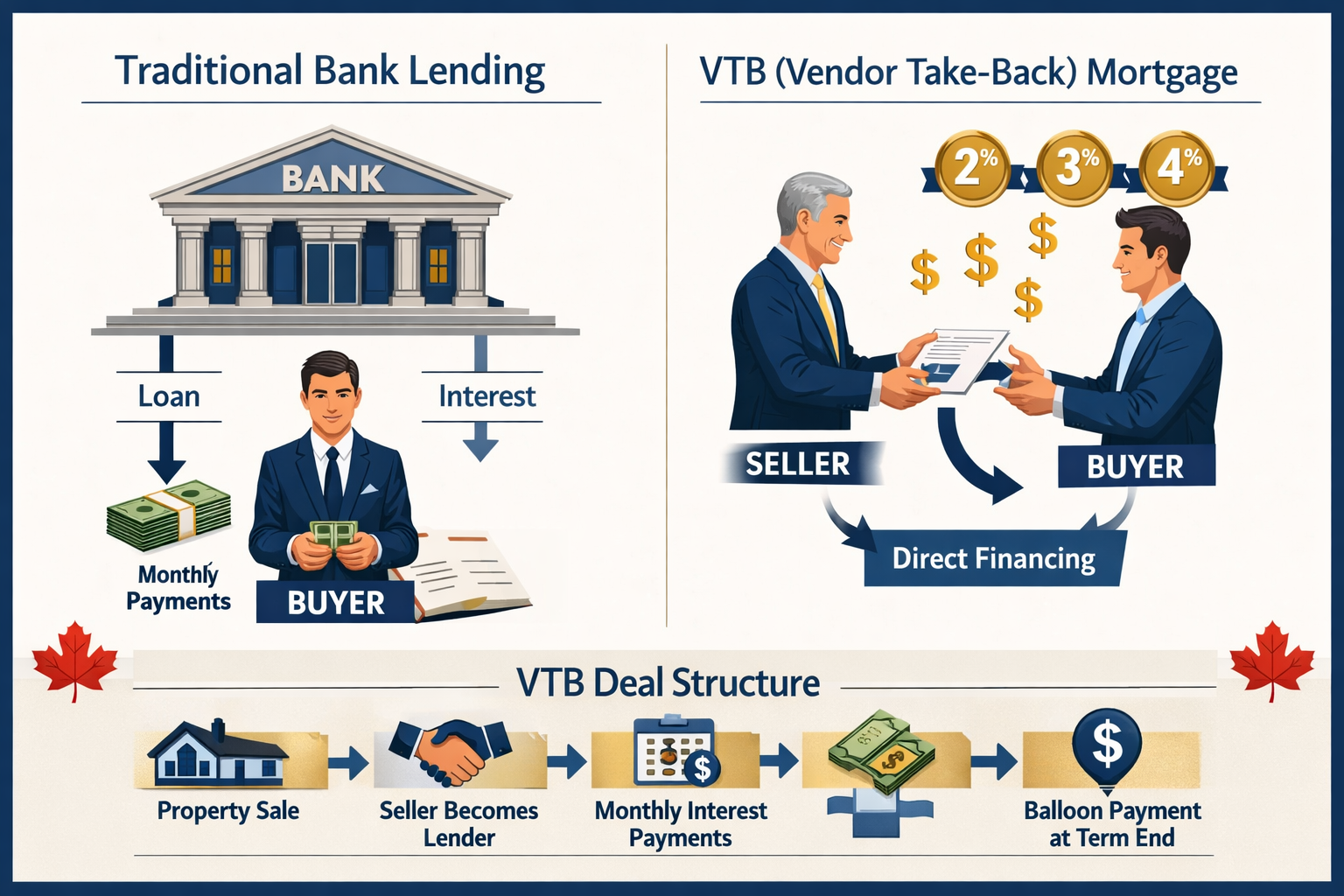
Here’s a practical example to make this concrete:
Scenario: A property in Ontario is listed at $500,000.
| Element | Details |
|---|---|
| Purchase Price | $500,000 |
| Buyer’s Down Payment | $50,000 (10%) |
| VTB Amount | $450,000 |
| VTB Interest Rate | 8% (interest-only) |
| Term | 24 months |
| Monthly Payment to Seller | $3,000 |
| Total Interest Over 2 Years | $72,000 |
| Balloon Payment at Term End | $450,000 |
The seller receives $50,000 at closing, then collects $3,000/month for two years. At the end of the term, the buyer must pay off the remaining $450,000 — typically by refinancing with a traditional lender once their financial situation has improved.
Typical VTB Terms in Canada
- Down payment: 5–10% (vs. 20% typically required by traditional lenders)
- Interest rate: 2–4% above current bank rates
- Term: Usually 1–3 years
- Payment structure: Interest-only monthly payments
- Balloon payment: Full principal balance due at term end
- Registration: Registered as a mortgage on title
In a market like Guelph, Ontario, where average home prices hover around $750,000, the difference between a 10% VTB down payment ($75,000) and a traditional 20% requirement ($150,000) is a full $75,000 in upfront capital. That’s a life-changing difference for many buyers.
Combining a VTB with Traditional Financing
VTBs don’t always replace bank financing — they often complement it. Here’s how a blended structure might look:
- First mortgage: From a bank or credit union (e.g., 65–70% of purchase price)
- VTB second mortgage: From the seller (e.g., 10–15% of purchase price)
- Buyer’s down payment: 10–20%
This layered approach helps buyers bridge the gap when they can qualify for some bank financing but not enough to complete the deal. It’s similar in concept to a second mortgage in Ontario, where a secondary lender fills the financing gap.
⚠️ Important: If a VTB is used alongside a bank’s first mortgage, the bank must typically approve the arrangement. Many lenders have specific rules about secondary financing on the same property.
Legal Requirements for VTB Mortgages in Canada
A VTB mortgage is a legally binding financial instrument. Both parties need proper legal protection. Here’s what’s required:
✅ What Must Be in the Contract
- Full loan amount and interest rate
- Payment schedule and due dates
- Term length and balloon payment details
- Default provisions and remedies
- Prepayment rights (can the buyer pay it off early?)
- What happens if the buyer sells the property before the term ends
👨⚖️ Why You Need a Real Estate Lawyer
This is non-negotiable. A real estate lawyer must:
- Draft or review the VTB mortgage agreement
- Register the mortgage on title at the land registry
- Ensure the agreement complies with Ontario mortgage law
- Advise each party on their rights and obligations
In Ontario, the Mortgages Act and the Land Registration Reform Act govern how mortgages are registered and enforced. Skipping legal counsel here is one of the most costly mistakes either party can make. For a broader look at common mortgage application mistakes, we’ve covered those in detail elsewhere.
Risks of a Vendor Take-Back Mortgage: Buyer’s Perspective
Vendor Take-Back Mortgage Canada: What It Is, How It Works and Risks to Know means understanding the downside too. For buyers, the risks include:
💸 Higher Cost of Borrowing
At 2–4% above bank rates, a VTB is expensive financing. On a $450,000 VTB at 8%, you’re paying $36,000/year in interest alone — with none of that reducing your principal balance.
🎯 The Balloon Payment Trap
The biggest risk for buyers is the balloon payment. If you can’t refinance with a traditional lender when the VTB term ends, you could face default. Your ability to exit the VTB depends heavily on your credit improving, your income stabilizing, and market conditions cooperating. Understanding your credit score’s role in mortgage approval is critical if you’re planning to refinance out of a VTB.
📋 Limited Consumer Protections
Traditional mortgages come with regulated disclosure requirements. VTBs negotiated privately may have fewer built-in protections. Read everything carefully.
Risks of a Vendor Take-Back Mortgage: Seller’s Perspective
Sellers aren’t off the hook either. Seller financing Canada arrangements carry real risks for the vendor:
⚠️ Buyer Default
If the buyer stops making payments, the seller must go through the legal process to enforce the mortgage — potentially including power of sale or foreclosure proceedings. This takes time, costs money, and is stressful.
🔒 Tied-Up Capital
The seller doesn’t receive their full sale proceeds at closing. That capital is locked up for the VTB term. If the seller needs liquidity for another purchase or investment, this creates a real constraint.
📉 Property Value Risk
If the buyer defaults and the property value has dropped, the seller may not recover the full VTB amount through a forced sale.
🧾 Tax Implications
Sellers receiving interest income from a VTB must report it as taxable income. Depending on the seller’s situation, this could push them into a higher tax bracket. Speak to a tax professional before agreeing to any VTB arrangement.
When Does a Vendor Take-Back Mortgage Make Sense?
A VTB is not the right tool for every situation. Here’s a quick framework:
✅ VTB May Make Sense When:
- The buyer has a solid plan to refinance within 1–3 years
- The buyer has a meaningful down payment (10%+) but can’t clear the stress test
- The seller wants income from the proceeds rather than a lump sum
- The market is slow and the seller needs to differentiate their listing
- Both parties have independent legal counsel
❌ VTB Likely Doesn’t Make Sense When:
- The buyer has no clear path to refinancing at term end
- The seller needs all their capital immediately
- Neither party has engaged a real estate lawyer
- The buyer’s financial situation is unlikely to improve
For buyers who are self-employed or have non-traditional income, a VTB can be a bridge to traditional financing. You might also want to explore how private mortgages work in Ontario as a comparable alternative.
Real estate investors should also consider how a VTB fits into a broader investment strategy — our guide on what to consider when buying a rental property covers the key financial factors.
VTB vs. Other Alternative Financing Options
| Feature | VTB Mortgage | Private Mortgage | B-Lender |
|---|---|---|---|
| Lender | Property Seller | Private Investor | Alternative Bank |
| Down Payment | 5–10% | 15–25% | 20% |
| Interest Rate | Prime + 2–4% | 8–12%+ | Prime + 1–2% |
| Term | 1–3 years | 1–2 years | 1–5 years |
| Amortization | Interest-only | Interest-only | 25–30 years |
| Legal Complexity | High | High | Moderate |
Conclusion: Is a Vendor Take-Back Mortgage Right for You?
A vendor take-back mortgage is a powerful but complex financial tool. For buyers who can’t access full bank financing in 2026 — whether due to the stress test, non-traditional income, or a financing gap — a VTB can be the bridge that makes a deal possible. For sellers in a slower Ontario market, it can mean the difference between a sale and a stale listing.
But the risks are real on both sides. Higher interest costs, balloon payment pressure, and potential default scenarios mean this is not a decision to take lightly.
Here are your actionable next steps:
- Talk to a mortgage broker before agreeing to any VTB terms — they can help you understand all your options and whether a VTB makes sense given your full financial picture. Our team at Everything Mortgages specializes in exactly these kinds of complex financing situations.
- Hire a real estate lawyer — for both buyer and seller, this is non-negotiable.
- Have a clear exit strategy — if you’re a buyer, map out exactly how you’ll refinance at term end.
- Review your credit profile now — the stronger your credit when the VTB term ends, the better your refinancing options will be.
- Compare all alternatives — VTBs, private mortgages, B-lenders, and co-signers all have different tradeoffs worth exploring.
The right financing structure depends on your unique situation. If you’re navigating a complex purchase or sale in Ontario in 2026, reach out to the team at Everything Mortgages — we’re here to help you find a path forward.
 Previous Page